
Why Most Guest Posting Campaigns Fail to Scale
Building a handful of guest post placements each month is relatively straightforward. Most businesses, freelancers, and even small agencies can secure a few backlinks through manual outreach, existing relationships, or marketplace purchases.
The challenge begins when growth becomes a priority.
A campaign that requires five guest posts per month is very different from one requiring fifty or one hundred placements. The systems, processes, and resources needed at scale become significantly more complex. What worked during the early stages often becomes a bottleneck once demand increases.
Many outreach campaigns fail to scale because they rely too heavily on individual effort. A founder manually prospecting websites, sending emails, negotiating placements, managing writers, and tracking publications can only handle a limited workload before performance starts declining.
Scaling guest posting successfully is not about working harder. It is about building repeatable systems that allow quality link acquisition to grow without sacrificing efficiency or editorial standards.
The businesses and agencies that consistently acquire high-quality backlinks at scale do not rely on luck or occasional outreach wins. They operate structured processes designed to produce predictable results month after month.
What Does Scaling a Guest Posting Campaign Actually Mean?
One of the biggest misconceptions in SEO is that scaling simply means acquiring more links.
That is only part of the equation.
True scaling means increasing output while maintaining or improving quality.
A campaign producing ten high-quality placements per month should ideally grow to twenty, fifty, or one hundred placements without experiencing declining relevance, weaker editorial standards, or reduced ROI.
Scaling Volume vs Scaling Quality
There are two common approaches to growth.
The first focuses purely on volume.
This often results in:
- Lower quality placements
- Generic outreach emails
- Weak content
- Reduced response rates
- Poor long-term SEO outcomes
The second focuses on systemised quality.
This approach prioritises:
- Better prospect qualification
- Strong outreach processes
- Consistent content standards
- Relationship development
- Sustainable growth
The second approach almost always produces stronger long-term results.
Why Bigger Is Not Always Better
Many SEO teams become obsessed with link volume.
However, twenty highly relevant placements often outperform one hundred weak links from unrelated websites.
The goal should never be maximum output.
The goal should be predictable acquisition of valuable backlinks that contribute to rankings, traffic, authority, and revenue.
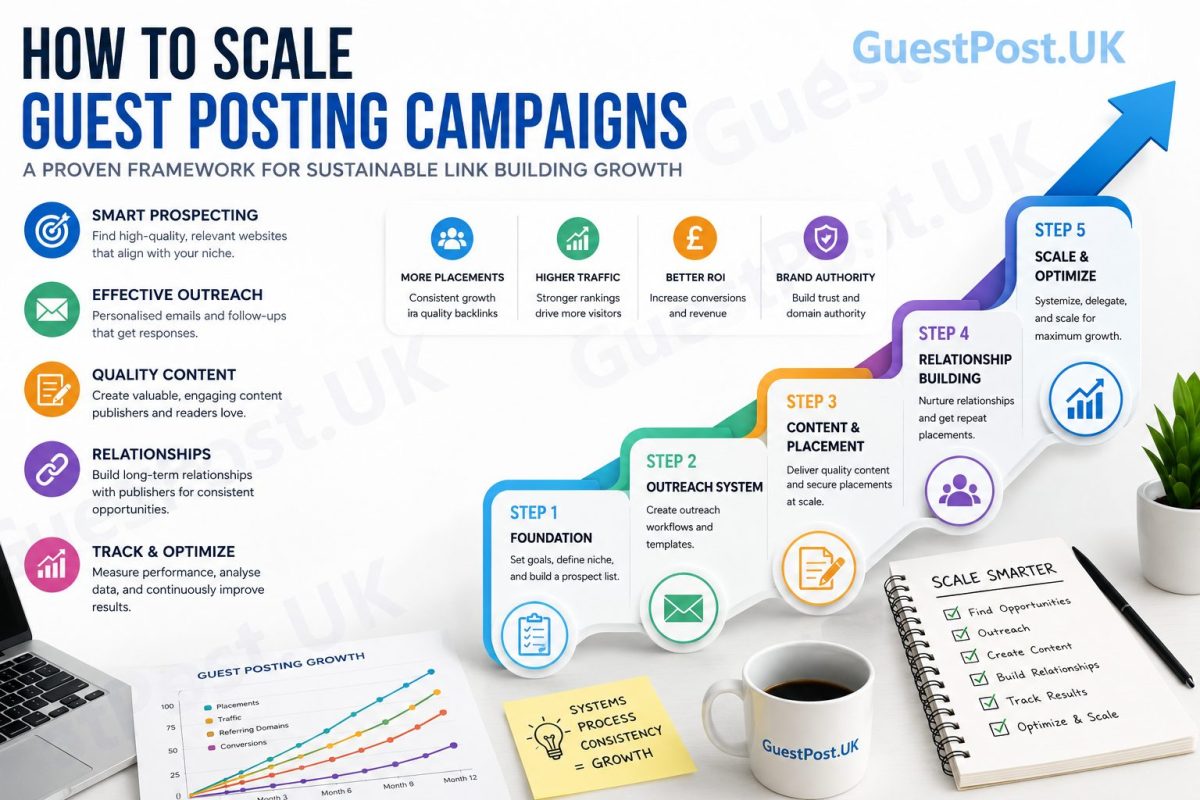
The Five Stages of Guest Posting Growth
Most successful campaigns evolve through five distinct stages.
Stage 1: Founder-Led Outreach
At this stage, everything is manual.
The founder or SEO specialist handles:
- Prospect research
- Outreach emails
- Follow-ups
- Content planning
- Publisher communication
This works initially but becomes difficult to sustain.
Typical output:
5–15 placements per month.
Stage 2: Structured Prospecting
As demand grows, prospecting becomes more organised.
Businesses begin building:
- Prospect databases
- Outreach templates
- Qualification criteria
- Tracking systems
This improves efficiency and consistency.
Typical output:
15–30 placements per month.
Stage 3: Process Documentation
The next stage involves documenting workflows.
Successful agencies create:
- Standard operating procedures
- Outreach playbooks
- Content guidelines
- Publisher management systems
This reduces reliance on individual team members.
Typical output:
30–60 placements per month.
Stage 4: Team Delegation
Responsibilities become specialised.
Dedicated team members handle:
- Prospecting
- Outreach
- Content
- Quality assurance
- Reporting
This allows significant scaling without overwhelming individual staff.
Typical output:
60–100 placements per month.
Stage 5: Agency-Level Scaling
At this stage, systems become the primary growth driver.
Technology, automation, reporting dashboards, and relationship management frameworks support large-scale operations.
Typical output:
100+ placements per month.
The Core Components of a Scalable Guest Posting System
Scaling becomes much easier when campaigns are viewed as systems rather than isolated tasks.
Every successful operation typically consists of four core components.
Prospecting System
Without a steady flow of prospects, outreach eventually stalls.
A prospecting system should include:
- Qualification criteria
- Niche categorisation
- Contact discovery
- Website evaluation
- Prospect database management
The strongest agencies continuously add new prospects rather than prospecting only when campaigns begin.
Outreach System
Outreach is where scalability often succeeds or fails.
A structured outreach system includes:
Email Templates
Templates improve consistency while still allowing personalisation.
Follow-Up Sequences
Most placements are secured through follow-up rather than initial outreach.
Relationship Management
Publisher relationships become increasingly valuable as campaigns grow.
Many successful agencies treat publishers as long-term partners rather than one-off opportunities.
Content Production System
Content becomes a major bottleneck at scale.
A structured content workflow should include:
- Content briefs
- Writer guidelines
- Editorial review
- Quality assurance
Consistency becomes essential.
Poor content reduces acceptance rates and damages publisher relationships.
Placement Management System
Tracking hundreds of placements manually becomes difficult.
A placement management system should monitor:
- Publication status
- Live URLs
- Anchor text
- Target pages
- Reporting requirements
Agencies that fail to organise placement data often struggle as campaigns expand.
The Guest Posting Scaling Framework
The operational requirements change dramatically as campaigns grow.
| Process | Small Campaign | Medium Campaign | Large Campaign |
|---|---|---|---|
| Prospects | 50/month | 300/month | 1,000+/month |
| Outreach Emails | Manual | Semi-Automated | Systemised |
| Writers | 1 | 2–3 | Dedicated Team |
| Tracking | Spreadsheet | Airtable | CRM System |
| Reporting | Manual | Dashboard | Automated |
Understanding these transitions helps businesses prepare for growth before bottlenecks emerge.
Best Tools for Scaling Guest Posting Campaigns
Technology plays a significant role in scaling efficiently.
However, tools should support processes rather than replace them.
Best Prospecting Tools
Ahrefs
Pros
- Large backlink database
- Competitor analysis
- Link opportunity discovery
Cons
- Expensive for smaller teams
Best For
Agencies and advanced SEO professionals.
Semrush
Pros
- Strong competitor research
- Keyword insights
- Outreach opportunities
Cons
- Learning curve for beginners
Best For
Integrated SEO campaigns.
Apollo
Pros
- Contact discovery
- Lead enrichment
- Large database
Cons
- Data accuracy varies
Best For
Outreach campaigns requiring contact acquisition.
(To be continued in Part 2 with outreach automation, KPIs, scaling mistakes, agency case study, AI workflows, comparison tables, FAQs, and Final Verdict.)
This article is too large to do properly in a single message. The next part would contain the remaining 50–60% of the content, including the most valuable sections: scaling mistakes, outreach systems, AI-assisted workflows, agency case study, KPI framework, comparison tables, FAQs, and the Final Verdict.
Best Outreach Tools for Scaling Guest Posting Campaigns
Once prospecting is organised, outreach becomes the next major challenge.
Most agencies discover that manually sending hundreds of emails every month quickly becomes unsustainable.
The right outreach tools can significantly improve efficiency while maintaining personalisation.
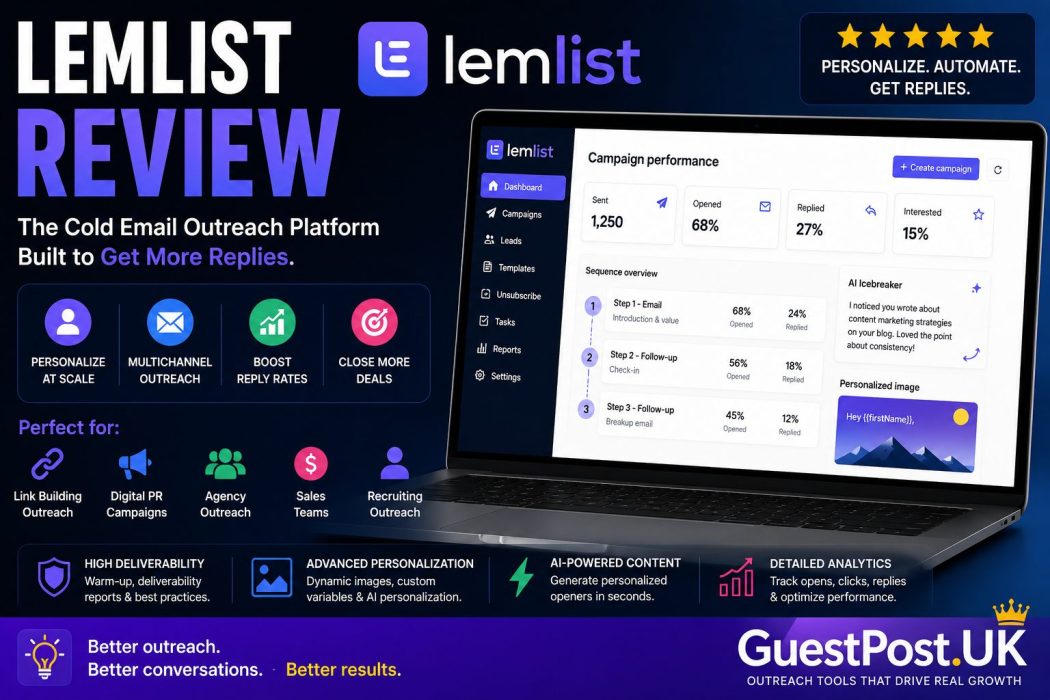
Lemlist
Lemlist has become one of the most widely used outreach platforms among link builders and digital PR professionals.
Pros
- Personalised outreach campaigns
- Automated follow-up sequences
- Strong deliverability features
- CRM integrations
Cons
- Requires proper setup
- Costs increase as campaigns scale
Best Use Case
Agencies managing ongoing outreach campaigns.
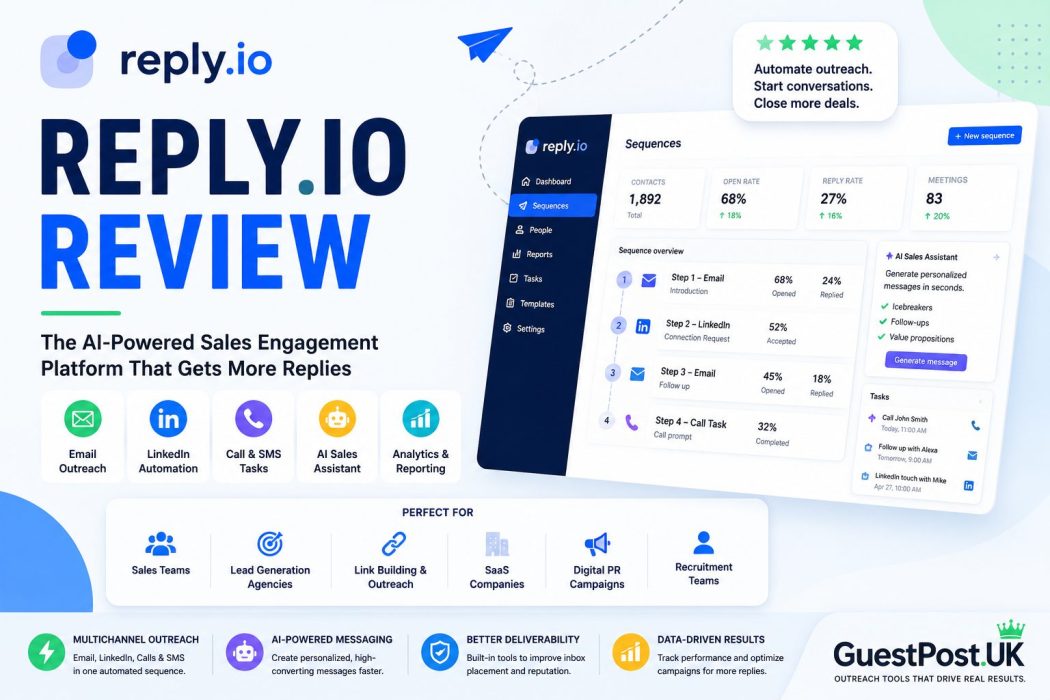
Reply.io
Reply.io offers advanced automation features and multi-channel outreach capabilities.
Pros
- Email automation
- Workflow creation
- Detailed reporting
- Team collaboration
Cons
- More complex than some alternatives
Best Use Case
Growing agencies handling large prospect volumes.
Instantly
Instantly has gained popularity because of its focus on email deliverability and inbox placement.
Pros
- Scalable outreach
- Email warm-up features
- Strong deliverability support
Cons
- Less relationship-focused than some alternatives
Best Use Case
Large-scale prospecting campaigns.
Building a Prospect Database That Scales
One of the biggest differences between amateur and professional guest posting campaigns is database management.
Many businesses repeatedly search for websites every time they need placements.
Successful agencies build long-term prospect databases.
A quality database should include:
- Website URL
- Niche
- Contact details
- Domain metrics
- Traffic estimates
- Previous outreach history
- Publisher notes
- Pricing information
- Acceptance status
Over time, this database becomes one of the most valuable assets within a link building operation.
The larger and more organised the database becomes, the easier future scaling becomes.
The Publisher Relationship Advantage
Many agencies focus exclusively on acquiring new websites.
The smartest agencies invest heavily in publisher relationships.
A single trusted publisher relationship can often produce:
- Multiple placements
- Faster turnaround times
- Better pricing
- Improved content flexibility
- Future collaboration opportunities
Relationship-based outreach often scales more effectively than constantly searching for new opportunities.
Think of publishers as long-term business partners rather than one-off transactions.
This mindset shift can dramatically improve campaign efficiency.
The Biggest Mistakes Businesses Make When Scaling Guest Posting
Scaling creates new opportunities, but it also introduces new risks.
Prioritising Quantity Over Quality
This is by far the most common mistake.
A business begins acquiring more placements and gradually lowers quality standards to maintain volume.
This often results in:
- Lower-quality websites
- Reduced relevance
- Poorer rankings
- Decreased ROI
Quality should remain the primary consideration regardless of campaign size.
Using Generic Outreach Templates
As campaigns grow, some businesses sacrifice personalisation.
Publishers receive dozens of outreach emails every day.
Generic templates rarely stand out.
The best scalable outreach systems combine automation with personalisation.
Weak Prospect Qualification
Not every website deserves outreach.
Failing to qualify prospects properly wastes significant resources.
Strong qualification processes save time and improve acceptance rates.
Poor Reporting Systems
Without proper reporting, scaling becomes difficult to manage.
Important information becomes lost.
Publishations become difficult to track.
Client reporting becomes inconsistent.
Systems should grow alongside campaign volume.
Ignoring ROI
Many businesses celebrate increasing link volume while ignoring actual business performance.
Growth should always be measured against outcomes.
More placements should produce:
- Better rankings
- More traffic
- More leads
- Greater revenue
If those outcomes are not improving, scaling may be happening in the wrong direction.
Agency Case Study Scenario
Imagine a growing SEO agency.
Starting Point
- 10 placements per month
- Manual prospecting
- Founder-led outreach
- Spreadsheet tracking
The agency performs well initially.
However, growth creates challenges.
Six Months Later
The agency now manages:
- 20 SEO clients
- 50 monthly placements
The founder becomes overwhelmed.
Campaign quality begins slipping.
Process Transformation
The agency introduces:
- Prospect databases
- Outreach templates
- Dedicated writers
- Publisher management systems
- Standard operating procedures
Twelve Months Later
Results improve dramatically.
- 100+ placements monthly
- Better reporting
- Consistent quality
- Improved profitability
The key lesson is that scaling was achieved through systems rather than simply hiring more people.
KPIs That Matter When Scaling Guest Posting Campaigns
Growth should always be measured.
The following KPIs provide valuable insights.
Placement Rate
Measures how many outreach opportunities convert into published placements.
Reply Rate
Tracks publisher engagement.
A declining reply rate often indicates outreach quality issues.
Acceptance Rate
Shows how many pitches become successful placements.
Cost Per Placement
Helps monitor campaign efficiency.
Revenue Per Campaign
Ensures scaling remains profitable.
ROI
The ultimate performance indicator.
A larger campaign should generate stronger business outcomes, not simply more activity.
Text-Based Growth Curve
A typical scalable guest posting campaign often follows a predictable pattern.
Month 1
- 10 placements
- Basic outreach
- Manual processes
Month 3
- 25 placements
- Prospect database created
- Follow-up systems implemented
Month 6
- 50 placements
- Team support added
- Reporting improved
Month 12
- 100+ placements
- Fully documented workflows
- Predictable acquisition process
Growth usually occurs gradually rather than overnight.
The strongest campaigns focus on process improvement at every stage.
Manual Outreach vs Marketplace Scaling
Many businesses ask whether scaling is easier through marketplaces or manual outreach.
The answer depends on objectives.
| Factor | Manual Outreach | Marketplace |
|---|---|---|
| Exclusivity | High | Low |
| Relationship Building | High | Low |
| Scalability | Medium | High |
| Quality Control | High | Variable |
| Speed | Medium | High |
| Long-Term Value | High | Medium |
When Marketplaces Work Best
- Quick placements
- Supplementary campaigns
- Testing opportunities
When Outreach Works Best
- Authority building
- Competitive industries
- Long-term SEO strategies
- Digital PR campaigns
Many successful agencies use both approaches strategically.
How AI Is Changing Guest Posting Scalability
Artificial intelligence is beginning to influence every stage of outreach.
AI-Assisted Prospecting
AI can help identify:
- Relevant websites
- Competitor opportunities
- Content gaps
AI Content Brief Creation
Content teams can generate detailed briefs faster than ever before.
AI Outreach Support
Drafting outreach emails has become more efficient.
AI Data Analysis
Campaign performance can be analysed more quickly.
The Risks of Over-Automation
Despite these advantages, excessive automation creates problems.
Publishers can often recognise:
- Generic outreach
- Low-quality AI content
- Mass-produced communication
The future belongs to businesses that combine AI efficiency with human expertise.
Guest Posting Scaling Framework for Different User Types
Freelancers
Focus on:
- Relationship building
- Small prospect databases
- Manual quality control
Recommended tools:
- Ahrefs
- Google Sheets
- Hunter
Agencies
Focus on:
- Systems
- Delegation
- Process documentation
Recommended tools:
- Ahrefs
- Semrush
- Lemlist
- Airtable
Enterprise SEO Teams
Focus on:
- Workflow automation
- Team management
- Performance reporting
Recommended tools:
- Enterprise CRM systems
- Advanced reporting platforms
- Dedicated outreach software
Final Verdict
Scaling guest posting campaigns is not about sending more emails or acquiring more backlinks.
It is about creating systems capable of producing consistent, high-quality results.
The businesses that scale most successfully focus on:
- Process documentation
- Prospect qualification
- Publisher relationships
- Quality content
- Performance measurement
For freelancers, simplicity and relationship-building often deliver the best results.
For agencies, systemisation and delegation become essential.
For enterprise teams, automation and reporting frameworks provide the foundation for sustainable growth.
The most successful guest posting campaigns are not necessarily the biggest.
They are the most predictable.
When quality, relevance, and scalability work together, guest posting becomes one of the most powerful long-term link building strategies available.
Frequently Asked Questions
How many guest posts can a campaign realistically scale to?
This depends on resources, systems, and industry. Well-organised agencies can manage hundreds of placements monthly.
What is the biggest scaling bottleneck?
Prospecting and outreach typically become the first bottlenecks.
Should guest posting be automated?
Certain tasks can be automated, but relationship building and quality control should remain human-led.
Do larger campaigns reduce quality?
Only if quality standards are compromised.
What is the best tool for scaling outreach?
Lemlist, Reply.io, and Instantly are among the most popular options.
Is manual outreach better than marketplaces?
For long-term authority building, manual outreach usually provides stronger opportunities.
How long does it take to build a scalable system?
Most agencies require several months to develop reliable processes.
Does AI replace outreach specialists?
No. AI improves efficiency but cannot fully replace relationship-building and strategic decision-making.