
Choosing a guest-post website should never come down to one metric. A placement can have a strong-looking DR, healthy estimated traffic and a polished homepage, yet still be a poor choice because the site is irrelevant, overloaded with paid links or has no real editorial standards.
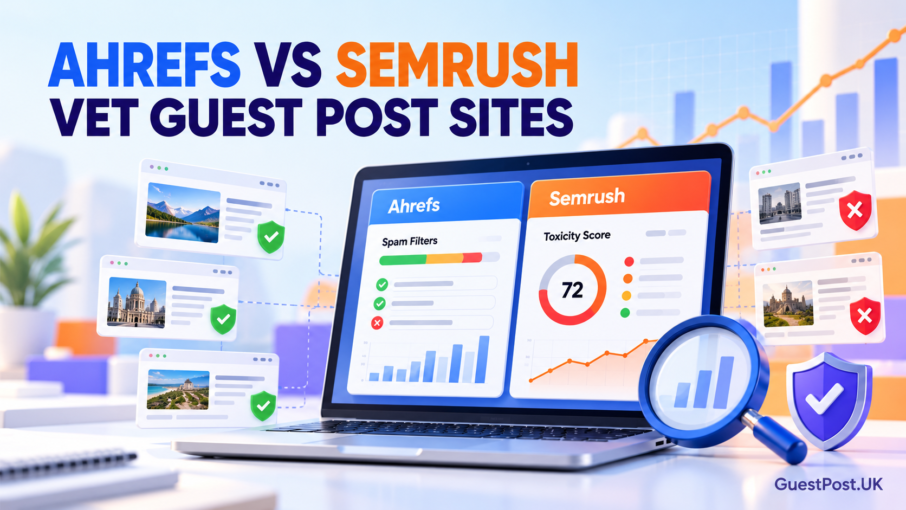
That is why tools such as Ahrefs and Semrush are useful. They help you spot patterns that deserve a closer look before you spend money or place a client link. The mistake is treating a spam filter or toxicity score as proof that a website is safe or unsafe.
For guest-post prospecting, use these signals as an early warning system, then review the publisher properly.
Our guide to using Ahrefs spam filters for guest-post websites explains the wider Ahrefs process. This comparison focuses on where Semrush adds value and where both tools can mislead you if used alone.
Ahrefs spam filters: best for initial prospect screening
Ahrefs is especially useful at the beginning of publisher research. It gives you a broad view of a potential website: organic keywords, estimated traffic, referring domains, top pages, outbound links and historical trends.
When checking a guest-post prospect, those signals can quickly highlight concerns:
- Traffic that appears to have collapsed without a clear reason.
- A large number of suspicious or irrelevant referring domains.
- Pages ranking only for unrelated or low-quality terms.
- A site with unusually aggressive outbound linking.
- No meaningful organic visibility despite impressive authority metrics.
- A topic mix that looks random rather than editorially focused.
The advantage of Ahrefs is context. Instead of only asking whether a domain looks “spammy”, you can ask whether it looks like a real publication with a genuine audience.
For example, a UK business publication may have moderate traffic but consistently publish relevant articles about finance, startups, technology or marketing. That could be a much more valuable guest-post opportunity than a high-DR general site with no clear audience or editorial identity.
This is why Ahrefs works well alongside the Guest Post Site Finder and Publisher Quality Checker. The tool data helps you shortlist prospects, while the wider review process helps you decide whether the placement makes sense for the client.
Semrush Toxicity Score: best for backlink-risk investigation
Semrush takes a more specific approach through its Backlink Audit tool. Its Toxicity Score helps identify backlinks that need further investigation. The score runs from 0 to 100 and is based on more than 45 toxic markers.
That makes Semrush particularly useful when you are auditing an existing backlink profile or reviewing a website that has a history of suspicious linking activity.
The tool can flag risk patterns, including potential link networks, mirror pages, suspicious anchor-text patterns, and other signals that may deserve attention. Semrush itself presents the score as a way to prioritise investigation, not as an automatic instruction to remove or disavow a link.
For a guest-post buyer, this distinction matters.
A high-risk signal does not automatically mean a publisher is unusable. A website may have accumulated poor links years ago, received spam links it didn’t create, or have a backlink profile that needs context. Equally, a low score does not prove that a new sponsored placement will be valuable.
The score tells you where to look more carefully. It does not replace editorial judgement.
The real difference between the two
Ahrefs is generally stronger for understanding the overall quality and organic visibility of a prospective publisher. Semrush is stronger for investigating potentially suspicious backlink patterns and link-level risks.
Use Ahrefs first when you are building a shortlist. Use Semrush when a prospect’s backlink profile raises questions or when you are reviewing an existing campaign.
Neither tool can answer the most important question on its own: will this placement reach a relevant audience and support the client’s long-term SEO goals?
A practical vetting workflow for guest-post websites
Use both platforms as part of a staged review rather than opening every report for every prospect.
Start with relevance. If the website doesn’t serve the client’s country, niche, or target audience, there is no reason to spend time analysing its backlink profile. A technology SaaS client needs relevant business, software or entrepreneur readership. A local service client may need country-specific media or regional websites.
Once the prospect passes that first test, use Ahrefs to check whether the site has believable organic visibility. Look at its main topic areas, top-performing pages, estimated search trend and referring-domain growth. A healthy website normally shows a consistent editorial direction.
Then use Semrush when you need a deeper investigation. This may include a sudden spike in referring domains, strange anchors, a large number of irrelevant sites linking in, or a pattern suggesting that the domain exists mainly to sell links.
The goal isn’t to exclude every site with an imperfect profile. Almost every established domain has some weak or irrelevant links. The aim is to avoid placements where several warning signs appear together.
Signals that deserve manual review
A single issue may be harmless. Multiple issues together are a reason to slow down and investigate.
Review the website manually when you notice:
- Very high authority but almost no visible organic traffic.
- Traffic that has fallen sharply and never recovered.
- Articles covering unrelated subjects with no clear editorial focus.
- Large numbers of sponsored-style posts published every day.
- Outbound links to casinos, adult sites, loans, crypto schemes or unrelated foreign-language pages.
- Thin content that appears written only to hold links.
- A homepage filled with generic contributor posts and little original publishing.
- Anchor-text patterns that appear excessively commercial or repetitive.
- No author pages, contact information, editorial identity or real audience signals.
A genuine publisher does not need to look perfect. It should, however, look like a website built for readers rather than one built only to sell placements.
Do not confuse a disavow workflow with prospecting
Semrush Toxicity Score is particularly useful for backlink auditing. It can help a site owner investigate suspicious links and decide whether to review, remove, or disavow them.
That is different from deciding whether to buy a new guest post.
When vetting a publisher, you are looking forward. You need to know whether the next article will be relevant, visible and worthwhile. A backlink-audit score is only one part of that decision.
For example, a publisher may have some historical toxic markers but still have strong current editorial standards, relevant readers and good organic visibility. Another website may show little obvious backlink risk while publishing dozens of low-quality paid articles every week. The second site may be the weaker placement, even if its tool score looks cleaner.
This is why manual review remains essential. Read recent articles. Check where links appear. Look at the publication dates, author pages, category structure and external-link behaviour. If the placement would not make sense to a real reader, it is unlikely to be a strong long-term choice.
Which tool should you choose?
Choose Ahrefs when you need to quickly research a publisher, compare organic visibility, and assess whether the website has a believable topical audience.
Choose Semrush when you need to investigate suspicious backlink patterns more deeply or audit a client’s existing backlink profile.
For a serious guest-post campaign, use both where necessary, then decide based on relevance and editorial quality. The best placement is not the one with the lowest toxicity score or the highest DR. It is the one that gives the client a natural, relevant mention on a real website with a genuine audience.
A well-reviewed publisher shortlist also makes outreach more efficient. Once you have identified suitable websites, use our Guest Posting Services for managed placements or explore the Guest Posting Sites area to compare available opportunities.