
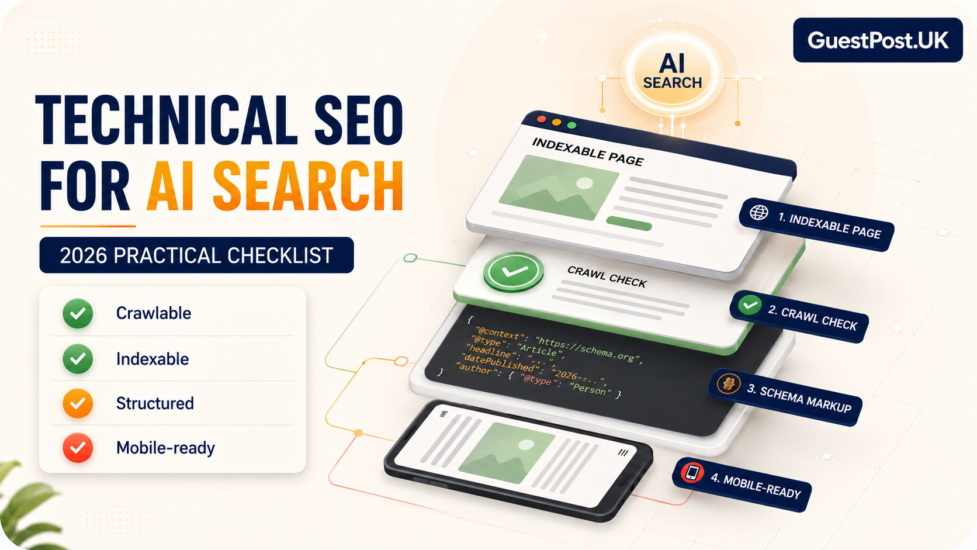
Technical SEO for AI search is less about finding a new optimisation trick and more about removing the obstacles that stop search engines from discovering, rendering, understanding, and confidently showing your content.
That is an important distinction. AI Overviews, Google AI Mode and other answer-led search experiences may change how people discover websites, but the route to visibility still begins with solid technical foundations. Google states that there are no additional requirements to appear as a supporting link in AI Overviews or AI Mode: a page must be indexed, eligible to appear in Google Search, and capable of receiving a snippet. Google’s AI features guidance
For website owners, that means the work is practical. Make valuable content accessible to crawlers, make your page structure unambiguous, eliminate accidental indexation blocks, and ensure important information is present in a form that search systems can process.
This technical SEO for AI search checklist is designed for agencies, in-house teams, ecommerce businesses and service-led websites that want to strengthen their visibility without relying on vague “GEO hacks”.
What Technical SEO for AI Search Actually Means
Technical SEO for AI search is the process of ensuring that search engines and AI-led search systems can access, index, interpret and retrieve the important content on your website.
It includes familiar SEO disciplines:
- Crawlability and indexation
- Internal linking and URL structure
- Mobile rendering
- JavaScript handling
- Canonicalisation
- Structured data
- Page speed and user experience
- Accurate product, business and author information
The difference is the standard you should apply. A page may technically be indexed but still be difficult to interpret quickly. It may contain the relevant answer only in an image, a JavaScript widget or a buried accordion. It may be one of several near-identical URLs competing for the same topic.
AI search systems are designed to retrieve useful supporting pages for complex questions. Google describes this as retrieval-augmented generation, where its systems retrieve relevant, up-to-date pages from the Search index to ground responses. Google’s guidance on generative AI features
A technically healthy website gives those systems clearer material to retrieve.
The Essential Technical SEO for AI Search Checklist
1. Confirm that priority pages are crawlable and indexable
This is the first check because nothing else matters if Google cannot access the page properly.
For every important service page, blog post, product category and commercial landing page, check:
- The URL returns a
200status code. - It is not blocked by
robots.txt. - It does not contain a
noindexdirective unintentionally. - It is not behind a login, a cookie wall, or a restrictive firewall.
- It has a self-referencing canonical where appropriate.
- It appears in the XML sitemap if you want the page indexed.
- Google can discover it through internal links.
Google’s technical requirements are straightforward: Googlebot must be able to find and access the page, and the page must contain indexable content. Google Search technical requirements
A common agency issue is finding a well-written page that is excluded by an old noindex tag, a redirected URL in the sitemap or a canonical pointing to a different page. Fixing these is often more valuable than commissioning another article.
2. Check the URL in Google Search Console, not only your browser
A page loading correctly for you does not guarantee that Google sees the same version.
Use the URL Inspection tool in Google Search Console to check whether the page is indexed, which canonical Google selected and whether the rendered page includes the content you expect. For larger websites, compare this with the Page Indexing and Crawl Stats reports.
Prioritise pages that are commercially important or intended to answer high-value questions, including:
- Core service pages
- Category pages
- Comparison articles
- Product pages
- Location pages
- High-performing blog posts
- Pages cited in outreach, PR or guest posting campaigns
An indexation audit is also an effective starting point for a broader SEO audit, especially when a website has accumulated old category URLs, tag archives, parameter pages or duplicate campaign landing pages.
3. Make the main answer available in HTML
AI search does not need a special writing style, but it does need content that can be accessed and understood. Do not rely on an infographic, video, slider or embedded tool as the only location for the page’s main information.
If your page explains a service, include the essential explanation in visible HTML text. If a product has important specifications, include them as crawlable product details rather than placing them only in an image. If you publish a comparison, make the decision criteria easy to read on the page.
This is particularly relevant for service websites. A polished hero section can look excellent while revealing very little to a crawler or prospective client. Give every priority page a clear textual purpose, direct explanation and useful supporting sections.
4. Use headings to show the logic of the page
Heading structure is not a magic ranking factor, but it is a practical way to make a page easier for people and systems to interpret.
Use one descriptive H1 that matches the page’s central topic. Then use H2 and H3 headings to separate the main questions, processes, comparisons or use cases.
For example, a page about link building services might use:
- H1: Link Building Services for UK Businesses
- H2: What Our Link Building Service Includes
- H2: How We Assess Link Opportunities
- H2: Guest Posting and Editorial Placements
- H2: Reporting and Quality Checks
The page should not use headings simply to repeat slight variations of the same keyword. Clear structure helps writers, users and search systems locate the relevant part of a longer page without creating thin, repetitive content.
5. Resolve JavaScript rendering problems
Modern websites often depend on JavaScript for filters, calculators, reviews, tabs, product data and even core copy. Google can process JavaScript, but JavaScript-heavy sites still need careful implementation.
Google recommends server-side rendering, static rendering or hydration as more durable approaches than dynamic rendering for JavaScript-powered content. Google’s JavaScript rendering guidance
Check whether essential content appears in the initial rendered HTML or whether it only loads after interaction. Key risks include:
- Product descriptions that load only after a user clicks a tab.
- Internal links generated only after a script runs.
- Infinite-scroll collections with no crawlable pagination.
- Important copy hidden behind unsupported or delayed scripts.
- Error states that show an empty page to crawlers.
- JavaScript redirects that obscure canonical URLs.
Use Google Search Console URL Inspection, a crawler such as Screaming Frog or Sitebulb, and browser tests with JavaScript disabled where appropriate. Your next article on JavaScript and AI search can explore this issue in greater depth, while this checklist should keep teams focused on the practical test: can Google reliably see the important page content?
6. Keep mobile content equivalent to desktop content
Google uses the mobile version of a site’s content for indexing and ranking. Google’s mobile-first indexing documentation
That makes mobile parity an AI search issue as well as a user-experience issue. Do not hide key service information, product content, internal links, schema or images on mobile merely to create a cleaner layout.
Test priority URLs on a real phone, not only inside a page builder preview. Look for:
- Missing content blocks
- Broken accordions
- Overlapping buttons
- Lazy-loaded images that fail to appear
- Mobile-only redirects
- Navigation that hides important category paths
- Excessive pop-ups preventing users from reading the page
A mobile visitor should be able to understand the page’s subject and next action without having to hunt through the layout.
Structured Data: Useful Context, Not an AI Search Shortcut
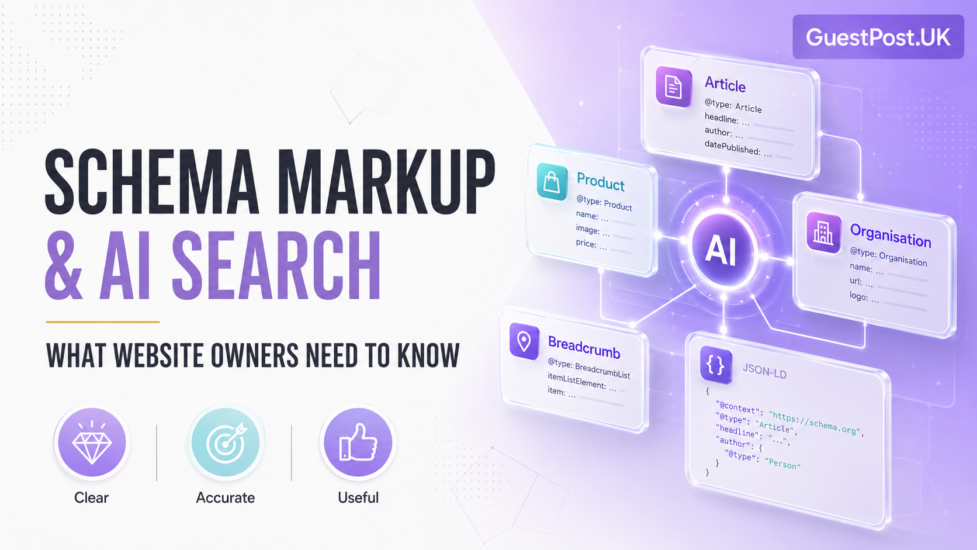
Structured data can help Google understand page entities and make pages eligible for relevant rich-result features. It is still worth implementing accurately for articles, products, organisations, local businesses, breadcrumbs, courses and other applicable page types.
However, structured data is not a special pass into AI results. Google is clear that no special schema markup is required for generative AI search. It remains valuable as part of a good overall SEO strategy, particularly when it supports rich-result eligibility. Google’s AI search myth-busting guidance
Use structured data when it faithfully represents the visible page content. Avoid adding types that do not match the page simply because they sound beneficial.
Structured data quality checks
Before publishing or updating a template, confirm that:
- Markup matches the visible page content.
- Required properties are included.
- Images referenced in schema are crawlable.
- The page is not blocked from Googlebot.
- Product price, availability and review information remain current.
- JSON-LD is valid and tested.
Google recommends JSON-LD where a website setup allows it, because it is generally easier to implement and maintain at scale. Google’s structured data introduction
Use the Rich Results Test to identify eligible rich-result types and technical issues, but remember that valid markup does not guarantee a rich-result display.
Improve Internal Linking and Topic Relationships
AI-led search queries are often broader and more conversational than traditional keyword searches. A user may ask for an explanation, a recommendation, a checklist, and an example in a single prompt.
Your website should show a logical relationship between those subjects. Internal links are how you help both users and crawlers navigate that relationship.
A practical model is:
- A core service page explains the offer.
- Supporting guides answer pre-purchase questions.
- Comparison articles help users evaluate options.
- Case studies or samples add evidence.
- Tool pages help users take action.
- Each page links naturally to the next relevant step.
For GuestPost.UK, an article about technical SEO for AI search can point readers towards SEO services, technical SEO support, SEO tools and internal linking.
Avoid sitewide blocks of loosely related links. One relevant link within the right section is more useful than ten links placed without context.
Optimise Important Images, Video and Product Information
Visual content can be surfaced in AI-led search experiences, so images and videos should not be treated as an afterthought. Google recommends high-quality, relevant visual assets where they improve the page. Google’s AI optimisation guide
For images, focus on:
- Descriptive filenames where practical.
- Accurate alt text that explains the image’s purpose.
- Relevant images close to the supporting content.
- Compressed files that do not slow the page.
- Mobile-friendly dimensions.
- Crawlable image URLs.
For ecommerce websites, product data needs even more discipline. Keep product titles, prices, stock status, brand details, reviews and structured data consistent. Where relevant, maintain accurate Merchant Center feeds, because Google can use product information in both traditional and AI-led shopping experiences.
Measure Technical SEO for AI Search Without Guesswork
The clearest graph-style pattern looks like this:
- Crawl errors fall → more priority URLs become indexed → impressions rise: technical access was likely limiting visibility.
- Pages index, but impressions remain flat → content may lack topical relevance or demand; review intent, internal links, and information quality.
- Impressions rise, but clicks do not → investigate titles, AI-led result layouts and whether the page directly satisfies the query.
- Clicks rise, but conversions stay flat → technical SEO succeeded in attracting visitors, but the page’s offer or next step may need improving.
- Mobile impressions decline while desktop remains stable → check mobile rendering, speed and content parity.
Google Search Console should be your source of truth for search performance and indexation signals. Pair it with Google Analytics to understand what happens after a visitor arrives, then use crawling tools to diagnose technical causes behind the trends.
A 30-Day Technical Prioritisation Plan
Week 1: Establish the baseline
Export priority pages from Search Console. Check indexation, canonical status, robots directives, XML sitemap inclusion, and internal link depth.
Week 2: Fix the blockers
Resolve accidental noindex directives, broken redirects, 4xx/5xx responses, canonical conflicts and pages with missing mobile content.
Week 3: Strengthen page understanding
Improve heading structures, visible service explanations, internal links, image alt text and relevant structured data. Focus on core pages first, not the entire site at once.
Week 4: Measure and refine
Review changes in crawl activity, index coverage, impressions and key query groups. Document what changed so the next content or development decision is evidence-led.
This approach is less exciting than a new AI-search tactic, but it is far more dependable. Technical SEO for AI search works when your best pages are easy to access, easy to understand and genuinely useful once a user lands on them.