
AI search tracking is becoming a core part of modern SEO reporting. Brands want to know whether ChatGPT, Perplexity, Gemini, Claude, and Google AI results recognise them, recommend them, or cite their websites when users ask commercially relevant questions.
The difficulty is that AI visibility data can be misunderstood. A high number of mentions does not automatically mean strong demand. A citation does not guarantee a click. And a small amount of ChatGPT traffic does not prove that AI search has no commercial value.
The right approach is to understand each metric, track it consistently, and connect it to organic search, branded demand, referral traffic, leads, and revenue. This guide explains the key AI search-tracking metrics and what they can genuinely tell your business.
What are AI search tracking metrics?
AI search tracking metrics measure how a brand appears within AI-generated answers. Depending on the platform, they may show whether a business is mentioned, recommended, cited, positioned above competitors or described positively.
Unlike traditional keyword rankings, AI search results are not fixed. A response can change depending on the prompt wording, the user’s location, model updates, source availability, and the AI platform itself.
That means these metrics should be treated as directional evidence, not an absolute position. The goal is to identify patterns: which topics your brand owns, where competitors dominate and what content or authority gaps need attention.
Brand mentions
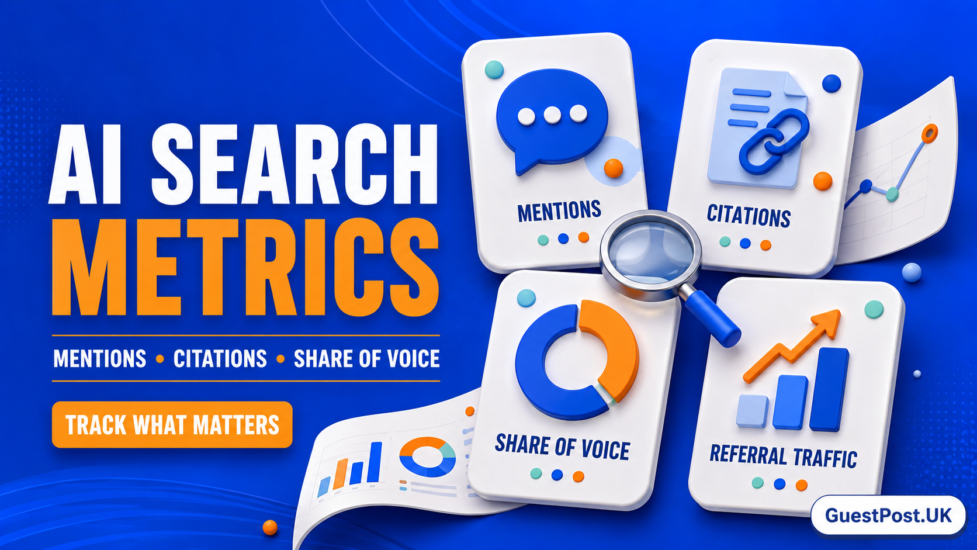
A brand mention records whether an AI platform includes your company, product or service in its response.
For example, if someone asks ChatGPT, “Which UK agencies offer guest posting services?”, an AI search tool may record a mention when GuestPost.UK appears in the answer.
Mentions are useful because they provide the broadest measure of visibility. They help answer:
- Is the brand present in relevant AI conversations?
- Which platforms are mentioning it most often?
- Which products, services or locations trigger a mention?
- Are competitors being mentioned more consistently?
However, not all mentions are equal.
A mention in a generic educational answer may have little commercial value. A mention in response to “best guest posting service for UK businesses” is likely more meaningful. For this reason, track mentions by prompt group: informational, commercial, comparison, local and branded.
A strong report should also inspect the actual answer. Being listed tenth in a long answer is different from being directly recommended first with a positive explanation.
Citations
A citation is a website, page or external source that the AI platform uses to support its answer. It may cite your own page, an independent publisher, a directory, a review site, a forum, a news article or a competitor’s content.
Citations are one of the most useful AI visibility metrics because they reveal why a brand may be included or excluded.
If Perplexity repeatedly cites your service page, that is a positive sign that the page is clear, accessible and relevant to the prompt. If ChatGPT repeatedly relies on competitor reviews or specialist publications, it shows where its authority comes from.
Track:
- Total citations to your domain
- Number of unique pages cited
- Citation rate by prompt group
- Most-cited pages
- Most-cited external domains
- Competitor citation sources
- Citation changes over time
A citation is not the same as an endorsement. AI systems may cite a page simply because it contains useful information. Still, repeated citations are valuable evidence that your content has become part of the answer engine’s source landscape.
To improve citation potential, make service pages specific, structured and answer-led. Use clear entities, concise definitions, relevant proof, FAQs, original insight and straightforward page architecture. Our AI search optimisation checklist explains the foundations in more detail.
Share of voice
AI share of voice shows how often your brand appears relative to competitors across the prompts you track.
If your company appears in 20 out of 100 tracked responses and competitors appear in 45, 35 and 15, your share of voice is 20%. The calculation may vary slightly by platform, but the principle is the same: it measures relative visibility.
Share of voice is especially useful because it prevents teams from celebrating isolated mentions. You may appear in several answers but still be losing the category to competitors.
Use share of voice to identify:
- Competitors dominating recommendation queries
- Topic groups where your brand is absent
- Markets or locations where visibility is weak
- Gaps between brand visibility and competitor authority
- Whether work is improving your relative position over time
The best comparison set usually consists of three to five genuine competitors. Avoid adding every business in the industry. Too many competitors make the report harder to interpret and less actionable.
Position and recommendation quality
Some AI tracking tools estimate where your brand appears in a response: first, second, third or later in a recommendation list.
Position can be valuable, but it needs context. AI answers are not standard ranked lists. A model may mention one brand first because it is best known, then recommend another brand more strongly for a specific user need.
Look beyond the number. Review:
- Whether the brand is directly recommended
- The wording used around the mention
- Whether competitors receive stronger descriptions
- Whether the answer includes a citation
- Whether the prompt has commercial intent
A useful insight could be: “The brand appears in 40% of tracked answers but is rarely the first recommendation for pricing-led prompts.” That gives the team clearer action than a generic visibility score does.
Sentiment
Sentiment shows whether AI systems describe a brand positively, neutrally or negatively.
Positive sentiment can support trust. Negative sentiment may reveal outdated information, poor reviews, unclear messaging or a reputation issue that needs attention. Neutral sentiment is not necessarily bad; it may simply mean that the model has limited evidence to make a stronger recommendation.
Track sentiment alongside actual response text. Automated sentiment labels can miss nuance. A response may sound neutral but still recommend a competitor because it has more evidence, more reviews, or clearer product information.
For local businesses, sentiment should be considered with review ratings, customer feedback, local citations and branded search results. A wider local SEO audit can help uncover inconsistencies that influence both search users and AI systems.
AI referral traffic
AI referral traffic shows users who arrive on your website directly from an AI platform. In GA4, this may include traffic from ChatGPT, Perplexity, Gemini, Copilot or other visible referrers.
Track:
- Sessions
- Engaged sessions
- Engagement rate
- Landing pages
- Key events
- Enquiries, calls or purchases
- Revenue where available
This metric matters, but it is often lower than businesses expect. Many AI interactions are zero-click: users receive an answer, remember the brand and visit later through Google, direct traffic or another channel.
Low referral traffic should not be ignored, but it should not be used as the only measure of AI search value. Review it alongside branded search growth, direct visits, returning users, assisted conversions and CRM enquiry notes.
Prompt coverage
Prompt coverage measures the proportion of your chosen questions where the brand appears. It is closely related to mentions, but it focuses attention on your prompt set.
Build a balanced list of 30–50 prompts across:
- Core services or products
- “Best” and recommendation searches
- Comparison and alternatives queries
- Pricing questions
- Problem-led searches
- Local searches
- Brand and competitor questions
Do not change the list every month. Stable prompts create a usable baseline. Add new prompts when customer behaviour changes, but keep the core set intact to measure real movement.
A practical monthly reporting workflow
Use the metrics together rather than in isolation.
First, review visibility and prompt coverage. Next, compare share of voice against competitors. Then inspect citations and the actual answers behind important changes. Finally, compare those findings with Search Console, GA4 and leads.
A monthly report might show:
| Signal | What it means | Next action |
|---|---|---|
| High mentions, low citations | Brand known, but pages are not trusted sources | Improve key pages and authority signals |
| Low mentions, strong organic rankings | AI visibility gap despite SEO strength | Improve answer-led content and external proof |
| Competitor citations rising | Their sources or content are influencing answers | Analyse cited domains and create a response plan |
| Referral traffic rising | More users are clicking through from AI tools | Improve landing-page conversion paths |
| Branded searches rising after visibility work | Possible consideration effect | Check CRM and assisted conversion evidence |
Turn metrics into an AI search action plan
The purpose of tracking is not to create another colourful dashboard. It is to decide what to improve next.
If AI tools mention competitors but not you, analyse the pages they cite and their external coverage. If your pages receive citations but do not convert, improve calls to action, evidence and user journeys. If important service pages are absent from answers, make their purpose, audience, pricing and proof clearer.
For businesses that need a structured approach, GEO services can combine visibility tracking with content, technical SEO, internal linking and authority-building work.
The most valuable AI search metric is the one that leads to a better decision. Track mentions for awareness, citations for source credibility, share of voice for competitive context and referral traffic for direct engagement. Then connect all of them to the outcomes that actually matter to the business.