
There is a big difference between asking AI to write some code and asking it to build an entire application.
A code assistant might create a login form, explain a database query or fix a JavaScript error. You still need to connect those pieces, configure hosting, create a database, implement authentication and eventually turn everything into something a customer can actually use.
Base44 is trying to remove that middle ground.
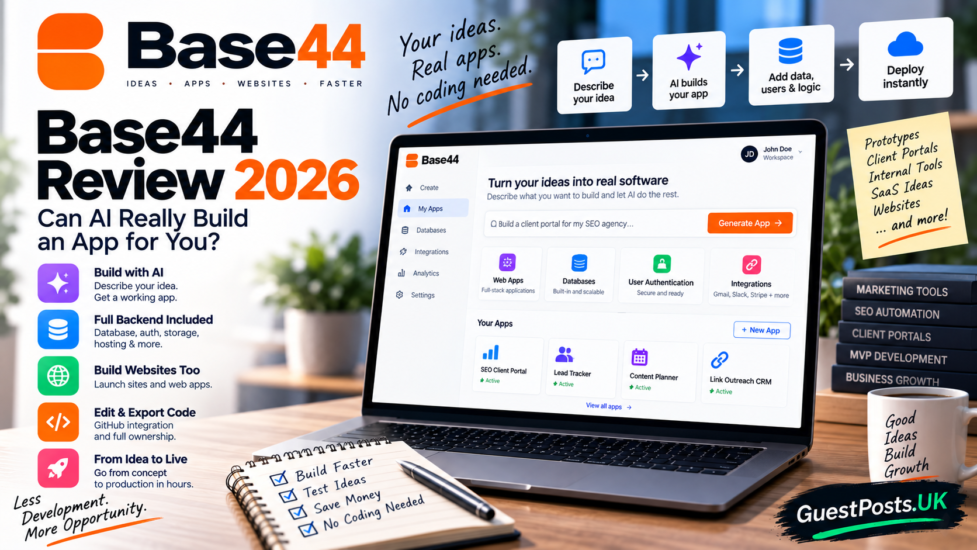
You describe an application in ordinary language and Base44 attempts to create the interface, backend logic, database, authentication and deployment for you. The finished application runs on production infrastructure rather than existing only as a visual prototype.
That makes Base44 interesting for considerably more than people who want to experiment with AI coding. A marketing agency could build a client portal. An SEO consultant could create an internal reporting dashboard. A publisher could develop a content workflow system. A business owner could test a SaaS concept without initially hiring a development team.
The attraction is obvious.
The more important question is what happens after the first impressive prompt.
Building version one of an application quickly is useful. Maintaining a complicated application through 50 rounds of changes, debugging unexpected behaviour and controlling costs is a much harder test.
That’s where this Base44 review becomes interesting.
Base44 starts with a conversation rather than a blank project
Base44 belongs to the growing category often described as vibe coding.
Instead of beginning with HTML, React, PHP or a database schema, you tell the platform what you want. Base44 interprets the request and constructs the application.
For example, an SEO agency might prompt:
Build a client SEO dashboard where clients can log in, see keyword positions, completed backlinks, monthly traffic, outstanding tasks and downloadable reports.
Base44 can then create the screens, database structure, user accounts and underlying logic needed to begin turning that description into an application. You continue refining it conversationally: add a field, change the dashboard, create another user role or modify how information is displayed.
According to Base44, this isn’t simply prototype generation. Its apps can contain working databases, backend logic, authentication, permissions, integrations and deployment.
For non-developers, that’s a substantial change.
Previously, having an application idea and actually producing software were two entirely different skills. AI app builders are narrowing that gap.
What does Base44 actually build?
The feature list is more comprehensive than the Facebook advert suggests.
Base44 includes its AI builder alongside database management, cloud storage, user authentication, email functionality, analytics, hosting and debugging tools. It can also add AI-powered functions such as chatbots and automated workflows to the applications being built.
That means you could theoretically create things such as a CRM, customer portal, internal project-management system, lead tracker, directory, membership platform or SEO utility without independently configuring all of the underlying infrastructure.
This is where I see a particularly interesting use case for digital marketers.
At GuestPost.UK, for example, tools such as our Smart Indexing Assistant and wider free SEO tools solve very specific search-marketing problems. Traditionally, building tools like these requires WordPress/PHP development or a dedicated application stack.
Platforms such as Base44 can dramatically lower the cost of experimenting with new tool ideas.
Instead of spending weeks developing an MVP, you could determine within hours whether the underlying concept is useful.
That doesn’t necessarily mean the final production tool should remain on Base44 forever. It means the expensive question of “is this worth building?” can potentially be answered much earlier.
The backend being included is the feature that matters
AI-generated interfaces are no longer particularly remarkable.
Almost any modern coding model can produce an attractive dashboard.
The difficult part begins when someone clicks a button.
Where is the information stored? Who is allowed to access it? What happens when two users modify something? How are emails sent? How does a customer log in? How does the application call another service?
Base44 automatically handles much of this infrastructure. Its current feature set includes databases, authentication and user management, storage, email systems and hosting.
This makes it fundamentally different from asking ChatGPT to generate an HTML page and copying that code into a website.
A static HTML generator gives you a page.
Base44 is trying to give you a working software product.
For marketers and entrepreneurs who understand a business problem but don’t understand backend architecture, that’s the strongest part of the proposition.
Base44 can now build websites too
This is one of the areas where Base44 has expanded.
Its current website builder can create multi-page responsive websites from natural-language instructions, including copy, contact forms, hosting, analytics and basic SEO foundations. Sites can be published to a Base44 URL on the free tier, while paid plans support custom domains.
Would I replace a mature WordPress SEO website with Base44 simply because AI can build one faster?
No.
A site like GuestPost.UK benefits from WordPress’s mature publishing ecosystem, granular SEO controls, plugins, structured content architecture and years of established workflows. For a content-heavy SEO services website, migration should be based on technical and commercial requirements rather than the novelty of an AI builder.
But Base44 makes much more sense for a campaign microsite, prototype, interactive application, private dashboard or new project where no existing infrastructure needs to be preserved.
That’s an important distinction.
Fast creation is most valuable when you’re starting from zero.
You can edit the generated code
This feature substantially improves Base44’s credibility for more technical users.
Paid plans include in-app code editing, allowing developers to inspect and modify what Base44 generates rather than remaining entirely dependent on conversational changes. Higher plans also allow users to choose AI models.
More importantly, Base44 now provides two-way GitHub integration.
According to its current pricing documentation, users own what they build and can export the complete source code to their own GitHub repository. Base44 explicitly says the code, application data and users belong to the customer rather than being locked permanently inside the platform.
That addresses one of my biggest concerns with no-code platforms.
Vendor lock-in becomes dangerous when a business builds something important and later discovers that moving away means rebuilding everything from scratch.
Exportable source code doesn’t mean migration will always be effortless. A production application may still depend on Base44 infrastructure or require development work when moved elsewhere.
But owning and being able to export the code is considerably better than having no exit route at all.
Integrations turn prototypes into useful business tools
Base44 supports connections with business services including Gmail, Slack, Notion, Google Drive, HubSpot and Salesforce.
This is where I’d expect businesses to find the most practical applications.
Consider an outreach agency. Rather than building another generic CRM, it could create an internal application that accepts a website, assigns it to an outreach specialist, tracks negotiations, records placement costs, stores publication dates and sends notifications when something changes.
For a business providing guest posting services, that application could reflect the actual fulfilment process instead of forcing the team to adapt its workflow to generic project-management software.
Until recently, custom internal software was difficult to justify for smaller businesses because development costs were too high.
AI builders change that equation.
A tool doesn’t need millions of users to be worthwhile. If a £50-per-month application saves a five-person team several hours every week, it may already justify itself.
The Base44 credit system needs to be understood before you subscribe
Base44 does not simply charge for the number of applications you create.
It uses message credits and integration credits.
Message credits are consumed while you’re building and changing an application through AI. A simple alteration may consume less than a complicated request involving several features.
Integration credits are consumed when the finished application performs certain actions involving integrations, such as generating AI responses, sending emails or generating images.
This distinction matters because an application can become expensive in two different ways.
A complicated build can consume lots of message credits during development.
A successful application can consume lots of integration credits after it launches.
If you build an AI chatbot that receives thousands of queries, for example, your ongoing usage becomes much more important than how many prompts were required to create it.
Base44 pricing in September 2026
Base44 currently has five public tiers, and annual billing receives approximately a 20% discount.
| Plan | Price when billed annually | Message credits | Integration credits |
|---|---|---|---|
| Free | $0 | 25/month | 100/month |
| Starter | $16/month | 100/month | 2,000/month |
| Builder | $40/month | 250/month | 10,000/month |
| Pro | $80/month | 500/month | 20,000/month |
| Elite | $160/month | 1,200/month | 50,000/month |
The Free plan includes Base44’s core building functionality, database, authentication, hosting and other fundamentals. Starter adds features such as unlimited apps, in-app code editing and custom-domain support. Builder adds considerably more credits, AI-model selection, a free domain for one year and GitHub integration. Pro and Elite primarily increase capacity while adding more advanced access and support.
The free plan is generous enough to determine whether you like the platform, but its 25 monthly messages are capped at five per day, according to Base44’s July 2026 pricing guide. That can become restrictive surprisingly quickly when you’re actively refining an application.
Paid plans therefore aren’t just about launching bigger applications. They give you enough conversational capacity to iterate properly.
The hidden cost isn’t necessarily the subscription
This is worth understanding before building something commercially important.
Third-party services connected to a Base44 application can have their own charges. Base44’s pricing page specifically notes that external services such as Stripe, SendGrid and OpenAI bill according to their respective pricing structures.
Suppose you build an AI content application.
You may pay Base44 for the application infrastructure and credits while also paying an AI-model provider for inference, an email provider for notifications and another API for data.
That’s normal in software development.
But non-technical users can easily see “$40/month” and assume that represents the entire operating cost of their new SaaS product.
It may not.
Before launching commercially, estimate the cost per active user, not merely the Base44 subscription.
What do actual Base44 users say?
This is where the review becomes considerably less straightforward.
Base44 currently has 880 Trustpilot reviews and a 2.8/5 TrustScore. Trustpilot reports that 34% of reviews are five-star while 54% are one-star, indicating a highly polarised customer experience rather than a generally mediocre one.
Positive reviewers frequently praise how quickly they can turn an idea into a working application or website without advanced programming skills. Recent September reviews include customers praising the ease of building websites and helpful support.
Negative reviews commonly raise different concerns: AI making repeated mistakes, credits being consumed while trying to correct those mistakes, difficulty resolving technical issues and frustration around support or application deployment.
That credit complaint matters because it reveals a weakness in the entire AI-building model.
With conventional software development, a bug costs developer time.
With Base44, repeatedly explaining the same bug to an AI can cost both time and credits.
The platform may therefore feel remarkably inexpensive when the AI understands your request correctly and unexpectedly expensive when it doesn’t.
G2 tells a similar story, but with far fewer reviews
Base44 currently has only four G2 reviews, producing a 3.8/5 overall rating. Three are positive while one is strongly negative.
One verified reviewer described the underlying capabilities as genuinely impressive but criticised the system for forgetting context and consuming messages while repeatedly correcting problems. Other reviewers were much more positive about the ability to transform ideas into usable applications and improvements to testing functionality.
Four reviews obviously aren’t enough to establish a reliable consensus.
Trustpilot’s much larger sample therefore deserves more weight, although online review platforms themselves should never be treated as controlled product testing.
The overall picture is nevertheless fairly clear: Base44 can produce impressive results quickly, but users become much less enthusiastic when the AI enters a correction loop.
Base44 vs Lovable vs Bolt
Base44 competes in a rapidly growing AI app-building category that includes Lovable, Bolt, Replit and other prompt-to-app platforms.
The important comparison isn’t which tool produces the prettiest homepage from one prompt. Nearly all of them can produce something visually impressive.
I’d compare them on what happens around the application:
| Area | Base44 | What to evaluate against alternatives |
|---|---|---|
| Frontend generation | Strong | Design quality and editability |
| Backend | Built in | How much configuration is required elsewhere |
| Database | Built in | Portability and control |
| Authentication | Built in | Roles and permission flexibility |
| Hosting | Built in | Scaling and deployment control |
| GitHub export | Yes on supported paid tiers | Code ownership and portability |
| AI model selection | Higher paid tiers | Choice and cost |
| Best use | Full-stack apps quickly | Depends heavily on project complexity |
For simple landing pages, almost any competent AI website builder may be sufficient.
For a functioning application, Iwould build the same project on two competing platforms before choosing.
Don’t ask each one to build a to-do list. Give them something representative of your actual requirement: multiple user roles, a database, authentication, filters, emails and one external API.
Then see which one survives the fifth round of changes.
That’s a much better test than comparing screenshots.
Base44 could be particularly useful for SEO tool development
This is where I think the platform becomes genuinely relevant to GuestPost.UK readers.
SEO businesses constantly identify small software problems that aren’t large enough to justify traditional custom development.
A few examples would be a backlink campaign tracker, keyword-clustering application, client reporting portal, content brief generator, outreach CRM, link prospect database, local SEO checklist or internal-link recommendation tool.
We already maintain a growing collection of SEO tools because useful utilities can generate search traffic while simultaneously introducing potential clients to the wider business.
Base44 potentially makes experimentation with this model much easier.
An SEO agency could create ten prototypes, discover that nine attract little interest and then invest properly in the one users actually want.
That’s a much healthier development model than spending thousands building an unvalidated idea.
Where Base44 is strongest
Base44’s greatest achievement is reducing the amount of infrastructure a non-developer needs to understand before producing useful software.
The database, authentication, storage, hosting and integrations being available inside the same environment matter much more than flashy AI-generated interfaces. GitHub integration and code ownership also provide an important escape route if a project eventually outgrows the platform.
Its free plan makes experimentation easy, while $16–$40 monthly paid tiers are inexpensive compared with traditional development for small internal tools and MVPs.
For prototypes, internal systems and relatively straightforward business applications, the economics can be extremely compelling.
Where Base44 becomes risky
The biggest risk is allowing the ease of creating version one to disguise the complexity of maintaining version fifty.
AI can misunderstand instructions. Fixes can introduce new bugs. Complex applications accumulate dependencies and edge cases. At some point, somebody needs to understand what the generated software is actually doing.
The public reviews around repeated corrections and credit consumption reinforce that concern.
I’d therefore be comfortable allowing a non-technical marketer to prototype an internal SEO tool in Base44.
I’d be much less comfortable launching a business-critical application handling substantial customer data, payments or complicated permissions without technical review.
AI dramatically lowers the barrier to creating software.
It doesn’t eliminate software engineering.
Who should use Base44?
Base44 makes the strongest case for entrepreneurs, marketers, agencies, product managers and technically curious business owners who understand the problem they want software to solve but don’t necessarily know how to build the solution.
Developers can also use it to accelerate prototyping, particularly now that source code can move through GitHub.
For SEO agencies, I’d look at it primarily as an internal tool and MVP platform rather than a replacement for WordPress. Building a bespoke client portal or testing a new SEO utility makes far more sense than migrating a mature content website merely because Base44 can generate one.
And if an experimental tool starts attracting meaningful traffic or customers, that is the point to decide whether Base44 remains the appropriate long-term architecture.
Is Base44 worth using in 2026?
Yes — but start with the Free plan and deliberately try to break what you build.
Don’t judge Base44 after the first prompt.
The first prompt is designed to impress you.
Add another user type. Change the database structure. Modify the workflow. Connect an external service. Ask it to fix something. Change your mind about a feature you added yesterday.
That is where you’ll discover whether Base44 works for your application.
The platform’s combination of natural-language development, backend infrastructure, database, authentication, hosting and code ownership is genuinely powerful.
At the same time, its 2.8 Trustpilot score across 880 reviews cannot simply be ignored. The recurring complaints about correction loops and credit consumption highlight a real limitation of building software through AI conversation.
GuestPost.UK rating: 4.0/5
Base44 is one of those tools where the underlying idea is more important than any individual feature. It changes software development from “Can I code this?” to “Can I describe this precisely enough?”
For prototypes, custom agency tools, dashboards and early-stage SaaS ideas, that can save an enormous amount of development time.
For complex, revenue-critical software, I’d use Base44 to move faster — not as an excuse to stop understanding the technology underneath it.