
Choosing the right SEO platform is no longer just about finding keywords. Modern SEO campaigns require accurate competitor analysis, technical site audits, backlink monitoring, rank tracking and content optimisation—all from a single dashboard.
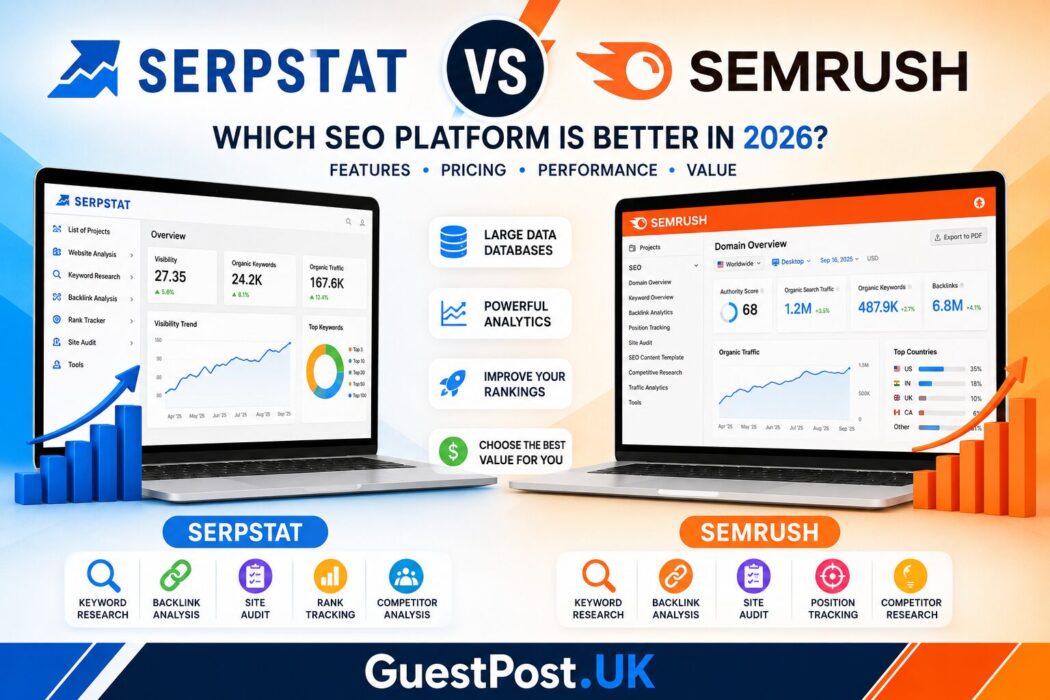
Two platforms that regularly appear on marketers’ shortlists are Serpstat and Semrush. Both offer comprehensive SEO toolkits designed to improve organic visibility, but they differ in depth, pricing, data coverage, and the types of users they serve.
If you’re searching for a Serpstat vs Semrush comparison, you’re likely deciding whether the additional investment in Semrush is worthwhile or whether Serpstat provides everything you need at a lower cost.
The answer depends on your SEO goals.
In this detailed comparison, we’ll examine both platforms across keyword research, backlink analysis, competitor intelligence, technical SEO, rank tracking, AI-powered features, pricing and usability to help you choose the best SEO software for your workflow.
Serpstat vs Semrush: Quick Comparison
| Feature | Semrush | Serpstat |
|---|---|---|
| Best For | Agencies, enterprises, advanced marketers | Freelancers, SMEs, growing businesses |
| Keyword Research | ★★★★★ | ★★★★☆ |
| Competitor Analysis | ★★★★★ | ★★★★☆ |
| Backlink Database | ★★★★★ | ★★★★☆ |
| Technical SEO Audits | ★★★★★ | ★★★★☆ |
| Rank Tracking | ★★★★★ | ★★★★☆ |
| Content Marketing Tools | ★★★★★ | ★★★☆☆ |
| AI Features | ★★★★★ | ★★★☆☆ |
| Ease of Use | ★★★★☆ | ★★★★★ |
| Pricing | Premium | Budget-friendly |
Both platforms are capable SEO suites, but they prioritise different audiences. Semrush focuses on depth and enterprise-level functionality, while Serpstat aims to provide excellent value with an easier learning curve.
What Is Semrush?
Semrush is one of the most recognised names in SEO software. Over the years, it has evolved from a keyword research tool into a complete digital marketing platform that covers SEO, PPC, content marketing, social media, local SEO, and competitive intelligence.
Its toolkit includes:
- Keyword research
- Competitor analysis
- Backlink analytics
- Site audits
- Position tracking
- Content optimisation
- Local SEO management
- AI-powered writing and optimisation tools
- PPC research
For agencies managing multiple clients, Semrush can replace several standalone tools with a single subscription.
Where Semrush Excels
Semrush performs particularly well when SEO decisions rely on large datasets.
For example, if you’re analysing a competitor’s entire organic strategy, Semrush allows you to review:
- ranking keywords
- estimated traffic
- traffic trends
- backlink growth
- paid search activity
- top-performing pages
- keyword gaps
This broader perspective makes campaign planning more strategic rather than reactive.
What Is Serpstat?
Serpstat started primarily as a keyword research platform but has expanded into an all-in-one SEO suite offering a wide range of optimisation tools.
Today, it includes:
- Keyword research
- Competitor analysis
- Rank tracking
- Backlink analysis
- Site auditing
- API access
- Team collaboration
One of Serpstat’s biggest advantages is affordability. It delivers many of the core features businesses require without the premium pricing associated with larger SEO platforms.
For freelancers, consultants and smaller agencies, this balance between functionality and cost makes Serpstat an attractive alternative.
Keyword Research Comparison
Keyword research remains the foundation of every successful SEO strategy.
Both Semrush and Serpstat provide keyword suggestions, search volume estimates, keyword difficulty scores and related search terms, but their workflows differ.
Semrush
Semrush offers one of the industry’s most comprehensive keyword databases.
Users can analyse:
- keyword difficulty
- search intent
- search volume
- trend history
- SERP features
- keyword clusters
- related questions
- competitive density
The platform also integrates keyword research with Topic Research and Keyword Strategy Builder, helping users move from discovering keywords to planning complete content clusters.
For agencies producing dozens of articles each month, this integration saves considerable time.
Serpstat
Serpstat focuses on making keyword discovery fast and practical.
Its keyword reports include:
- search volume
- keyword difficulty
- PPC competition
- related keywords
- search suggestions
The interface is straightforward, allowing users to identify opportunities without having to navigate multiple reports.
Although its database is smaller than Semrush’s, it performs well for most small and medium-sized SEO campaigns.
Which Tool Wins?
If you need the broadest keyword coverage and advanced planning capabilities, Semrush has the edge.
If your goal is efficient keyword research for blogs, business websites or local SEO campaigns, Serpstat offers excellent value.
Competitor Analysis
Understanding why competitors outrank you is one of the quickest ways to improve SEO performance.
Semrush
Competitor analysis is one of Semrush’s strongest features.
Users can investigate:
- top competitors
- keyword overlap
- keyword gaps
- traffic trends
- paid advertising activity
- top landing pages
- authority metrics
Instead of guessing which keywords drive competitor growth, you can see where opportunities exist and prioritise content accordingly.
Serpstat
Serpstat also provides valuable competitor insights.
You can compare domains, identify shared keywords and monitor visibility changes over time.
While the reports aren’t as detailed as Semrush’s, they provide more than enough information for most SEO professionals managing small- to medium-sized projects.
Backlink Analysis
Backlinks remain one of Google’s strongest ranking signals, making backlink analysis a critical feature in any SEO platform.
Semrush
Semrush offers an extensive backlink database with detailed metrics, including:
- referring domains
- anchor text
- toxic links
- authority scores
- backlink growth
- lost links
- new backlinks
Its Backlink Gap tool is particularly useful for identifying websites that link to competitors but not to your own site.
This can significantly improve outreach campaigns and link-building strategies.
Serpstat
Serpstat includes backlink monitoring, referring domain reports and anchor text analysis.
For routine backlink audits and competitor comparisons, it performs well.
However, agencies managing large-scale link-building campaigns may find Semrush’s broader database and advanced reporting more beneficial.
Site Audit Comparison
Technical SEO often determines whether great content reaches its ranking potential.
Both tools include comprehensive site auditing capabilities.
Semrush Site Audit
Semrush analyses hundreds of technical SEO factors, including:
- crawlability
- Core Web Vitals
- HTTPS implementation
- duplicate content
- broken links
- internal linking
- structured data
- page speed
Issues are prioritised by severity, helping teams focus on fixes with the greatest SEO impact.
Serpstat Site Audit
Serpstat’s auditing tool covers the essential technical checks required for healthy websites.
It highlights common problems, explains why they matter and provides practical recommendations for improvement.
For many businesses, these reports are more than sufficient for maintaining strong technical SEO without the complexity of enterprise-level auditing.
Rank Tracking Comparison
Tracking keyword rankings over time is essential for measuring SEO progress. It helps you understand whether your optimisation efforts are working, identify sudden ranking drops and spot new opportunities before competitors do.
Both Semrush and Serpstat offer reliable rank tracking, but the level of detail varies.
Semrush
Semrush Position Tracking is one of the platform’s standout features.
It allows users to monitor:
- Daily keyword rankings
- Desktop and mobile positions
- Local SEO rankings
- Featured snippets
- AI Overviews and SERP features (where available)
- Competitor ranking movements
- Visibility trends
- Cannibalisation issues
For agencies managing multiple clients, these reports make it easy to demonstrate SEO progress with clear historical data.
Serpstat
Serpstat also provides dependable rank tracking with daily updates and historical performance reports.
Users can monitor:
- Keyword position changes
- Search visibility
- Competitor rankings
- Local keyword performance
The interface is straightforward, making it suitable for freelancers and businesses that want actionable insights without unnecessary complexity.
Which Platform Performs Better?
Both tools handle rank tracking well, but Semrush offers more advanced reporting and customisation. If rank tracking forms a significant part of your SEO workflow, Semrush has the advantage.
Content Marketing and AI Features
Modern SEO extends far beyond keyword research. Creating high-quality, search-focused content is just as important as finding the right keywords.
This is another area where the two platforms differ.
Semrush
Semrush has invested heavily in content marketing tools and AI-powered optimisation.
Its ecosystem includes features for:
- Content idea generation
- SEO writing assistance
- Topic research
- Content optimisation
- Search intent analysis
- Readability improvements
- On-page SEO recommendations
These tools help writers produce content that aligns with both user intent and search engine expectations.
For content teams publishing regularly, the integrated workflow can save considerable time.
Serpstat
Serpstat focuses more on keyword-driven optimisation.
While it provides valuable keyword insights for content planning, it doesn’t offer the same breadth of AI-assisted writing and optimisation tools as Semrush.
For users who already rely on dedicated AI writing platforms or content optimisation software, this may not be a disadvantage.
User Experience and Ease of Use
A feature-rich SEO platform is only valuable if it fits naturally into your daily workflow.
Semrush
Semrush presents a professional dashboard packed with reports, charts and advanced filters.
The platform is highly organised, but first-time users may need time to become familiar with the range of available tools.
Fortunately, detailed tutorials and onboarding resources make the learning process easier.
Serpstat
Serpstat has a cleaner, less intimidating interface.
Navigation is intuitive, and most reports can be accessed with only a few clicks.
For freelancers, bloggers and business owners who don’t work in SEO every day, this simplicity can lead to a more efficient workflow.
Which Is Easier to Use?
If you’re new to SEO software, Serpstat is generally easier to learn.
Experienced SEO professionals, however, will appreciate the depth and flexibility that Semrush offers once they become familiar with the platform.
Pricing Comparison
Pricing often plays a decisive role when choosing SEO software.
Semrush
Semrush is positioned as a premium platform, and its pricing reflects that.
The higher subscription cost provides access to an extensive collection of tools covering SEO, PPC, content marketing, social media management and competitive intelligence.
For agencies and larger businesses, consolidating multiple marketing tools into a single platform can justify the investment.
Serpstat
Serpstat is considerably more affordable while still offering a comprehensive set of SEO features.
Its lower entry price makes it attractive for:
- Freelancers
- Bloggers
- Start-ups
- Local businesses
- Small agencies
If your budget is limited, Serpstat delivers strong value without sacrificing the core SEO functionality most users need.
Pros and Cons
Semrush
Pros
- Exceptional keyword database
- Industry-leading competitor analysis
- Comprehensive backlink analytics
- Excellent technical SEO audits
- Advanced rank tracking
- Powerful content marketing tools
- Strong AI-assisted optimisation features
- Suitable for agencies and enterprise SEO
Cons
- Premium pricing
- Steeper learning curve
- More functionality than smaller businesses may require
Serpstat
Pros
- Excellent value for money
- Easy-to-use interface
- Reliable keyword research
- Solid competitor analysis
- Comprehensive technical audit tools
- Affordable for freelancers and SMEs
Cons
- Smaller keyword and backlink databases
- Fewer AI-powered content tools
- Less detailed competitive intelligence
- Advanced reporting is more limited than Semrush
Best Use Cases
Rather than asking which platform is objectively better, it’s more useful to consider which one fits your business.
Choose Semrush if you:
- Manage SEO for multiple clients.
- Run a digital marketing agency.
- Require in-depth competitor analysis.
- Build large-scale content strategies.
- Invest heavily in link building.
- Need PPC and SEO data in one platform.
- Want advanced AI-assisted content optimisation.
Choose Serpstat if you:
- Work as a freelancer or consultant.
- Run a small or medium-sized business.
- Need dependable keyword research.
- Focus mainly on organic SEO.
- Want an affordable all-in-one SEO suite.
- Prefer a straightforward interface.
Is Serpstat a Good Alternative to Semrush?
For many businesses, the answer is yes.
If your daily SEO activities involve keyword research, technical audits, rank tracking and basic competitor analysis, Serpstat provides excellent value.
It covers the essential features required to build and maintain successful SEO campaigns without the higher subscription costs associated with enterprise platforms.
However, agencies managing large portfolios of clients or organisations operating in highly competitive markets may benefit from Semrush’s larger datasets, deeper competitive intelligence and broader range of integrated marketing tools.
In other words, Serpstat is a strong alternative to Semrush, particularly for users who prioritise affordability and simplicity over enterprise-level functionality.
Text-Based Performance Comparison
Imagine your SEO requirements increasing over time:
Personal Blog → Local Business → Growing eCommerce Store → National Brand → Digital Agency → Enterprise Marketing Team
Across that progression:
- Serpstat delivers outstanding value from personal projects through to growing businesses and smaller agencies.
- Semrush becomes increasingly valuable as campaigns grow in complexity, competition and scale.
As your SEO strategy expands to include larger content teams, advanced competitor monitoring, international SEO and integrated marketing campaigns, Semrush’s additional capabilities become more apparent.
Frequently Asked Questions
Which is better: Serpstat or Semrush?
Semrush is generally the stronger platform for agencies, enterprise SEO and advanced competitor analysis. Serpstat offers excellent value for freelancers, bloggers and small businesses looking for a comprehensive SEO toolkit at a more affordable price.
Is Serpstat accurate for keyword research?
Yes. Serpstat provides reliable keyword suggestions, search volume estimates, and keyword difficulty metrics suitable for most SEO campaigns. While its database is smaller than Semrush’s, it remains highly effective for everyday keyword research.
Does Semrush have a larger keyword database?
Yes. Semrush maintains one of the largest keyword databases in the SEO industry, giving users access to a broader range of keyword opportunities, historical data and competitive insights.
Is Serpstat worth it for beginners?
Absolutely. Serpstat’s clean interface, competitive pricing and well-rounded feature set make it an excellent choice for beginners who want professional SEO capabilities without an overwhelming learning curve.
Which platform is better for backlink analysis?
Semrush has the advantage thanks to its larger backlink database, advanced link-auditing tools, and comprehensive competitor backlink analysis. Businesses running extensive link-building campaigns are likely to benefit from its additional depth.
Can I replace Semrush with Serpstat?
For many freelancers, bloggers and small businesses, yes. Serpstat offers enough functionality to handle keyword research, rank tracking, technical SEO and competitor analysis effectively. Agencies or enterprise users requiring advanced reporting and broader marketing tools may still prefer Semrush.
Which SEO Tool Should You Choose? Serpstat vs Semrush
When comparing Serpstat vs Semrush, there isn’t a universal winner—only the platform that best aligns with your goals, budget and workflow.
If you need an enterprise-grade SEO platform capable of handling large-scale keyword research, advanced competitor intelligence, comprehensive backlink analysis, technical audits and AI-assisted content optimisation, Semrush remains one of the strongest choices available. Its depth of data and integrated marketing features make it particularly well suited to agencies, established businesses and experienced SEO professionals.
On the other hand, Serpstat proves that effective SEO software doesn’t have to come with a premium price tag. It offers an impressive combination of keyword research, technical SEO, backlink monitoring and rank tracking within an intuitive interface that appeals to freelancers, consultants and growing businesses.
Ultimately, if you’re looking for the best SEO tool with the widest range of capabilities and you’re comfortable investing in a premium platform, Semrush is the stronger long-term solution. If your priority is maximising value while still accessing a powerful all-in-one SEO suite, Serpstat is one of the best Semrush alternatives available today.