
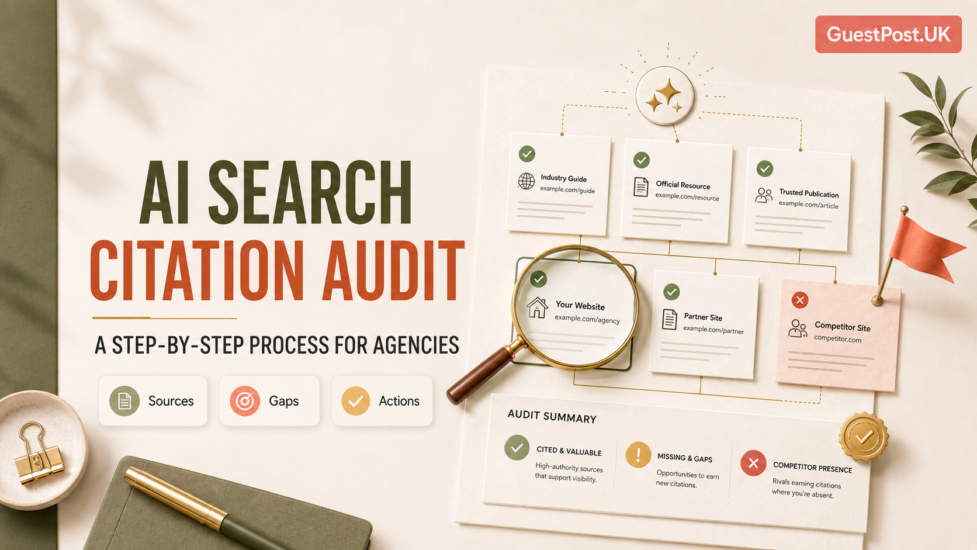
An AI search citation audit is not a report that asks, “Did an AI tool mention our client this week?”
That question is too narrow, and the answer is often unstable. AI-generated responses vary based on user wording, location, follow-up questions, freshness signals, and the sources available at the time. A useful audit instead examines whether a client is discoverable, defensible and genuinely useful across the questions that shape their market.
For an agency, the work sits at the intersection of technical SEO, content strategy, digital PR, and commercial positioning. You are checking whether the client’s own website can support key claims, whether their brand is being mentioned in relevant conversations, and whether competitors are supplying the facts, comparisons and proof that AI systems are more likely to surface.
Google explains that AI Overviews and AI Mode can use a “query fan-out” approach, issuing related searches across subtopics and sources before forming a response. The sources shown can therefore differ from a conventional single-keyword search. Google Search Central
That is why an AI search citation audit should be structured, repeatable and honest about what it can measure.
What an AI Search Citation Audit Should Measure
A proper audit distinguishes among four forms of visibility.
| Area | What you are assessing | Why it matters |
|---|---|---|
| Brand presence | Whether the client is mentioned in relevant AI-led answers | Indicates awareness and source recognition |
| Website citations | Whether the client’s own URLs appear as supporting sources | Shows whether owned content is useful and accessible |
| Topic coverage | Whether the site answers important buyer questions | Reveals content gaps and weak commercial journeys |
| Source ecosystem | Which publishers, competitors and third parties are referenced | Identifies PR, outreach and authority opportunities |
Do not collapse these into one score. A brand can be mentioned without citing its own website. A website can be cited for an informational guide but not for a commercial recommendation. A competitor may dominate list-style queries while the client performs strongly for technical how-to questions.
The agency’s job is to identify the pattern, explain the likely cause and recommend sensible action.
Set the Audit Scope Before You Start Testing
The most common mistake is running random prompts, taking screenshots and calling the result an audit. That produces interesting examples but little strategic value.
Start by defining the scope with the client.
Choose the commercial topics that matter
For a B2B SEO client, the topic set might include:
- Primary service category
- Core problem the service solves
- Commercial comparison terms
- Buyer due-diligence questions
- Pricing or process questions
- Industry-specific use cases
- Competitor alternatives
- Location-based service searches where relevant
For a guest posting business, examples could include “how to choose a guest posting service”, “guest post outreach agency UK”, “safe link building options” and “how to assess a publisher website”.
Avoid using only the client’s brand name. Branded prompts measure recognition; non-branded prompts reveal whether the business can earn discovery from people who have not heard of it.
Build a query set with intent labels
A manageable first audit usually contains 30–60 prompts, grouped by intent rather than by an inflated list of keyword variations.
| Intent type | Example prompt pattern | Audit purpose |
|---|---|---|
| Educational | “How does [service] work?” | Tests explanatory content |
| Evaluation | “What should I check before choosing [service]?” | Tests buyer guidance and trust |
| Comparison | “[Client type] vs [alternative]” | Tests competitive relevance |
| Recommendation | “Best [service] for [audience]” | Tests authority and third-party mentions |
| Transactional | “Where can I buy/get [service]?” | Tests direct commercial visibility |
| Problem-solving | “How do I fix [problem]?” | Tests practical expertise |
Record the precise prompt. A slight wording change can produce a different response, and that is useful context rather than an inconvenience.
Fix the market variables where possible
When checking a UK-focused client, use UK-specific wording and record the testing date. If the relevant AI product allows location or personalisation controls, keep the test environment consistent.
Also note whether the response includes:
- A named brand mention
- A clickable source link
- A citation to the client’s domain
- A citation to a third-party source mentioning the client
- A competitor citation
- No sources at all
This keeps the audit factual. Do not imply that a brand is “ranking number one” in an AI answer. These systems do not produce conventional stable rankings.
Step 1: Audit the Client’s Own Website First
Before assessing the wider web, inspect whether the client has pages worth citing.
Google states that pages must be indexed and eligible to appear with a snippet in Google Search before they can be shown as supporting links in AI Overviews or AI Mode. Google’s AI features guidance
Review the following for every priority URL:
- Is the page indexable and returning a valid
200response? - Does it explain the topic directly in readable text?
- Is the information current and specific?
- Does it include first-hand process knowledge or evidence?
- Does the title reflect the real search intent?
- Are important images, pricing details or product facts visible on-page?
- Does structured data accurately reflect the visible content?
- Is the URL supported by relevant internal links?
An agency can use a technical SEO audit framework here, but the emphasis should be on source readiness rather than producing a generic crawl report.
Look for “citation-sized” information
This does not mean breaking every page into short blocks just for AI. Google specifically says there is no need to “chunk” content or write in a special way for generative search. Google’s optimisation guidance
It does mean each priority page should contain clear, self-contained information that addresses a real question.
Useful examples include:
- A concise definition.
- A transparent description of the service process.
- A qualification or eligibility checklist.
- A comparison table with clear methodology.
- A specific recommendation with its conditions.
- A case-based explanation of what happened and why.
- Current product, location or business information.
Weak examples include unqualified superlatives, generic marketing claims and long passages that describe benefits without explaining the service.
Step 2: Test the Prompt Set and Capture Evidence
Run the prepared prompts across the AI search experiences relevant to the client’s audience. Use a clean spreadsheet or reporting dashboard.
For each response, record:
- Prompt used
- Platform checked
- Date
- Search location or market setting
- Brand mentioned: yes/no
- Client domain cited: yes/no
- Third-party mention cited: yes/no
- Main competitors shown
- Source URLs used
- Response angle
- Notes and screenshots where useful
A simple traffic-light system can help teams review a large query set:
- Green: client is cited or accurately mentioned in a commercially meaningful answer.
- Amber: client is absent, but its content could plausibly support the query after improvement.
- Red: competitor sources dominate, or the client has no suitable source page.
Do not treat green as “job done”. Check whether the citation supports a useful business proposition or appears only for a minor fact.
Step 3: Separate Owned-Citation Gaps From Authority Gaps
This is the most valuable part of the AI search citation audit.
If the client is not appearing, determine what kind of gap exists.
Owned-content gap
The client has no page that adequately answers the question, or its existing page is too thin, outdated, inaccessible, or commercially vague.
Typical response: improve the page, create a focused supporting guide, add proof, tighten internal links and resolve technical barriers.
Authority gap
The client has a strong page, but AI-led results consistently cite more established third-party sources, trade publications, comparison sites or competitors.
Typical response: build authority through high-quality digital PR, expert commentary, relevant guest posting and earned mentions. The aim is not to manufacture citations, but to create credible sources that support the client’s expertise.
Entity-consistency gap
The client is listed under an inconsistent name, has incomplete business details, or lacks clear evidence linking the brand to its expertise, products, or locations.
Typical response: review organisation information, author pages, profiles, third-party listings, About content and relevant structured data. Ensure core facts are consistent across the website and credible external sources.
Query-fit gap
The client’s pages are useful but aimed at the wrong level of the buyer journey. For example, a service page may not answer a broad educational question, while a long guide may not help someone compare providers.
Typical response: create the right content format for the intent: guide, comparison, service page, case study, checklist or supporting tool.
Step 4: Map the Sources AI Systems Prefer
The audit should document which sources repeatedly appear for priority topics.
You may notice a pattern such as:
- Government or standards bodies dominate factual questions.
- Established trade publications dominate recommendations.
- Product documentation dominates technical comparisons.
- Review platforms dominate reputation-led queries.
- Competitor guides dominate buyer-education questions.
- Forums and community sites appear for lived experience.
This source map helps agencies decide whether the client needs better owned content, stronger editorial coverage, more independent validation or a clearer market position.
Do not recommend guest posts merely because other publishers appear. Ask whether the proposed placement would genuinely help the client become more discoverable in a relevant topic ecosystem.
For example, a cyber-security firm may benefit more from expert commentary in a recognised technology publication than a low-quality general business blog, even if both offer a dofollow link.
Step 5: Review Technical Access for Major AI Search Crawlers
Public content cannot be surfaced properly if it is blocked from crawling.
For Google AI features, foundational Google Search requirements still apply: the page should be crawlable, indexable, internally discoverable and available in textual form. Google Search Central
For ChatGPT search, OpenAI says that sites wishing to have content included in summaries and snippets should not block OAI-SearchBot. OpenAI’s publishers and developers FAQ
Review:
robots.txtrulesnoindexdirectives- CDN, firewall or bot-management blocks
- Login walls and cookie barriers
- JavaScript-rendering failures
- Canonical conflicts
- Slow or unstable priority URLs
- Content that only appears after interaction
This should be a selective quality check, not an excuse to spend the entire audit on technical issues. Focus on the URLs that would realistically support priority prompts.
Step 6: Connect AI Visibility With Search and Referral Data
Citation observations are useful, but client reporting should not depend on screenshots alone.
Google reports AI feature activity within the normal Search Console Performance report under the Web search type. Agencies should use that data alongside broader organic trends rather than trying to isolate every individual AI Overview click. Google’s guidance
For ChatGPT referrals, OpenAI says referral links include utm_source=chatgpt.com, allowing traffic to be tracked in analytics platforms. OpenAI’s publisher FAQ
Track three layers:
- Visibility: citations, mentions, source appearances and prompt coverage.
- Search behaviour: impressions, clicks, landing pages and branded search trends.
- Business value: enquiries, assisted conversions, sales, demo requests or qualified leads.
A citation is a signal, not a conversion. A sensible report connects the work to the client’s wider acquisition goals.
The Trend Pattern Agencies Should Report
A useful graph-style explanation might look like this:
- Priority-page improvements → better indexation and more query impressions: the client’s own source material is becoming easier to discover.
- New expert content and third-party coverage → more brand mentions across prompt groups: market authority is expanding.
- Citations increase, but referral sessions remain low: the client is present, but the cited information may not lead to a strong click incentive.
- Referral sessions are rising, but leads remain flat: review the landing-page message match and the call to action.
- Competitor citations persist for a topic after content improvements: investigate stronger source evidence, unique research or credible external validation.
Never report every change as a win. If the data is mixed, say so. A credible agency audit distinguishes emerging opportunity from proven commercial impact.
Step 7: Turn Findings Into a 90-Day Action Plan
The audit should end with a prioritised plan, not a vague recommendation to “improve AI SEO”.
First 30 days: fix source readiness
- Resolve indexation and crawler-access issues.
- Update priority service and commercial pages.
- Add clear answers, proof and supporting internal links.
- Correct inconsistent business information.
- Establish a measurement baseline.
Days 31–60: close content and entity gaps
- Publish guides that answer high-value buyer questions.
- Build comparison or alternative content where the evidence supports it.
- Improve author, expert and About-page signals.
- Add case-based evidence, original data or useful tools.
- Strengthen contextual internal links between guides and services.
Days 61–90: build independent corroboration
- Identify relevant editorial and digital PR opportunities.
- Contribute expert commentary where the client has genuine expertise.
- Secure relevant mentions through high-quality outreach.
- Review citation patterns again using the same set of prompts.
- Compare visibility changes with Search Console and analytics trends.
Guest posting can support this third phase when the placement has genuine topical relevance and adds a useful expert contribution. It should complement the client’s own content, not compensate for a weak website.
Questions Clients Often Ask About AI Search Citation Audits
Can an agency guarantee citations in ChatGPT or Google AI Mode?
No. AI-generated answers and source selections can change by query, time, user context and available information. An agency can improve source readiness, content quality, technical accessibility and market authority, but should not promise a fixed citation position.
How often should an AI search citation audit be repeated?
For most ongoing SEO clients, a focused monthly check with a fuller quarterly audit is sensible. Large ecommerce brands, publishers, or rapidly changing SaaS markets may need more frequent monitoring.
Are AI citation-tracking tools reliable?
They can be useful for gathering observations at scale, but no third-party platform has access to Google’s internal AI systems. Use them as a workflow aid, then validate important findings with manual tests and first-party traffic data.
Does more schema markup increase AI citations?
Structured data helps search engines understand specific page elements and can support eligibility for rich results, but it is not a specialised AI citation mechanism. Use accurate markup that matches the visible page, rather than adding schema solely to chase mentions.
Treat the Audit as a Source-Quality Programme
The value of an AI search citation audit is not in counting how many times a brand appears in a chat response. It is in identifying whether the client has the right information, evidence, technical access and external credibility to be a sensible source.
When the audit is done properly, the recommendations improve more than AI visibility. They make service pages clearer, content more useful, outreach more selective and client reporting more grounded in evidence.
That is the kind of work agencies can defend in a strategy meeting — even when the AI landscape changes again.