
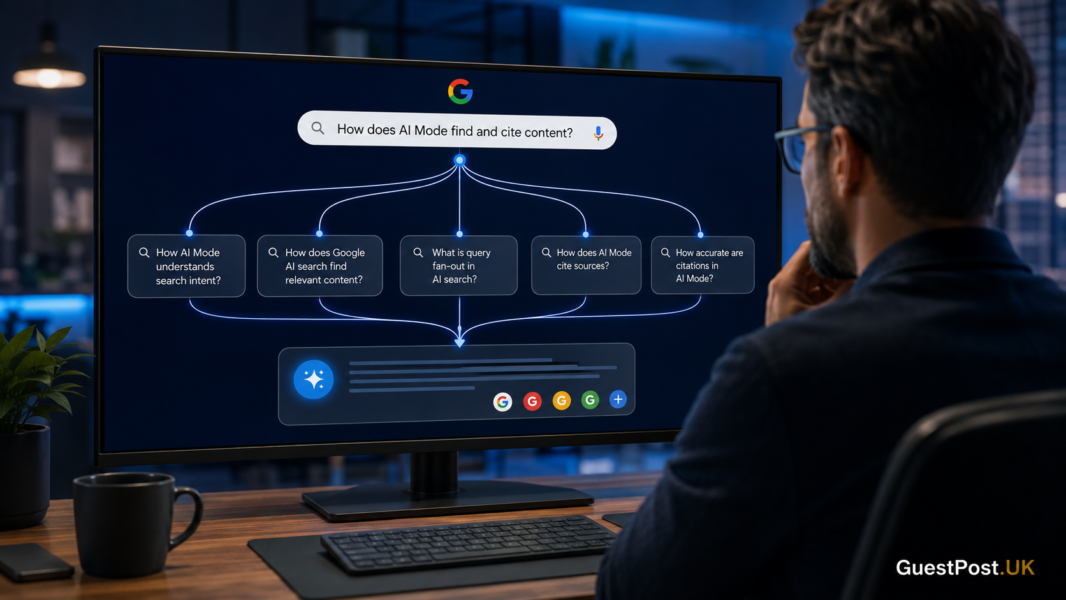
A person might ask Google, “What is the best way for a small business to build authority online?” In traditional search, Google would largely match that question with relevant web pages. In AI search, the system can explore several connected questions at once before creating an answer.
That process is called query fan-out. It is one of the reasons businesses now need content that covers a topic properly, not just a single target keyword. It is also central to the shift from classic SEO towards generative engine optimisation.
Query fan-out explained simply
Query fan-out is when an AI search system expands one user question into several related searches. It uses those searches to gather information from different pages, perspectives, and data sources, then brings the findings together into a single response.
Google has confirmed that AI Mode and AI Overviews may use this approach. Its systems can issue multiple related searches across subtopics and data sources to create a more complete answer, while identifying supporting pages that may be shown as links. Google’s AI-features documentation explains that the links and responses can differ between AI Mode and AI Overviews because they may use different models and techniques.
Think of it like this:
| User’s original question | Possible related searches an AI system may explore |
|---|---|
| How can a local business get more customers from Google? | local SEO checklist, Google Business Profile optimisation, local citations, review strategy, local backlinks |
| Are guest posts still worth it for SEO? | guest-post quality signals, editorial backlinks, Google link spam policy, guest posting ROI, guest posts vs digital PR |
| Which SEO tool is best for an agency? | rank tracking for agencies, client reporting features, SEO tool pricing, backlink analysis tools, AI visibility tracking |
The exact searches are not publicly shown to website owners, and they can change depending on the question, location, current information and the searcher’s needs. The important point is that AI search looks beyond the original wording.
Why query fan-out matters for SEO
For years, a page could perform well by closely matching one popular keyword. That still matters, but it is no longer enough for many complex searches.
If your article answers only “what is guest posting?”, it may not help an AI system address related needs such as how to judge a publisher, what anchor-text risk looks like, how long results take, or whether guest posts support brand visibility.
A more complete guide can cover the core topic and naturally answer the questions that typically follow. This makes the page more useful to people and gives search systems more relevant context to understand.
This does not mean creating a separate page for every possible variation. Google warns against producing large quantities of content simply to manipulate AI results. Instead, focus on content with a real purpose, clear expertise and useful depth.
A practical example for a guest-posting business
Suppose a prospective client asks:
“How do I choose safe guest post sites that improve rankings?”
The system may need evidence about several factors before it can construct a good answer:
- Topical relevance between the website and publisher
- Editorial standards and content quality
- Genuine audience and traffic signals
- Link placement and anchor-text naturalness
- Whether the publication accepts every topic indiscriminately
- The difference between authority metrics and real quality
- Risks around paid links and manipulative link schemes
A useful page should not just say, “Choose a high-DA site.” It should explain the full decision process and help the reader make a better choice.
This is why your existing article on choosing high-quality guest post sites is valuable. Supporting it with relevant guides on guest posting quality, backlink profiles, and editorial links helps create a stronger content cluster.
How to create content that works across related searches
Cover the main job first
Start by answering the user’s central question clearly. Do not bury the answer beneath a long history lesson or generic opening. A visitor should quickly understand what the page will help them do.
Add the decision points people genuinely need
Consider the questions a reader would ask before they can act. For a guide to SEO reporting, include which metrics matter, what should be compared, how often to report, and how to explain results to a client.
For a guide to link building, the key factors could be relevance, authority, placement quality, anchor text, risk, and expected outcomes.
Use headings that reflect real subtopics
Clear H2 and H3 headings make a page easier for people to scan and help search systems understand the structure. Use descriptive wording such as “How to assess publisher relevance” rather than vague headings like “Important information”.
Include something competitors cannot easily copy
Original examples, first-hand observations, practical checklists, screenshots, templates and clear opinions all improve usefulness. AI systems do not need more generic summaries of information already available everywhere.
Link to the next useful resource
Internal links should guide the reader through the topic. A person researching AI search visibility may also need a guide to ranking in Google AI Overviews or our AI search optimisation checklist. These links improve the journey and make the relationship between your pages clearer.
Do you need to optimise for every fan-out query?
No. Trying to predict and target every hidden sub-query would create thin, repetitive content.
Instead, use normal research methods to identify the most important related questions:
- Google autocomplete and People Also Ask
- Search Console queries and pages
- Customer calls, sales emails and support questions
- Competitor content gaps
- Relevant Reddit, forum and community discussions
- AI-search prompt testing for your highest-value topics
Group closely related questions into one genuinely helpful page. If a subtopic is substantial enough to deserve its own guide, create a supporting article and link it properly. This is a better approach than forcing every answer into one oversized page.
Query fan-out changes what “topical authority” looks like
Topical authority is not about publishing the highest number of articles. It is about becoming a credible, useful source across the questions that matter within your area of expertise.
For GuestPost.UK, that means connecting useful resources on guest posting, blogger outreach, link building, digital PR, SEO reporting, and AI search visibility. Each article should add a distinct layer rather than repeat what another page already says.
Query fan-out gives businesses a reason to think beyond individual keywords. When your content answers the main question, supports the next questions, and offers real experience, it has a stronger chance of being useful in both classic search and AI-generated answers.
To find gaps in your current content or build an AI-search-ready topic plan, explore our GEO services, keyword gap analysis and topic cluster builder.