
Artificial intelligence is changing the way people discover businesses online.
For years, website audits focused almost entirely on Google’s ranking factors. We checked title tags, page speed, backlinks and keyword positions. Those elements still matter, but they are no longer the whole picture.
Today’s AI-powered search platforms evaluate websites differently. They attempt to understand who you are, whether your business demonstrates genuine expertise and whether your information deserves to be trusted before recommending it to users.
That means a website can rank reasonably well in traditional search yet still struggle to appear in ChatGPT, Gemini, Perplexity or Google AI Overviews.
This checklist has been designed to help bridge that gap.
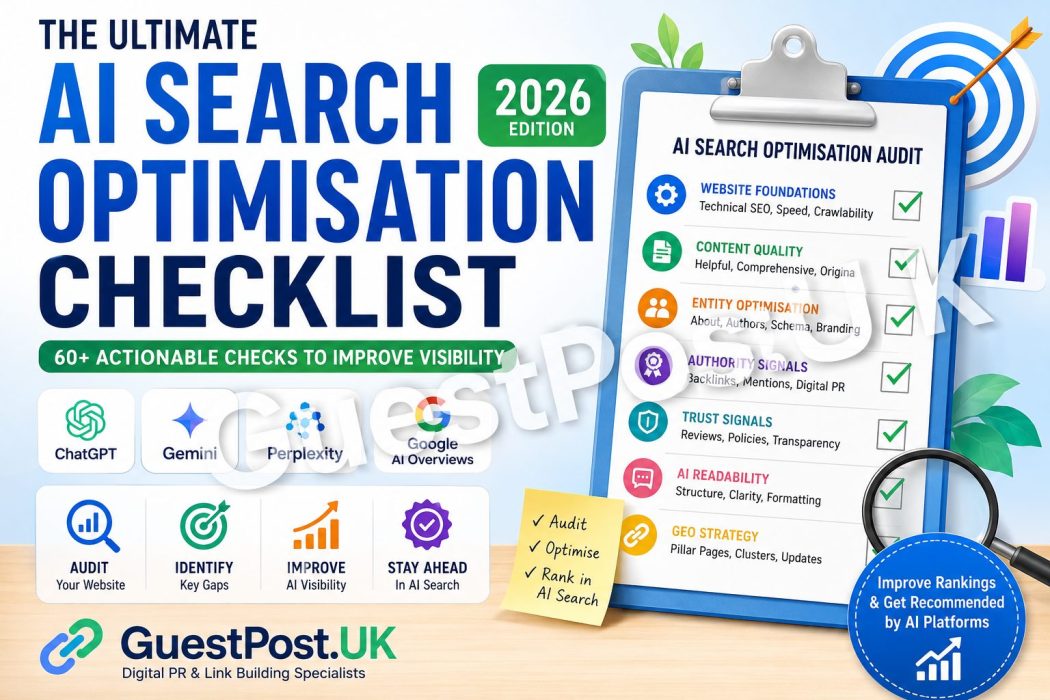
Rather than providing vague advice, it offers a practical audit framework that businesses, agencies and marketing teams can use to evaluate their readiness for AI search.
Treat this page as a working document.
Return to it regularly.
Review your progress.
Identify weaknesses.
Improve one area at a time.
Over the coming years, organisations that continually strengthen these signals are likely to gain a significant competitive advantage.
Introducing the AI Visibility Audit
At GuestPost.uk, we believe successful Generative Engine Optimisation is built on six interconnected pillars rather than isolated SEO tasks.
Together they form what we call the AI Visibility Audit™.
                 AI VISIBILITY
                       ▲
                       │
          ┌────────────┼────────────┐
          │            │            │
     Technical     Content      Authority
          │            │            │
          └────────────┼────────────┘
                       │
                Entity & Trust
                       │
                 Consistency
Each section of this checklist focuses on one of these pillars.
By the end of the audit, you’ll have a much clearer understanding of where your website performs well and where further work is needed.
Section One — Website Foundations
Strong AI visibility begins with strong technical foundations.
Many businesses jump straight into creating AI-focused content without first ensuring that their website is easy to crawl, understand and navigate.
Think of your website as a building.
Content may be the furniture, but technical SEO forms the foundations.
Without stable foundations, everything built above them becomes less effective.
✔ Checkpoint 1 — HTTPS Security
Why this matters
Trust begins with security.
Visitors expect modern websites to use encrypted HTTPS connections, and search engines have treated HTTPS as a standard for years. AI platforms also benefit from accessing secure, reliable websites.
Although HTTPS alone will not improve AI visibility, failing to use it immediately weakens user confidence and signals that your website is not being maintained to modern standards.
How to check
- Does every page load using https://?
- Are there any mixed-content warnings?
- Do HTTP URLs automatically redirect to HTTPS?
What good looks like
Every page loads securely without browser warnings, and visitors never encounter duplicate HTTP versions.
Priority
★★★★★ Essential
✔ Checkpoint 2 — Mobile Experience
Why this matters
AI search does not exist only on desktop computers.
Many users interact with ChatGPT, Gemini and other AI assistants directly from smartphones.
A poor mobile experience creates friction long before visitors engage with your content.
Fast-loading pages, readable typography and intuitive navigation all contribute to stronger user engagement—signals that often align with long-term search performance.
How to check
Ask yourself:
- Does every page display correctly on mobile devices?
- Are buttons easy to tap?
- Is text comfortably readable without zooming?
- Do important elements remain visible on smaller screens?
What good looks like
Users should be able to complete every important action from a mobile device without frustration.
Priority
★★★★★ Essential
✔ Checkpoint 3 — Website Speed
Why this matters
Nobody enjoys waiting.
Slow websites reduce engagement, increase abandonment and often prevent users from exploring additional content.
While AI systems do not recommend websites solely because they are fast, technical quality remains an important trust signal.
Fast websites also make it easier for search engines to crawl and refresh content efficiently.
How to check
Review:
- Largest Contentful Paint (LCP)
- Interaction to Next Paint (INP)
- Cumulative Layout Shift (CLS)
Also ask:
- Do large images slow the page?
- Are unnecessary scripts loading?
- Is caching configured correctly?
What good looks like
Pages should load quickly enough that users can begin reading almost immediately without noticeable delays.
Priority
★★★★★ Essential
✔ Checkpoint 4 — Logical Website Structure
Why this matters
Imagine walking into a library where books have been placed randomly.
Finding information would be frustrating.
Websites work in exactly the same way.
Artificial intelligence benefits from clearly organised information.
Logical navigation helps both visitors and search engines understand how different topics relate to one another.
How to check
Can a visitor reach your most important content within three or four clicks?
Do related pages naturally link together?
Does every major topic have its own dedicated section?
What good looks like
Your website should feel organised rather than overwhelming.
Every page should have an obvious place within the overall structure.
Priority
★★★★★ Essential
✔ Checkpoint 5 — Internal Linking
Why this matters
Many businesses think of internal links simply as navigation.
In reality, they help establish relationships between topics.
For example, if your website includes pages covering:
- AI Search Optimisation
- Generative Engine Optimisation
- Digital PR
- Guest Posting
- Entity Optimisation
those pages should reinforce one another through natural internal linking.
This creates a stronger topical ecosystem that both users and AI systems can understand.
How to check
Review whether:
- Every important page receives internal links.
- Pillar pages link to supporting articles.
- Supporting articles link back to cornerstone content.
- Anchor text accurately describes the destination.
What good looks like
Internal links should guide readers naturally towards deeper knowledge rather than existing purely for SEO purposes.
Priority
★★★★★ Essential
✔ Checkpoint 6 — Crawlability
Why this matters
Outstanding content has little value if search engines struggle to discover it.
Broken crawl paths, blocked resources or poorly configured technical settings can prevent important pages from being indexed effectively.
AI systems ultimately depend on discoverable information.
How to check
Review:
- robots.txt
- XML sitemap
- Canonical tags
- Indexation status
- Crawl errors inside Google Search Console
What good looks like
Every important page should be crawlable, indexable and included within a clean XML sitemap.
Priority
★★★★★ Essential
✔ Checkpoint 7 — Clean URL Structure
Why this matters
Clear URLs improve usability for both people and machines.
Compare these examples:
Poor
example.com/page?id=483&cat=19
Better
example.com/ai-search-optimisation-checklist
Simple URLs communicate purpose immediately.
They are easier to remember, easier to share and easier for search engines to interpret.
How to check
Ask yourself:
- Is the URL descriptive?
- Is it unnecessarily long?
- Does it contain random numbers?
- Does it accurately reflect the page topic?
What good looks like
Short, descriptive URLs organised within a logical site hierarchy.
Priority
★★★★☆ High
Website Foundations Score
Before moving to the next section, score yourself.
| Audit Area | Complete | Needs Work |
|---|---|---|
| HTTPS Security | ☐ | ☐ |
| Mobile Experience | ☐ | ☐ |
| Website Speed | ☐ | ☐ |
| Site Structure | ☐ | ☐ |
| Internal Linking | ☐ | ☐ |
| Crawlability | ☐ | ☐ |
| URL Structure | ☐ | ☐ |
Foundation Score: ___ / 20
How to interpret your score
18–20: Excellent. Your technical foundations are unlikely to limit your AI search performance.
14–17: Good, but there are still opportunities to strengthen the user experience and crawlability.
Below 14: Address these technical issues before investing heavily in advanced Generative Engine Optimisation strategies. Strong foundations make every future improvement more effective.
Content That AI Systems Want to Recommend
Publishing more content is no longer enough.
Artificial intelligence is becoming increasingly selective about the information it chooses to reference. Instead of simply identifying pages that mention a keyword, modern AI systems attempt to understand whether a page genuinely helps answer a user’s question.
That changes the purpose of content.
Instead of asking:
“How many articles should we publish this month?”
Ask:
“If someone read only this page, would they leave with complete confidence in the answer?”
This section evaluates whether your content deserves to become a trusted resource rather than simply another indexed webpage.
✔ Checkpoint 8 — Does Every Page Have a Clear Purpose?
Why this matters
One of the biggest weaknesses we encounter during SEO audits is content without a defined objective.
Some pages attempt to educate, sell, compare products and target multiple keywords simultaneously. The result is usually a page that satisfies none of these intentions particularly well.
AI systems perform best when the purpose of a page is immediately obvious.
How to check
Choose any page on your website and answer this question:
What is the single objective of this page?
If the answer is unclear, the page probably needs restructuring.
What good looks like
Every page should have one dominant purpose:
- Educate
- Compare
- Sell
- Review
- Demonstrate
- Guide
- Explain
Readers should never wonder why the page exists.
Priority
★★★★★ Essential
✔ Checkpoint 9 — Does Your Content Solve the Entire Problem?
Why this matters
Many articles answer only the first question a visitor has.
Exceptional resources anticipate the next five.
Imagine someone searching:
“How do I optimise my website for AI search?”
A weak article might define AI search and stop there.
A stronger article explains implementation, common mistakes, tools, examples, measurement techniques and future considerations.
The second article eliminates the need for additional searches.
That is exactly the type of experience AI platforms aim to provide.
How to check
Ask:
Could someone confidently complete the task after reading this page?
Or would they immediately need another article?
What good looks like
Comprehensive resources that leave very few important questions unanswered.
Priority
★★★★★ Essential
✔ Checkpoint 10 — Are You Adding Information Gain?
Why this matters
The internet already contains millions of articles.
Publishing another version of existing advice rarely creates value.
Instead, every page should contribute something new.
This concept is often referred to as information gain.
Rather than recycling what everyone else has written, your content should move the conversation forward.
How to check
Identify whether your page includes at least one of the following:
- Original research
- Industry observations
- Practical frameworks
- Real-world experience
- Customer insights
- Proprietary methodologies
- Case scenarios
- Unique graphics
If none of these exist, ask yourself:
“What would make this article worth referencing?”
What good looks like
Readers should encounter ideas they cannot easily find elsewhere.
Priority
★★★★★ Essential
✔ Checkpoint 11 — Is Your Content Easy for AI to Understand?
Why this matters
People often assume AI prefers complicated language.
The opposite is usually true.
Clear communication reduces ambiguity.
Simple explanations are easier to interpret accurately, particularly when AI systems summarise information.
That does not mean oversimplifying.
It means communicating complex ideas with clarity.
How to check
Review your writing.
Do paragraphs become unnecessarily long?
Are technical terms explained?
Does each heading clearly describe the following section?
Could someone unfamiliar with the subject follow your reasoning?
What good looks like
Clear structure.
Logical progression.
Minimal ambiguity.
Natural language.
Priority
★★★★★ Essential
✔ Checkpoint 12 — Does Your Content Demonstrate Experience?
Why this matters
Anyone can describe a concept.
Far fewer people can explain what actually happens when theory meets reality.
Experience is often what separates memorable content from generic advice.
Instead of saying:
“Digital PR improves authority.”
Explain:
“During one campaign we discovered that journalists were far more interested in original survey data than another opinion piece. That insight completely changed our outreach strategy.”
Even when anonymised, practical experience adds depth.
How to check
Review whether your content includes:
- Lessons learned
- Real scenarios
- Practical implementation
- Common mistakes
- Decision-making processes
What good looks like
Readers should feel they are learning from someone who has actually done the work.
Priority
★★★★★ Essential
✔ Checkpoint 13 — Are Your Articles Internally Connected?
Why this matters
Think about the way universities organise knowledge.
Individual lectures contribute towards a larger course.
Courses contribute towards a degree.
Knowledge is connected.
Your website should work in the same way.
If every article exists in isolation, AI systems struggle to recognise the depth of your expertise.
Internal links create context.
Context creates authority.
How to check
Review whether supporting articles naturally connect back to:
- Pillar pages
- Related resources
- Service pages
- Case studies
- Checklists
What good looks like
Every article strengthens several others.
The website feels like a knowledge ecosystem rather than a collection of unrelated posts.
Priority
★★★★★ Essential
✔ Checkpoint 14 — Are You Updating Evergreen Content?
Why this matters
Publishing excellent content once is rarely enough.
Industries evolve.
Software changes.
Statistics become outdated.
Examples lose relevance.
Artificial intelligence increasingly values information that reflects the current landscape.
How to check
Review cornerstone pages every three to six months.
Update:
- Statistics
- Examples
- Screenshots
- Industry trends
- New technologies
- Internal links
What good looks like
Cornerstone resources improve over time instead of gradually becoming obsolete.
Priority
★★★★☆ High
Entity Optimisation
Search engines index pages.
Artificial intelligence attempts to understand organisations.
That distinction makes entity optimisation one of the most important components of modern GEO.
An entity is more than a company name.
It is the complete picture AI forms about your organisation from everything it can discover online.
The stronger and more consistent that picture becomes, the easier it is for AI systems to recommend your business confidently.
✔ Checkpoint 15 — Does Your About Page Build Confidence?
Why this matters
Many About pages focus entirely on company history.
Visitors—and AI systems—are usually more interested in understanding expertise.
A strong About page should explain:
- Who you help.
- Why you are qualified.
- What experience you bring.
- What makes your approach different.
How to check
Read your About page objectively.
Does it build confidence?
Or does it simply describe the business?
What good looks like
A page that communicates expertise before promotion.
Priority
★★★★★ Essential
✔ Checkpoint 16 — Are Your Experts Visible?
Why this matters
People trust people.
The same principle increasingly applies to AI.
Anonymous articles provide little evidence of expertise.
Named contributors with biographies, credentials and experience create much stronger trust signals.
How to check
Do your key articles include:
- Author names?
- Professional biographies?
- Relevant experience?
- Profile photographs?
- Links to additional content?
What good looks like
Readers understand exactly who produced the information and why they should trust it.
Priority
★★★★★ Essential
✔ Checkpoint 17 — Is Your Brand Consistent Everywhere?
Why this matters
Imagine discovering five different versions of the same company’s information online.
Different addresses.
Different telephone numbers.
Different descriptions.
Confidence immediately falls.
AI systems face the same challenge.
Consistency strengthens entity recognition.
How to check
Review your:
- Website
- Company directories
- Google Business Profile
- Industry listings
- Social platforms
Do they tell the same story?
What good looks like
A consistent brand identity wherever someone encounters your business online.
Priority
★★★★★ Essential
Content & Entity Audit Score
| Audit Area | Complete | Needs Work |
|---|---|---|
| Clear Page Purpose | ☐ | ☐ |
| Comprehensive Content | ☐ | ☐ |
| Information Gain | ☐ | ☐ |
| AI Readability | ☐ | ☐ |
| Demonstrated Experience | ☐ | ☐ |
| Internal Content Network | ☐ | ☐ |
| Evergreen Updates | ☐ | ☐ |
| Strong About Page | ☐ | ☐ |
| Expert Authors | ☐ | ☐ |
| Brand Consistency | ☐ | ☐ |
Section Score: ___ / 30
Progress Review
If your score is above 24, your website is developing many of the characteristics associated with trusted AI sources.
If your score falls below 20, focus less on publishing additional content and more on improving the quality, depth and credibility of the pages you already have.
In the next section, we’ll move beyond your website and audit the external signals that influence AI trust, including authority building, digital PR, editorial mentions, brand recognition and ongoing GEO maintenance.
Authority: Is the Internet Talking About Your Business?
Many organisations believe authority begins and ends with backlinks.
That was never entirely true, and it is becoming even less accurate as AI search evolves.
Imagine two companies offering identical services.
The first has spent years publishing insightful research, speaking at conferences, appearing on podcasts and contributing expert commentary to respected publications.
The second has quietly built a technically sound website but has almost no presence beyond its own domain.
Which business is an AI system more likely to trust?
The answer has little to do with keyword density.
Authority is built when other people recognise your expertise—not when you repeatedly claim it yourself.
✔ Checkpoint 18 — Are You Earning Editorial Mentions?
Why this matters
Independent recognition is one of the strongest credibility signals available.
Editorial mentions demonstrate that journalists, publishers or industry writers considered your organisation knowledgeable enough to include in their content.
Unlike advertisements, editorial coverage is earned rather than purchased.
How to check
Review the past twelve months.
Has your business been mentioned in:
- Industry publications?
- Online magazines?
- News websites?
- Trade journals?
- Professional associations?
What good looks like
Regular editorial coverage from relevant, trustworthy websites.
Priority
★★★★★ Essential
✔ Checkpoint 19 — Are You Publishing Link-Worthy Resources?
Why this matters
Exceptional resources attract attention naturally.
If every new backlink requires manual outreach, your content may not yet offer enough value to earn links on its own.
The strongest authority assets continue attracting links long after publication.
Examples
- Original research
- Annual reports
- Industry benchmarks
- Interactive tools
- Templates
- Comprehensive guides
- Proprietary frameworks
What good looks like
Resources people reference because they genuinely improve the discussion.
Priority
★★★★★ Essential
✔ Checkpoint 20 — Is Your Brand Mentioned Without Links?
Why this matters
A surprising number of businesses ignore unlinked brand mentions.
From an AI perspective, these references still contribute to understanding who you are and how your organisation fits within an industry.
Being discussed by respected sources—even without a hyperlink—reinforces recognition.
How to check
Search for your business name.
Where is it being discussed?
Who is talking about you?
Is the context positive and relevant?
What good looks like
Consistent, authentic mentions across trusted industry websites.
Priority
★★★★☆ High
✔ Checkpoint 21 — Are You Creating Thought Leadership?
Why this matters
Authority is not simply about being visible.
It is about contributing something meaningful.
Businesses that introduce new ideas often become the ones AI systems reference most confidently.
Examples
- Opinion articles
- White papers
- Research reports
- Industry predictions
- Conference presentations
- Practical methodologies
What good looks like
Your organisation influences conversations rather than simply joining them.
Priority
★★★★★ Essential
Trust Signals
Authority attracts attention.
Trust converts attention into confidence.
Artificial intelligence increasingly evaluates whether a business appears legitimate, transparent and dependable before recommending it.
Many of these signals seem small individually.
Collectively, they become powerful.
✔ Checkpoint 22 — Is It Easy to Verify Your Business?
Why this matters
Visitors should never struggle to understand who they are dealing with.
Transparent organisations inspire confidence.
Anonymous businesses create hesitation.
How to check
Can someone easily find:
- Contact details?
- Registered business information?
- Team members?
- Office location?
- Support channels?
What good looks like
Complete transparency without unnecessary barriers.
Priority
★★★★★ Essential
✔ Checkpoint 23 — Are Reviews Genuine and Visible?
Why this matters
Reviews remain one of the strongest indicators of public trust.
Authentic customer feedback provides reassurance that your expertise has delivered real results.
What good looks like
- Independent review platforms
- Testimonials with context
- Verified customer experiences
- Balanced feedback
Priority
★★★★★ Essential
✔ Checkpoint 24 — Does Your Website Demonstrate Credibility?
Why this matters
Trust is often built through small details.
Ask yourself whether your website includes:
- Privacy Policy
- Terms and Conditions
- Cookie Policy
- Editorial guidelines (where relevant)
- Clear contact information
- Professional design
- Up-to-date branding
Individually these may appear minor.
Together they communicate professionalism.
Priority
★★★★☆ High
✔ Checkpoint 25 — Would You Trust Your Own Website?
Why this matters
This may be the most revealing question in the entire audit.
Imagine discovering your business for the first time.
Would you immediately trust it?
Or would you continue searching?
Sometimes stepping into the customer’s shoes reveals weaknesses that technical audits never uncover.
Priority
★★★★★ Essential
Monthly GEO Maintenance Checklist
Generative Engine Optimisation is not something you complete once.
It should become part of your ongoing marketing routine.
Every Month
☐ Review AI-generated answers relating to your industry.
☐ Check whether competitors are being mentioned more frequently.
☐ Update one cornerstone article.
☐ Improve internal links.
☐ Refresh outdated statistics.
☐ Publish one genuinely useful resource.
☐ Look for new digital PR opportunities.
☐ Monitor brand mentions.
☐ Strengthen author profiles where appropriate.
☐ Review Google Search Console for technical issues.
AI Search Readiness Score
Now calculate your overall score.
| Category | Maximum |
|---|---|
| Website Foundations | 20 |
| Content Quality | 30 |
| Entity Optimisation | 20 |
| Authority Building | 15 |
| Trust Signals | 15 |
Your Total
_______ / 100
90–100 — AI Ready
Your website demonstrates many of the characteristics associated with recognised, trustworthy organisations.
Continue refining and expanding your authority.
75–89 — Strong Foundations
You’re moving in the right direction.
Focus on increasing external recognition through digital PR, guest posting and thought leadership.
50–74 — Significant Opportunity
Your website has potential, but important weaknesses remain.
Prioritise content depth, entity optimisation and authority building before expanding into new topics.
Below 50 — Build the Foundations First
Rather than chasing advanced GEO tactics, strengthen your website, establish expertise and improve trust signals.
Long-term authority always outperforms short-term optimisation.
The GuestPost.uk AI Readiness Wheel
Every high-performing website eventually develops strength across six connected areas.
                 AI VISIBILITY
                      ▲
                      │
              ┌───────┼───────┐
              │               │
        TECHNICAL         CONTENT
              │               │
              ├───────┼───────┤
              │               │
          AUTHORITY        ENTITY
              │               │
              └───────┼───────┘
                      │
                   TRUST
Weakness in one area often limits the effectiveness of the others.
The objective is not perfection.
It is balance.
Ready for a Professional AI Search Audit?
Reading a checklist is useful.
Applying it objectively to your own business is much harder.
Many organisations overestimate their strengths because they are too close to their own websites to identify the gaps.
At GuestPost.uk, we carry out comprehensive AI Search Optimisation and Generative Engine Optimisation (GEO) audits designed to uncover the issues preventing businesses from becoming trusted sources within ChatGPT, Gemini, Perplexity and Google AI Overviews.
Our audits include:
- AI visibility assessment
- Technical SEO review
- Entity optimisation analysis
- Content quality evaluation
- Topical authority mapping
- Digital PR opportunities
- Internal linking strategy
- Actionable implementation roadmap
Whether you’re an established brand, an agency or a growing business, we’ll help you understand exactly where your website stands—and what to prioritise next.
Book Your AI Search Optimisation Audit
Email: info@guestpost.uk
Telephone: 0161 531 1523
Website: https://guestpost.uk
Contact: https://guestpost.uk/contact/
Frequently Asked Questions
How often should I complete an AI Search Optimisation audit?
For most businesses, a full audit every quarter is ideal, with a lighter monthly review covering content updates, technical issues and AI visibility trends.
Is this checklist only for large businesses?
No. The principles apply equally to small businesses, agencies, local companies, e-commerce stores and enterprise organisations. The scale of implementation may differ, but the underlying objectives remain the same.
Does this checklist replace traditional SEO?
Not at all. Strong technical SEO remains essential. This checklist builds upon those foundations by introducing the additional trust, authority and entity signals that increasingly influence AI-powered search experiences.
Can I score highly without publishing hundreds of articles?
Yes. Quality consistently outweighs quantity. A smaller collection of exceptional resources often performs better than a large archive of thin or repetitive content.
Is Generative Engine Optimisation a one-off project?
No. GEO should become an ongoing process of strengthening authority, improving content and increasing recognition across your industry.
Bright Horizons Ahead
Artificial intelligence is changing how businesses are discovered, but it is not changing what makes a business worth recommending.
Organisations that communicate clearly, contribute meaningful expertise, earn recognition from others and maintain high standards of quality are the ones most likely to succeed.
This checklist is not intended to be completed once and forgotten.
Return to it regularly.
Measure your progress.
Improve one area at a time.
Because in the age of AI search, sustainable visibility isn’t built through shortcuts.
It’s built through consistent credibility.