
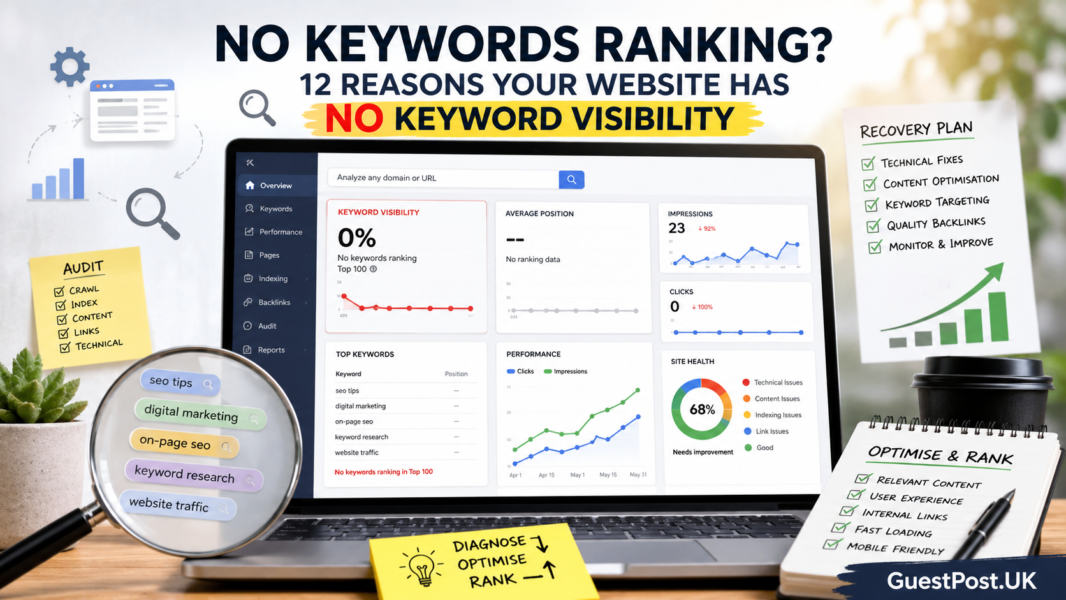
Seeing no keywords for your website can be alarming. You open Semrush or Ahrefs, enter your domain and find zero organic keywords, almost no estimated traffic and perhaps no visible rankings at all. Alternatively, Google Search Console may show very few queries even though your website has been online for weeks or months.
This does not automatically mean Google has penalised your website or that your content contains no keywords. In SEO tools, “no keywords” normally means the tool cannot currently detect your pages ranking within the search positions and datasets it measures.
Semrush, for example, states that it may show no keyword data when a website does not rank within Google’s top 100 results for keywords contained in its database. Ahrefs similarly defines an organic keyword as a search query for which the target website appears in organic search results.
The important question is therefore not simply “Why do I have no keywords?” It is:
Why is Google not giving my pages enough search visibility for those rankings to be detected?
That is the problem worth diagnosing.
What Does “No Keywords” Mean in SEO?
When an SEO platform reports no keywords, it usually means it has detected no organic search queries for which your website is ranking within the positions and database covered by that particular tool.
It does not necessarily mean:
- your pages contain no keywords;
- Google has not indexed your website;
- your SEO plugin is broken;
- your domain is penalised;
- nobody can find your website;
- your pages have zero impressions;
- the website needs hundreds of backlinks before it can rank.
The first step is determining where you are seeing the problem.
If Semrush says zero keywords but Google Search Console records impressions and queries, you already have search visibility. The third-party platform simply has not detected it all.
Google Search Console should therefore be one of the first places you check for a website you control. Google’s Performance report shows the queries through which searchers find and visit your pages, along with impressions, clicks, and other performance metrics.
Google Search Console vs Semrush vs Ahrefs: Why Keyword Numbers Differ
A common mistake is treating every keyword count as though it came from the same dataset.
It does not.
| Tool | What the keyword data represents | Best use |
|---|---|---|
| Google Search Console | Search performance data Google provides for your verified property | Diagnosing your own site’s actual Google visibility |
| Semrush | Keywords detected within Semrush’s search database and ranking coverage | Competitor research, ranking discovery and keyword opportunities |
| Ahrefs | Organic queries Ahrefs detects a target ranking for | Competitor research, keyword movements and SEO analysis |
Semrush explicitly says its Organic Rankings reports cover keywords for which a domain appears in Google’s top 100 results.
Ahrefs describes its organic traffic numbers as estimates, based in part on keywords it detects a website ranking for and their search volumes, rather than as a replacement for first-party analytics.
For your own website, therefore, do not panic because one third-party tool shows zero keywords.
Check Search Console first, then use tools like Semrush and Ahrefs to understand the broader competitive landscape.
For a deeper understanding of what Semrush can and cannot tell you, our Semrush guide covers its main SEO datasets, workflows and practical applications.
12 Reasons Your Website May Have No Keywords Ranking
1. Your Website Is Too New
New websites rarely begin with a meaningful keyword footprint immediately.
Google needs to discover the site, crawl its pages, process the content and determine where those pages fit among existing results. A brand-new domain also has little historical search performance to work with.
That does not mean you should simply wait.
Use the early period to establish:
- clear site architecture;
- properly optimised core pages;
- useful supporting content;
- logical internal linking;
- crawlable navigation;
- relevant external mentions and backlinks.
A new site’s keyword graph often looks more like:
0 detected keywords → a handful of long-tail queries → impressions across more terms → positions 50–100 → positions 20–50 → selected page-one rankings
SEO growth is normally uneven rather than a smooth upward line.
2. Google Has Not Indexed Important Pages
A page cannot generate normal organic rankings if it is not eligible to appear in Google’s index.
Check important URLs individually in Google Search Console.
Common indexing problems include:
- accidental
noindexdirectives; - incorrect canonical tags;
- blocked resources;
- redirects;
- duplicate pages;
- thin or low-value pages;
- crawl issues;
- pages discovered but not yet indexed.
If Search Console is reporting Crawled – currently not indexed, our guide on why pages are crawled but currently not indexed explains the issue in greater depth.
Do not start rewriting every title tag until you know the pages themselves are indexable.
3. Your Pages Do Not Target Clear Search Intent
A page can contain thousands of words and still have weak keyword visibility.
The issue may be that Google cannot clearly determine which search problem the page solves.
Consider a page titled:
Our Innovative Digital Solutions
What should it rank for?
SEO services? Web development? PPC? Software? Consulting?
Now compare it with:
SEO Audit Services for UK Businesses
The second page communicates a considerably clearer topic and commercial intent.
Every important page should have a primary purpose, supported by closely related secondary terms rather than attempting to rank for every keyword remotely connected to the business.
This is where structured keyword research becomes important.
4. You Are Targeting Keywords That Are Too Competitive
Sometimes there are no keywords because the site’s targeting is unrealistic.
A new website targeting:
SEO
is competing against an enormous ecosystem of established domains.
The same business might initially have a better opportunity targeting subjects such as:
technical SEO audit for small businesses
or:
SEO audit checklist for ecommerce websites
The objective is not to pursue low-volume keywords forever. It is to progressively build topical relevance and search visibility.
Our guide to free keyword research tools can help uncover lower-competition queries and related search opportunities without immediately committing to expensive software.
5. Your Content Is Too Thin to Compete
Keyword placement alone does not create a competitive page.
A 400-word article that answers half of the searcher’s questions may struggle against pages offering clearer explanations, examples, supporting evidence, practical steps, and better topical coverage.
That does not mean every page needs 3,000 words.
Depth should match intent.
A search for “what is anchor text?” may require a concise explanation plus examples. A search for “how to perform an SEO audit” naturally demands considerably more detail.
Evaluate whether your page actually deserves to outrank the pages currently appearing for the query.
6. Your On-Page SEO Gives Google Weak Signals
Pages sometimes have good information but poor optimisation.
Check:
- title tag;
- H1;
- opening paragraphs;
- H2 and H3 structure;
- image alt text where appropriate;
- internal anchor text;
- URL structure;
- semantic topic coverage;
- duplicate titles;
- competing pages targeting the same intent.
Your primary keyword does not need to appear in every heading.
The aim is clarity, not repetition.
Our on-page SEO guide covers how these page-level signals work together.
7. Your Website Has Weak Internal Linking
A page that sits six clicks deep within your website, with no contextual internal links, is sending weak structural signals.
Internal links help search engines understand:
- which pages are important;
- how topics relate;
- which URLs form part of the same subject cluster;
- what a destination page is about;
- how authority can move through the site.
Suppose you publish ten articles around keyword research but never link them to your main keyword research page.
You have created content, but not necessarily a coherent topic cluster.
A structured internal linking strategy can help organise these relationships more effectively.
8. Several Pages Are Competing for the Same Keyword
More pages are not automatically better.
Imagine these URLs:
/seo-audit/
/seo-audit-services/
/professional-seo-audit/
/seo-website-audit/
If all four essentially target the same search intent, Google may struggle to determine which page is the strongest candidate.
This is often described as keyword cannibalisation.
The solution can involve:
- consolidating overlapping content;
- assigning distinct search intent;
- improving internal linking;
- redirecting obsolete pages;
- strengthening one canonical resource.
Before creating another page, search your existing site for content targeting the same query.
9. Your Website Has Very Little Authority
Content quality matters, but SEO does not occur in isolation.
If established competitors have strong brands, years of useful content, relevant backlinks, and extensive topical coverage, a comparatively unknown website may take longer to gain a competitive edge.
This is particularly noticeable for competitive commercial terms.
Backlinks are not a substitute for weak content, but relevant links and authoritative mentions can help search engines discover and evaluate pages within the wider web ecosystem.
The priority should be quality and relevance, not accumulating thousands of arbitrary links.
10. Your Site Has Technical SEO Problems
A technically unhealthy site can undermine otherwise strong content.
Potential problems include:
- incorrect canonicals;
- broken redirects;
- duplicated pages;
- malformed robots directives;
- sitemap problems;
- broken internal links;
- poor mobile usability;
- rendering issues;
- severe performance problems;
- incorrect HTTP status codes.
If a site has no keywords across hundreds of supposedly optimised pages, I would investigate technical causes before assuming every article is badly written.
A comprehensive SEO audit is usually more useful at that stage than continuing to publish blindly.
You can also run individual URLs through the GuestPost.UK SEO Checker to identify basic on-page and technical issues worth investigating.
11. Your Competitors Cover the Topic Better
SEO is relative.
Your page does not need to be “bad” to rank poorly. It only needs to be less useful or less competitive than the results Google already has available.
Analyse the pages occupying positions 1–10.
Look at:
- subjects they cover;
- questions they answer;
- content format;
- search intent;
- page depth;
- internal linking;
- site authority;
- backlinks;
- unique information;
- freshness where relevant.
Do not simply copy their headings.
Instead, identify what the existing SERP considers necessary and where you can provide something materially more useful.
A structured SEO competitor analysis can reveal these gaps much faster than guessing.
12. The SEO Tool Has Not Detected Your Rankings Yet
This final cause is frequently overlooked.
You may actually rank for queries while Semrush or Ahrefs still shows very few or no keywords.
Semrush says that when a domain does not rank within the top 100 for keywords contained in its database, it has no keyword data to display. It also notes that its database is intended to complement, rather than replace, a site’s internal analytics.
Likewise, Ahrefs’ organic keyword and traffic figures are based on the keywords and rankings it detects rather than your complete first-party Google performance dataset.
This creates a critical distinction:
No keywords detected by an SEO tool ≠ no Google visibility whatsoever.
Always compare third-party estimates with Search Console.
What to Check When Semrush Says You Have No Keywords
Use this order:
- Open Google Search Console.
- Check Performance → Search results.
- Expand the date range.
- Look at total impressions rather than clicks alone.
- Check the Queries tab.
- Check which Pages receive impressions.
- Confirm important pages are indexed.
- Search your domain manually for target terms where appropriate.
- Compare the findings with Semrush.
- Investigate SEO weaknesses only after establishing what Google itself is showing.
If Search Console displays hundreds of queries while Semrush displays zero, you primarily have a measurement difference.
If both show almost nothing, you probably have a genuine visibility problem.
No Keywords vs No Traffic: They Are Different Problems
A website can rank for keywords and still receive almost no traffic.
For example:
- Keyword A: position 78
- Keyword B: position 64
- Keyword C: position 43
- Keyword D: position 31
- Keyword E: position 22
Technically, the website has keywords.
Commercially, those rankings are producing very little.
A more useful SEO progression is:
Indexed → impressions → keyword rankings → top 20 → top 10 → top 3 → clicks → enquiries/revenue
This is why reporting only “number of keywords” can be misleading.
Moving five commercially valuable terms from positions 12–18 into the top five can be far more important than adding 500 irrelevant keywords ranking below position 80.
Which Tool Should You Trust for Keyword Visibility?
Google Search Console
Best for: Your own website.
Advantages:
- first-party Google search performance data;
- shows queries generating impressions;
- identifies landing pages;
- reveals clicks and visibility trends.
Limitation: It is designed around properties you can verify rather than competitor research.
Semrush
Best for: Competitor analysis, keyword discovery and ranking research.
Advantages:
- strong competitive intelligence;
- historical ranking research;
- keyword gap analysis;
- SERP position tracking.
Limitation: It does not represent every query through which Google may show your website.
Ahrefs
Best for: Combining organic ranking analysis with backlink and competitor research.
Advantages:
- organic keyword reports;
- strong competitor workflows;
- backlink context;
- historical visibility analysis.
Limitation: Organic traffic and keyword counts remain third-party estimates rather than your complete Google Search Console dataset.
A Practical 30-Day Recovery Plan for a Website With No Keywords
Do not respond to zero rankings by publishing 50 random blog posts.
Start systematically.
Week 1: Diagnose
Check:
- indexing;
- Search Console impressions;
- technical SEO;
- site architecture;
- existing rankings;
- page quality.
Week 2: Build the Keyword Map
Assign one clear search intent to each important URL.
Identify:
- primary keywords;
- secondary queries;
- long-tail opportunities;
- competitor gaps;
- missing pages.
Week 3: Improve Existing Pages
Prioritise pages already receiving impressions.
Improve:
- titles;
- headings;
- content depth;
- intent alignment;
- internal links;
- topical coverage.
Week 4: Build Authority
Publish genuinely missing supporting content and begin acquiring relevant links and mentions to the pages that matter most.
Then measure again.
Do not judge SEO progress purely by whether one tool’s keyword counter moves overnight.
FAQs About Having No Keywords
Why does Semrush say my website has no keywords?
Semrush may report no keywords when it cannot detect your domain ranking within the top 100 Google results for keywords contained in its database. Check Google Search Console before assuming your website has no search visibility.
Why does Ahrefs show zero organic keywords?
Ahrefs reports organic keywords that it detects a website ranking for. A zero or very low count can therefore mean it has not detected meaningful rankings for the target within its dataset, rather than proving that Google never displays the website.
Can a website rank without targeting keywords?
A page can appear for queries it was not deliberately optimised for because search engines interpret overall content and relevance. However, a clear keyword and search-intent strategy usually makes content planning substantially more deliberate and measurable.
How long does it take for a new website to rank for keywords?
There is no universal ranking period. Competition, indexing, content quality, site authority, technical health and the query itself all affect how quickly meaningful visibility develops.
Does zero traffic mean I have no ranking keywords?
No. A website may rank in low positions for several keywords without generating meaningful clicks. Check impressions and queries in Google Search Console rather than relying only on traffic.
Should I create more content if I have no keywords?
Not immediately. First determine whether existing pages are indexed, technically sound, correctly targeted and competitive. Publishing additional content without diagnosing the underlying issue can simply create more underperforming URLs.
Can backlinks fix a website with no keyword rankings?
Backlinks can support authority and visibility, but they cannot reliably compensate for pages that are unindexed, poorly targeted or irrelevant to search intent. Fix foundational SEO issues first, then build relevant authority around worthwhile pages.
How do I find keywords my competitors rank for?
Tools such as Semrush and Ahrefs allow you to analyse competitor domains and identify organic keywords and ranking pages. Semrush’s Organic Rankings and competitor reports are specifically designed for this type of competitive research.
What to Prioritise When You Have No Keywords
If your website appears to have no keywords, do not immediately buy backlinks, rewrite every page or publish dozens of new articles.
Start with Google Search Console.
If Google is already showing impressions and queries, your site has search visibility even if Semrush or Ahrefs has not detected it yet. Use Search Console to understand your own site’s performance, then use Semrush or Ahrefs for competitor intelligence, keyword discovery and broader market analysis.
If Search Console also shows almost no visibility, work through the fundamentals in order:
indexing → technical health → keyword targeting → search intent → content quality → internal linking → authority → ongoing measurement
For beginners, Search Console should be the foundation because it answers the most important initial question: is Google actually showing my website?
For agencies and SEO consultants, combining Search Console with Semrush or Ahrefs provides a much stronger picture. First-party data tells you what is happening on the site you control; competitive SEO platforms help explain the opportunities around it.
And if hundreds of published pages still produce no keywords, no impressions and no measurable organic growth, stop publishing temporarily and diagnose the site properly. At that point, the problem is unlikely to be solved by adding another generic blog post.