
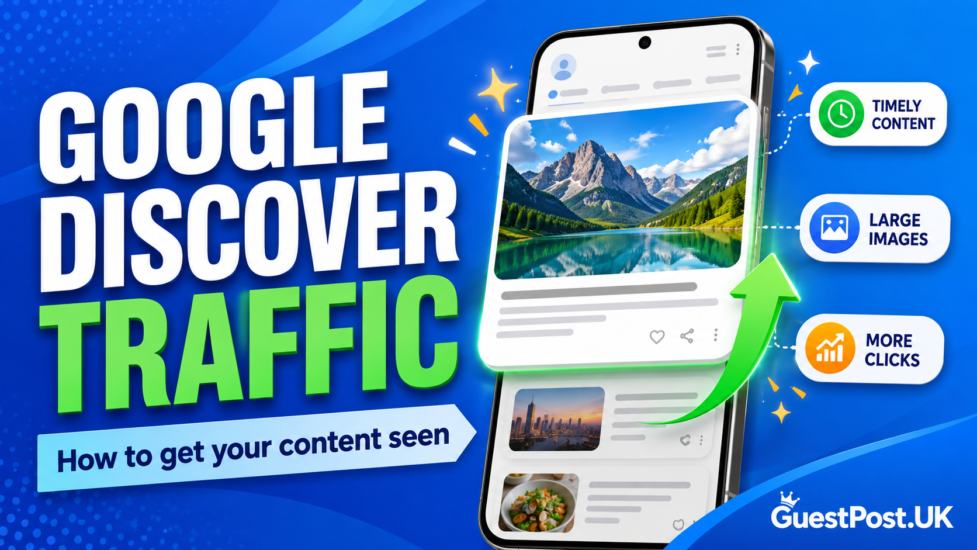
Google Discover can introduce your content to people before they type a search. Instead of responding to a keyword, it recommends articles, videos and updates based on a person’s interests and activity across Google products.
For publishers, that can create meaningful bursts of highly relevant traffic. For businesses, it can put a timely expert article or useful buying guide in front of people who may never have searched for the brand directly.
Discover is not a predictable traffic channel, and Google does not guarantee inclusion. But it is not random either. Google’s own guidance points towards timely or insightful content, compelling images and a people-first approach. The right strategy is to give your best content the strongest possible chance—not to manufacture sensational headlines and hope for a spike.
A consistent SEO content writing process is the starting point: publish work that earns attention because it is genuinely useful.
How Google Discover differs from ordinary Search
Traditional Search begins with a query. A person asks, “How to find quality guest posting sites?” and Google tries to return the most relevant answers.
Discover works differently. It anticipates what a person may want to read next. An article can appear because it relates to an interest, a current development, or a topic they have engaged with before.
That has two implications:
- Keyword research remains useful, but it is not enough on its own
- The topic, angle, image and timing of an article all influence whether someone wants to engage
An evergreen guide can appear in Discover, but fresh perspectives often have a stronger opportunity. A generic “What Is SEO?” post is unlikely to stand out. “What the Latest Google Spam Update Means for UK Businesses” has a clearer reason to be read now.
Choose topics with a reason to exist today
Discover rewards content that feels worth pausing for. Before publishing, ask one question: why would a person interested in this subject want to read this article today?
Strong angles include:
- A meaningful Google, AI search or platform update
- A new study or data point with practical implications
- A clear response to a widespread industry question
- A seasonal buying or planning moment
- A first-hand case study, experiment or expert observation
- An emerging trend explained without hype
For example, “Link Building Tips” is broad and heavily covered. “What Link Builders Should Check After a Google Spam Update” is more specific, timely and gives the reader a clear outcome.
Do not turn every blog into news coverage. Your core evergreen pages still matter for stable organic traffic. The best publishing mix combines durable guides with timely articles that offer useful perspectives on current conversations.
Make the headline informative, not manipulative
Discover: users decide quickly whether to tap an article. A vague or exaggerated title may earn a click, but it can erode trust if the page does not deliver.
Google advises against clickbait and sensational teasers. Write a headline that explains the value honestly.
Compare:
- Weak: “This SEO Change Will Transform Your Rankings”
- Better: “Google’s New AI Search Report: What Website Owners Can Measure”
The better version sets a realistic expectation. It names the subject, signals who the article is for and tells the reader what they will gain.
A good test is to remove the image. Would someone still understand why the article is worth reading? If not, the angle may be too vague.
Use large, relevant images that add meaning
Images are especially important in Discover. Google recommends compelling, high-quality images that are relevant to the content, with large images at least 1,200 pixels wide. It also recommends enabling large-image previews through the max-image-preview:large robots meta tag or equivalent header.
The image should support the article, not decorate it.
For an article about site migrations, show a clear visual of pages moving through a structured migration process. For a report on branded search growth, use an image that helps readers understand brand recognition or Search Console analysis. Avoid stock photos of people pointing at screens when they add nothing to the story.
Also make sure that:
- The image is crawlable and available on the mobile page
- The page contains relevant text near the image
- The file name and alt text describe the subject naturally
- You have permission to use the image
- The image is not misleading, overly edited or low resolution
Distinctive, original visuals can make an article more recognisable when readers see it again in Discover.
Add insight that other pages do not have
Discover is not an excuse to republish the same observations in different wording. Google’s people-first guidance remains relevant: create content that offers unique information, analysis, research or experience.
Before writing, identify the contribution your article will make. It could be:
- A step-by-step action plan after an announced update
- Commentary based on running real campaigns
- A comparison that includes limitations, not just benefits
- Screenshots or examples showing how a tool works
- Answers to questions clients actually ask
- A curated set of sources that saves readers time
For GuestPost.UK readers, a useful article might explain how an algorithm update affects publisher vetting, sponsored content or link-risk decisions. That has more value than repeating the update announcement.
Where relevant, connect the article to a deeper resource. A timely post on content quality can naturally point readers to an SEO audit or a supporting guide, but the article must stand on its own first.
Keep the page technically ready
A compelling article still needs to be accessible to Google.
Check that the page is indexable, mobile-friendly and not blocked by an accidental noindex tag. Use a descriptive title, clear H1 and logical headings. Link to the article from an appropriate category, hub page or related post so it is not isolated after publication.
Make sure the page has a visible publication date where that is appropriate, especially for current analysis. If you update the article materially, revise the content as well as the date; simply changing a timestamp without improving the page is not useful to readers.
Avoid intrusive pop-ups and slow-loading pages. Discover visitors are often mobile users, so the first screen should quickly show the title, a relevant image, and the start of the useful content.
Measure Discover correctly in Search Console
Search Console includes a dedicated Discover report once your site reaches Google’s minimum impression threshold. It shows impressions, clicks and CTR, and lets you review performance by page, country, appearance type and date.
Do not panic when a successful Discover article later falls back to zero. Discover traffic is naturally volatile because it reflects changing user interests and the freshness of a story. One article may perform strongly for two days, while another creates a smaller but longer-lasting pattern.
Review your best-performing pages for common traits:
- What was the angle?
- Was it timely, evergreen or both?
- Which image style was used?
- Did the headline promise a specific benefit?
- Did readers continue to other pages?
- Did the article generate newsletter sign-ups, enquiries or links?
Use the insight to improve future publishing rather than trying to clone one temporary spike.
Build a library that deserves recommendation
Google Discover is best treated as an extension of good publishing, not a separate hack. Create articles with a clear reason to exist, show readers something worthwhile and support them with strong visual presentation.
Over time, timely expert content can reach new audiences, while your evergreen resources help those visitors continue their journey. If you need help building that combination of content, authority and relevant publisher visibility, explore our guest posting services.
The goal is not merely to appear in a feed. It is to become a source people are glad Google recommended.