
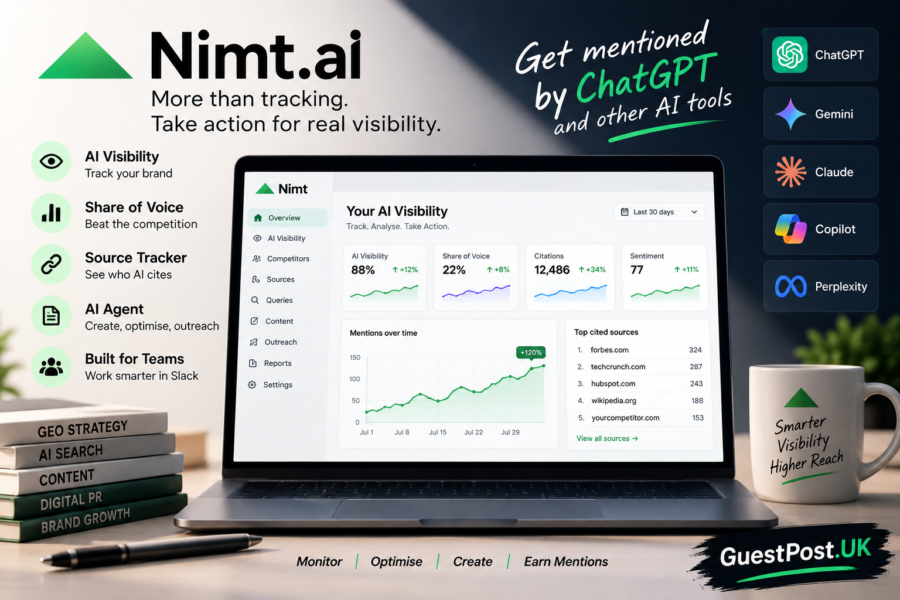
AI visibility platforms have become one of the fastest-growing categories in search marketing. Tools can now monitor whether brands appear in ChatGPT, Gemini, Claude, and other AI-generated answers, measure share of voice, and identify the websites that AI systems cite.
The problem is that measurement alone does not improve visibility.
Nimt.ai is attempting to address that gap. Rather than positioning itself purely as another AI visibility dashboard, Nimt combines generative engine optimisation (GEO) monitoring with an AI agent designed to act on the information it discovers.
It can track brand mentions and citations, analyse competitors and query fan-outs, and then assist with work such as content creation, page improvements, schema, outreach and PR. Nimt can also operate via Slack, rather than requiring teams to spend all their time in another marketing dashboard.
That makes it particularly interesting for SEO agencies, content teams and brands trying to move beyond simply measuring their presence in AI search.
But how much does Nimt actually offer, how much does it cost, and how does it compare with established platforms such as Profound and Peec AI?
What is Nimt.ai?
Nimt is an AI search visibility and optimisation platform founded in Sweden by Manuel Lemholt Berger, Martin Bergström and Oliver Ekberg. The founders have backgrounds spanning agencies, SaaS and software development.
Its product essentially has two sides.
The first is measurement. Nimt monitors how brands appear across major AI systems and provides metrics covering visibility, rankings, citations, competitors, sentiment and share of voice.
The second is execution. Its AI agent is intended to take those findings and perform or assist with the work required to improve the brand’s position.
This distinction is important.
Many GEO platforms effectively tell a marketer:
Your competitor is appearing more frequently than you for these prompts.
Nimt wants the next step to be:
Here is why they are winning, which sources matter, and the work we can perform to improve your position.
That moves the product closer to an AI SEO/GEO coworker than a conventional rank tracker.
Nimt.ai features
AI visibility tracking
The central dashboard measures how frequently a brand appears within AI-generated responses.
Nimt currently advertises tracking across major AI platforms, including ChatGPT, Claude, and Gemini, as well as other AI search environments. Its current materials state that eight models are covered across its plans.
For marketers accustomed to traditional rank tracking, the principle is familiar, but the measurement is different.
Instead of asking whether your page ranks third in Google, you might investigate whether ChatGPT recommends your business at all when someone asks for the best providers within your market.
Share of voice
Nimt’s Share of Voice metric provides competitive context.
Suppose your company appears in 20% of relevant AI responses while a competitor appears in 55%. Simply knowing that your brand receives AI mentions is not particularly useful; seeing how you compare to the market leader is much more actionable.
Nimt therefore combines visibility with competitor monitoring to show which brands dominate particular topics.
For agencies, this could also provide a useful reporting metric alongside conventional organic rankings and Search Console data.
Citation and source tracking
One of the more useful features for SEO and digital PR professionals is Source Tracker.
AI answers frequently rely on third-party websites rather than exclusively citing the brand being discussed. Nimt identifies the URLs being used as sources and categorises the type of content being cited.
These can include:
- reviews;
- guides;
- listicles;
- product pages;
- forums; and
- other third-party publications.
This matters enormously for GEO.
If several AI platforms repeatedly cite a particular industry publication when recommending businesses, earning inclusion on that publication could potentially be more valuable for AI visibility than simply publishing another article on your own domain.
Nimt also lets users examine whether cited sources favour their brand or competitors.
For a business involved in guest posting, link building and digital PR, this is probably one of Nimt’s most interesting applications.
Instead of selecting outreach targets based entirely on DA, DR or organic traffic, marketers can potentially incorporate another question:
Which publications are actually influencing AI-generated recommendations?
Query fan-out analysis
Query fan-out is another noteworthy feature.
Modern AI search systems can break a user’s question into related searches or subqueries before constructing an answer. Nimt provides visibility into these associated queries.
That can reveal content opportunities which traditional keyword research might overlook.
For example, a company monitoring a broad commercial query may discover that AI systems investigate pricing, comparisons, independent reviews and particular product attributes before generating their recommendation.
Those findings can inform both on-site content and off-site campaigns.
AI Brand Strength and sentiment
Nimt also provides an AI Brand Strength metric alongside sentiment analysis.
Sentiment is particularly valuable because visibility alone isn’t necessarily positive.
Being mentioned frequently because users are asking about complaints or poor reviews is very different from being consistently recommended as one of the best products in a category.
The platform therefore attempts to measure not only whether AI talks about a brand, but how it talks about it.
AI agent
This is the feature that most clearly separates Nimt’s positioning from basic AI rank trackers.
The Nimt agent can work on:
Content creation – producing material designed around identified opportunities.
Page optimisation – making or recommending changes to existing content.
Schema – helping improve structured information.
Outreach and PR – identifying relevant sources and assisting with pitches designed to earn citations.
Recurring tasks – work can be scheduled to run repeatedly.
Nimt says its agent can operate through both its own application and Slack.
This is an attractive idea for agencies because dashboards themselves can become a productivity problem. Adding yet another platform that staff must check every morning doesn’t necessarily save time.
Being able to ask the agent questions through an existing workflow could reduce that friction.
There is, however, an important distinction between automating marketing work and guaranteeing marketing outcomes.
No legitimate GEO platform can simply guarantee that ChatGPT will recommend a brand because a particular optimisation has been completed. AI answers can vary by model, prompt, location, freshness and other factors.
Nimt should therefore be viewed as an optimisation and execution platform, rather than a guaranteed route into AI recommendations.
Nimt.ai pricing
Nimt uses a credit-based model.
At the time of this review, its public pricing lists Flex at $89 per month when billed annually, with 10,000 credits. It also advertises $45 in free credits for new users to get started.
The pricing structure includes features such as:
| Feature | Nimt Flex |
|---|---|
| Starting price | $89/month billed yearly |
| Credits | 10,000 |
| AI visibility | Included |
| Share of voice | Included |
| Citation tracking | Included |
| Competitor tracking | Included |
| Data retention | Unlimited |
| Countries/regions | 230 |
| Languages | Unlimited |
| Projects/domains | Unlimited |
| Team members | Unlimited |
| Data Studio | Included |
| Credit rollover | Included |
There is also an enterprise option with additional services including custom invoicing, onboarding and dedicated support.
Credit-based pricing does make the headline monthly price slightly less informative than a conventional fixed-feature subscription. Prospective users should calculate how their intended monitoring and agent activity will consume credits before comparing costs.
Nimt.ai vs Peec AI vs Profound
Nimt competes in an increasingly crowded market.
Two obvious comparisons are Peec AI and Profound.
| Nimt.ai | Peec AI | Profound | |
|---|---|---|---|
| AI visibility tracking | Yes | Yes | Yes |
| Citation analysis | Yes | Yes | Yes |
| Competitor tracking | Yes | Yes | Yes |
| AI execution agent | Strong focus | More tracking-focused | Workflow-based |
| Query fan-out | Yes | Yes/varies by functionality | Yes |
| Slack workflow | Yes | Not its core proposition | Platform-led |
| Best suited to | Agencies & in-house teams | GEO monitoring | Larger organisations |
| Nimt-listed starting comparison | $89/month yearly | €89 entry point | $99 entry point |
Nimt’s own comparisons obviously have a commercial incentive and should not be treated as independent testing. Nevertheless, they demonstrate its intended differentiation: Nimt wants to compete on execution rather than monitoring alone.
Peec AI remains attractive for teams primarily interested in structured AI visibility monitoring.
Profound is better established towards the enterprise end of the market and offers sophisticated workflows.
Nimt becomes more compelling when the organisation wants the software to help perform the work identified through monitoring, rather than merely exporting another list of recommendations.
What do Nimt.ai users say?
Independent public feedback is currently one of the weakest areas when assessing Nimt.
At the time of research, Trustpilot showed a 3.7/5 TrustScore but only one published review, meaning the sample size is far too small to draw meaningful conclusions.
That reviewer was positive, highlighting relatively quick onboarding, AI visibility information, competitor GEO analysis, recommendations and the ability to ask questions about the data.
The more important takeaway, however, is the lack of a substantial independent review base.
Nimt is still a relatively new platform. Until there are considerably more verified customer reviews, buyers should put more weight on testing the product with their own domain than on headline review scores.
Fortunately, the availability of free starting credits makes that reasonably practical.
Pros and cons of Nimt.ai
Pros
Combines tracking and execution
This is Nimt’s biggest differentiator. Discovering an AI visibility problem and acting on it can happen within the same environment.
Strong citation intelligence
Source tracking has practical applications for SEO, guest posting, PR and link-building campaigns.
Query fan-out data
Understanding the searches AI systems perform around a topic can expose valuable content gaps.
Broad competitive monitoring
Share of voice, rankings, sentiment and brand-strength measurements provide more context than a simple mention counter.
Agency-friendly structure
Unlimited projects, domains and users are particularly interesting for agencies managing multiple clients.
Slack integration
Teams can interact with the agent without constantly switching dashboards.
Cons
Limited independent customer feedback
There simply isn’t enough third-party review volume yet to establish a strong public consensus.
Credit pricing requires calculation
$89 per month sounds straightforward, but actual value depends on how quickly your workflow consumes credits.
GEO remains an evolving discipline
AI platforms, retrieval behaviour and citation patterns change quickly. Today’s optimisation tactic may not carry the same weight six months later.
Results cannot be guaranteed
No platform controls whether ChatGPT, Gemini or Claude ultimately recommends a particular brand.
Who should use Nimt.ai?
Nimt looks most appropriate for three groups.
SEO and GEO agencies can monitor multiple clients, investigate citation opportunities and potentially incorporate AI visibility into reporting and outreach campaigns.
In-house marketing teams can use it to identify why competitors are receiving stronger AI visibility and turn those findings into content or PR activity.
Digital PR and link-building teams may find Source Tracker especially useful because it introduces a new way of prioritising publishers: not merely by conventional SEO metrics, but by whether AI systems actually cite them.
Smaller businesses with little content, PR or SEO activity may find a dedicated GEO platform premature. Traditional technical SEO, useful content, brand development and authority building should not be abandoned simply to chase AI visibility metrics.
Is Nimt.ai worth it?
Nimt.ai is one of the more interesting entrants in the expanding AI visibility market because it addresses an obvious weakness in first-generation GEO software: knowing you have a problem isn’t the same as fixing it.
Its combination of AI visibility monitoring, share of voice, citation intelligence, query fan-out, competitor analysis and an execution-focused agent gives it a wider proposition than a basic AI rank tracker. The $89-per-month starting price also makes it accessible enough for agencies and established marketing teams to test without immediately incurring enterprise-level software costs.
The main reservation is maturity. Independent customer feedback remains sparse, and claims about improving AI visibility should be evaluated through actual testing rather than marketing promises.
For GuestPost.UK readers, however, Source Tracker may be the standout feature. The ability to discover which third-party articles, reviews, and publications influence AI answers could connect GEO much more directly to guest posting, digital PR, and authority-building strategies.
Our rating: 4.2/5
Nimt is worth testing if AI search visibility has become a measurable part of your SEO strategy, particularly if you’re already using content, outreach and digital PR to build authority. The free starting credits make testing your own domain a much better decision than judging the platform purely from screenshots or promotional claims.