
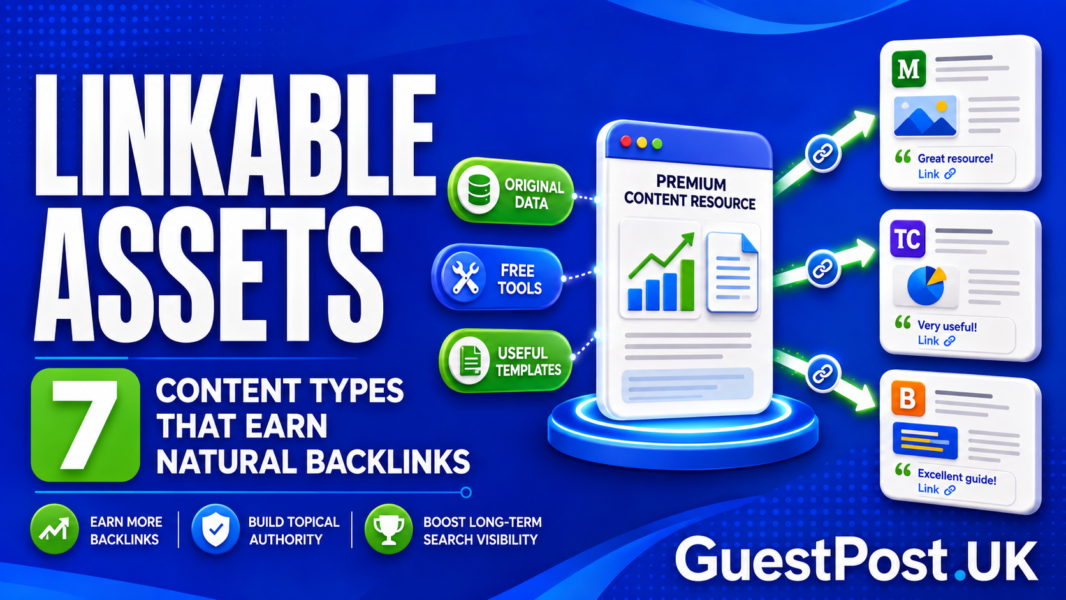
A linkable asset is content created with the expectation that others may genuinely want to reference it. It is not a page built around a sales pitch, a forced infographic or a list of generic statistics copied from other websites. It gives a journalist, blogger, customer or industry professional a useful reason to link.
That distinction matters. A strong service page may convert visitors brilliantly, but it is rarely the page someone chooses to cite in an article. A useful tool, original study, clear explainer or practical resource often has a better chance of earning links naturally.
Linkable assets work best alongside proactive link building services. Outreach introduces the right people to an asset; the asset gives them a legitimate reason to cover it.
What makes an asset link-worthy?
The best assets do one of three things:
- Provide information people cannot easily find elsewhere
- Save people time by explaining a complex subject clearly
- Give people something useful to quote, embed, compare or share
Google’s people-first content guidance is a helpful test. A page should exist because it benefits readers—not because the website owner wants a quick ranking signal. If the asset would still be useful without SEO, it is on the right track.
Do not expect links to appear automatically after pressing publish. Even excellent content needs promotion. But when the resource is genuinely distinctive, outreach becomes a relevant introduction rather than an awkward request for a favour.
1. Original data and industry studies
Original research is one of the strongest forms of linkable content because it creates a source others can cite.
You do not need a huge research department. A useful study can come from:
- An anonymised analysis of customer or campaign data
- A survey of business owners, consumers or professionals
- A manual review of a defined set of websites or listings
- A recurring index tracking a niche trend
- A benchmark comparing common tools, prices or practices
The crucial point is transparency. Explain the sample size, date range, method and limitations. A survey of 100 small businesses can still be valuable, but do not present it as a definitive view of every business in the UK.
Turn the findings into a concise article, a few quotable statistics and a simple downloadable chart. This gives journalists and writers several ways to use the work.
2. Free tools and calculators
A practical tool can attract links for years if it solves a repeated problem.
Useful examples include:
- A website migration checklist generator
- A redirect mapping template
- A guest post pricing calculator
- A UTM builder for campaign tracking
- A local SEO audit checklist
- A simple content-refresh scoring tool
The tool does not need to be complex. In fact, a reliable spreadsheet-style calculator can be more valuable than an over-engineered interactive feature that nobody understands.
Before building anything, check whether the problem is frequent enough to justify the effort. Look at customer questions, sales calls, internal processes and Search Console queries. The strongest tool ideas often start as a task your own team repeats every week.
A useful resource can also naturally guide visitors towards related services. Someone using an SEO checker may later need a deeper audit, but the tool must deliver value before any sales message appears.
3. Statistics pages people can cite
A well-maintained statistics page can become a reference point for writers working on a topic. The asset is not the number of statistics; it is the quality of the curation.
Choose a narrow topic, such as “UK small business SEO statistics” or “guest posting outreach benchmarks”, then:
- Cite every original source clearly
- Include the publication date for each statistic
- Remove outdated figures rather than leaving them indefinitely
- Separate global and UK data where relevant
- Add short context explaining what each number does and does not prove
Avoid lifting figures from competing statistics pages without checking the original study. A page full of recycled data may look comprehensive, but it gives people little reason to cite you instead of the source they already know.
4. Practical templates people can use immediately
Templates earn attention because they reduce the effort required to start a task.
For a digital marketing audience, useful options include an outreach email framework, an editorial calendar, an SEO briefing template, a link-audit spreadsheet, or a content-quality checklist.
Make the template genuinely usable. A downloadable file is helpful, but include guidance on the page too: who it is for, how to adapt it and common mistakes to avoid.
A template can attract relevant links from bloggers, training providers and agencies while helping your own audience. It also provides a natural place to link to deeper guidance, such as your guest posting services, without making the page feel like an advert.
5. Visual explainers that simplify a difficult topic
Infographics still work when the visual format improves understanding. They do not work when they squeeze a standard blog post into tiny text.
Good subjects for visual explainers include processes, decision trees, timelines, comparisons and checklists. For example, a clear diagram showing how an SEO audit progresses from crawl issues to content and authority review can be more shareable than 2,000 words of explanation.
Design for readability first. Use a clear headline, generous spacing, useful labels, and a version that is easy to view on mobile. Provide supporting text on the page so the asset remains understandable and accessible.
6. First-hand case studies
Case studies earn links when they reveal something useful, not when they only announce a win.
A credible case study explains:
- The starting problem
- The decisions made and why
- What was implemented
- What changed
- What did not work as expected
- The limitations of the result
Where client confidentiality prevents exact figures, share the process and percentage changes with permission. Readers value honest insight more than vague statements such as “traffic increased significantly”.
A strong case study can support sales, attract relevant industry mentions and build trust with potential clients at the same time.
7. Definitive resource hubs
A resource hub is a structured collection that helps people navigate a subject. It is more than a long list of links.
For example, a link-building hub might contain a beginner guide, outreach templates, risk checks, glossary terms, tool recommendations and supporting articles on reclaiming lost links. Each page should have a distinct purpose, while internal links show readers where to go next.
Google recommends descriptive, relevant anchor text for internal links. This also helps a linkable asset pass visitors and earned authority to the service pages and guides that matter most.
Promote the asset with a useful angle
The outreach message should not say, “We created an infographic—please link to it.” Explain why the recipient’s readers may care.
Find writers who have already covered the topic, then offer the specific element that supports their work: a new data point, a free template, a clearer visual or an expert perspective. Personalise the outreach around their audience and article.
Keep the offer easy to assess. Include the asset URL, one sentence on its value and any relevant statistic or image. Do not demand a link or use manipulative anchor text.
Google’s spam policies apply to link schemes, so the sustainable approach is to earn editorial coverage through value and relevance—not exchanges or tactics designed primarily to manipulate rankings.
Build assets that support long-term authority
The most successful linkable assets are useful enough to earn attention, then connected well enough to support the rest of the website.
Start with one focused asset that solves a real problem in your niche. Promote it to people who would honestly find it helpful. Update it when the facts change, and use contextual internal links to guide the visitors it attracts.
That approach creates more than backlinks. It builds content people remember, recommend and return to.