
You pay for a guest post. The article goes live, the backlink is exactly where it should be, and weeks later Google still appears to know nothing about the page.
For link builders, that is an irritating problem.
It is also the problem that QuickIndex.app has built its entire product around.
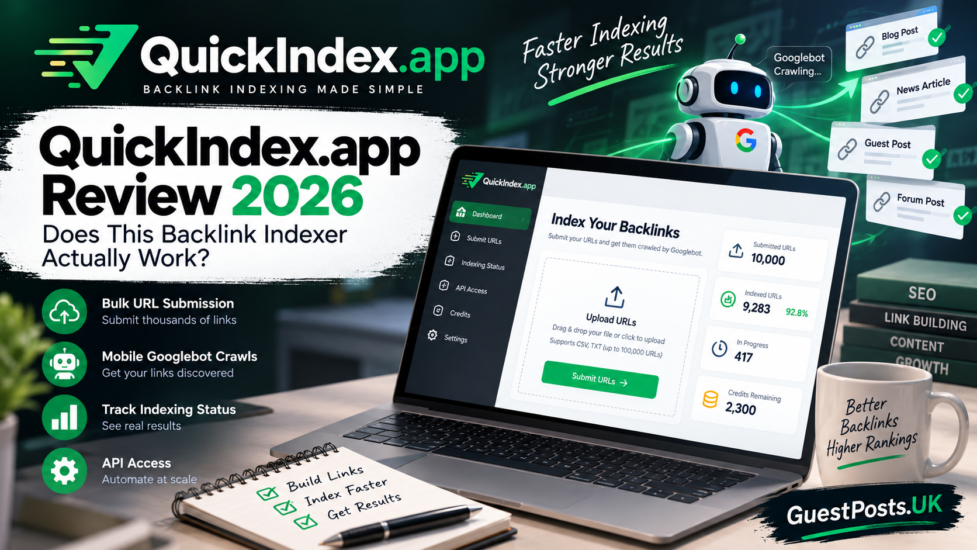
The service allows users to submit backlink URLs in bulk and says it can encourage Googlebot to crawl them, with published processing times of 24–72 hours. Instead of another monthly SEO subscription, QuickIndex sells credits: one submitted URL consumes one credit, with packages beginning at $10 for 1,000 URLs.
For agencies running sizeable guest posting campaigns, the proposition immediately sounds attractive. Building backlinks is expensive; getting those placements discovered is part of making the investment worthwhile.
There is, however, an important question behind all backlink indexing services:
Can an external tool really get Google to index a backlink?
Not quite in the way the marketing might suggest.
That distinction is what makes QuickIndex worth examining.
What exactly is QuickIndex.app?
QuickIndex.app is a specialised backlink indexing service rather than a general SEO platform.
You aren’t getting keyword research, content optimisation, competitor tracking and technical auditing bundled into one dashboard. Its job is much narrower:
Give Google more opportunities to discover URLs containing your backlinks.
The process is straightforward.
You can submit URLs manually via the dashboard or via the API. QuickIndex says its system then generates Mobile Googlebot crawls, with each submitted URL receiving two crawl attempts. The company advertises 24–72-hour processing and claims indexing rates above 90% for suitable, quality pages.
That last qualification matters.
QuickIndex itself acknowledges that it cannot guarantee 100% indexation and says performance depends on factors including content quality, website authority and indexing restrictions.
In other words, this isn’t a magic “put anything into Google” button.
And you shouldn’t treat it as one.
Crawling and indexing are not the same thing
Before assessing QuickIndex, we need to separate two terms that are frequently mixed up.
Crawling means Googlebot discovers or visits a URL.
Indexing means Google subsequently decides that the page belongs in its searchable index.
A page can be crawled without being indexed.
That can happen due to technical directives, duplication, low-value content, canonicalisation, quality signals, or numerous other reasons.
This distinction is especially relevant when evaluating a backlink indexer because QuickIndex says it guarantees two Mobile Googlebot crawls, while its 90%+ indexing figure is a stated success rate for qualifying links—not a guarantee that Google will index every URL.
Our own Answer Engine Optimisation guide makes a similar point from a broader search perspective: pages first need to be accessible, indexable and technically understandable before search or answer systems can make meaningful use of them.
So what you’re purchasing from QuickIndex is primarily a discovery and crawling mechanism intended to improve the probability of indexation.
That’s a much more accurate description.
How QuickIndex.app works
The workflow is refreshingly short.
1. Submit your backlink URLs
Users can upload URLs through the dashboard.
Importantly, you submit the page that contains the backlink, not just your own target URL.
For example, imagine GuestPost.UK arranges a placement for a client, and the article is published on:
publisher.com/example-guest-post/
That publisher URL is what needs to be discovered.
QuickIndex also offers API access, which becomes more relevant to agencies handling hundreds or thousands of links.
2. QuickIndex initiates crawling
QuickIndex describes its system as a Mobile Googlebot crawling method and says each submitted URL receives two crawls.
The company explicitly says it does not use Google’s Indexing API for this process.
That is worth noting because Google’s Indexing API is not a general-purpose API intended for submitting arbitrary articles and backlinks.
3. Indexation is checked
QuickIndex then tracks the URLs and reports their indexing status.
Its published expectations are that approximately half of suitable links become indexed within the first 24 hours, and most quality links are indexed within 72 hours. Again, those are the provider’s figures, not a guarantee from Google.
The distinction should remain clear throughout any test.
What types of backlinks does QuickIndex support?
This is where the product becomes more interesting for link builders.
QuickIndex lists several types of pages where it reports stronger results, including:
- Web 2.0 articles;
- article submissions;
- forum profiles and posts;
- social bookmarks;
- social profiles;
- social posts; and
- other content-based backlinks.
It reports lower success rates of around 60–70% for low-authority domains, thin pages and URLs affected by robots.txt restrictions. It also states that spam links, noindex pages and penalised domains are unsuitable.
That is actually one of the more sensible statements on its website.
If a publisher deliberately applies noindex, an indexing service cannot simply overrule the publisher and Google.
Similarly, getting a terrible backlink indexed doesn’t suddenly make it a valuable backlink.
Our guide to increasing Domain Authority discusses the same principle from the link-quality side: topical relevance, real traffic, editorial standards, indexation and the quality of the publication matter more than simply accumulating URLs.
QuickIndex can potentially help with discovery.
It cannot manufacture authority.
QuickIndex.app features: deliberately simple
Some SEO products take half an hour simply to understand the navigation.
QuickIndex isn’t one of them.
Its feature set is relatively compact.
Bulk URL submission
Bulk uploading is essential here because manually submitting hundreds of backlink pages would defeat much of the purpose.
This makes the product more useful to agencies, affiliate operators and link-building teams than somebody who earns two backlinks per month.
API access
QuickIndex provides an API for automated submissions.
An agency could therefore connect indexing into an existing fulfilment workflow instead of manually moving URLs between systems.
That becomes particularly interesting at scale.
If your link-building strategy involves continuous outreach and placements, API-based processing can remove another repetitive administrative task.
Index status monitoring
Knowing that a URL was submitted isn’t enough.
The status functionality provides feedback on whether URLs subsequently appear indexed, allowing teams to distinguish completed work from pages requiring further investigation.
Mobile Googlebot crawling
QuickIndex heavily promotes its Mobile Googlebot method.
It claims each submitted URL receives two crawl attempts and contrasts this with indexing services that use different discovery mechanisms.
The exact implementation should naturally be treated as the vendor’s proprietary method rather than something outsiders can completely verify from its marketing pages.
Credits instead of a subscription
This may actually be QuickIndex’s most commercially attractive feature.
You don’t necessarily need another recurring monthly bill.
Buy credits, use them when placements go live, and purchase more when required.
For sporadic campaigns, that makes considerably more sense than paying every month for unused capacity.
QuickIndex.app pricing
The pricing is unusually easy to understand.
| Package | Price | URLs/Credits | Cost per URL |
|---|---|---|---|
| Starter | $10 | 1,000 | $0.010 |
| Pro | $40 | 5,000 | $0.008 |
| Business | $70 | 10,000 | $0.007 |
| Enterprise | $100 | 20,000 | $0.005 |
One credit equals one submitted URL, and credits remain valid for six months. QuickIndex currently advertises free test credits for new accounts, but its own pages show different promotional amounts, so check the live offer when registering.
The economics are compelling for volume users.
Even the Starter package works out at one cent per submitted URL.
A normal business that acquires 10 quality backlinks per month clearly doesn’t need 20,000 credits. An SEO agency processing thousands of URLs across multiple campaigns has a much stronger use case.
The 90%+ indexing claim needs context
This is where we’d be cautious.
QuickIndex prominently advertises 90%+ success rates for quality links.
That’s an impressive figure.
But it is a vendor-published performance claim, not a guarantee from Google or an independently established benchmark that we could verify during this review.
The company itself reports lower expected performance for weak domains and thin pages, and explicitly states it cannot guarantee that every URL will be indexed.
That’s why we wouldn’t buy 20,000 credits and immediately upload an entire backlink database.
Run a controlled test instead.
Take perhaps 25–50 legitimate backlink URLs that are currently absent from Google’s index. Record their status before submission, send them through QuickIndex, and check again after 24 hours, 72 hours, 7 days, and perhaps 14 days.
That gives you evidence from your own backlink profile.
QuickIndex vs Google Search Console
These are not substitutes for one another.
Google Search Console’s URL Inspection functionality is intended for URLs on properties you control.
If you publish a guest article on somebody else’s website, you normally don’t own that publisher’s Search Console property.
That’s exactly where third-party backlink indexing services find their market.
For your own website, first investigate the underlying technical issue. Our SEO services cover indexation, crawling, internal linking, and technical barriers, because repeatedly trying to push a problematic page towards Google doesn’t address why Google doesn’t want it.
For external backlinks on sites you don’t control, QuickIndex serves a different purpose.
QuickIndex vs Links Indexer
QuickIndex itself publishes a comparison with Links Indexer, and naturally that comparison should be read as vendor material.
Nevertheless, there is a genuine difference in pricing structure.
QuickIndex uses pay-as-you-go credits, while Links Indexer uses recurring quotas alongside separate backlink-credit allowances. QuickIndex starts at $10 for 1,000 URL submissions; its comparison page lists Links Indexer’s Standard tier at $9.99 per month and notes additional campaign features such as drip feeding and website crawling.
| Area | QuickIndex | Links Indexer |
|---|---|---|
| Billing | One-time credits | Monthly plans |
| Entry paid price | $10 | $9.99/month* |
| API | Yes | Yes |
| Drip-feed campaigns | Not prominently offered | Yes |
| Website crawler | No | Yes |
| Best fit | Simple bulk submissions | Recurring campaigns |
*Based on published pricing referenced in QuickIndex’s August 2026 comparison; always verify current competitor pricing directly.
QuickIndex therefore makes more sense if you want simplicity.
Links Indexer may make more sense if you need campaign management functionality for the indexing process.
What about public QuickIndex reviews?
This is one area where we’d like to see considerably more evidence.
QuickIndex displays testimonials from SEO professionals on its website and claims that more than 1,200 SEO agencies use the service.
Those testimonials are useful as customer feedback but shouldn’t be confused with a substantial independent review ecosystem.
For a relatively new specialist SEO service, that isn’t necessarily surprising. It does mean we’d place much greater weight on a controlled trial than on testimonial copy.
The free test allocation makes that possible without committing to a large package.
Where QuickIndex fits into guest posting
This is the use case that matters most to us.
A professional guest-posting workflow doesn’t end at:
Article published → backlink received → job finished.
The placement should also be checked.
Is the article live?
Is the backlink correct?
Is the anchor correct?
Is the page crawlable?
Is it indexable?
Has it actually entered the index?
Our Guest Posting Services already include indexing support, along with manual outreach and editorial placements.
A bulk indexer could serve as another tool in that workflow, particularly for larger campaigns.
But it should never become an excuse to accept poor publishers.
A strong article on a legitimate, actively crawled website should always be preferable to hundreds of weak pages that require increasingly aggressive attempts to get Google’s attention.
If backlink quality itself is the issue, tools such as our existing Majestic SEO guide are more useful for analysing authority, referring domains, Trust Flow and link context.
Different tools solve different problems.
Pros and cons
What we like
Extremely inexpensive at scale. Starting at $10 for 1,000 submissions makes experimentation cheap.
No forced monthly subscription. Credits suit irregular link-building campaigns.
API access. Agencies can automate submissions rather than create another manual process.
Clear one-credit-per-URL model. There isn’t much ambiguity about what you’re purchasing.
Acknowledges limitations. Despite aggressive headline marketing, QuickIndex does state that no service can guarantee 100% indexation.
What we’d question
The 90%+ figure is vendor-reported. We’d want campaign-level testing before assuming similar performance.
Crawling doesn’t guarantee indexing. This is the most important limitation.
Limited independent review footprint. There isn’t yet enough third-party feedback to establish a broad consensus.
It cannot rescue fundamentally poor links. noindex, spam, thin content and weak publishers remain weak regardless of the submission tool.
Credits expire. Six months is generous for active agencies but still worth remembering.
Who should consider QuickIndex?
QuickIndex makes the most sense for:
SEO agencies processing substantial numbers of client backlinks.
Guest-posting providers checking and supporting newly published placements.
Affiliate marketers managing large external link profiles.
Link builders who frequently find legitimate placements remaining undiscovered.
It makes much less sense for a small company earning a handful of natural links each year.
And if hundreds of pages on your own website aren’t being indexed, don’t immediately reach for a backlink indexer. Investigate the technical cause first.
Our Bing tools guide also covers URL inspection and indexing diagnostics from another search engine perspective, while a proper technical SEO review should examine crawling, canonicals, robots directives, content quality, and internal links together.
Is QuickIndex.app worth trying?
At $10, this isn’t a difficult product to test.
That is probably the best thing QuickIndex has going for it.
You don’t need to accept its 90%+ success claim at face value, nor dismiss backlink indexers outright. Take a sample of genuine, currently unindexed backlink pages and measure what happens.
If 40 out of 50 suitable URLs become indexed after previously sitting undiscovered, you have something useful.
If three do, you haven’t lost much.
GuestPost.UK rating: 3.9/5
QuickIndex.app has a clear purpose, sensible pay-as-you-go pricing and features that fit high-volume link-building operations. Its API and bulk processing are particularly relevant to agencies.
Just keep the hierarchy right: quality backlink first, crawlability second, indexing support third.
An indexing service can help Google discover a worthwhile guest post. It cannot turn a worthless backlink into a worthwhile one.