
Most SEO platforms ask you to learn their interface.
SAAGA Solve asks you a different question:
What do you want done?
Tell it to audit a website, investigate keyword gaps, or compare your domain with competitors, and its AI agents can pull information from connected services, work through the task, and return an answer.
That difference sounds small. It isn’t.
Traditional SEO software puts the analyst between multiple datasets. You might open Search Console for queries, Semrush for competitor rankings, Ahrefs for backlinks, a crawler for technical problems and Google Sheets to assemble the findings.
SAAGA Solve is attempting to put an AI agent in the middle of that stack.
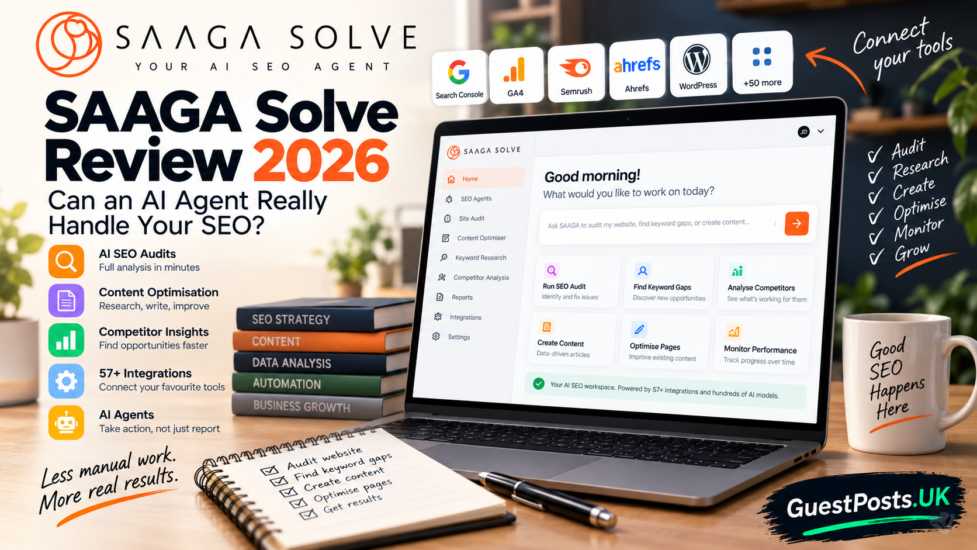
The platform currently supports connections including Google Search Console, GA4, Ahrefs, Semrush, DataForSEO and WordPress, with more than 57 integrations advertised. It can also work with hundreds of AI models, rather than tying every task to a single LLM.
That makes SAAGA considerably more ambitious than another AI article generator.
And it raises a more useful question than whether its interface looks impressive:
Can you trust an AI agent with real SEO work?
SAAGA Solve isn’t really an SEO dashboard
Calling SAAGA Solve an “SEO tool” doesn’t quite describe it.
It is closer to an agentic marketing workspace.
You connect the services your organisation already uses and then let an agent retrieve and process information from them. SAAGA says users can give instructions in ordinary language such as “audit my site”, “find my keyword gaps” or “compare me to my competitors”.
That approach is especially relevant to agencies.
Imagine preparing an SEO review manually.
You could:
- export Search Console data;
- inspect organic competitors;
- collect keyword gaps;
- crawl the site;
- inspect backlinks;
- check performance;
- organise the findings;
- prepare a client report.
SAAGA’s proposition is that an agent can perform much of that collection and synthesis while the SEO professional concentrates on interpretation.
That last part is important.
Our own professional SEO audit service follows the principle that finding errors isn’t enough. An audit needs to determine which problems actually matter and what should be fixed first. SAAGA can dramatically accelerate discovery, but that doesn’t automatically make its prioritisation correct.
I find SAAGA’s case study more interesting than its marketing claims
SAAGA published a particularly useful 2026 case study that compared an AI-assisted audit with a manually prepared one.
The manual analysis reportedly required 16 hours.
The agent-assisted first pass ran in eight minutes.
That headline would make excellent advertising. But SAAGA’s own case study makes a much more credible admission: eight minutes wasn’t the client-ready delivery time.
After adding an hour of human review, the realistic comparison was approximately 68 minutes.
The study also says the human analyst remained responsible for judgement around buyer framing, category positioning and prioritising the work.
That is precisely how I would want to use this technology.
Not:
AI replaces the SEO consultant.
But:
AI eliminates several hours of gathering, exporting, cross-referencing and formatting so the consultant spends more time deciding what should happen.
For an agency completing ten audits per month, that distinction could materially affect margins.
One agent, multiple SEO data sources
This is probably SAAGA’s strongest idea.
Its integrations currently include familiar SEO and analytics systems such as:
- Google Search Console;
- Google Analytics 4;
- Semrush;
- Ahrefs;
- DataForSEO;
- WordPress.
SAAGA advertises more than 57 integrations.
That means it isn’t necessarily trying to create another proprietary backlink database capable of beating Ahrefs at backlink discovery or another keyword index intended to beat Semrush.
Instead, it can use those services as data sources.
For someone already familiar with our Ahrefs SEO playbook or Semrush guide, think of SAAGA as a layer built on top of tools like these.
Ahrefs finds the backlinks.
Semrush provides competitive search data.
Search Console provides verified first-party performance data.
SAAGA’s agent can potentially bring those findings together.
This distinction also makes claims that SAAGA “replaces” an entire SEO stack, which is slightly complicated. If your workflow relies on integrations with premium third-party datasets, those underlying sources still matter.
The SEO audit capabilities are surprisingly broad
SAAGA isn’t limited to conversational analysis.
Its SEO suite spans research, planning, implementation and monitoring, with specialised tools for site health, content auditing, competitor research, site structure and optimisation.
Site Health Checker
The Site Health Checker looks at technical fundamentals including:
- sitemap validity;
- robots.txt;
- indexation;
- crawl bottlenecks; and
- crawler-related issues.
These are the kinds of problems that should be investigated before throwing more backlinks at a struggling website.
GuestPost.The UK’s own free Smart Indexing Assistant takes a related diagnostic approach by checking crawlability, indexability, technical health, internal discovery, and AI readiness, without claiming it can force Google to index a page.
SAAGA goes considerably further because those technical findings can become part of a broader agent workflow.
Content Auditor
The Content Auditor compares pages against organic competitors and looks for issues involving keyword usage, metadata, duplicate content, broken links, readability and content gaps.
It also offers content-quality scoring, suggested fixes and performance monitoring.
This could be useful when an agency has hundreds of ageing articles and needs to decide what to refresh rather than blindly publishing another hundred.
Page Performance Grader
SAAGA’s Page Performance Grader combines several checks that are normally separate.
It can assess metadata, backlinks, load performance, Core Web Vitals, technical errors and content gaps, then rank suggested actions by impact.
That combination is useful, but specialists shouldn’t confuse an aggregated score with diagnosis.
If the problem is page performance, for example, I’d still validate the finding using tools such as Google Lighthouse before making development decisions.
AI is excellent at narrowing the scope of the investigation.
Specialist evidence should still validate important fixes.
SAAGA also wants to produce the content
This is where the platform moves beyond auditing.
Its AI Article Writer starts with a primary keyword, gathers related keywords and ranking URLs, scrapes competing pages, generates a content brief, writes the article and then audits the finished content for on-page SEO issues.
In theory, that creates an almost complete workflow:
Research → SERP analysis → brief → writing → optimisation → audit.
That’s attractive for high-volume publishers.
It is also where human oversight becomes more important.
Competitor-derived content can easily become formulaic. If every AI writer analyses the same ten SERP results and produces a statistically optimised version of what already ranks, the internet gets ten more versions of essentially the same article.
For content intended to attract links, generate enquiries or build genuine topical authority, original experience, expert commentary, proprietary information and a distinctive editorial position still matter.
Automation should remove production friction rather than remove originality.
Can SAAGA actually make website changes?
Potentially, yes.
This is one of the differences between an agent and an ordinary chatbot.
SAAGA enables connecting sites and writing data back to supported services, including WordPress. Its independent G2 reviewer specifically highlighted the ability to connect websites and make edits within the platform.
That is powerful.
It also changes the risk profile.
There is a considerable difference between:
“Tell me which title tags you would change.”
and:
“Change all of them.”
For client SEO, I would initially set approval gates for publishing, redirects, metadata changes, schema, internal linking, and other consequential edits.
Automation becomes much more valuable after the workflow has proved reliable.
SAAGA Solve pricing in September 2026
This is where the platform gets slightly unusual.
There are seat pricing and LLM usage to consider.
Current monthly pricing is:
| Plan | Price | Best suited to |
|---|---|---|
| Free | $0/user/month | Testing the platform |
| Starter | $20/user/month | Light individual usage |
| Pro | $129/user/month | Regular/heavier agent workflows |
| Enterprise | $1,500 platform fee + $64.50/seat | Agencies and larger organisations |
The Free plan includes a one-time $5 LLM credit.
Starter currently includes $10 of LLM credit, while Pro includes $64.50 monthly credit. Once the included allowance is exhausted, additional model usage is charged according to consumption.
This means $20 isn’t necessarily your total monthly cost.
SAAGA itself describes average usage as around $20 for a light Starter user and roughly $300 for a heavy Pro user.
I actually prefer that disclosure to an “unlimited AI” promise with hidden restrictions.
But agencies need to model usage carefully.
SAAGA Solve vs Semrush vs Ahrefs
This isn’t a completely fair comparison because they perform different jobs.
| Capability | SAAGA Solve | Semrush | Ahrefs |
|---|---|---|---|
| AI agents | Core feature | Limited/feature-specific | Limited/feature-specific |
| Keyword database | Via tools/integrations | Major strength | Major strength |
| Backlink research | Via integrations | Strong | Major strength |
| Technical auditing | Yes | Yes | Yes |
| AI content workflow | Strong | Yes | Growing |
| Cross-tool automation | Major strength | More ecosystem-based | More ecosystem-based |
| WordPress actions | Yes | Limited workflow | Not core |
| Best use | Automating workflows | All-round SEO/marketing | SEO/backlink research |
The best reason to buy SAAGA isn’t that its backlink database is better than Ahrefs.
It is because you may be tired of manually moving information between Ahrefs, Semrush, Search Console, analytics tools, spreadsheets, and your CMS.
If choosing between the two traditional platforms themselves, our Ahrefs vs Semrush comparison covers the research workflows where each is strongest.
SAAGA is solving a different bottleneck: labour between tools.
What are real users saying?
There is now some independent feedback, although the sample remains small.
Trustpilot currently shows SAAGA Solve with a 4.0 TrustScore from three reviews. All three visible written reviews are five-star, with users particularly praising agency time savings, workflow acceleration, and the ability to synthesise multiple SEO data sources.
G2 has only one review, giving SAAGA 5/5. That reviewer praised model switching, custom agents, integrations and the ability to work with connected sites, while also noting that the product could be more intuitive and that its UI/UX still reflects an early-stage platform.
That last criticism sounds plausible.
Agentic SEO platforms inherently have a learning curve because you’re no longer simply clicking “Site Audit” and reading a fixed report. You are designing instructions and workflows.
More importantly, four independent reviews across those two platforms aren’t enough to establish a broad customer consensus.
The feedback is encouraging.
The sample is still small.
What SAAGA gets right
The most convincing part of SAAGA Solve isn’t its use of AI. Nearly every SEO platform can say that now.
It’s the attempt to connect data → analysis → action.
That offers several real advantages.
Less tool switching. Pulling information from connected SEO platforms into one workflow could save considerable agency time.
Custom agents. Repeatable processes can potentially be turned into reusable workflows rather than rebuilt for every client.
Human-readable instructions. Marketers don’t need to code an automation simply to investigate a keyword gap.
Real integrations. The agent isn’t limited to whatever information an LLM happens to know.
Free entry point. You can test the workflow before paying for Pro.
Potential agency economics. Removing several hours of mechanical audit preparation could matter much more financially than saving £20 on another SEO subscription.
Where I’d be cautious
The same features create the biggest risks.
AI can still reach the wrong conclusion. Access to accurate data doesn’t guarantee accurate strategic interpretation.
Agent permissions matter. Allowing software to modify a live WordPress website deserves stricter controls than allowing it to produce a report.
Usage costs can vary. The advertised seat price isn’t always the complete bill.
The product is still maturing. Independent feedback remains limited, and G2’s sole reviewer specifically mentioned UI/UX improvement.
It doesn’t eliminate specialist tools. In many workflows, SAAGA is orchestrating their data rather than replacing the underlying source.
And most importantly:
SEO prioritisation still requires judgement.
Finding 200 issues is easy.
Knowing which five will actually affect organic revenue is the valuable part.
That’s why even our free SEO Audit Report Generator is designed around turning findings into priorities rather than presenting users with an intimidating list of warnings.
The best SAAGA Solve use case isn’t what I expected
At first glance, SAAGA looks like another all-in-one SEO platform.
After examining how it works, I don’t think that’s its strongest positioning.
Its best customer may be an SEO agency that already owns too many tools.
Such an agency doesn’t necessarily need another keyword database.
It needs somebody—or something—to pull Search Console performance data, inspect competitors in Semrush, analyse Ahrefs links, check the site, organise the findings, update a spreadsheet, and prepare the first draft of the client analysis.
That’s expensive human time being spent on data movement.
SAAGA’s agent model makes considerably more sense there.
It could also complement a manual SEO audit by handling the repetitive discovery layer while an experienced consultant validates the findings and decides priorities.
Is SAAGA Solve worth it?
For a casual website owner: probably more platform than you need.
For a content marketer: potentially useful, particularly if research, writing and optimisation are currently fragmented across several subscriptions.
For an SEO consultant: worth testing.
For an agency: genuinely interesting.
I wouldn’t cancel Ahrefs, Semrush or specialist crawling software on day one because SAAGA says it can consolidate your stack. I’d connect a real project, reproduce an existing agency workflow and measure three things:
time saved, accuracy and total cost.
Take an audit that normally requires four hours. Run the same task through SAAGA. Then manually check every important finding.
If it reduces four hours to 45 minutes while maintaining acceptable accuracy, the business case practically writes itself. If you spend two hours correcting the agent, the flashy automation doesn’t matter.
GuestPost.UK rating: 4.3/5
SAAGA Solve is one of the more convincing examples of where SEO software appears to be heading: away from dashboards that merely display data and towards agents that can gather information, reason across tools and execute parts of the workflow.
It isn’t an autonomous replacement for an experienced SEO professional. Interestingly, SAAGA’s own case study effectively acknowledges that. And that makes the product more credible, not less.
The winning workflow isn’t likely to be AI instead of an SEO expert. It’s an SEO expert who no longer wastes half the day copying information between six tabs.