

Gumloop is an AI automation platform built for teams that want to create workflows and agents without relying on developers for every idea. It can browse and process information, work with documents and spreadsheets, connect applications, use AI models and turn repeated agency tasks into structured workflows.
For SEO agencies, that makes it particularly interesting. Many day-to-day tasks involve gathering information from several sources, sorting it, finding patterns and preparing work for a strategist, writer or outreach specialist.
Gumloop can help with that. It can speed up competitor research, content briefs, prospect enrichment, reporting preparation and internal knowledge tasks. It cannot replace strategic SEO judgement, trustworthy data or personalised relationship-building.
This Gumloop review explains where the platform fits, what it costs and whether it is worth using for SEO.
Gumloop at a glance
| Area | Gumloop |
|---|---|
| Best for | AI-first research and workflow automation |
| Pricing | Free plan available; Pro starts from $37 per month |
| Main capability | Build no-code AI agents and multi-step workflows |
| SEO strengths | Research, document analysis, data enrichment and workflow preparation |
| Integrations | Connectors, browser actions, APIs and AI models |
| Team collaboration | Unlimited seats on Pro |
| Best agency fit | Teams that need AI to process information, not only move data |
| Main limitation | Credit usage and outputs require close review |
Gumloop is not a complete SEO platform. It does not replace Google Search Console, a rank tracker, a crawler or an outreach database. It works best as an operational layer that helps your agency collect, structure and act on information from those tools.
What is Gumloop?
Gumloop lets users build AI-powered workflows from connected blocks. A workflow can trigger when something happens, collect information from a website, spreadsheet or document, ask an AI model to analyse it and then send the resulting output to another system.
The platform is designed for more than basic “if this happens, send an email” automation. It is particularly focused on AI agents that can work through research, text, data and documents.
For SEO, the difference is useful.
A traditional automation might copy a new client lead from a form into a CRM. A Gumloop workflow could take that lead, extract the company website, review the site’s core pages, identify likely services and create a structured internal research note for the sales team.
That output still needs a person to check it, but it can remove a large amount of repetitive preparation.
Gumloop features for SEO agencies
AI research workflows
Gumloop can support research-heavy SEO tasks that would otherwise require opening many tabs, copying notes, and manually organising data.
Possible workflows include:
- Reviewing a list of competitor URLs
- Extracting recurring page topics and headings
- Grouping websites by niche or audience
- Summarising customer reviews
- Finding repeated questions in a collection of SERP results
- Comparing product or service information
- Building a first-draft content gap report
For example, an agency could provide a set of five competitor service-page URLs and ask Gumloop to identify their common positioning, proof points, FAQs, pricing signals and content gaps. A strategist can then use that research to create a more informed content plan.
The quality of the analysis depends on the instructions. Tell the agent exactly what to extract and what not to assume. It should report uncertainty rather than inventing missing facts.
Content brief preparation
Content briefs are a strong use case for Gumloop. An SEO agent can collect a topic, target audience, Search Console queries, competitor headings, and internal link opportunities, then create a structured brief for a writer.
A good workflow may produce:
- Primary page purpose
- Search intent
- Audience and objections
- Suggested heading structure
- Questions to answer
- Source and evidence requirements
- Internal links to include
- Competitor gaps
- Suggested call to action
This is more useful than asking an AI tool to “write a blog post about SEO”. It creates a quality-controlled starting point for editorial work.
You can pair this with the SEO content brief generator to ensure the final brief has a commercial goal, meaningful internal links and a clear human approval stage.
SEO reporting and data summaries
Agencies can use Gumloop to prepare reporting notes from exported data. It can read spreadsheets, identify significant changes and draft a summary for the account manager.
Useful reporting tasks include:
- Grouping queries by topic
- Flagging priority pages with falling clicks
- Summarising changes in rankings or impressions
- Comparing month-on-month data
- Categorising technical issues
- Creating an internal “what changed” draft
The operative word is “draft”. An AI agent may misinterpret seasonality, low sample sizes, tracking changes, or unrelated website updates. A client report should always be reviewed by a strategist who understands the campaign.
For a more structured reporting workflow, GuestPost.UK’s monthly SEO report generator can help turn reliable campaign data into client-friendly reporting.
Prospect research and outreach preparation
Gumloop can make guest post and digital PR prospecting more efficient, particularly in the early research stage.
It can help collect:
- Website topic and audience notes
- Recent article themes
- Likely editorial angles
- Contact-page information
- Relevance to a particular client
- Personalisation points for an outreach message
This can save time, but it must not become an excuse for bulk low-quality outreach. AI agents can misunderstand a website, identify irrelevant opportunities or create messages that feel obviously automated.
Every publication should be manually checked for audience, relevance, quality, traffic signals and editorial fit. A useful blogger outreach service is publication-first and relationship-led, not a volume exercise.
Gumloop pricing
Gumloop has a free plan for testing smaller workflows and a Pro plan starting at $37 per month. The Pro tier includes AI models, a monthly credit allowance, unlimited seats and a 14-day free trial. Enterprise pricing is customised.
The pricing model is credit-based. That means the real cost depends on what your workflows do. A lightweight classification task may use few credits. A workflow that repeatedly browses websites, processes large documents or makes several AI calls can use them far more quickly.
Gumloop also offers the option to use your own API keys in certain plans. This can provide greater control over model costs, but it adds another expense to monitor.
Before adopting Gumloop for an agency, calculate:
- Number of workflows
- Average runs per month
- Number of websites or documents processed
- AI model calls per run
- Concurrent workflow needs
- Client data and access requirements
- Staff time needed to review outputs
The platform can be excellent value when it eliminates repetitive research. It is poor value if it runs expensive workflows that produce generic output nobody uses.
Gumloop strengths
Gumloop’s biggest strength is that it is genuinely built around AI workflows rather than treating AI as an extra button inside a conventional automation tool.
Its key advantages include:
- Strong support for research and information-processing workflows
- No-code workflow building
- AI models and agent capabilities
- Unlimited seats on Pro
- Useful for documents, web research and structured summaries
- Flexible enough for content, reporting and prospecting operations
- Lower entry cost than many enterprise AI platforms
It is especially appealing to agencies that already know what they want to automate but need a way to connect research and AI analysis without building custom software.
Gumloop limitations
Gumloop is not an autopilot for SEO.
It cannot accurately judge whether a publisher is high-quality, whether a content angle is strategically right, or whether an AI-generated claim is suitable for publication. It also cannot safely make live technical changes without human approval.
Other limitations include:
- Credit usage can become unclear in complex workflows
- The learning curve increases with more advanced automations
- Output quality depends heavily on inputs and prompts
- Human review is still needed for every client-facing result
- Some conventional SaaS integrations may be easier in Zapier or Make
- It does not replace specialist SEO data sources
If your main need is simply moving information between common apps, Zapier or Make may be easier. If your agency needs custom API logic or self-hosted control, n8n may be a better fit.
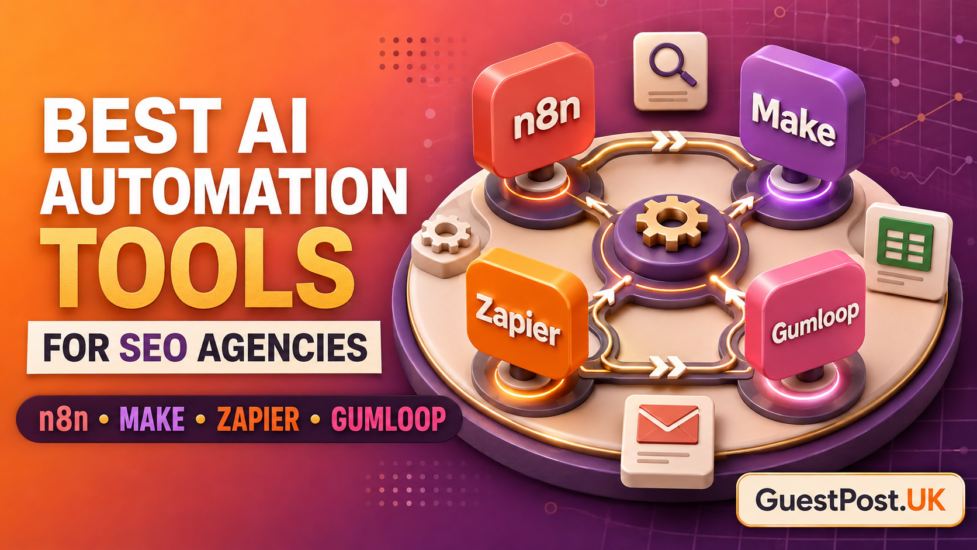
Gumloop vs Make, Zapier and n8n
Gumloop is strongest when the workflow requires AI to read, research, analyse or transform information.
Choose Gumloop for AI-powered research, document workflows and agent-style tasks.
Choose Make for visual multi-step agency processes involving mainstream apps, spreadsheets, CRMs and project-management tools.
Choose Zapier for simple, fast connections across many common SaaS platforms.
Choose n8n for custom API systems, advanced logic, self-hosting and data-heavy automation.
Many agencies will use more than one platform. For example, Gumloop can prepare a competitor research summary, Make can create the project tasks, and Zapier can send notifications to the appropriate team members.
A practical Gumloop workflow to build first
Start with a workflow that has clear inputs, a clearly useful output and a human approval stage.
A competitor-content research agent is a sensible first project:
- Add competitor URLs to a Google Sheet
- Ask Gumloop to extract headings, page purpose and key proof points
- Group recurring themes
- Flag missing subtopics on your client’s relevant page
- Create a structured research summary
- Send it to the strategist for review
- Turn approved findings into a content brief or task list
This is low-risk, repeatable, and easy to judge. It also saves time without allowing AI to publish, contact publishers or change a client website.
Put AI automation where it creates real value
Gumloop is worth considering for SEO agencies that spend a lot of time researching, summarising and moving information between systems. It is particularly good for turning scattered data into a usable first draft of a brief, audit, research pack or prospect note.
Start small and measure the result. If a workflow saves time while improving consistency, expand it. If it produces generic work that needs heavy correction, refine the process or keep it manual.
The most effective use of Gumloop by the agency is not to automate expertise away. It is to give strategists, writers and outreach specialists more time for the judgement-heavy work that clients actually value.