

AI Search Traffic Is Not Enough: How to Measure Leads, Sales and ROI From GEO
A brand mention in ChatGPT or a citation in Google AI Mode can be valuable, but neither pays a bill on its own.
The real question for any GEO campaign is not, “Did we appear in an AI answer?” It is, “Did that visibility contribute to qualified leads, sales or revenue?” This is where many AI-search reports become too shallow. They show mentions, screenshots and traffic, but do not connect the work to business outcomes.
A proper GEO strategy should be measured in the same disciplined way as SEO, digital PR or paid acquisition: visibility first, then visits, then meaningful action, then commercial return.
Know the difference between attention and value
AI-search performance sits in four layers. Each layer matters, but they should not be confused.
| Layer | Example metric | What it tells you |
|---|---|---|
| Visibility | Brand mentioned in ChatGPT or cited in AI Mode | Your business is appearing in the conversation |
| Engagement | AI referral sessions and landing-page engagement | People are visiting and exploring your website |
| Intent | Enquiries, calls, downloads or booked consultations | Visitors are showing commercial interest |
| Outcome | Sales, revenue, profit or customer lifetime value | The campaign is producing business value |
A campaign can perform well at one layer and poorly at another. For instance, an information-rich article may gain AI visibility but attract readers with no buying intent. That is not necessarily bad, but it should not be reported as direct ROI.
Set up the actions that matter before reporting ROI
Google Analytics 4 refers to important business interactions as key events. An event can be marked as a key event when it represents an action that matters to the business, allowing it to appear in performance reporting. Google’s GA4 guidance explains how this works.
For a service business, the right events might include:
- Contact-form submissions
- Clicks on a phone number or WhatsApp button
- Quote requests
- Calendar bookings
- Downloaded proposals or pricing guides
- Live-chat conversations
- Newsletter sign-ups that enter a sales sequence
For ecommerce websites, add purchases, revenue, add-to-basket actions and checkout starts.
Do not treat every click as equal. A person scrolling through a blog post is not worth the same as someone booking a £2,000 SEO consultation. Define the journey before you try to calculate return.
Identify direct AI-search traffic
Some AI referrals can be tracked directly. OpenAI confirms that ChatGPT Search referral URLs include utm_source=chatgpt.com, allowing publishers to identify traffic in analytics platforms such as GA4. OpenAI’s publisher FAQ explains this tracking method.
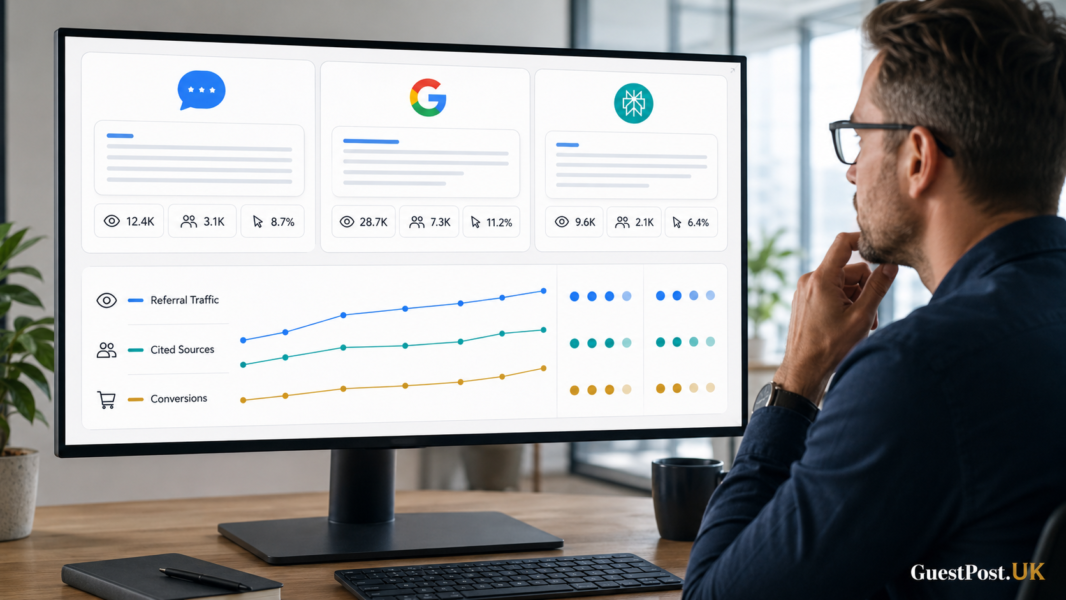
Create a GA4 comparison or report that includes traffic from:
chatgpt.com- Perplexity referral traffic
- Other identifiable answer-engine referrers
- Any AI-platform UTM source that appears in your analytics
Then review three figures:
- Sessions from AI sources
- Key events from AI-source visitors
- Conversion rate and revenue from those visitors
A small number of AI visitors may still be valuable. For B2B services, ten highly relevant visitors who generate two enquiries can be more important than 500 low-intent blog visits.
Google AI Mode requires a different approach
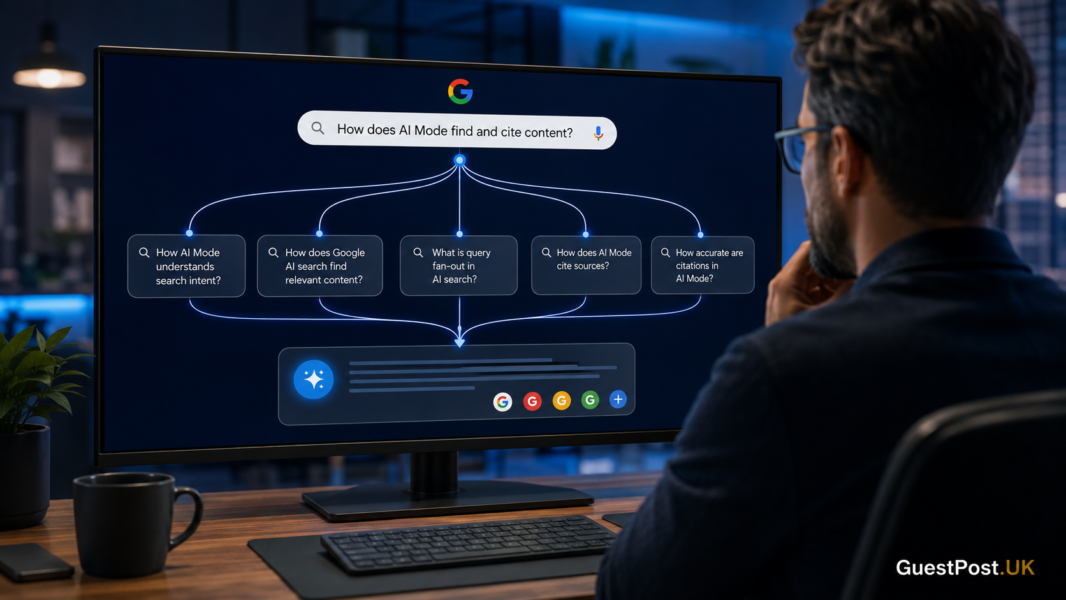
Google’s generative AI visibility does not always produce a separately labelled referral source in GA4. However, eligible Search Console properties can use the Generative AI performance report to see impressions from AI Overviews and AI Mode.
This helps show whether your pages are appearing in Google’s AI features. It does not automatically prove that every later organic conversion came directly from an AI answer.
Use it alongside page-level organic performance. If a page gains AI-feature impressions, shows an increase in organic visits and produces more key events after a meaningful content or authority campaign, that is useful evidence. Be clear about the difference between direct attribution and a likely contribution.
Our guide on measuring AI search visibility explains how to monitor the visibility and traffic side of this process in more detail.
Measure assisted conversions as well as last-click leads
AI search often introduces a brand before a person is ready to buy.
Someone may discover a helpful answer through ChatGPT, visit your website, leave, then return a week later through a Google brand search before submitting an enquiry. If you only look at last-click attribution, you may give all credit to branded organic traffic and none to the AI touchpoint.
GA4’s attribution and key-event path reports help show the touchpoints people encounter before a conversion. Google’s attribution guidance explains how the reports distribute credit across a customer journey.
For longer sales cycles, combine analytics with your CRM:
- Ask leads how they heard about you
- Save original landing pages and referral sources against each lead
- Track lead status, deal value and closed revenue
- Review which AI-source or AI-visible pages assisted the strongest leads
This is especially important for agencies, consultants, SaaS providers and other businesses where a sale may happen weeks after the first visit.
Use a simple GEO ROI calculation
Once you know the campaign cost and attributable revenue, the calculation is straightforward:
ROI = (Revenue from GEO − GEO investment) ÷ GEO investment × 100
For example, imagine a business invests £1,500 in a GEO campaign over three months. During that period, it records four qualified leads from identifiable AI referrals and assisted journeys. One becomes a client worth £4,500 in first-year revenue.
ROI = (£4,500 − £1,500) ÷ £1,500 × 100 = 200%
This calculation should be adjusted for your business model. Some companies prefer gross profit rather than revenue. Others use customer lifetime value where repeat sales are common. What matters is using the same definition consistently.
Report the quality of leads, not only the quantity
A monthly GEO report should answer questions a business owner actually cares about:
- Which pages gained AI visibility?
- How many AI-source visitors arrived?
- Did they take key actions?
- Which services or products did they show interest in?
- How many leads became qualified opportunities?
- What revenue or pipeline value can be linked to the work?
- What should be improved next month?
If AI traffic lands on a blog article but rarely converts, add a better internal path to a related service page. If an AI-visible service page receives enquiries but few sales, review its trust signals, offer and follow-up process. If a specific topic repeatedly creates qualified leads, build more helpful supporting content around it.
That is where AI-search reporting becomes a growth tool rather than a collection of screenshots.
For clear reporting that connects search visibility, leads and commercial action, explore our SEO client reporting, SEO campaign service and AI search optimisation checklist.