
Why Website Structure Directly Impacts SEO Authority
If your website were a city, structure would be its road network. Without clear roads, even the most valuable destinations remain inaccessible. The same applies to SEO—no matter how strong your content is, poor structure limits discoverability, crawlability, and ultimately, rankings.
Understanding how to structure a website for maximum SEO authority is one of the most underrated yet powerful strategies in modern SEO. Google doesn’t just rank pages—it evaluates how your entire site is organised.
Key stat: According to studies by Backlinko, pages closer to the homepage (within 3 clicks) receive significantly more organic traffic.
Key stat: A well-optimised internal linking structure can increase indexation rates by up to 40% (Ahrefs data).
Core Principles of Website Structure for SEO Authority
To master how to structure a website for maximum SEO authority, you need to focus on three pillars:
1. Crawlability
Search engines must be able to easily access and understand your pages.
2. Hierarchy
Your content should follow a logical structure from broad topics to specific pages.
3. Link Equity Distribution
Authority flows through internal links—your structure determines where it goes.
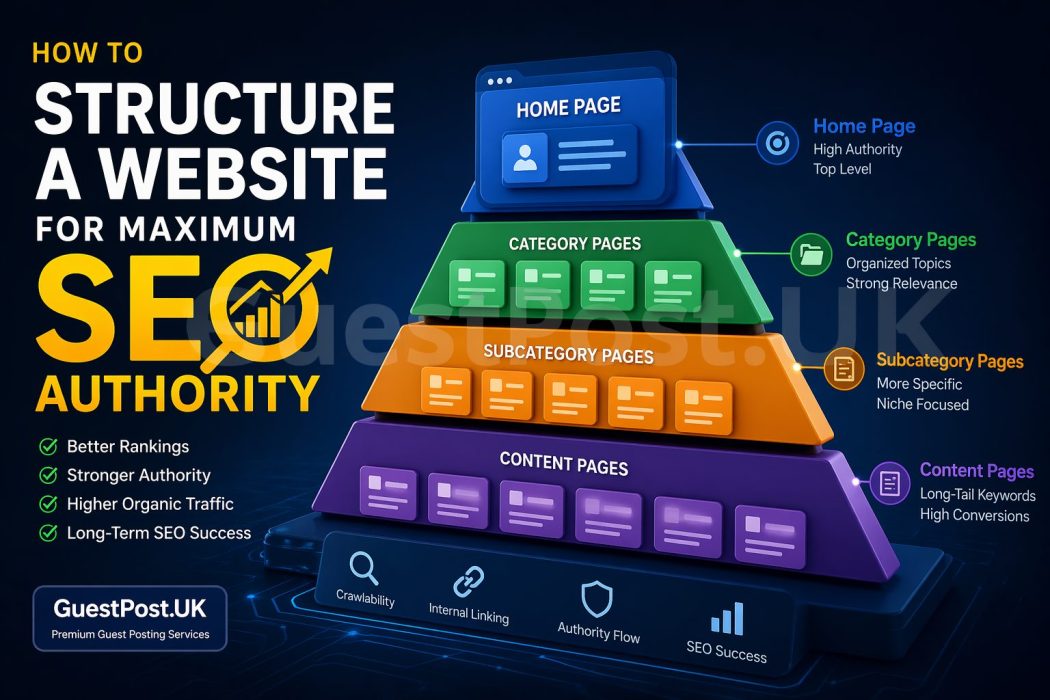
Ideal SEO Site Structure (Silo Model Explained)
The most effective approach is the topical silo structure.
Example Structure:
Homepage
 ├── SEO Services
 │    ├── Technical SEO
 │    ├── On-Page SEO
 │    └── Link Building
 ├── Blog
 │    ├── SEO Guides
 │    ├── Case Studies
 │    └── Tools & Reviews
Why This Works:
- Establishes topical authority
- Improves keyword relevance
- Enhances internal linking efficiency
Analogy:
Think of your site like a library. If books (pages) are randomly placed, finding information becomes difficult. A structured library (clear categories) makes discovery effortless—for both users and search engines.
Flat vs Deep Website Structure (Which Is Better?)
| Feature | Flat Structure | Deep Structure |
|---|---|---|
| Click Depth | 1–3 clicks | 4+ clicks |
| Crawl Efficiency | High | Low |
| SEO Authority Flow | Strong | Weak |
| User Experience | Better | Worse |
| Best For | SEO-focused sites | Large legacy websites |
Verdict:
A flat structure is ideal when learning how to structure a website for maximum SEO authority, as it ensures faster crawling and stronger ranking signals.
URL Structure Best Practices for SEO Authority
Clean URLs reinforce structure and improve rankings.
Best Practices:
- Keep URLs short and descriptive
- Include primary keywords naturally
- Use hyphens (not underscores)
- Avoid unnecessary parameters
Example:
Good:/seo/website-structure-guide
Bad:/page?id=12345&category=seo
Internal Linking Strategy That Builds Authority
Internal linking is where most websites fail when trying to optimise their structure for maximum SEO authority.
Key Strategies:
- Link from high-authority pages to important pages
- Use keyword-rich anchor text (naturally)
- Ensure every page has at least 2–3 internal links
- Prioritise cornerstone content
Internal Link Flow Visual:
Homepage (High Authority)
   ↓
Category Pages
   ↓
Blog Posts / Service Pages
   ↓
Supporting Content
Creating Topic Clusters for SEO Dominance
Topic clusters are essential for building authority.
Structure:
- Pillar Page (broad topic)
- Cluster Content (supporting articles)
Example:
Pillar: Website Structure Guide
Clusters:
- Internal Linking Strategy
- URL Optimisation
- Crawl Budget Management
Benefits:
- Signals expertise to Google
- Improves rankings for competitive keywords
- Strengthens semantic relevance
Navigation Optimisation for SEO and UX
Navigation is more than design—it’s an SEO signal.
Best Practices:
- Keep main navigation simple (5–7 items)
- Use descriptive labels (not “Services” → use “SEO Services”)
- Include breadcrumb navigation
- Add HTML sitemap for users
Technical Structure Elements You Must Optimise
When implementing a website structure for maximum SEO authority, technical elements play a crucial role.
Must-Have Components:
- XML Sitemap (for search engines)
- Robots.txt (crawl control)
- Canonical tags (avoid duplication)
- Proper use of H1–H6 hierarchy
- Mobile-friendly structure
Content Hierarchy and On-Page SEO Structure
Each page should follow a logical structure:
Ideal Page Layout:
- H1: Primary keyword
- H2: Main sections
- H3: Supporting details
- Short paragraphs
- Bullet points
Why This Matters:
- Improves readability
- Helps Google understand content
- Enhances featured snippet chances
Simple Visual Representation of SEO Authority Flow
Authority Score
│
│        ● Homepage
│       ● ● Category Pages
│     ● ● ● Blog Posts
│   ● ● ● ● Supporting Pages
│________________________________
         Site Structure Depth
Insight:
The closer a page is to the homepage, the more authority it receives.
Common Website Structure Mistakes to Avoid
When learning how to structure a website for maximum SEO authority, avoid these pitfalls:
Mistakes:
- Orphan pages (no internal links)
- Overcomplicated navigation
- Deep page hierarchy
- Duplicate content structures
- Ignoring mobile structure
Pros and Cons of Structured SEO Architecture
Pros:
- Better rankings
- Improved crawlability
- Stronger topical authority
- Enhanced user experience
Cons:
- Requires planning upfront
- Time-consuming restructuring for existing sites
- Needs ongoing optimisation
Advanced SEO Strategies for Website Structure
1. Hub-and-Spoke Model
Create central hubs linking to related content.
2. Strategic Internal Linking Funnels
Guide users towards conversion pages.
3. Authority Sculpting
Direct link equity to high-priority pages.
4. Content Pruning
Remove or merge weak pages to strengthen overall authority.
Best Tools to Plan and Optimise Website Structure
If you’re serious about mastering how to structure a website for maximum SEO authority, these tools are essential:
| Tool | Best For | Pricing | Key Feature |
|---|---|---|---|
| Ahrefs | Site audits & internal links | Premium | Site structure visualisation |
| SEMrush | Keyword & content clustering | Premium | Topic research tools |
| Screaming Frog | Technical audits | Freemium | Crawl analysis |
| Sitebulb | Visual SEO audits | Paid | Structure mapping |
Use Cases:
- Agencies: SEMrush + Ahrefs
- Technical SEOs: Screaming Frog + Sitebulb
- Content-focused sites: Ahrefs for internal linking
How to Restructure an Existing Website (Step-by-Step)
- Audit your current structure
- Identify key pages and topics
- Create a new hierarchy
- Implement internal linking
- Update URLs (if needed)
- Redirect old URLs properly
- Submit updated sitemap
People Also Ask: Website Structure SEO Questions
How many clicks should a page be from the homepage?
Ideally, no more than 3 clicks to maximise crawlability and authority.
Does website structure affect rankings?
Yes. Structure directly impacts indexing, authority distribution, and user experience.
What is the best structure for SEO?
A flat, silo-based structure with strong internal linking.
Should I change my website structure for SEO?
Only if your current structure limits crawlability or the flow of authority.
How do I build topical authority?
Use pillar pages, clusters, and consistent internal linking.
Final Thoughts on Building SEO Authority Through Structure
Mastering how to structure a website for maximum SEO authority is not optional—it’s foundational. Every successful SEO campaign is built on a solid structural framework.
If your site is poorly structured, even the best content and backlinks won’t deliver maximum results. But when your architecture is optimised, everything else becomes more effective—rankings improve, traffic increases, and conversions follow.
For long-term SEO growth, prioritise structure before scaling content.