
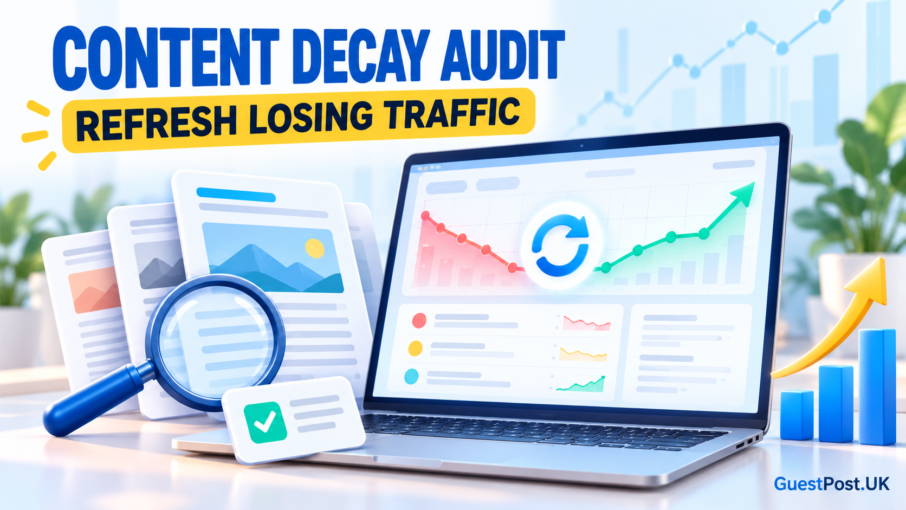
A content decay audit helps you find pages that once performed well in Google but now lose clicks, impressions, rankings, or commercial value.
This is one of the most practical SEO tasks for an established website. Instead of always creating new pages, you improve content that already has search history, backlinks, internal links, and some topical relevance.
For a site offering SEO, guest posting or link-building services, content decay can affect more than blog traffic. A weakening guide may stop sending visitors to a service page. A once-useful comparison article may no longer support affiliate clicks. An old list of guest-posting websites can lose relevance as publishers, pricing and editorial standards change.
The goal is not to update everything that is old. The goal is to identify pages where a focused improvement could bring back relevant visibility.
What content decay really looks like
Content decay is usually gradual. A page may not disappear from search results overnight. Instead, it starts slipping from positions five to nine, or from page one to page two. Click-through rate can fall because the search result no longer matches user expectations. Competitors may publish more useful, recent or better-structured alternatives.
Common signs include:
- Clicks and impressions declining over several weeks or months.
- Average position falling for the page’s important queries.
- A previously strong page receiving fewer leads or enquiries.
- Search results becoming more competitive or more commercial.
- Information, tools, examples or pricing no longer being current.
- The page targeting a broad phrase without answering specific user questions.
- Internal links pointing to a newer or more relevant page instead.
A traffic drop doesn’t always mean the page is poor. Search demand itself may have declined, seasonality may be involved, or Google may be showing different result types. That is why the audit should review trends and search intent before deciding what to change.
Start with the pages that already matter
The best refresh opportunities are rarely random articles with no visibility. Start with pages that have shown they can earn impressions, clicks or relevant conversions.
In Google Search Console, compare a recent period with the previous equivalent period. Look for URLs with meaningful declines in clicks or impressions, particularly where the page still ranks within striking distance of the first few results.
A page moving from position 7 to position 13 is usually a stronger refresh candidate than a page ranking at position 80. The first page already has topical relevance and may only need clearer intent matching, stronger information or better internal support.
For GuestPost.uk, priority pages could include:
- Guest-posting and link-building guides that once attracted commercial searches.
- Tool guides that can lead users towards the SEO Tools hub.
- Publisher-quality content that supports the Guest Post Site Finder or Publisher Quality Checker.
- Service-related articles that should naturally support SEO Services or Link Building Services.
- Older tool comparisons where features, pricing or buyer expectations have changed.
A page can have low traffic but still deserve attention if it helps a high-value service page rank or convert. Commercial relevance matters more than raw session numbers.
Separate traffic loss from an intent mismatch
Before refreshing a page, search its main keyword and look closely at the current results.
If Google now ranks comparison pages, pricing guides and service pages, but your article is a broad informational guide, the issue may be search intent rather than content quality. Adding a few paragraphs will not solve that. The page may need a more useful commercial section, stronger comparisons or a clearer route to the right service.
For example, someone searching “guest post pricing” may want an explanation of costs, quality factors and what they receive for their budget. They may not be satisfied by a generic article about why backlinks matter. That is why a dedicated Guest Post Pricing Guide is better suited to that query.
Likewise, a search for “how to find guest posting sites” often needs a process, filtering criteria and practical evaluation steps. A page that only lists benefits may lose ground to more action-focused alternatives. It should guide readers towards a logical next step, such as using the Guest Post Site Finder or reviewing available Guest Posting Sites.
The strongest refreshes don’t just add words. They make the page more useful for today’s searcher.
How to prioritise content decay opportunities
Not every declining page should be refreshed immediately. Prioritise pages using a mix of traffic potential, business value and effort required.
A simple way to do this is to sort pages into three groups:
Quick wins are pages that still receive impressions, rank around positions 4–20 and only need targeted improvements. These are often the fastest opportunities to recover clicks.
Commercial priorities are pages that support services, marketplace activity or affiliate opportunities. Even modest traffic can be valuable when the topic matches a buyer’s need.
Strategic refreshes are older cornerstone pages that should remain accurate and useful because many internal links point to them. They may take more work but can strengthen an entire topic cluster.
Your SEO Audit service can help identify the technical, content and internal-link issues affecting these pages. For day-to-day prioritisation, focus first on URLs that combine declining visibility with a clear opportunity to improve the user journey.
A practical content refresh checklist
Once you choose a page, review it as if you were seeing it for the first time.
Check whether the title and opening section still match the searcher’s likely question. Update old examples, dates, screenshots, prices and tool information. Remove sections that no longer help the reader make a decision.
Then strengthen the page with useful additions such as:
- A clearer explanation of the primary topic.
- Specific steps, examples or checklists.
- New subtopics now appearing in the search results.
- Better comparison points for commercial queries.
- Relevant internal links to services, tools and supporting guides.
- A stronger call to action that fits the search intent.
- Updated images where they improve understanding.
Be careful not to rewrite successful sections just for the sake of change. Preserve what is accurate, helpful and already ranking. The refresh should improve the page’s usefulness without removing its existing value.
Use internal links to support refreshed pages
Internal links help Google and users understand which pages are most useful within a topic. A refreshed article should link naturally to the next relevant step, while related pages should link back where it makes sense.
For example, a content-decay guide can point readers to the SEO Content Audit process and the Internal Link Advisor. A refreshed guest-posting article can support Guest Posting Services and relevant publisher-research tools.
At the same time, check whether older posts mention the refreshed URL. Adding a small number of relevant contextual links from supporting articles can help reinforce the page without creating a forced linking pattern.
Think in clusters rather than isolated pages. A single improved commercial guide, supported by related informational articles and useful tools, is more likely to perform than a page left disconnected from the rest of the site.
Measure the result after publishing
Content refreshes need time to crawl, re-evaluate, and compare against competing pages. Track the page in Search Console after publishing, but don’t judge results after only a few days.
Monitor:
- Clicks and impressions for the page.
- Main queries and their average positions.
- Click-through rate after title and meta-description changes.
- Engagement, enquiries or tool usage where relevant.
- Whether the page is now receiving internal links and assisting conversions.
Keep a simple record of what changed and when. This makes it easier to see which improvements worked across the website. Over time, you will build a refresh process based on real results instead of guessing what Google may prefer.
A regular content decay audit turns existing content into an active SEO asset. By improving pages with history and relevance, you can recover useful traffic, improve internal journeys, and create more value from the content you have already invested in.