
Google’s search results are changing quickly, but the most important advice for website owners is surprisingly straightforward: do not abandon SEO fundamentals in pursuit of “AI optimisation”.
Google has now published clearer guidance around visibility in AI search experiences, including AI Overviews and AI Mode. Its message is that no separate trick, secret file, or special markup is required. The same foundations that help a useful page perform in Google Search also give it the best chance of being surfaced in AI-driven results.
For businesses investing in content, links and technical work, that is good news. The goal is not to create pages for a robot. It is to make pages genuinely useful, technically accessible and clear enough that Google can understand what they answer, who they help and why they are trustworthy.
At GuestPost.UK, we approach SEO and Generative Engine Optimisation services the same way: strong search foundations first, then practical improvements that make a website easier to discover, assess, and trust.
What Google actually says about AI search
Google’s own AI search guidance makes one point especially clear: SEO still matters.
AI-powered search features use information from Google’s existing Search index. That means the basics remain essential:
- Google must be able to crawl and index the page.
- The content must answer a real user need.
- Claims should be accurate, supported and easy to verify.
- Pages need a clear purpose, not just to target a phrase.
- Technical problems that weaken organic visibility can also limit AI search visibility.
This matters because much AI SEO advice has made the process sound more complicated than it is. Businesses are being told they need to rewrite every page in a particular “AI-friendly” style, add new files to their website or publish large volumes of generic question-and-answer content.
That is not a reliable strategy.
A better approach is to improve the information your real customers need before they decide. For a guest-posting business, that may mean explaining how placements are checked, what affects pricing, which publisher signals matter, and how you manage a campaign. For a SaaS company, it may mean clear comparison pages, use-case guides, practical implementation advice and honest limitations.
The strongest pages are not trying to sound clever. They make the next step easier for the reader.
What you do not need to chase
You don’t need to treat every new AI-related term as a ranking requirement.
Google’s guidance specifically pushes website owners back towards established SEO best practices rather than separate tactics for AI features. In practical terms, that means you should be cautious about anyone promising visibility in AI Overviews through one plugin, one schema type or one technical file.
You do not need to:
- Create an
llms.txtfile in the belief that it guarantees AI visibility. - Add unusual schema purely because it is described as “AI schema”.
- Rewrite good content into robotic lists of short answers.
- Publish dozens of near-identical pages around every possible question.
- Assume a mention in an AI result will always deliver more traffic than a normal organic result.
Instead, focus on whether a page genuinely answers a specific search journey. A solid SEO audit can help uncover crawlability issues, thin content, unclear page targeting and internal-link gaps that reduce visibility across both traditional and AI-influenced search.
Build pages that answer complete questions
AI search often appears when someone asks a broader or more detailed question. A searcher may not simply look for “guest posting services”. They may ask:
- How do I find guest-post websites without buying poor-quality links?
- What should a B2B SaaS company check before choosing a publisher?
- Is a high DR website always a good guest-post opportunity?
- What is included in a professional SEO audit?
Your page does not need to repeat the entire question word-for-word. It needs to answer it properly.
That means covering the practical details a user would need next: definitions, selection criteria, examples, risks, alternatives and relevant actions. It also means linking readers towards the next useful resource. Someone learning how to assess publisher quality, for example, should be able to move naturally from a guide into the Publisher Quality Checker or the Guest Post Site Finder.
This creates a better visitor journey and gives search engines clearer context about how your pages relate to each other.
Make your expertise easy to verify
Pages are more useful when they show genuine experience and make key information easy to verify.
For service-led websites, this does not require complicated credentials pages or exaggerated claims. It means being specific. Explain the process, show what a client can expect, define important terms and avoid promising outcomes that no responsible SEO provider can guarantee.
A useful guest-posting page, for example, should explain how relevance is assessed, what editorial checks are made, and why authority metrics alone aren’t enough. A useful content-planning page should show how you select a topic, review search intent, and place a supporting article within a wider cluster.
This is where practical tools can strengthen content. Instead of publishing a vague page about “quality backlinks”, you can direct readers to a Guest Post Site Finder to search for relevant opportunities or use the Publisher Quality Checker to review a site before deciding.
The content gives the method. The tool helps the visitor apply it.
Internal links still matter
Internal linking is not an old SEO tactic made irrelevant by AI search. It remains one of the clearest ways to help both readers and search engines understand your website.
A page about AI search visibility should connect naturally to your technical and commercial services. A guide on content quality should point towards the relevant planning tools. A guest-post pricing page should lead readers to the service, the marketplace process or a relevant calculator.
The key is relevance. Do not add links simply because a page exists. Add them where a reader would realistically want more help.
For example:
- An article about AI-search-ready content can link to Content Planning Tools.
- A guide about finding search opportunities can link to the Google Keyword Tool.
- A page discussing content gaps can lead into the Keyword Cluster Generator.
- A business reviewing its technical foundations can move into a professional SEO Audit.
This helps important pages receive context and authority from related content. More importantly, it stops a good visitor from reaching the end of an article with nowhere useful to go.
Use AI to improve the process, not replace judgement
AI can add value to an SEO workflow. It can help organise research, generate outline ideas, identify content gaps and speed up repetitive preparation work. But it shouldn’t be the final editor, subject expert, or quality-control process.
The risk is not that AI exists. The risk is publishing generic information that adds no original value.
Before publishing, ask a simple question: could a reader find the same answer on ten other websites? If the answer is yes, the page probably needs more useful detail.
For GuestPost.UK, the strongest content will usually include practical insight from real outreach, publisher evaluation, content planning and SEO campaign work. That could be a checklist, a decision framework, an example workflow or a clear explanation of what can go wrong.
Pages built with that level of care perform well in conventional search results, serve readers arriving through AI search better, and are more likely to earn relevant links over time.
A practical AI-search checklist for website owners
Use this checklist before treating AI visibility as a separate project:
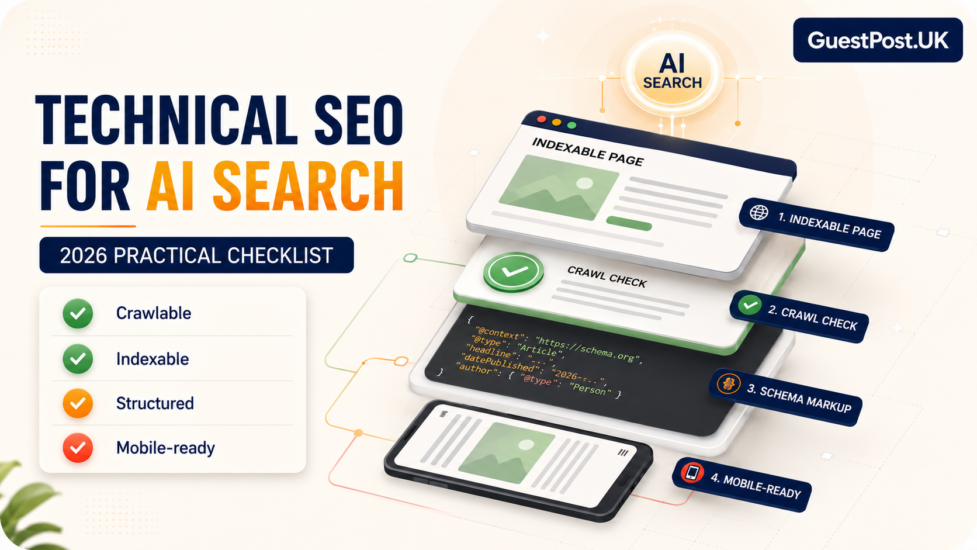
- Confirm that your key commercial and informational pages are indexable.
- Review old pages that no longer answer the searcher’s current question.
- Make important service pages more specific about outcomes, process and limitations.
- Add relevant internal links between guides, tools and commercial pages.
- Refresh statistics, examples, and pricing information when they become outdated.
- Publish content where your experience genuinely adds something beyond a generic summary.
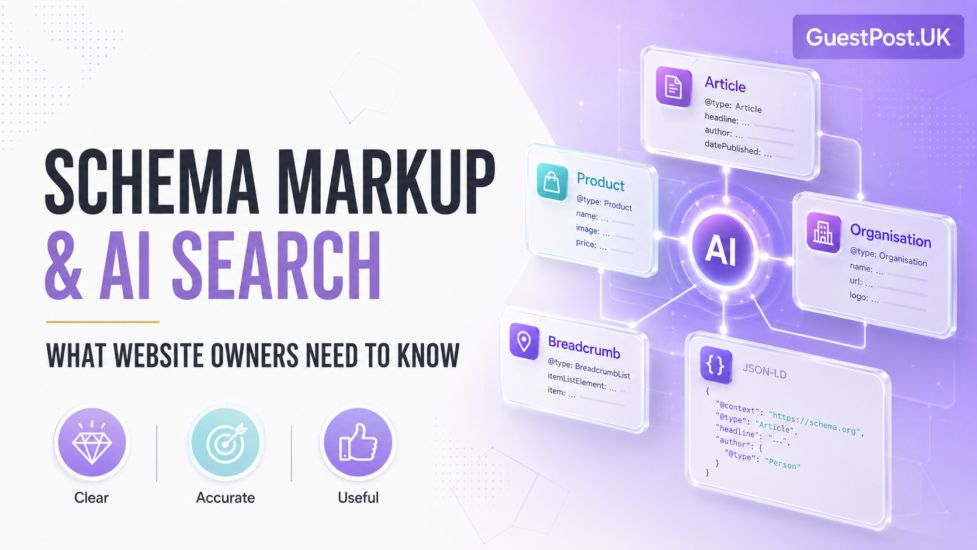
- Use structured data where it accurately describes the page, not as a shortcut to visibility.
- Review Google’s guidance for AI features before spending money on any supposed “AI SEO” requirement.
The real opportunity is better SEO
AI search changes how some people discover information, but it does not remove the need for useful websites. If anything, it makes clarity, accuracy and trust more valuable.
The businesses most likely to benefit are not those rushing to label every page as AI-optimised. They are the ones improving what already matters: helpful content, strong technical foundations, clear internal linking and a website that gives people a reason to choose them.
That is the sensible route for long-term visibility—whether a visitor finds you through Google’s normal results, an AI Overview, an AI search result or a recommendation from another publisher.