
For years, marketers treated authority as a backlink problem.
If a website accumulated enough links from authoritative domains, rankings improved. Rankings generated traffic. Traffic generated leads. The formula seemed relatively straightforward.
That model still works, but it no longer explains everything happening in search.
A growing number of companies are discovering an unusual pattern. They invest heavily in link acquisition, build respectable backlink profiles, and achieve solid organic visibility. Yet they remain largely absent from industry conversations. Journalists rarely quote them. Industry reports rarely reference them. Podcasts rarely mention them. AI systems rarely recommend them.
At the same time, competitors with fewer backlinks often become recognised names within their sectors.
This creates an uncomfortable question.
If backlinks are still important, why are some brands becoming influential while others remain invisible?
The answer lies in the difference between authority and recognition.
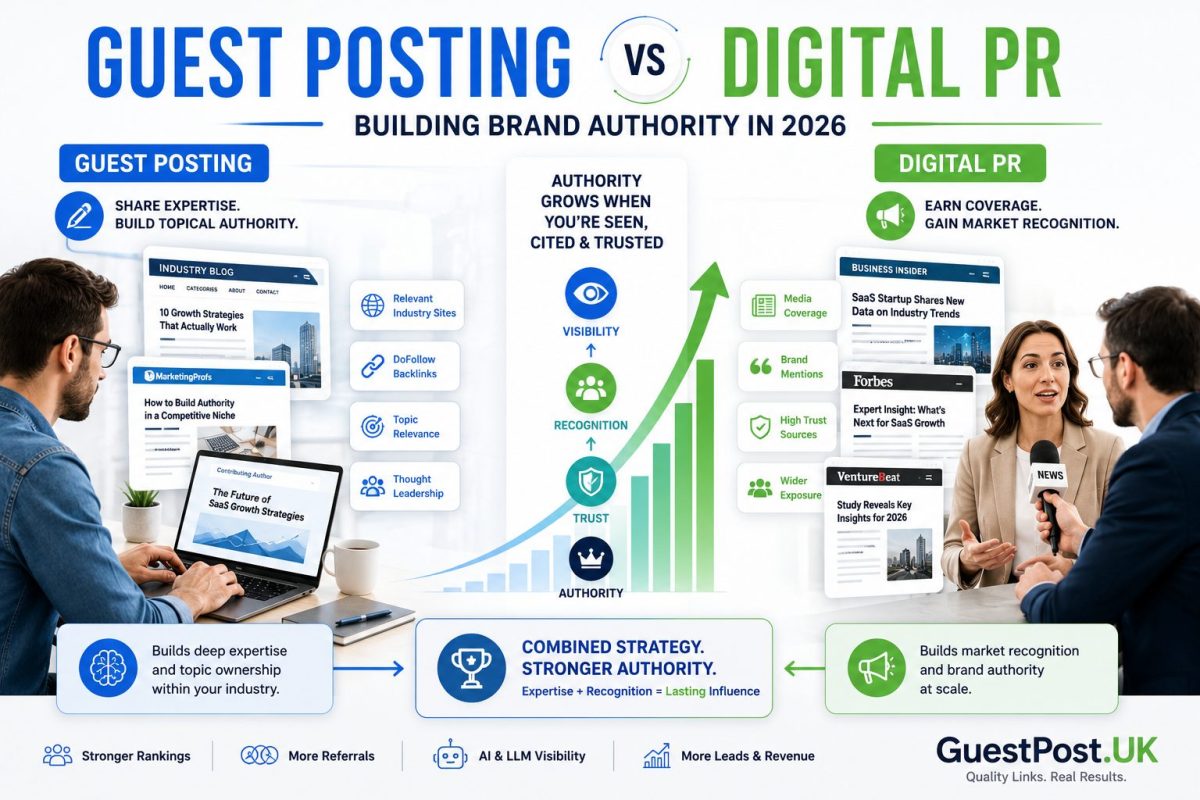
Guest posting and digital PR both contribute to authority building, but they do so in fundamentally different ways. One expands expertise across relevant industry ecosystems. The other accelerates visibility through third-party validation.
Understanding the distinction is becoming increasingly important as search engines and AI systems move beyond simple link analysis towards broader assessments of expertise, trust, and industry presence.
The Visibility Gap Most Companies Never Notice
Many organisations focus exclusively on what happens inside SEO tools.
They track rankings, backlinks, authority scores, and traffic growth. These metrics are useful, but they rarely tell the full story.
Imagine two software companies operating within the same market.
Company A acquires 500 quality backlinks over two years through consistent outreach campaigns. Rankings improve steadily. Traffic grows. Lead generation increases.
Company B acquires fewer links but appears repeatedly in industry publications, contributes expert commentary to journalists, participates in podcasts, publishes original research, and secures coverage through digital PR campaigns.
If you compare the backlink profiles alone, Company A appears stronger.
If you compare industry recognition, Company B often wins comfortably.
This difference creates what I call the Visibility Gap.
The Visibility Gap emerges when a company’s search authority grows faster than its market recognition.
Many businesses never realise this gap exists until competitors begin dominating industry conversations despite having weaker-looking SEO metrics.
Why Brand Authority Is Becoming More Valuable Than Raw Link Volume
The internet is becoming increasingly crowded.
Every industry contains thousands of companies producing content, publishing articles, and running SEO campaigns. Standing out requires more than visibility within search results.
It requires becoming recognisable.
Brand authority develops when a business becomes associated with expertise in a specific area. People begin encountering the brand repeatedly across different environments. They see it referenced in articles, cited in reports, quoted by journalists, discussed in communities, and mentioned by other experts.
Over time, familiarity develops.
Trust often follows familiarity.
This process has existed for decades in traditional marketing, but it is becoming increasingly relevant to SEO because modern search systems attempt to evaluate authority in similar ways.
The Authority Surface Area Framework
One of the simplest ways to understand the difference between guest posting and digital PR is through what I call Authority Surface Area.
Imagine authority as a physical surface.
A company that only publishes content on its own website has a relatively small authority surface area. Search engines can evaluate the content, but external validation remains limited.
Now imagine that same company appears across:
- Industry publications
- Expert roundups
- Podcasts
- Research studies
- Trade websites
- News publications
- Conference presentations
- Guest articles
The authority surface becomes significantly larger.
Every additional touchpoint increases the number of opportunities for people, search engines, journalists, and AI systems to encounter the brand.
Both guest posting and digital PR expand authority surface area.
They simply expand it in different directions.
Why Digital PR Creates Authority Faster
Digital PR operates through borrowed trust.
When a respected publication references a company, part of that publication’s credibility transfers to the brand being mentioned.
This transfer often happens subconsciously.
A cybersecurity startup featured in a respected technology publication immediately appears more credible than an identical startup with no external coverage.
Nothing about the business itself has changed.
Perception has changed.
Digital PR accelerates this process because it places brands inside environments that audiences already trust.
This explains why a single mention in a respected publication sometimes creates more authority than dozens of ordinary backlinks.
The impact extends beyond SEO.
Investors notice.
Prospects notice.
Journalists notice.
Future opportunities often emerge from previous visibility.
This creates a compounding effect that many businesses underestimate.
Why Guest Posting Creates Authority More Deeply
Digital PR often generates broad visibility.
Guest posting generates concentrated visibility.
The distinction matters.
A successful guest posting campaign repeatedly places a brand inside highly relevant industry discussions.
Rather than appearing briefly within a news story, the brand contributes directly to the conversation.
This creates a different type of authority.
Readers begin associating expertise with specific topics.
Instead of simply recognising the company name, they begin understanding what the company knows.
This distinction becomes particularly important in specialist industries where trust depends heavily on demonstrated expertise.
A cybersecurity company, legal firm, SaaS provider, or SEO agency often benefits from being perceived as knowledgeable rather than merely visible.
Guest posting excels at building that perception.
The Trust Transfer Effect
One of the least discussed aspects of authority building is trust transfer.
Trust rarely develops in isolation.
Most people trust recommendations because they trust the source making the recommendation.
The same principle applies online.
When a respected industry publication publishes an article written by a recognised expert, trust flows from the publication towards the contributor.
When a journalist references a company within a story, trust flows through the citation.
When multiple trusted sources repeat similar signals, the effect becomes stronger.
This process explains why authority often appears disproportionate to backlink counts.
Not all mentions are equal.
Not all links are equal.
The source matters.
The context matters.
The accumulated pattern matters.
Why AI Systems Care About These Signals
The emergence of AI-powered search introduces a new dimension to authority building.
Traditional search engines rank documents.
AI systems attempt to generate recommendations.
To do this effectively, they need confidence.
Confidence comes from repeated evidence.
If a company appears consistently across respected industry sources, AI systems gain more reasons to associate that company with expertise.
This is particularly relevant for B2B sectors where recommendations often depend on credibility rather than popularity.
A company repeatedly referenced across specialist publications creates a stronger authority signal than a company existing primarily on its own domain.
This is one reason why brand mentions, citations, and third-party references are attracting renewed attention within SEO circles.
A SaaS Example: Two Different Growth Strategies
Consider two hypothetical SaaS businesses entering the same market.
The first invests heavily in outreach-driven link acquisition.
The second splits resources between guest posting, digital PR, industry research, and thought leadership.
Three years later, both have strong backlink profiles.
However, the second company has achieved something else.
Its executives appear in industry publications.
Its research is referenced by journalists.
Its brand appears in conference presentations.
Its insights are cited by other websites.
The company has moved beyond link acquisition.
It has become part of the industry’s information ecosystem.
That transition often creates a competitive advantage that is difficult to replicate quickly.
Why Most Businesses Should Not Choose One Strategy
Marketing teams frequently ask whether they should invest in guest posting or digital PR.
In reality, this is often the wrong question.
The better question is:
Which authority gap are we trying to solve?
A company struggling with visibility may benefit more from digital PR.
A company struggling with topical expertise may benefit more from guest posting.
A mature business seeking long-term authority often requires both.
The objective is not selecting a winner.
The objective is understanding the role each strategy plays within a broader authority-building framework.
The Future of Authority Building
The next generation of SEO campaigns will likely look very different from those of the past decade.
Backlinks will remain important.
However, the conversation is expanding.
Authority is increasingly shaped by:
- Recognition
- Citations
- Mentions
- Expertise
- Topic ownership
- Industry presence
The companies that adapt earliest will gain advantages that extend beyond rankings.
They will become easier to discover, easier to trust, and easier to recommend.
That applies to search engines, AI systems, journalists, and potential customers alike.
FAQ
Is digital PR better than guest posting?
Not necessarily. Digital PR typically creates broader visibility, while guest posting often builds deeper topical authority. The best approach depends on the specific authority gap a business is trying to address.
Which strategy helps AI search visibility more?
Both contribute differently. Digital PR strengthens recognition and third-party validation, while guest posting reinforces expertise and topic associations.
Can guest posting build brand authority?
Yes. Consistent contributions to respected industry publications can significantly strengthen perceived expertise and trust.
Does digital PR help SEO?
Yes. Digital PR often generates authoritative mentions, editorial links, brand searches, and visibility signals that support long-term SEO performance.
Should small businesses focus on guest posting or digital PR?
Many smaller businesses benefit from establishing expertise through guest posting before investing heavily in larger digital PR campaigns.
Closing Perspective
The debate between guest posting and digital PR often assumes authority is a finite resource earned through a single tactic.
In reality, authority emerges from repeated exposure across trusted environments.
Digital PR expands visibility.
Guest posting deepens expertise.
Together, they increase the likelihood that a brand becomes recognised rather than merely discovered.
And in an era where AI systems increasingly evaluate reputation alongside relevance, recognition may become one of the most valuable assets a business can build.