
The Real Problem Byword AI Is Trying to Solve
Most AI writing tools are built for:
- Individual blog posts
- Chat-based workflows
- Manual prompting
- Small-scale publishing
Byword AI takes a very different approach.
Instead of focusing on “AI conversations”, Byword AI focuses almost entirely on:
scalable SEO publishing.
That distinction matters.
This platform is designed for people managing:
- Large niche sites
- Programmatic SEO projects
- Affiliate portfolios
- Agency content operations
- High-volume publishing systems
The core philosophy behind Byword AI is simple:
generate large amounts of SEO-focused content with minimal manual effort.
And honestly, that makes it one of the more interesting AI SEO tools currently available.
What Makes Byword AI Different?
A lot of AI writing tools are starting to feel identical.
Different branding.
Same workflows.
Same “write article” buttons.
Byword AI feels more operational.
It behaves more like a publishing engine than a writing assistant.
The platform focuses heavily on:
- Bulk content generation
- SEO article automation
- CSV-based workflows
- Programmatic publishing
- WordPress automation
- Search-driven content scaling
This makes it less appealing for casual bloggers — but potentially very powerful for SEO operators.
First Impressions of Byword AI
The interface is surprisingly minimal.
Compared to flashy AI dashboards overloaded with templates, Byword AI feels more utilitarian.
That can initially seem underwhelming.
But after using it properly, the simplicity starts making sense.
The platform is clearly designed for:
- Speed
- Scale
- Workflow efficiency
rather than creative writing experiences.
Byword AI Features
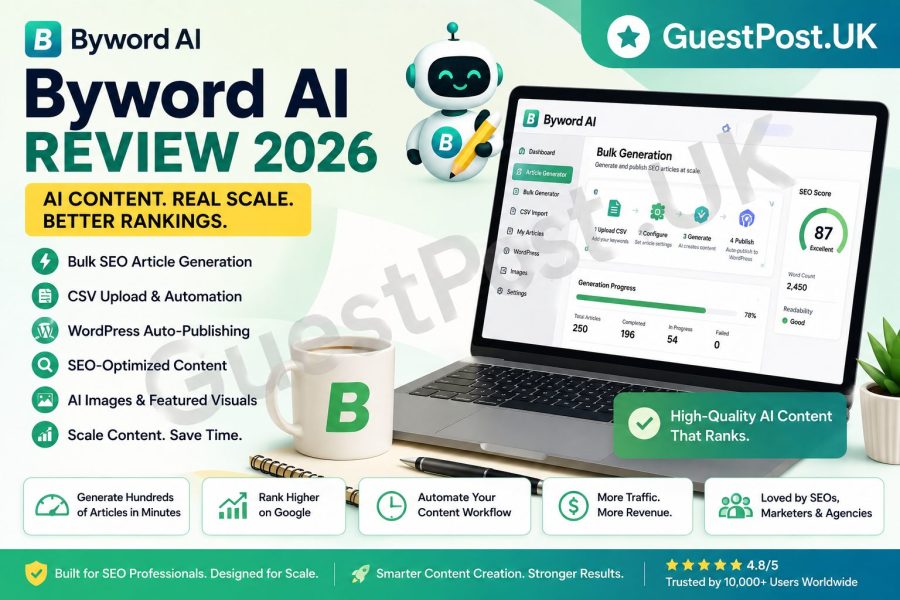
Bulk SEO Article Generation
This is the feature that defines the platform.
Users can upload keyword lists and automatically generate large volumes of articles.
This is especially useful for:
- Topical authority projects
- Long-tail SEO strategies
- Location pages
- Affiliate site scaling
- Supporting content hubs
For SEO agencies handling many websites, this can dramatically reduce production bottlenecks.
CSV Upload Workflow
One of the more advanced features is CSV-based generation.
You can essentially feed the platform:
- Keywords
- Titles
- Content angles
- Article instructions
and automate content production at scale.
This workflow feels closer to programmatic SEO than traditional blogging.
WordPress Publishing Integration
Byword AI integrates directly with WordPress.
This allows:
- Automatic draft publishing
- Scheduled publishing
- Faster deployment
For publishers managing large content inventories, this feature alone can save countless hours.
AI Image Generation
The platform also includes AI-generated featured image functionality.
This helps streamline:
- Blog publishing
- Content formatting
- Visual automation
Although most serious publishers will still prefer custom images for branding consistency.
SEO-Focused Article Structure
The generated content generally includes:
- Heading hierarchy
- Structured formatting
- SEO-oriented layouts
- Readability optimisation
It clearly prioritises search-focused publishing.
Byword AI Pricing
Byword AI uses a usage-based pricing structure rather than purely flat subscriptions.
Pricing Style
Typically based on:
- Number of articles
- Word count
- AI generation volume
This actually makes sense for bulk publishers.
Smaller bloggers may find it less attractive, but agencies and publishers scaling aggressively may appreciate the flexibility.
What Byword AI Does Extremely Well
Long-Tail SEO Scaling
This is probably the platform’s strongest area.
If your strategy involves targeting:
- Hundreds of low-competition keywords
- Informational search intent
- Supporting topical pages
Byword AI becomes very useful.
Speed
The content generation speed is impressive.
You can realistically create entire content clusters much faster than traditional workflows.
Workflow Automation
This is not just an “AI writer”.
It behaves more like:
a lightweight SEO publishing infrastructure.
That distinction is important.
Programmatic SEO Support
Many AI writing tools talk about scale.
Very few actually support scalable SEO workflows properly.
Byword AI is one of the few platforms genuinely designed for this style of publishing.
Where Byword AI Feels Weak
Content Personality
The content can feel:
- Predictable
- Formulaic
- Structurally repetitive
especially at scale.
Without editing, many articles risk sounding too similar.
Weak EEAT Signals
Like most AI-generated SEO content, it lacks:
- Real expertise
- Personal experience
- Unique insight
This becomes a bigger issue in competitive niches.
Not Ideal for Premium Editorial Brands
If you run:
- High-end SaaS publications
- Strong editorial brands
- Authority publications
You will still need significant human refinement.
Creative Writing Limitations
The platform is heavily SEO-oriented.
It is not designed for:
- Storytelling
- Persuasive copywriting
- Emotional branding
- Thought leadership
Byword AI vs KoalaWriter
| Feature | Byword AI | KoalaWriter |
|---|---|---|
| Bulk Publishing | Excellent | Moderate |
| Affiliate SEO | Strong | Excellent |
| Workflow Automation | Very strong | Moderate |
| Programmatic SEO | Excellent | Limited |
| Ease of Use | Intermediate | Beginner-friendly |
| Human-Like Tone | Moderate | Better |
Practical Difference
KoalaWriter feels more like:
An SEO writing assistant.
Byword AI feels more like:
an SEO publishing machine.
Byword AI vs SEOWriting AI
| Feature | Byword AI | SEOWriting AI |
|---|---|---|
| Bulk Generation | Excellent | Excellent |
| WordPress Integration | Strong | Strong |
| Programmatic SEO | Better | Moderate |
| Workflow Simplicity | Moderate | Easier |
| Content Structure | Good | Good |
| Scaling Efficiency | Excellent | Very strong |
Which One Wins?
- Byword AI is stronger for scalable SEO systems
- SEOWriting AI is easier for casual users
Is Byword AI Good for Affiliate SEO?
Yes — probably more than most AI tools.
Best Affiliate Use Cases
Supporting Informational Content
Excellent for:
- “How to” articles
- Informational clusters
- Supporting long-tail pages
Topical Authority Expansion
Very useful for:
- Silos
- Topic hubs
- Internal linking strategies
Large Content Inventories
Affiliate sites targeting thousands of keywords may benefit heavily.
However:
Money pages still require careful manual refinement.
Is Byword AI Dangerous for SEO?
This depends entirely on how it is used.
The Real Risk
The biggest risk is:
Mass publishing low-quality AI content without editing.
That approach is becoming increasingly risky.
Best Practices for Safe SEO Usage
If using Byword AI:
- Edit important pages manually
- Improve originality
- Add expertise
- Add unique insights
- Improve internal linking
- Avoid spam-style publishing
The safest approach is:
AI-assisted scaling with editorial oversight.
Who Should Actually Use Byword AI?
Excellent Fit For
SEO Agencies
Especially agencies managing:
- Many clients
- Large publishing schedules
- Content-heavy campaigns
Affiliate Marketers
Useful for:
- Scaling supporting content
- Expanding topical coverage
Programmatic SEO Projects
One of the better AI platforms for this.
Poor Fit For
Personal Bloggers
It may feel overly operational.
Premium Editorial Sites
The content still lacks editorial depth without manual enhancement.
Highly Regulated Niches
Medical, legal, and financial sites still require genuine expertise.
Final Thoughts on Byword AI
Byword AI is not trying to be the smartest AI writer.
It is trying to be:One of the fastest, most scalable SEO publishing systems.
And in many ways, it succeeds.
Biggest Strengths
- Bulk SEO workflows
- Programmatic publishing
- WordPress automation
- Long-tail scaling
- SEO operational efficiency
Biggest Weaknesses
- Repetitive structure risk
- Weak originality
- Requires editorial oversight
- Limited creativity
Overall Verdict
Byword AI works best for:
- SEO operators
- Agencies
- Affiliate publishers
- Large-scale content projects
It is less about:
“writing beautiful articles”
and more about:
building scalable SEO infrastructure.
That makes it a very different type of AI content tool compared to many competitors.
FAQs About Byword AI
Is Byword AI good for SEO?
Yes, especially for scalable SEO workflows and long-tail publishing strategies.
Can Byword AI content rank on Google?
Yes, but editorial improvement and SEO quality control remain essential.
Is Byword AI better than KoalaWriter?
For bulk publishing and programmatic SEO, yes. For natural writing quality, KoalaWriter often feels better.
Does Byword AI require editing?
Absolutely. Human editing is still highly recommended.
Is Byword AI good for affiliate sites?
Yes. It performs particularly well at scaling informational affiliate content.
Is Byword AI worth it in 2026?
For agencies and publishers focused on scale, workflow automation, and SEO operations, it offers strong value.