
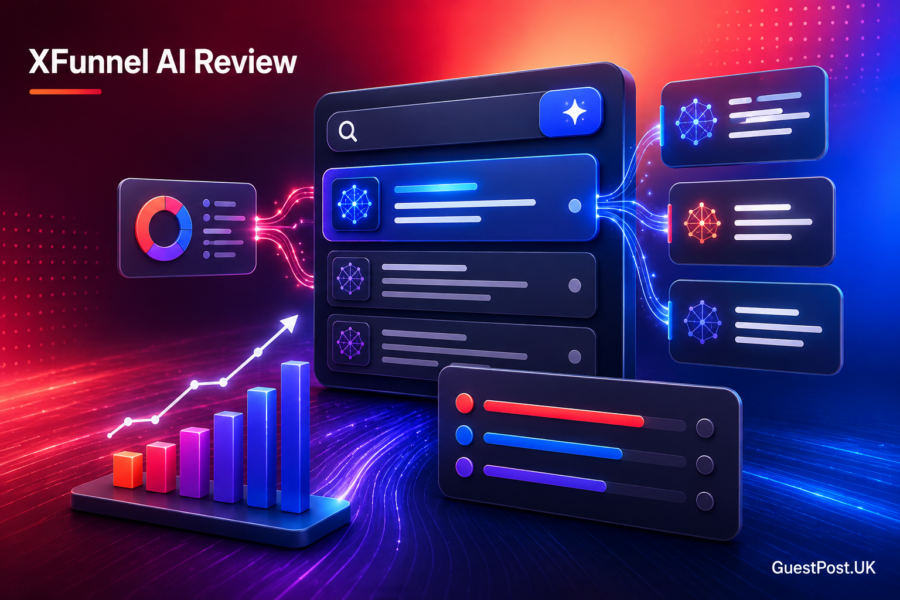
XFunnel is an AI-search optimisation platform aimed at B2B businesses that want to understand how their brand appears in ChatGPT, Gemini, Claude, Perplexity and Google’s AI-led search experiences.
Rather than positioning itself as another rank tracker, XFunnel focuses on the full buying journey. It helps brands discover the questions buyers ask AI tools, measure how often they are mentioned, analyse competitor visibility and test practical improvements over time.
That approach is especially relevant for B2B companies. A potential buyer may ask an AI assistant which cybersecurity platform, CRM, HR software or SEO agency is most suitable for their situation long before they visit a website or fill in a form. If a brand is absent from that research stage, normal traffic reports may not reveal the lost opportunity.
XFunnel is designed to make that early, often invisible, part of the buyer journey more measurable. However, it is clearly built for serious B2B marketing programmes rather than small businesses looking for a low-cost AI mention checker.
What is XFunnel?
XFunnel is a Generative Engine Optimisation platform that measures and improves how brands appear in AI-generated answers. It covers major AI search environments, including ChatGPT, Gemini, Claude, Perplexity, Google AI Overviews and Google AI Mode.
The platform brings together four areas of work:
- AI-search question and topic research
- Brand visibility and share-of-voice tracking
- Competitor, citation and response analysis
- Testing and optimisation programmes
XFunnel has a strong B2B focus because it treats AI search as a buyer-journey problem, not simply a brand-mention problem. It can analyse visibility by persona, product, region, topic, and funnel stage.
For example, a SaaS company could separately monitor questions asked by a technical buyer, a marketing manager, and a procurement lead. Each audience may use different language, care about different features and receive different competitor recommendations.
This is a more useful approach than tracking a handful of broad prompts such as “best project management software”. It allows teams to identify the exact commercial conversations where they are missing, misrepresented or outperformed.
XFunnel features
AI-search visibility tracking
XFunnel monitors how frequently a brand appears in answers across AI platforms and compares that visibility with selected competitors. Core metrics include brand mentions, share of voice and sentiment.
This gives marketers a practical starting point: are we present in the conversations that matter, and are competitors becoming the default recommendation instead?
The platform also supports segmentation. Businesses can compare performance by geographic market, target persona, product line and topic. This is especially useful for B2B organisations with multiple services or international markets.
A brand may be visible for generic awareness questions but missing when buyers ask decision-stage questions such as:
- “Best enterprise HR software for UK teams”
- “Which SEO agency has experience with SaaS link building?”
- “Best CRM for a scaling B2B sales team”
- “Alternatives to [competitor name] for mid-market companies”
Those are the conversations closest to commercial value.
Question and response analysis
XFunnel helps teams identify relevant questions and review the AI responses behind their visibility data. That matters because a visibility score alone does not explain why a brand appears or does not appear.
The detailed view can show:
- Which questions generate competitor mentions
- The sources and pages used within AI responses
- Whether the brand is described accurately
- How answers differ by persona or stage of the buying journey
- Gaps between a company’s positioning and how AI presents it
For B2B brands, inaccurate descriptions can be as damaging as a lack of visibility. If AI consistently describes a product as suitable only for small businesses when it is built for enterprise teams, that can shape the wrong perception before a prospect reaches the website.
Buyer-journey and persona analysis
This is one of XFunnel’s more distinctive strengths. Instead of treating every prompt equally, the platform can map AI answers against different buyer personas and funnel stages.
A cybersecurity company, for instance, may need visibility across several conversations:
- An IT manager comparing technical features
- A compliance lead researching risk requirements
- A finance director evaluating costs
- A procurement team comparing vendors
- A senior decision-maker looking for case studies and proof
Each person needs different evidence. The technical audience may rely on documentation and integrations, while decision-makers may look for customer examples, comparison pages, analyst coverage and independent reviews.
That is why a strong B2B AI search strategy requires more than generic blog content. It needs clear service or product pages, FAQs, comparison content, proof of expertise and consistent brand signals on trusted third-party websites.
Citation and competitor intelligence
AI answers often rely on a mixture of first-party pages, industry publications, reviews, research and competitor content. XFunnel analyses sources and citations to help teams understand which evidence is influencing the answer.
The platform’s own research suggests that B2B AI-search results frequently cite product and company pages, particularly for lower-funnel questions. That reinforces an important point: commercial pages need to be genuinely useful, specific and evidence-led.
A thin landing page with broad claims is unlikely to compete effectively with a detailed competitor comparison, well-structured product documentation or independently supported customer proof.
Citation intelligence can inform several practical actions:
- Improve an important product, service or pricing page
- Create an honest comparison page for a recurring buyer question
- Add technical details, examples, FAQs and case-study evidence
- Correct inconsistent brand information across the web
- Earn credible industry mentions through digital PR and editorial outreach
- Strengthen key pages with relevant internal links
This is where a quality-led guest posting service can be part of the wider strategy. The objective should be useful brand context and genuine third-party credibility, not random links placed solely for an SEO metric.
Optimisation playbooks and experiments
Many AI visibility tools are primarily dashboards. XFunnel differentiates itself by offering optimisation playbooks, testing and expert support alongside measurement.
Its platform encourages teams to run experiments, track their impact and refine the work based on visibility changes. This is a sensible approach because AI answers are not static. Results can vary by model update, prompt wording, region and the information available across the web.
A typical XFunnel-led programme may include:
- Identifying high-value buyer questions
- Establishing a visibility and citation baseline
- Prioritising the most meaningful gaps
- Updating pages, content and proof points
- Measuring the result over a defined period
- Repeating the process with the next opportunity
The important word is testing. No tool can promise that a page change will make a brand appear in every AI answer. The best platforms provide reliable data, a sensible hypothesis and a way to measure whether the change produced a meaningful improvement.
“AI-search visibility becomes commercially useful when it shows a real buyer question, the sources shaping the answer and the specific action a marketing team should take next.”
XFunnel pricing
XFunnel does not publish straightforward self-service plan prices on its public pricing page. That normally indicates a custom, enterprise-oriented sales process, where the cost depends on the required number of brands, markets, prompts, users, integrations and support level.
This is not automatically a drawback. A B2B company operating across several regions or product categories may need a tailored programme rather than a fixed prompt allowance. But it does mean potential buyers should ask detailed questions before committing.
Key points to clarify during a demo include:
- Which AI platforms and countries are included
- How many prompts, brands and competitors can be tracked
- How often responses are refreshed
- Whether pricing includes optimisation support and experiments
- What reporting, exports and integrations are available
- Whether the platform is now included within a HubSpot product or workflow
HubSpot announced its acquisition of XFunnel in October 2025, stating that the platform would be integrated into its marketing products. That makes XFunnel particularly interesting for B2B teams already using HubSpot, although the exact product packaging and availability should be confirmed directly before purchase.
XFunnel pros and cons
Pros
- Built around B2B buyer journeys, not generic mentions
- Tracks visibility, share of voice, sentiment and competitors
- Supports persona, region, product and funnel-stage analysis
- Strong focus on citation analysis and practical experimentation
- Includes expert guidance rather than leaving teams with a dashboard
- Broad AI-search coverage across major platforms
- Potential strategic fit for HubSpot users
Cons
- No transparent public pricing
- Likely better suited to larger brands with a meaningful budget
- May be more hands-on than teams wanting simple self-service tracking
- Platform packaging could change as HubSpot integration develops
- Still requires quality content, technical SEO and credible authority work to produce results
XFunnel alternatives
Scrunch AI is a good alternative for companies seeking AI visibility tracking, citation intelligence, AI-bot monitoring, and technical page diagnostics on a single platform. Its public plans make it easier to assess cost before a demo. Read our Scrunch AI review for a detailed breakdown.
Profound is aimed at larger teams that need answer-engine monitoring, prompt-volume research, AI-agent workflows and enterprise marketing support.
Peec AI is a better fit for agencies and growth teams seeking clear prompt-level reporting, multi-project management and an easier analytics workflow.
Ahrefs Brand Radar works well for SEO teams that want AI visibility alongside backlink research, keyword data and conventional competitor analysis.
For a broader comparison, see our guide to the best AI search visibility tools.
Final verdict: is XFunnel worth it?
XFunnel is a strong option for B2B brands that see AI search as a strategic discovery channel, especially where buying decisions involve multiple personas, long sales cycles and competitive product research.
Its buyer-journey approach is more sophisticated than simply checking whether a brand appears in ChatGPT. By connecting visibility, citations, competitors and optimisation experiments, it gives marketing teams a clearer route from insight to action.
The trade-off is accessibility. With custom pricing and an enterprise-focused model, XFunnel is unlikely to be the best first tool for a small business experimenting with AI search.
For established B2B companies, particularly those already using HubSpot and investing in content, SEO, digital PR and authority building, XFunnel can provide a valuable framework for understanding how AI shapes the pipeline before traditional analytics ever records a website visit.