
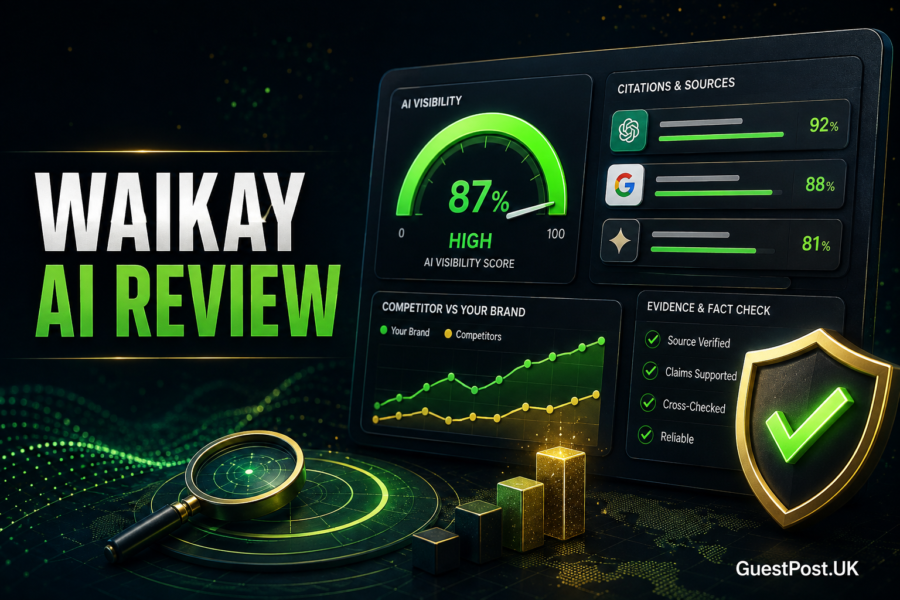
Waikay is an AI brand-monitoring platform that helps businesses understand how large language models describe, recommend and cite them. It tracks a brand across AI environments, analyses competitors, identifies source gaps and flags inaccurate information that may affect reputation or visibility.
The tool is aimed at a growing problem in SEO and brand marketing: a company can have good Google rankings but still be missing from AI search results, be confused with another business, or be described with outdated information.
For example, an AI assistant may recommend several SEO agencies but omit your brand entirely. It may mention your business but associate it with the wrong services. Or it may cite competitors and third-party publications for every commercial prompt in your category.
Waikay is designed to make those issues visible and turn them into an action plan. Its lower starting price also makes it more accessible than some enterprise AI visibility tools, although the depth of analysis will still depend on the plan and credit allowance you choose.
What is Waikay?
Waikay is a platform for monitoring and improving AI brand visibility. It tracks how AI models understand a business, which topics they associate with it, what sources they cite and how the brand compares with competitors.
The platform covers multiple AI models, including ChatGPT, Gemini, Claude and Sonar, Perplexity’s answer engine. Its website also mentions a six-model monitoring setup, so businesses should confirm the exact model coverage available in their chosen plan before subscribing.
Unlike conventional rank tracking, Waikay does not focus solely on a keyword’s position. Its approach is closer to brand intelligence. It looks at whether AI models know who you are, understand your offers correctly and include you in relevant commercial conversations.
Its core products include:
- Brand AI visibility tracking
- Topic reports and AI Understanding Scores
- Prompt-level monitoring
- Competitor benchmarking
- Fact tracking and hallucination detection
- Source and citation tracking
- GEO Action Plans
This makes Waikay particularly relevant for agencies, B2B SaaS companies, ecommerce brands and businesses where reputation and accurate positioning affect whether prospects choose to enquire.
Waikay’s key features
Brand AI visibility tracking
Waikay tracks brand presence across selected prompts and AI models. It reports how often a brand is mentioned, how it compares with competitors and whether visibility is improving over time.
The platform uses several measurements, including AI Visibility, Share of Voice and Topical Presence. These are intended to show not just whether a brand appears, but how strongly it is associated with the commercial topics that matter to its market.
For example, an outreach agency may want AI systems to associate it with “editorial backlinks”, “UK guest posting”, “brand authority” and “B2B link building”. If an AI model understands the company name but does not connect it with those themes, the agency has an authority and content-positioning gap to address.
That is one reason a broader GEO strategy requires more than just a tool subscription. Clear service pages, expert content, relevant mentions and consistent entity information all help reinforce what a business should be known for.
Topic reports and AI Understanding Score
Waikay’s topic reports assess how strongly AI models associate a brand with chosen commercial subjects. They produce an AI Understanding Score and identify gaps as critical, significant or moderate.
This is useful because it focuses on the relationship between a brand and a topic, rather than simply counting mentions. A business may be widely known but not recognised as a specialist in the service it offers.
A practical example would be a software company known generally for project management but not considered an appropriate solution for construction firms or enterprise teams. Topic-level analysis can help show whether that distinction exists in AI-generated answers.
The output should guide a proper review of:
- The service or product page covering the topic
- Supporting guides, comparisons and FAQs
- Product facts, proof points and use cases
- Case studies and customer outcomes
- Independent publications mentioning the business
- Internal links that connect the relevant content cluster
Fact tracking and hallucination detection
Fact tracking is one of Waikay’s most interesting features. It allows businesses to see statements that AI models make about their brand, validate correct information and flag errors.
This is useful for businesses with complex offers, multiple locations, changing product features or a history of inconsistent public information. An incorrect AI answer about pricing, availability, service scope, or company identity can create friction before a prospect ever reaches the website.
However, this feature needs realistic expectations. No platform can instantly rewrite an AI model’s knowledge. What Waikay can do is help identify the inaccurate statement, trace the possible source and prioritise the pages or third-party references that need improving.
The best response is normally to correct the first-party source, make key facts easy to verify and improve consistency across trusted relevant websites. Trying to “game” an AI model with repetitive pages or low-quality links is unlikely to create a durable result.
Source tracking and citation opportunities
Source tracking shows the websites and pages that AI models cite when discussing a brand, competitor or relevant commercial topic. Waikay separates knowledge sources from commercial sources.
Knowledge sources shape AI’s general understanding of a company. Commercial sources influence the answers generated when a user asks which brand, provider or product is best.
That distinction is useful. A company may have plenty of factual references online but very little representation in the sources AI uses for decision-stage recommendations.
For a business competing in a crowded market, source tracking can support a more targeted plan:
- Improve a weak first-party comparison or service page
- Publish information that answers a genuine buyer question
- Pursue expert-led PR on trusted industry sites
- Earn relevant editorial mentions, not generic placements
- Update old content that contains inaccurate claims
- Create useful assets that other publications want to cite
This connects naturally with quality guest posting and blogger outreach. The aim should be to strengthen real topical relevance and public brand evidence, rather than chasing link volume.
GEO Action Plans
Waikay converts topic and prompt findings into GEO Action Plans. These are intended to give users a clear next step rather than leaving them to interpret a complex dashboard on their own.
An action plan may highlight missing topics, weak sources, inaccurate AI statements or competitor advantages. This can be valuable for small marketing teams that understand the problem but struggle to translate AI search data into a practical work queue.
The recommendations should still be reviewed by an experienced SEO or content strategist. A platform can identify an opportunity, but it cannot fully understand commercial priorities, brand risk or the quality of a proposed content angle without human input.
“The value of AI brand monitoring is not knowing that a model missed your brand. It is understanding the topic, source and information gap that made the omission happen.”
Waikay pricing
Waikay offers an early-adopter plan at $24.95 per month, including its tools, 8 credits per month, and 1 user. It also offers a free starting option, with larger agency and enterprise arrangements available for brands tracking hundreds of companies or thousands of prompts.
Third-party listings and Waikay’s own comparison material indicate additional paid tiers for small and large teams, but plans, credits, and model coverage can change. Always check the current pricing page before purchasing.
The low entry price is a meaningful advantage. It gives consultants and smaller businesses a way to explore AI visibility without immediately committing to the $200–$700 monthly pricing common among enterprise-focused alternatives.
The key limitation is credits. A low-cost plan may be ideal for testing a single brand or a small set of prompts, but a full-agency or multi-market programme will require greater capacity.
| Consideration | Why it matters |
|---|---|
| Credits and prompt volume | Determines how much meaningful monitoring you can perform |
| AI model coverage | Check that your priority platforms are included |
| Number of brands | Essential for agencies and multi-product businesses |
| Regions and languages | Important for international visibility |
| Action-plan allowance | Affects how many opportunities can be analysed |
| User limits and API access | Matters for reporting and team workflows |
Waikay pros and cons
Pros
- One of the more affordable entries into AI brand monitoring
- Tracks AI visibility, source citations and competitor presence
- Useful topic-level view through AI Understanding Scores
- Fact tracking can help identify inaccuracies and hallucinations
- GEO Action Plans make data more actionable
- Supports multilingual monitoring and international use cases
- Agency and enterprise options are available
Cons
- Credit-based limits may restrict lower plans
- Exact model coverage and plan allowances need checking
- Less suitable than some enterprise platforms for advanced technical crawling data
- Monitoring does not guarantee control over AI answers
- Requires a real content, SEO and authority plan to improve results
Waikay alternatives
Scrunch AI is a strong alternative for teams that need AI visibility tracking alongside AI bot traffic, site audits, and agent-focused content delivery. Read our Scrunch AI review for the full comparison.
Profound is better suited to larger organisations seeking enterprise AEO monitoring, prompt research and AI-agent workflows.
Peec AI is a good fit for agencies that need straightforward prompt tracking, multi-client reporting and visible citation opportunities.
Ahrefs Brand Radar works well for SEO teams that want AI-driven search visibility linked to established backlink, competitor, and search-demand data.
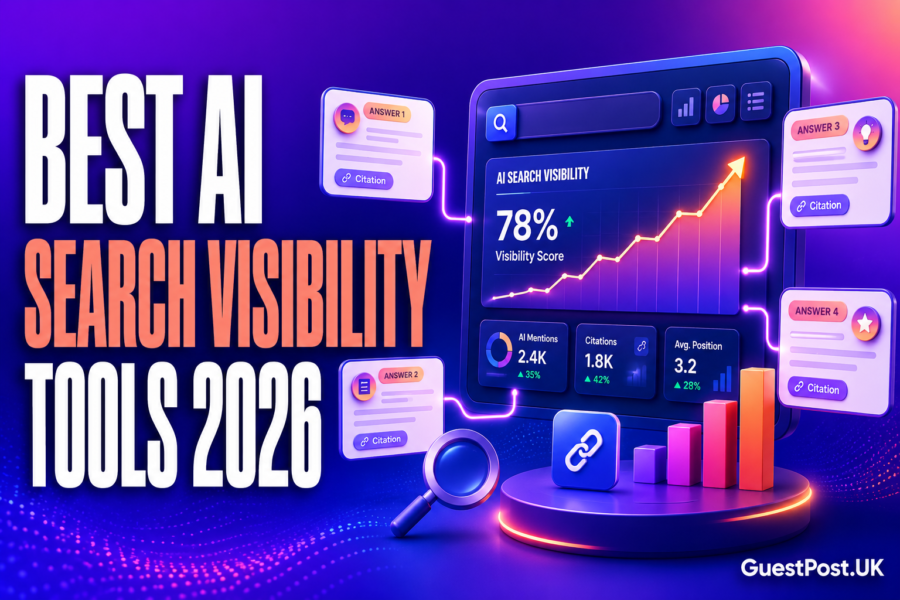
For a wider market overview, read our comparison of the best AI search visibility tools.
Is Waikay worth using?
Waikay is worth considering for marketers who want to understand how AI systems perceive their brand without having to start with an expensive enterprise platform.
Its most useful differentiators are the focus on brand understanding, fact accuracy, source tracking and topic-level gaps. These features move the conversation beyond “did ChatGPT mention us?” towards “does AI understand what we do, describe it correctly and recommend us for the right topics?”
The platform is particularly suitable for SEO consultants, agencies, B2B brands and growing businesses that need a practical first layer of AI visibility intelligence.
Use Waikay as a diagnostic tool. Then act on the findings by providing clearer content, stronger service pages, accurate public information, relevant internal links, and credible third-party authority. That is how an AI visibility report becomes a sustainable marketing advantage.