
AI can help writers research, structure and improve a guest article. It can also make it dangerously easy to produce generic content at scale.
So, are AI-generated guest posts safe for SEO? The honest answer is: they can be, but only when the finished article is useful, original, relevant and properly reviewed. The risk is not simply that AI was used. The risk is publishing thin, repetitive or manipulative content on a third-party website purely to gain a link.
That distinction matters for buyers, agencies, writers and publishers. If you are weighing up AI-assisted placements, first read our guide on AI-generated content and backlinks. This article provides the practical quality checks to apply before a guest post goes live.
Google looks at the outcome, not a magic AI percentage
Google does not publish a rule saying an article becomes unsafe once a certain percentage is AI-written. Its concern is whether content exists mainly to manipulate rankings and whether it genuinely helps users.
Google’s generative-AI guidance says the tools can be useful for research and structure, but generating many pages without adding value may breach its scaled-content-abuse policy. Read Google’s guidance here.
This means that a well-edited, expert-led article can be more valuable than a poorly written human-authored piece. Equally, an article written entirely by a person can still be low quality if it says nothing new and exists only to place a backlink.
With guest posts, there are two standards to consider:
- Is the article genuinely worth publishing for the host site’s audience?
- Is the link placement editorially sensible and appropriately handled?
Both must be right.
Why AI-assisted guest posts can become risky
The problem usually starts before the writing itself. A vague prompt such as “write 1,000 words about link building and add this anchor text” often produces an article that could appear on almost any website.
That is a poor fit for a real publication. It may include broad claims, invented statistics, obvious filler and a backlink that feels forced into the text.
A low-quality AI guest-post campaign often has warning signs:
- The same structure and phrases appear across multiple placements
- Articles use generic advice with no original examples
- The subject does not match the host website’s audience
- The anchor text is awkward or overly commercial
- Sources, pricing, features or statistics cannot be verified
- The publisher accepts unrelated content every day
- There is little or no editorial review before publication
Google’s spam policies apply regardless of whether weak material was created by AI, humans or a mixture of both. The issue is scaled, unoriginal content created mainly to manipulate search rankings. Google’s spam-policy explanation is clear on this point.
Use AI as a drafting assistant, not the final editor
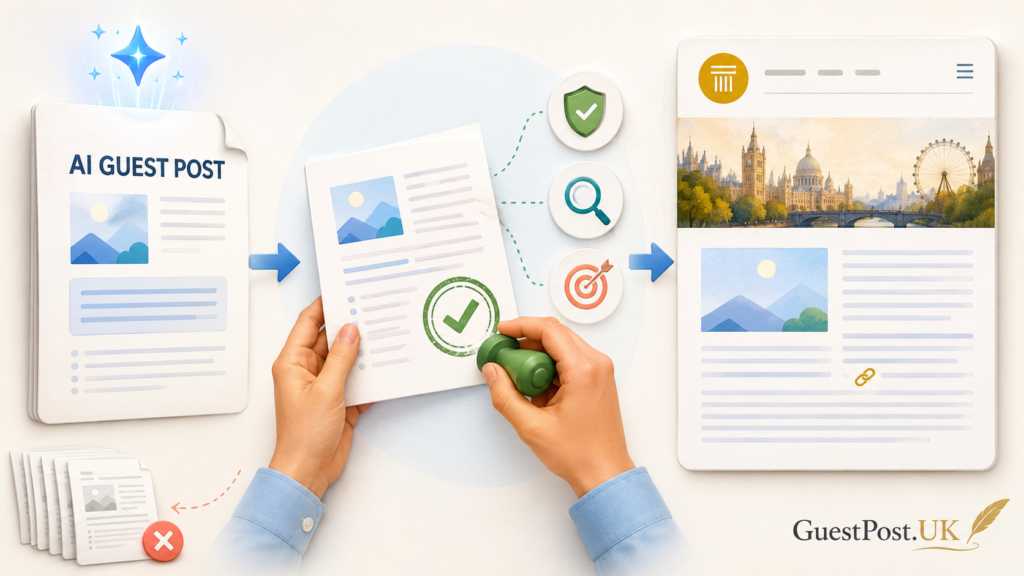
A safer workflow gives AI a limited role and keeps a knowledgeable person responsible for the finished article.
Begin with a real brief
The brief should include the target audience, publication niche, article angle, key facts, desired reader outcome and only naturally relevant internal or client links.
For example, an article for a UK small-business publication should not read like a technical SEO agency brochure. It should solve a clear business problem, use accessible language and include a link only where it genuinely supports the topic.
Add original input before writing
Provide actual experience, client-safe examples, expert observations, research findings or useful checklists. This is what stops the article from becoming a generic summary.
A guest post does not need to reveal confidential information to be original. It can explain a decision process, common mistakes, a practical framework or a lesson learned from real work.
Verify every factual claim
AI can produce confident but incorrect statements. Check statistics, dates, prices, feature descriptions, legal claims and references against trustworthy primary sources.
If a fact cannot be verified, remove it or rewrite it as a clearly labelled opinion.
Edit for the host site, not only the keyword
A guest post should match the publication’s tone, readers and standards. Adjust the introduction, examples, headings and level of detail so it feels made for that site.
If the article could be published unchanged on 50 unrelated websites, it probably is not strong enough.
A pre-publication quality checklist
Use this short check before approving an AI-assisted guest post.
| Check | What good looks like |
|---|---|
| Relevance | The topic fits the host publication and the reader’s interests |
| Originality | It includes useful insight, examples or a perspective beyond generic advice |
| Accuracy | Claims, figures and sources have been checked |
| Readability | The article flows naturally and does not repeat predictable AI phrasing |
| Link context | The linked page genuinely helps the reader at that point |
| Anchor text | It is natural, varied and not forced into an unrelated sentence |
| Editorial standard | The publisher has reviewed the article rather than publishing automatically |
| Disclosure | Paid or sponsored links are handled appropriately |
For a fuller placement review, use our guest-posting quality checklist. It covers the website, article and link together, because a strong article cannot make up for a poor-quality publisher.
Paid guest posts need careful link handling
This is separate from the question of AI.
Google’s guidance states that paid placements should use rel="sponsored"; nofollow remains an acceptable alternative. Google also warns that large-scale sponsored or guest-post campaigns designed primarily to pass ranking value can pose risks for both the site publishing the links and the site acquiring them. Google’s guidance on qualifying paid links is worth reviewing.
A legitimate publication can still accept contributed or sponsored material. The key is that the content receives proper oversight, the relationship is transparent where required, and the placement offers real value to readers.
Do not use AI content as a shortcut for pushing the same commercial anchor text across a large number of websites.
What good AI-assisted guest posts look like
The strongest examples usually have a simple formula:
- A focused topic that makes sense for the publication
- A useful answer to a real reader question
- Specific, accurate and current information
- A human editor who improves the draft
- A relevant link placed naturally within the article
- A publisher that cares about content quality and audience trust
For example, an article about measuring SEO campaign results may naturally link to a reporting service. An article about choosing reputable publishers may link to a guest-posting quality guide. The link should support the reader’s next step, not interrupt the article.
This approach also supports guest posting for AI-search visibility, because useful third-party content can improve how clearly a business is discussed across the web.
The standard to apply in 2026
Do not ask only, “Will this AI guest post rank?” Ask a better question:
Would the host site’s audience find this article useful even if there were no backlink in it?
If the answer is yes, the content is likely moving in the right direction. If the answer is no, rewrite the article, choose a better angle or do not publish it.
AI can speed up good work. It cannot replace editorial judgment, topical relevance or real expertise. Those are still the qualities that protect a guest-post campaign and make it worth the reader’s time.
For carefully planned placements, explore our guest posting services, blogger outreach services and link building services.