

A brand search result is often the first serious credibility check a potential client makes. They may have seen your company in a referral, a guest article, a LinkedIn post, or a proposal, and then search for your business name before getting in touch.
What appears on that page can either reinforce confidence or create hesitation. A strong brand SERP makes it easy to find the right website, understand what the company does and see evidence that it is active and credible. A weak one can surface outdated profiles, confusing pages, competitors with similar names or irrelevant third-party results.
For businesses investing in guest posting services, a brand SERP audit is a useful way to check whether off-site visibility is supporting the reputation you are building.
Start with a clean search
Open a private browser window, sign out of Google where practical and search:
- Your brand name
- Your brand name plus your main service
- Common spelling variations
- Your founder or spokesperson’s name
- Your brand name plus “reviews”, “contact” or a location
Do not judge the results from one search alone. Google can tailor pages by location, device, language and previous activity. Take screenshots, record the date and note anything that looks inconsistent or unhelpful.
The aim is not to control every result. It is to understand the story a new customer sees in the first page of Google.
Check whether your own website owns the important positions
Your homepage should normally make the business clear within seconds: who you are, what you offer and where to go next. But a homepage alone cannot answer every branded search need.
Look for your important pages in the results:
- Homepage
- About page
- Core service pages
- Contact page
- Case studies, testimonials or trusted resources
- Relevant social profiles
- Google Business Profile, where applicable
If a user searches for your business followed by “SEO audit” or “link building”, they should land on the relevant page rather than a generic archive page. This is where clear site architecture and useful internal links matter. A visitor reading about a technical issue should be able to move naturally to your SEO audit service without having to search again.
Google explains that contextual internal links help people and search engines understand a website and find related pages. Every important page should have at least one internal route pointing to it. Google’s link best-practice guidance is a useful reference when you are reviewing those routes.
Look beyond rankings: is the message consistent?
A first-page result may rank well but still fail the brand test. Read the visible titles and descriptions as though you were a new customer.
Check for:
- Old business names, addresses or phone numbers
- Service descriptions that no longer match your offer
- Mixed messaging between your website, directories and social profiles
- Broken pages or outdated campaign landing pages
- A competitor appearing because your name is too similar
- Poor-quality profiles that look more prominent than your official pages
Create a simple three-column note: “accurate”, “needs updating” and “needs investigation”. This keeps the audit practical rather than turning into an endless list of cosmetic changes.
An old directory listing may be quick to correct. An article with an inaccurate claim may require contacting the publisher. A misleading result on your own site may need a rewrite, redirect or a clearer page title.
Review your Google Business Profile if customers can find you locally
For a local or service-area business, the Google Business Profile can be one of the most visible branded results. Google says that a claimed and verified profile lets owners manage details such as contact information, business type, address and photos in Search, Maps and eligible knowledge panels. See Google’s business-details guidance.
Confirm that the name, primary category, opening hours, website link, service area and contact details match your website. Add current photos and respond to reviews in a professional, useful way.
Google also notes that local visibility is mainly influenced by relevance, distance and prominence. Complete information, reviews and links from other websites may all help a business stand out, but no one can pay Google for a better organic local ranking. Google’s local-ranking guidance is worth keeping in mind when an agency promises quick map-pack positions.
Use Search Console to find the branded questions people ask
Manual searching shows the presentation of your brand. Search Console shows the demand behind it.
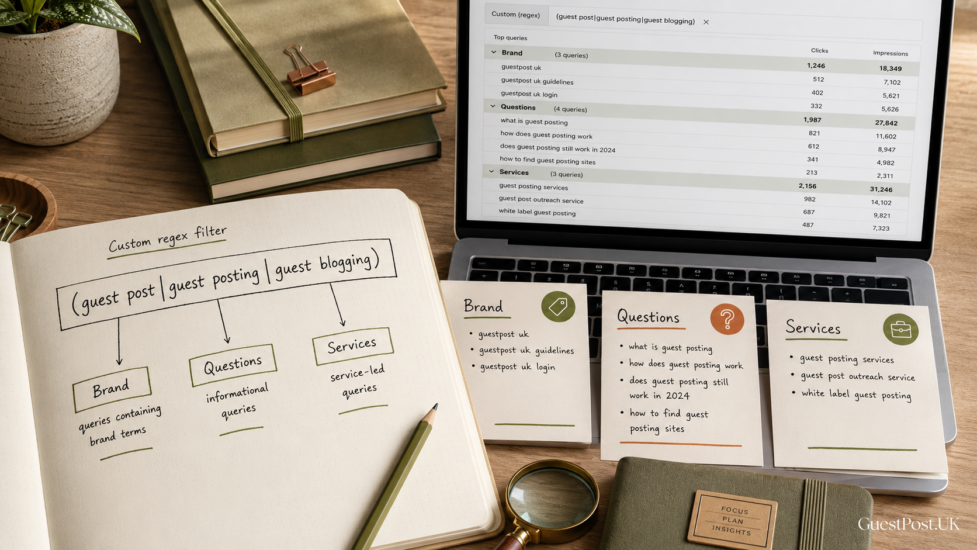
Filter Performance data for your company name, product names and common variations. Review which pages receive branded impressions, which queries lead to them and whether the click-through rate is healthy. Google’s branded queries filter can help separate searches from people who already know your company from discovery-led non-branded searches. Google notes that branded searches tend to produce higher-ranking pages and stronger click-through rates, while non-branded visibility better reflects new-audience growth. Read Google’s announcement.
Watch for branded searches that repeatedly land on the wrong page. For instance, if people search for your business plus “pricing” but only find a blog post, consider whether a transparent service or pricing page would better meet that need.
Strengthen the results you can genuinely improve
The best brand SERP work is not about creating filler pages to push something down. It is about publishing and maintaining the pages customers actually need.
Prioritise:
- A clear homepage with a specific value proposition
- Service pages that explain scope, process and next steps
- An up-to-date About page with real company information
- Helpful articles that demonstrate expertise
- Accurate directory and social profiles
- Credible third-party mentions on relevant publications
Quality link building services can support this work by earning relevant coverage and citations from real websites. The objective should be recognition and trust, not simply a higher number of links.
Deal with negative or inaccurate results sensibly
If an inaccurate page is hosted on another website, contact the publisher first. Google can reflect what exists across the web, but it cannot correct a publisher’s source material for you.
Where removal is not possible, concentrate on creating stronger, accurate pages that deserve to rank. Google’s longstanding advice on reputation management is to tackle an issue at its source where possible and proactively publish useful information that represents the business properly. Its guidance on managing reputation in search remains a sensible principle.
Run a brand SERP audit every quarter and after major changes, such as a rebrand, a new service launch, an office move, or significant press coverage. The results page is not just an SEO report—it is a public version of your business reputation.