

A weak content brief creates expensive problems later. The writer misunderstands the search intent, the client dislikes the angle, the editor has to request another draft, and the SEO team discovers the page does not fit the wider content plan.
That is why the best AI content brief generators are useful to agencies. They do not just save time finding headings from competing pages. Used properly, they bring SERP research, topic coverage, questions, keyword clustering, and editorial requirements into a single document that gives a writer a sensible route forward.
The important phrase is used properly. A brief generator should not produce a rigid list of keywords for a writer to force into 2,000 words. It should help an agency make better decisions before writing starts: what the page needs to answer, where competitors are thin, what evidence the client can add and how the new page connects to the rest of the site.
For teams building briefs manually in Google Docs, a dedicated SEO content brief generator can be a useful starting point. For larger retainers, the tools below make the workflow far more scalable.
What an agency brief needs that a solo-writer brief does not
A solo writer may only need a target keyword, a title and a rough outline. An agency brief has more jobs to do because it needs to survive the handoffs between strategist, account manager, writer, editor, and client.
A genuinely useful agency brief should state:
- The commercial purpose of the page, not only its primary query
- The target audience and their likely stage of decision-making
- Search intent, including whether the results favour guides, tools, category pages or comparisons
- Recommended structure and the questions that must be answered
- Relevant entities, subtopics and supporting terminology
- Pages to link to internally, plus appropriate anchor-text ideas
- Claims that need a client source, example or expert quote
- Tone, brand restrictions and conversion requirements
- What will make the page more useful than the current results
That final point is the one many AI-generated briefs miss. A summary of ranking pages is not automatically a content strategy. If every competitor uses the same ten headings, copying them only creates the eleventh version of the same article.
The strongest AI content brief tools at a glance
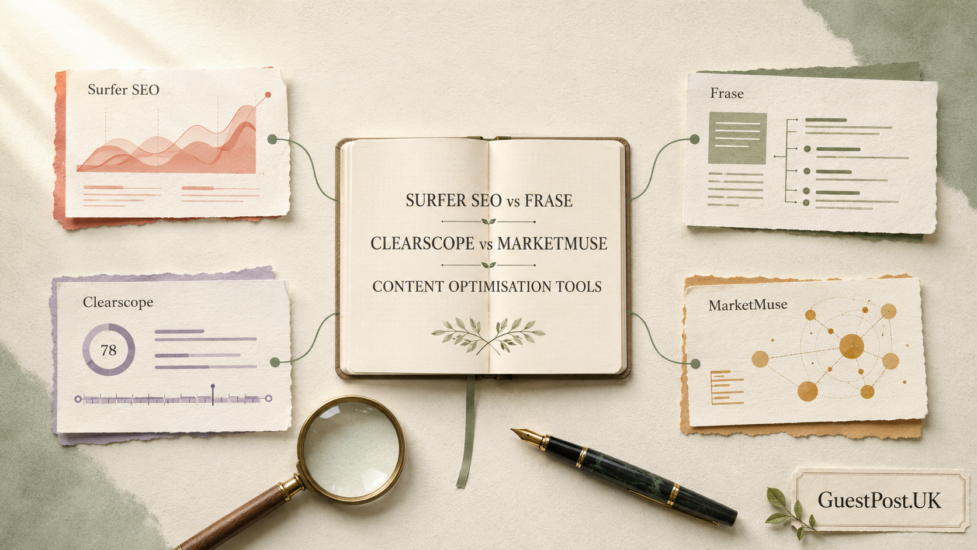
| Tool | Best for | What it adds to an agency workflow | Starting point |
|---|---|---|---|
| Content Harmony | Repeatable client-ready briefs | Custom templates, research blocks and highly structured outputs | From $50 per month |
| Keyword Insights | Topic clustering and content planning | SERP-based clusters, brief generation and bulk workflows | From around $58 per month |
| Frase | Fast research-to-brief production | SERP analysis, questions, outlines and drafting in one place | From $39 per month annually |
| Clearscope | Editorial quality and writer adoption | Clean reports and content guidance for high-value work | From $129 per month |
| Surfer SEO | Optimisation-led content teams | Briefing, scoring and production workflow in a broader toolkit | Plans vary by product and usage |
Pricing, credits and included reports change regularly, so check each provider’s current plan before committing. More important than the headline price is the cost per approved, usable brief. A low-cost tool is not a bargain if your team still spends an hour rewriting every output.
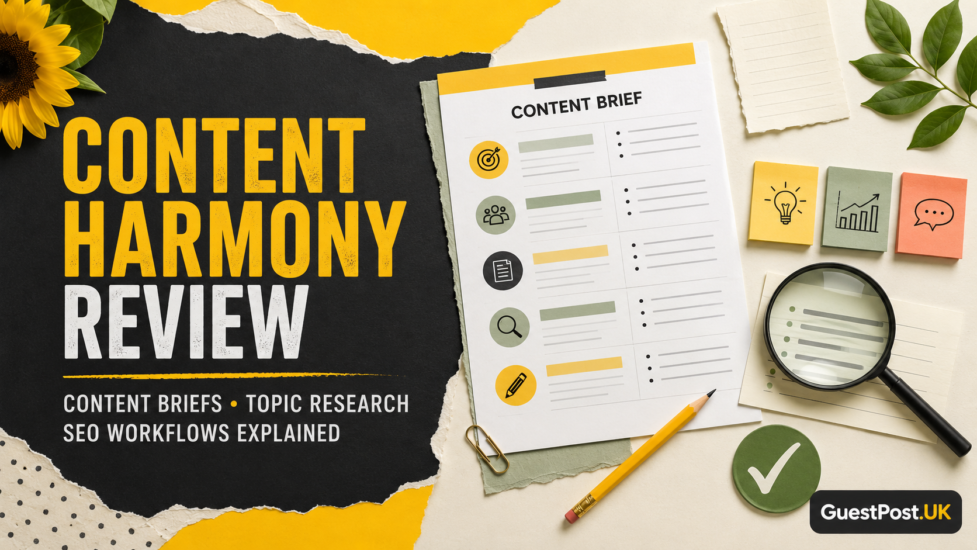
Content Harmony: best for agencies that need a proper brief template
Content Harmony is built on the idea that content production runs better when research is structured as a brief rather than a folder of screenshots and tabs. Its workflow begins with research and feeds useful findings into a customisable brief editor.
That makes it particularly relevant to agencies. You can build different brief templates for service pages, commercial comparisons, local landing pages, informational articles and guest-post campaigns. Instead of giving every writer the same generic document, your template can surface the information that matters for that content type.
For example, a brief for a client’s “best accounting software” comparison might include review criteria, audience objections, product differentiators, and tables to be checked. A brief for a local service page may prioritise geographical proof, trust signals, practical service details, and relevance to nearby locations.
Where Content Harmony stands out
Its brief editor and highlighted research blocks make it easier to turn SEO analysis into a document a writer can act on. That is better than sending a keyword export and hoping the writer interprets it correctly.
It is a strong choice if your agency:
- Produces briefs for several writers or clients every month
- Wants branded, repeatable templates rather than one-size-fits-all reports
- Needs to reduce revision rounds caused by unclear direction
- Works across different page types and industries
- Wants research findings to appear directly inside the brief
The workflow pricing model is also straightforward for agencies that can estimate their monthly production volume. Content Harmony currently offers plans based on content workflows rather than pretending every client has identical needs.
Where it needs human input
Content Harmony can show what the SERP covers. Your strategist must decide what the client can say that is more useful.
Before sending a brief to a writer, add a short “information gain” section. Ask the account manager for real examples, product screenshots, customer questions, internal data, quotes from the client’s subject-matter experts, or a position competitors are avoiding. That is how an SEO brief becomes an original article.
Keyword Insights: best for agencies planning clusters at scale
Keyword Insights is more than a document generator. Its central strength is grouping keywords by SERP similarity, which is valuable when an agency needs to decide which terms deserve one page and which need separate pages.
This matters because content teams often create cannibalisation without meaning to. They build individual briefs for near-identical phrases, publish several pages with overlapping intent and then wonder why none performs consistently.
Keyword Insights helps earlier in the process. You can cluster a large keyword set, understand the likely page groups and then create briefs around those clusters. Its content brief feature includes live search results, headings from ranking pages, question sources and sharing options, making it useful for planned editorial calendars.
Where Keyword Insights earns its place
This is usually the best option for agencies with large content roadmaps, new-client onboarding work or multiple sites in the same sector.
Use it when you need to:
- Cluster hundreds or thousands of keywords before briefing begins
- Identify which topics should be treated as one page
- Generate briefs in bulk after strategy approval
- Find content gaps in an existing site architecture
- Reduce cannibalisation across an ambitious publishing plan
It can be especially effective alongside a technical and content review. A good SEO audit identifies the existing pages, authority gaps and technical blockers; Keyword Insights can then help turn the opportunity list into a sensible content map.
The risk to avoid
Keyword clustering is a planning input, not a publishing instruction. Search results change, client priorities change, and some terms that cluster together still need separate landing pages because they serve different commercial audiences.
An agency strategist should check the cluster before it becomes a brief. Look at the results themselves, the stage of the buyer journey and whether the client has a different service or product page that needs protecting.
Frase: best for quick, practical research briefs
Frase is a strong fit for agencies that want a fast research-to-writing loop. It pulls together competitor-page structures, questions, topic ideas, and content guidance in a single workspace, helping a strategist quickly move from a target topic to a workable outline.
It is less intimidating than a complex enterprise planning platform, which is an advantage for lean teams. A strategist can produce a solid first-pass brief, add client-specific requirements and hand it to a writer without moving information through five different tools.
Frase has also expanded into a broader SEO, GEO, and AI search workflow. That may appeal to agencies looking for a single platform that supports research, drafting, optimisation and publishing.
Best uses for Frase
Frase is particularly useful for:
- Small and mid-sized agencies with a regular content-production rhythm
- Faster turnaround briefs for informational posts
- Writers who need SERP research and questions in one place
- New content teams building a more organised process
- Teams that want AI assistance without automatically handing publishing to AI
The sensible workflow is to use Frase to gather and organise the evidence, then add a strategist’s judgement before assigning the article.
Do not confuse speed with strategy
Frase can quickly create a draft. It cannot determine whether the topic is commercially viable, whether the client has sufficient authority to compete, or whether an existing page should be improved instead.
That decision should come from your keyword strategy, Search Console data, client goals and competitive analysis. If a page targets a valuable service query, the brief should also connect it to the right conversion path, such as your SEO services or a relevant supporting guide.
Clearscope: best for premium editorial collaboration
Clearscope remains popular with editorial-focused content teams because the experience is clean and straightforward. Its reports help writers understand relevant terms and topic coverage without making the document feel like a spreadsheet disguised as a writing assignment.
For agencies producing fewer but higher-value pieces, that can justify the price. Think B2B thought leadership, technical guides, product-led content and commercial comparison pages where the cost of a weak article is much higher than the cost of one report.
Clearscope now covers broader discoverability work across Google and AI search, but its natural place in an agency process is still the editorial hand-off: helping writers and editors produce comprehensive, relevant work in a usable environment.
Choose Clearscope when
- Client content must meet a high editorial standard
- Writers need simple, credible guidance rather than complex tooling
- You are creating high-value pillar pages or comparison content
- Agency specialists and client experts collaborate on drafts
- A smoother writing experience will increase adoption
The limitation is budget. Teams producing large quantities of low-value posts may find the cost difficult to justify. It is better suited to quality-led production than indiscriminate volume.
Surfer SEO: best for a broader optimisation workflow
Surfer SEO is most useful when content briefs are one part of a larger production and optimisation system. Its Content Editor, scoring approach and wider SEO workflow appeal to agencies that want a repeatable standard from brief through to publication.
It can work well where different writers need a shared process. The strategist creates the direction, the writer works in the editor, and the SEO lead has a visible final check before publication.
What agencies should use it for
Surfer is a practical choice when your agency needs:
- A consistent on-page review process across many writers
- Content-brief and optimisation workflows in the same platform
- A clearer route for refreshing existing posts
- Reporting around content performance and visibility
- A system that works across several active client accounts
But do not make the score the brief’s success metric. A high score does not prove that a page is accurate, persuasive or different from competitors. Build the brief around the reader’s need first, then use optimisation guidance to check whether important subtopics have been missed.
A better agency process: AI research, human direction
The best content brief generators are most effective when they support a clear five-stage process.
1. Validate the opportunity
Check the keyword, page intent, commercial relevance, current rankings and existing site coverage. Do not brief a page just because a keyword tool reports search volume.
2. Use AI to compress research
Gather ranking-page patterns, questions, common entities, likely content format and related subtopics. This is where the tools above save real time.
3. Add the client’s unfair advantage
Insert proof that competitors cannot reproduce easily: team experience, methodology, data, pricing context, screenshots, case-study details, product knowledge or customer language.
4. Map the internal journey
Specify the pages the article should naturally support. An AI-search explainer may lead readers to GEO services. A guide about earning authority may connect to guest posting services. This should be planned before writing, not bolted on afterwards.
5. Review the brief before the draft starts
A ten-minute strategist review can prevent an hour of writer revision. Check that the angle is distinctive, the page serves the correct search intent, and every key instruction is clear.
Choose the generator that fits the stage you are trying to improve
Choose Content Harmony if client-ready brief templates and structured research are your main priority.
Choose Keyword Insights if your agency needs to cluster keywords, plan content architecture, and create briefs at volume.
Choose Frase if you want the quickest practical route from topic research to a writer-ready outline.
Choose Clearscope if editorial quality and writer adoption matter more than raw production volume.
Choose Surfer SEO if briefing sits inside a wider content-optimisation process already used by your agency.
The winning brief is neither the longest nor the one with the most suggested keywords. It is the one that gives a capable writer enough direction to create a page your client would be proud to put their name on—and enough freedom to say something competitors have not already said.