
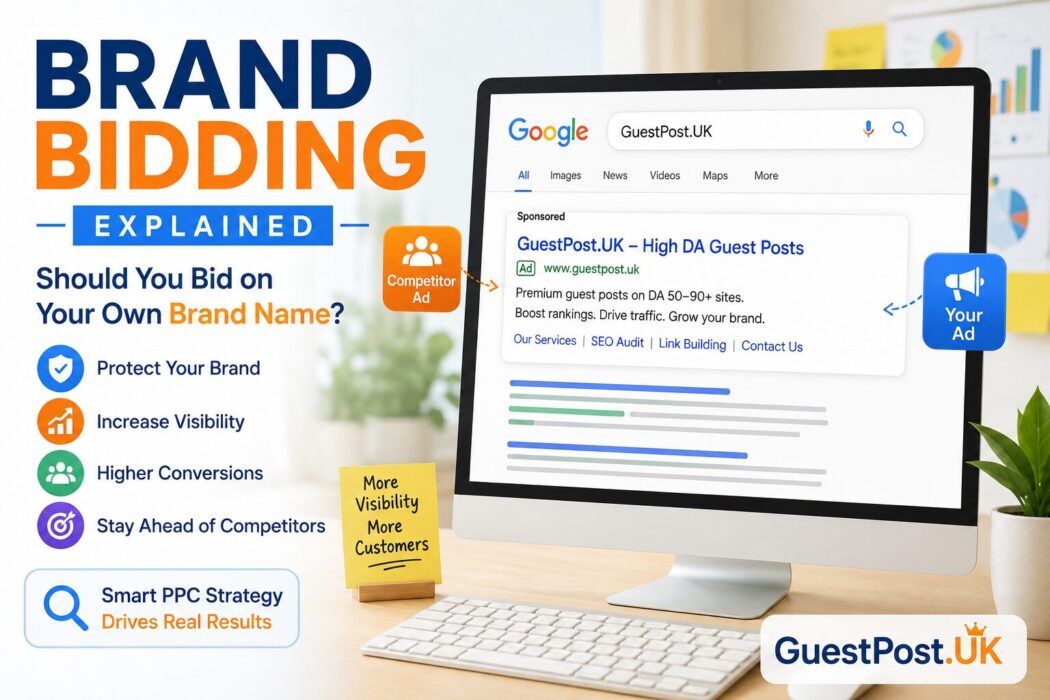
Many businesses invest heavily in building brand awareness through SEO, content marketing, social media, and offline advertising, only to discover that competitors appear above them in Google Ads when someone searches for their company name.
This practice is known as brand bidding, and it remains one of the most debated topics in paid search marketing.
Some advertisers see it as a legitimate competitive strategy, while others believe it unfairly targets businesses that have invested years building their reputation. Questions often arise about whether competitors are allowed to bid on branded keywords, whether you should bid on your own brand name, and how brand bidding affects SEO and organic traffic.
The reality is that brand bidding is neither inherently good nor bad. Like most PPC strategies, its effectiveness depends on your objectives, competition, budget, and how your campaigns are managed.
In this guide, we’ll explain how brand bidding works, Google’s advertising policies, the advantages and disadvantages, and when bidding on branded keywords makes commercial sense.
What Is Brand Bidding?
Brand bidding is the practice of bidding on branded keywords within Google Ads or another search advertising platform.
A branded keyword contains the name of a company, product, service or trademark.
For example:
- GuestPost.UK
- Nike trainers
- Apple MacBook
- Semrush
- Ahrefs
- Microsoft Office
When someone searches for one of these terms, advertisers can participate in an auction to display sponsored adverts above or alongside the organic search results.
There are generally two forms of brand bidding:
Bidding on Your Own Brand
A company chooses to advertise against its own brand name.
For example, if GuestPost.UK runs Google Ads targeting:
- GuestPost.UK
- GuestPost UK
- GuestPostUK
- GuestPost.UK SEO
that is known as first-party brand bidding.
Many businesses do this to:
- Protect branded search traffic
- Increase visibility
- Promote specific offers
- Direct visitors to dedicated landing pages
- Prevent competitors from occupying the top sponsored positions
Bidding on a Competitor’s Brand
A different company targets another business’s brand name.
For example:
Company A bids on:
- Company B
- Company B pricing
- Company B alternatives
- Company B reviews
The objective is usually to attract users who are already researching a competing business and encourage them to compare alternatives before making a purchasing decision.
This practice is common across industries including:
- SaaS
- SEO
- Digital marketing
- Insurance
- Finance
- Legal services
- Ecommerce
- Telecommunications
Although controversial, competitor brand bidding is generally permitted under Google’s advertising policies, provided advertisers comply with trademark and advertising guidelines.
Why Brand Bidding Matters in PPC
Branded searches often have very different characteristics from generic keyword searches.
Someone searching:
SEO agency
is still exploring options.
Someone searching:
GuestPost.UK
already knows the business.
This difference significantly changes user intent.
Branded searches typically deliver:
- Higher click-through rates
- Better conversion rates
- Lower acquisition costs
- Stronger commercial intent
- Greater purchase readiness
As a result, branded keywords frequently become some of the highest-performing campaigns within a Google Ads account.
However, this also explains why competitors may choose to target them.
If another advertiser can persuade even a small percentage of those users to compare alternative providers, they may acquire valuable customers who were already close to making a purchase.
For businesses with strong brand recognition, protecting branded search visibility can therefore become an important component of a wider PPC strategy.
How Brand Bidding Fits Into the Customer Journey
Brand bidding is closely linked to customer intent.
Imagine two different users searching Google.
User A
Searches:
best SEO agency
This person is still researching.
They are comparing providers, reading reviews and gathering information before making a decision.
Both SEO and PPC campaigns targeting generic keywords aim to capture this early-stage audience.
User B
Searches:
GuestPost.UK
This person already knows the brand.
Perhaps they:
- Visited the website previously
- Read a guest post
- Received a recommendation
- Saw a social media advert
- Clicked an email campaign
- Watched a webinar
Their search demonstrates considerably stronger commercial intent.
This explains why branded keywords often convert better than generic searches.
Businesses that understand this difference can allocate advertising budgets more strategically.
Why Businesses Bid on Their Own Brand
At first glance, paying for clicks on your own company name might seem unnecessary.
After all, if your business already ranks first organically, why pay for advertising?
The answer depends on several commercial factors.
Protecting Search Visibility
Paid adverts appear above most organic search results.
Even when your website ranks first organically, competitors may occupy the sponsored positions above it.
Running your own branded campaign helps ensure your business maintains maximum visibility.
Controlling the First Impression
Google Ads provides greater flexibility than organic listings.
Advertisers can highlight:
- Promotions
- Limited-time offers
- Free consultations
- Pricing
- Product launches
- Seasonal campaigns
- New services
For example, an SEO agency could use branded adverts to promote:
- Free SEO audits
- New AI SEO services
- Local SEO packages
- Link building campaigns
without waiting for organic snippets to update.
Improving Click-Through Rates
Studies consistently show that combining paid and organic visibility often increases total clicks.
Instead of competing against your organic listing, branded adverts frequently reinforce user confidence by giving your business greater search presence.
Defending Against Competitors
Perhaps the strongest reason to bid on your own brand is defensive.
If competitors are actively targeting your company name, branded campaigns help reduce the likelihood of potential customers clicking competing adverts before reaching your website.
For businesses operating in highly competitive industries such as SEO, software or financial services, this defensive strategy is often considered a worthwhile investment.
Does Brand Bidding Affect SEO?
This is one of the most common questions asked by marketers.
The short answer is:
No, brand bidding does not directly influence Google’s organic rankings.
Google Ads and Google’s organic search algorithm operate independently.
Winning an advert auction does not improve your:
- Organic rankings
- Domain authority
- Backlink profile
- Content quality
- Technical SEO
However, brand bidding can indirectly support wider marketing performance.
For example, increased visibility may lead to:
- More branded traffic
- Greater brand awareness
- Higher engagement
- Increased conversions
- Better campaign attribution
Businesses often combine branded PPC campaigns with strong organic optimisation through services such as SEO Audits, Keyword Research Services and SEO Competitor Analysis to maximise their overall search visibility rather than relying on either channel alone.
How Brand Bidding Works in Google Ads
Brand bidding follows the same auction process as any other Google Ads keyword. The difference is that the keyword being targeted contains a company, product or trademark name rather than a generic search phrase.
For example, when someone searches:
- GuestPost.UK
- Semrush
- Ahrefs
- Nike trainers
Google instantly runs an auction among advertisers targeting those keywords.
The advert that appears first is not simply the one with the highest bid. Google also evaluates several quality factors before determining the final advert positions.
The auction primarily considers:
- Maximum bid
- Quality Score
- Expected click-through rate
- Landing page experience
- Ad relevance
- Ad extensions and assets
This means an advertiser with a slightly lower bid but a highly relevant advert and landing page can often outrank a competitor willing to pay more.
A Simple Brand Bidding Example
Imagine three companies competing for the keyword:
“GuestPost.UK”
| Advertiser | Bid | Ad Quality | Likely Outcome |
|---|---|---|---|
| GuestPost.UK | £0.60 | Excellent | Position 1 |
| Competitor A | £1.20 | Average | Position 2 |
| Competitor B | £0.80 | Poor | Position 3 |
Although Competitor A bids the highest amount, GuestPost.UK may still achieve the top advert because its landing page, brand relevance and expected click-through rate are significantly stronger.
This is why businesses should not focus solely on increasing bids. Improving advert quality often delivers better long-term performance.
Can Competitors Bid on Your Brand Name?
Yes.
In most countries, Google allows advertisers to bid on competitors’ branded keywords.
This often surprises business owners.
For example, Company A may legally bid on searches for:
- Company B
- Company B pricing
- Company B reviews
- Company B alternatives
The objective is usually to encourage users to compare different providers before making a purchase.
This strategy is common across competitive industries including:
- SEO agencies
- SaaS platforms
- Insurance companies
- Law firms
- Ecommerce retailers
- Financial services
- Telecommunications
- Travel companies
However, there is an important distinction between bidding on a competitor’s keyword and using a competitor’s trademark within advert copy.
The latter is subject to additional restrictions.
Google’s Trademark Policy Explained
Google generally separates keyword targeting from advert text.
Bidding on Trademarked Keywords
In many regions, advertisers can bid on trademarked keywords without violating Google’s advertising policies.
For example, a digital marketing agency could target searches such as:
- Semrush
- Ahrefs
- Moz Pro
provided the adverts themselves comply with Google’s policies.
This allows businesses to present themselves as alternative providers while users are actively researching competitors.
Using Trademarks in Advert Copy
Including another company’s trademark directly within an advert is treated differently.
Google may restrict the use of trademarks in advert copy where valid trademark complaints exist, unless the advertiser qualifies under specific exceptions such as:
- Resellers
- Informational websites
- Review websites
- Genuine comparison pages
- Compatibility information
For example:
Allowed
Compare leading SEO platforms
Potentially problematic
Official Semrush Partner
when that statement is false.
Similarly:
Better than Brand X
may be acceptable if supported by legitimate comparison content and compliant with local advertising regulations.
Businesses should therefore review Google’s trademark guidance before launching competitor campaigns.
Is Competitor Brand Bidding Ethical?
Legal and ethical are not always the same thing.
Within the PPC industry, opinions remain divided.
Some marketers argue that:
- Search advertising is competitive by nature.
- Users benefit from seeing alternatives.
- Competition encourages better products and pricing.
Others believe:
- Companies should not profit from another business’s brand investment.
- Competitor bidding can confuse customers.
- Smaller businesses are disadvantaged when larger advertisers target their brand.
In practice, most established advertisers accept competitor bidding as part of digital marketing.
Rather than attempting to eliminate it completely, they focus on strengthening both their organic presence and branded PPC campaigns.
Brand Bidding vs Generic Keyword Bidding
Although both strategies use Google Ads, they serve very different purposes.
| Brand Bidding | Generic Keyword Bidding |
|---|---|
| Targets company or product names | Targets general search terms |
| High purchase intent | Mixed search intent |
| Usually lower search volume | Often much higher search volume |
| Higher conversion rates | Lower average conversion rates |
| Typically lower cost per click | Often more expensive in competitive sectors |
| Protects existing demand | Creates new demand |
Brand Bidding
Brand campaigns target users who already know the business.
For example:
- GuestPost.UK
- GuestPost UK reviews
- GuestPost.UK pricing
These users are often close to making a decision.
Generic Keywords
Generic campaigns target broader searches such as:
- guest posting services
- SEO agency
- link building company
- keyword research services
These users are still exploring options and comparing providers.
Because more advertisers compete for generic keywords, competition and cost per click are often significantly higher.
Which Converts Better?
In many industries, branded keywords achieve stronger conversion rates.
This happens because branded users already possess a degree of familiarity with the business.
Someone searching:
GuestPost.UK
has usually:
- Heard about the company
- Visited previously
- Read an article
- Received a recommendation
- Seen previous advertising
By contrast, someone searching:
SEO services
may have no preferred provider at all.
They are likely to compare multiple agencies before making contact.
For this reason, many advertisers divide campaigns into:
- Brand campaigns
- Non-brand campaigns
- Competitor campaigns
This separation makes reporting significantly easier.
Should You Always Bid on Your Own Brand?
Not necessarily.
Several factors influence the decision.
Consider Brand Bidding When
- Competitors actively advertise on your brand name.
- Your brand receives significant monthly searches.
- You run regular promotions.
- You want maximum search visibility.
- You operate in a highly competitive market.
- You rely heavily on online enquiries.
For example, an SEO agency investing heavily in content marketing and earning thousands of branded searches each month may find defensive brand campaigns highly cost-effective.
You May Not Need Brand Campaigns When
- No competitors target your brand.
- Branded search volume is extremely low.
- Your marketing budget is very limited.
- Organic listings dominate the search results with little competition.
In these situations, investing additional budget into broader commercial keywords or improving organic visibility through SEO Services or Keyword Research Services may generate greater long-term value.
How Brand Bidding Supports SEO Rather Than Replacing It
Some marketers mistakenly view PPC and SEO as competing channels.
In reality, they often complement each other.
For example:
- SEO builds sustainable organic visibility.
- Brand bidding protects branded traffic.
- Organic content educates potential customers.
- PPC captures immediate commercial intent.
A company that ranks organically for “SEO audit services“ while also maintaining branded campaigns for “GuestPost.UK” benefits from multiple touchpoints throughout the buyer journey.
Businesses seeking stronger long-term visibility should therefore view brand bidding as one component of a wider search marketing strategy rather than a substitute for technical SEO, content creation or authoritative link building.
Advantages of Brand Bidding
When implemented strategically, brand bidding can become one of the highest-performing campaigns within a Google Ads account. This is because branded searches usually come from users who are already familiar with your business and are much closer to making a purchasing decision than someone performing a generic search.
That said, brand bidding should support your overall marketing strategy rather than replace investments in SEO, content marketing and customer experience.
Protects Your Brand from Competitors
One of the biggest reasons businesses bid on their own brand name is defensive advertising.
Imagine you’ve invested years building your reputation through:
- SEO
- Guest posting
- Content marketing
- PR campaigns
- Social media
- Email marketing
A potential customer finally searches your company name.
Instead of seeing your advert first, they see a competitor promoting a discount or free trial above your organic listing.
Even if the user eventually clicks your website, the competitor has already gained valuable visibility.
A branded campaign helps reduce this risk by ensuring your business occupies the most prominent sponsored position whenever possible.
Increases Overall Search Visibility
When both a paid advert and an organic listing appear together, your business occupies more space on the search engine results page (SERP).
This increased visibility can:
- Build trust
- Improve brand recognition
- Increase click-through rates
- Reduce competitor exposure
- Strengthen purchase confidence
For highly competitive industries, appearing in both paid and organic results often creates a stronger impression than relying on either channel alone.
Delivers Higher Conversion Rates
Branded keywords usually demonstrate much stronger commercial intent than generic keywords.
Consider these two searches:
Search A
SEO agency
The user is still researching.
Search B
GuestPost.UK
The user already knows the business.
They may have:
- Read one of your articles
- Received a recommendation
- Seen previous advertising
- Visited your website before
- Compared your services
Because they are further along the buying journey, branded visitors often convert at a significantly higher rate.
Provides Greater Control Over Messaging
Organic search snippets depend largely on Google’s interpretation of your page.
Google Ads allows much greater control.
You can highlight:
- Limited-time promotions
- New service launches
- Pricing
- Awards
- Trust signals
- Free consultations
- Seasonal campaigns
For example, GuestPost.UK could advertise:
- Free SEO Audit
- DA 90+ Guest Posts
- UK Blogger Outreach
- Local SEO Packages
without waiting for Google’s organic snippets to update.
Improves Campaign Attribution
Many businesses underestimate the value of branded PPC for reporting.
Dedicated brand campaigns allow marketers to measure:
- Brand awareness growth
- Repeat visitor behaviour
- Campaign performance
- Conversion trends
- Cost per acquisition
- Return on ad spend
Separating branded traffic from generic traffic also makes monthly PPC reporting far more meaningful.
Disadvantages of Brand Bidding
Despite its benefits, brand bidding is not always the right strategy.
Businesses should understand the potential drawbacks before allocating budget.
Paying for Existing Demand
One criticism is that branded PPC simply pays for visitors who may have clicked your organic listing anyway.
If your business already ranks first organically and no competitors are advertising against your brand, additional advertising may generate limited incremental value.
This is why every branded campaign should be evaluated against measurable commercial outcomes rather than assumptions.
Increased Advertising Costs
As more competitors begin bidding on your brand name, cost per click may increase.
Competitive industries often experience bidding wars, particularly when:
- Software companies compete
- SEO agencies target each other
- Insurance providers advertise aggressively
- Financial services dominate search results
Although branded clicks usually remain cheaper than broad commercial keywords, costs can still rise over time.
Limited Audience Growth
Brand campaigns target people who already know your business.
They do not generate significant awareness among entirely new audiences.
To expand market share, businesses also need campaigns targeting:
- Generic keywords
- Informational searches
- Commercial investigation queries
- Problem-solving searches
Combining brand bidding with strong Keyword Research Services helps identify these broader opportunities.
Can Trigger Competitive Responses
Launching competitor campaigns may encourage rivals to target your own brand.
Some industries experience ongoing cycles where businesses continually bid against each other’s branded keywords.
Before adopting competitor brand bidding, consider whether the potential gains justify the likelihood of increased competition.
Real-World Brand Bidding Scenarios
Every business operates differently.
The following examples demonstrate when brand bidding may—or may not—deliver value.
Scenario 1: Established SEO Agency
An agency receives over 8,000 branded searches every month.
Several competitors advertise against its name.
In this case, branded campaigns make strong commercial sense because they:
- Protect search visibility
- Reduce competitor exposure
- Improve conversion rates
- Reinforce brand authority
Scenario 2: New Local Business
A recently launched company receives very few branded searches.
Almost nobody searches for its business name because brand awareness is still developing.
Instead of allocating budget to branded campaigns, the business may achieve better results by targeting broader local keywords and investing in content and local SEO.
As brand recognition grows, branded campaigns can then become part of the overall marketing strategy.
Scenario 3: SaaS Company
A software provider launches a free trial.
Branded PPC adverts promote:
- Free demonstrations
- Limited-time offers
- New features
- Customer success stories
Meanwhile, organic search supports product education through comparison articles, tutorials and detailed documentation.
Paid search captures high-intent users, while SEO continues attracting new prospects researching software solutions.
When Should Businesses Bid on Their Own Brand?
There is no universal answer.
Instead, evaluate the following factors.
Brand bidding is often worthwhile when:
- Competitors regularly advertise on your brand name.
- Your brand generates substantial monthly searches.
- You operate in a competitive market.
- Paid campaigns produce profitable conversions.
- You want greater control over search messaging.
- You run seasonal promotions or limited-time offers.
You may decide against brand bidding when:
- Your marketing budget is extremely limited.
- Competitors are not targeting your brand.
- Branded search volume remains very low.
- Organic search already dominates the results with little competition.
Testing remains the most reliable approach.
Run a branded campaign, measure its incremental value and compare performance with periods where the campaign is paused.
Common Brand Bidding Mistakes
Many advertisers assume branded campaigns require minimal management.
In reality, poor execution can waste budget and reduce performance.
Bidding Without Monitoring Competitors
Competitor behaviour changes frequently.
Review search results regularly to understand:
- Who is advertising
- Which messages they use
- Their landing pages
- Promotional offers
- New positioning strategies
This information can also support wider Competitor SEO and Keyword Gap Analysis efforts.
Sending Traffic to the Homepage
Many businesses direct every branded click to their homepage.
Often, a dedicated landing page produces stronger results.
Depending on the user’s intent, consider directing visitors to:
- Service pages
- Pricing pages
- Product pages
- Contact forms
- Consultation booking pages
Landing pages should closely match the advert’s messaging.
Ignoring Mobile Users
Branded searches increasingly occur on smartphones.
Ensure adverts and landing pages provide:
- Fast loading speeds
- Clear calls to action
- Mobile-friendly layouts
- Simple navigation
Improving page speed and user experience benefits both PPC and SEO performance.
Focusing Only on Clicks
High click-through rates are encouraging, but conversions matter far more.
Measure outcomes such as:
- Enquiries
- Purchases
- Bookings
- Phone calls
- Revenue
- Customer acquisition cost
A campaign producing fewer clicks but stronger commercial results is generally more valuable than one generating large volumes of low-quality traffic.
Brand Bidding vs SEO: Which Strategy Should You Prioritise?
One of the biggest misconceptions in digital marketing is that businesses must choose between SEO and paid advertising.
In reality, the strongest online brands use both strategically.
SEO builds long-term organic visibility, while brand bidding helps protect and maximise that visibility when users are ready to take action.
Rather than competing with one another, the two channels often produce the best results when managed together.
How SEO Works
Search Engine Optimisation focuses on improving a website’s organic visibility.
This includes activities such as:
- Technical SEO
- Keyword research
- Content optimisation
- Internal linking
- Link building
- User experience improvements
- Website performance
The objective is to earn higher rankings naturally without paying for every click.
Unlike PPC, SEO requires patience, but its benefits can continue long after the work has been completed.
For example, a well-written article targeting “SEO competitor rank tracker” or “keyword gap analysis“ may continue attracting traffic for years with only occasional updates.
How Brand Bidding Works
Brand bidding operates differently.
Instead of waiting to earn visibility, advertisers pay to appear when someone searches for their brand name.
The advantages include:
- Immediate visibility
- Complete control over advert messaging
- Promotion of specific offers
- Defence against competitor adverts
- Faster testing of marketing campaigns
The downside is that traffic stops when advertising spend stops.
Unlike SEO, brand bidding does not build lasting organic authority.
Brand Bidding vs SEO Comparison
| SEO | Brand Bidding |
|---|---|
| Builds long-term organic traffic | Generates immediate paid visibility |
| No payment per click | Pay for every click |
| Requires ongoing optimisation | Requires ongoing advertising budget |
| Improves website authority | Protects branded search traffic |
| Best for long-term growth | Best for high-intent branded searches |
| Slower results | Immediate results |
| Supports all stages of the customer journey | Focuses primarily on users already familiar with the brand |
Both channels serve different purposes.
Businesses relying exclusively on PPC often struggle with rising advertising costs, while companies relying solely on SEO may leave valuable branded search traffic exposed to competitors.
When SEO Is the Better Investment
SEO should usually receive priority when your objective is to:
- Increase long-term organic traffic
- Build authority within your industry
- Rank for informational keywords
- Generate consistent leads
- Reduce dependency on advertising
For example, GuestPost.UK publishes educational content covering:
- SEO guides
- Link building
- AI SEO
- Marketing tools
- Keyword research
Each article attracts users who may later become customers.
Unlike adverts, these pages continue working even when advertising campaigns are paused. These foundations improve the effectiveness of both SEO and PPC campaigns.
When Brand Bidding Makes More Sense
Brand bidding delivers the greatest value when:
- Your business already receives significant branded searches.
- Competitors are targeting your company name.
- You have seasonal promotions.
- You want to increase conversions from existing brand awareness.
- Your branded campaigns achieve strong return on ad spend (ROAS).
For example, imagine a visitor:
- Reads one of your blog articles.
- Leaves the website.
- Returns three days later by searching your company name.
A branded advert can reinforce trust and direct them to the most appropriate landing page, increasing the likelihood of conversion.
Using SEO and Brand Bidding Together
The strongest digital marketing strategies combine both approaches.
A typical customer journey might look like this:
Stage 1 – Awareness
The user searches:
They discover one of your blog articles through organic search.
Stage 2 – Research
Several days later, they search:
GuestPost.UK reviews
They compare your business with competitors.
Stage 3 – Purchase
Finally, they search:
GuestPost.UK
Your branded advert appears alongside your organic listing.
The customer clicks through and submits an enquiry.
Neither SEO nor PPC achieved the conversion independently.
Instead, both channels supported different stages of the buying journey.
Textual Graph: Cost vs Competition vs Conversions
The relationship between keyword competition and conversion rates often follows a recognisable pattern.
High Conversion
│                              Brand Keywords
│                                   ●
│
│                            Competitor Keywords
│                         ●
│
│                 Long-tail Commercial Keywords
│              ●
│
│        Service Keywords
│      ●
│
│ Generic Industry Keywords
│ ●
└────────────────────────────────────────────►
      Lower Competition              Higher Competition
At the same time, advertising costs often increase as commercial intent becomes stronger.
Higher CPC
│
│                          Highly Competitive Brand Terms
│                                  ●
│
│                      Competitor Brand Keywords
│                           ●
│
│              Commercial Service Keywords
│                    ●
│
│      Informational Keywords
│          ●
│
│ Broad Educational Searches
│ ●
└────────────────────────────────────────────►
          Lower Intent                 Higher Intent
These examples demonstrate why successful advertisers rarely evaluate keywords based solely on search volume.
Commercial intent, conversion potential and customer lifetime value often matter far more.
Best Tools for Brand Bidding and PPC Analysis
Choosing the right tools helps you evaluate whether branded campaigns are genuinely profitable.
Google Ads
Best for: Running branded PPC campaigns
Google Ads provides:
- Campaign creation
- Keyword bidding
- Conversion tracking
- Audience targeting
- Performance reporting
- Ad extensions
Every branded campaign begins here.
Google Keyword Planner
Best for: Keyword discovery
Useful for:
- Search volume estimates
- Keyword variations
- Competition levels
- Forecasting
Although designed for advertisers, it also supports broader keyword research.
Semrush
Best for: Competitor PPC research
Semrush allows marketers to analyse:
- Competitor adverts
- Paid keywords
- Estimated traffic
- Advertising history
- PPC competitors
This can help identify whether competitors are actively bidding on your brand.
Ahrefs
Best for: Organic visibility
Ahrefs complements branded PPC by showing:
- Organic rankings
- Competitor keywords
- Backlink profiles
- Content opportunities
While primarily recognised for SEO, it provides valuable context for businesses balancing paid and organic search.
Google Analytics 4
Best for: Measuring conversions
Track how branded traffic contributes to:
- Leads
- Sales
- Revenue
- User journeys
- Landing page performance
Without conversion tracking, it becomes difficult to judge whether branded campaigns are delivering commercial value.
Best Practices for Brand Bidding
Whether you’re managing a small local business or a national PPC campaign, several principles consistently produce better results.
Separate Brand and Non-Brand Campaigns
Never combine branded and generic keywords within the same campaign.
Keeping them separate allows you to measure:
- Cost per click
- Conversion rate
- Return on ad spend
- Impression share
- Quality Score
more accurately.
Monitor Competitor Activity
Review branded search results regularly.
Ask questions such as:
- Who is advertising?
- What offers are they promoting?
- Which landing pages do they use?
- Have new competitors entered the auction?
Competitor monitoring should form part of your wider digital marketing strategy.
Optimise Landing Pages
Winning the click is only the first step.
Ensure landing pages provide:
- Clear calls to action
- Fast loading speeds
- Mobile optimisation
- Trust signals
- Relevant messaging
Improving landing page quality can also contribute to stronger Quality Scores within Google Ads.
Measure Business Outcomes
Ultimately, success should be measured by:
- Revenue
- Leads
- Customer acquisition
- Return on investment
rather than impressions or clicks alone.
A branded campaign producing fewer clicks but significantly more sales is usually the stronger performer.
Frequently Asked Questions About Brand Bidding
What is brand bidding?
Brand bidding is the practice of bidding on branded keywords within platforms such as Google Ads. These keywords contain the name of a company, product or trademark. Businesses may bid on their own brand to protect search visibility or, where permitted, bid on competitors’ brand names to present themselves as an alternative.
Is brand bidding legal?
In most countries, yes.
Google generally allows advertisers to bid on trademarked keywords. However, using another company’s trademark within advert copy may be restricted depending on Google’s trademark policy and the circumstances of the advertisement.
Businesses should ensure their campaigns comply with both Google’s advertising policies and local trademark laws.
Should I bid on my own brand name?
For many businesses, yes.
Brand bidding is particularly valuable if:
- Competitors advertise on your brand name.
- Your brand receives significant monthly searches.
- You want greater control over your search messaging.
- Branded campaigns deliver profitable conversions.
If your brand has very little search demand and competitors are not bidding on it, your budget may achieve better results targeting broader commercial keywords.
Can competitors bid on my business name?
Yes.
Google generally permits advertisers to bid on competitors’ branded keywords.
However, competitors cannot necessarily use your trademark within advert copy without meeting Google’s policy requirements or obtaining the appropriate permissions.
Does brand bidding improve SEO?
No.
Google Ads does not directly influence Google’s organic ranking algorithm.
Running branded PPC campaigns will not increase:
- Organic rankings
- Domain Authority
- Backlink quality
- Technical SEO performance
However, branded advertising can indirectly support SEO by increasing brand awareness, encouraging repeat visits and improving the overall search experience.
Is bidding on competitor keywords worth it?
It depends on the industry and the campaign objectives.
Competitor campaigns can generate high-quality leads when:
- Your offer is genuinely stronger.
- Your landing page clearly explains the differences.
- Your pricing is competitive.
- Your conversion rate justifies the advertising cost.
Poorly targeted competitor campaigns often produce expensive clicks with relatively low conversion rates.
Testing and careful measurement are essential.
Are branded keywords cheaper than generic keywords?
Often, yes.
Because your own website is usually the most relevant destination for searches containing your brand name, branded campaigns frequently benefit from:
- Higher Quality Scores
- Better click-through rates
- Lower average cost per click
- Higher conversion rates
Actual costs vary depending on industry competition and advertiser activity.
Can small businesses benefit from brand bidding?
Absolutely.
Even local businesses can benefit if:
- Competitors advertise against their brand.
- They receive regular branded searches.
- Customers often search their business name before making contact.
For businesses with minimal brand awareness, however, investing in local SEO and broader commercial keywords may provide greater initial returns.
How do I know if competitors are bidding on my brand?
The simplest approach is to search your business name in Google and review the sponsored results.
You can also use PPC research platforms to monitor:
- Competitor adverts
- Paid keyword strategies
- Advertising history
- Impression trends
Checking periodically helps identify new competitors entering the auction.
Should I focus on SEO or brand bidding first?
For most businesses, SEO should remain the long-term foundation.
SEO creates sustainable visibility, attracts new audiences and builds authority.
Brand bidding then protects and maximises the value of the brand awareness that SEO, content marketing and other promotional activities have already generated.
Rather than viewing the two channels as competitors, successful businesses integrate them into one cohesive search marketing strategy.
Is Brand Bidding Worth It?
Brand bidding remains one of the most effective PPC strategies when used with clear commercial objectives.
Businesses that have invested heavily in building their reputation often assume organic rankings alone will protect their branded traffic. In reality, competitors can appear above those organic listings through paid advertising, potentially diverting highly qualified visitors before they ever reach your website.
That doesn’t mean every company should automatically launch branded campaigns.
The right decision depends on factors such as:
- Brand search volume
- Advertising budget
- Competitive landscape
- Conversion rates
- Customer lifetime value
- Overall marketing strategy
For Small Businesses
If your company is still developing brand awareness, prioritise:
- Local SEO
- High-quality content
- Technical optimisation
- Commercial keyword targeting
Once branded searches begin increasing, review whether branded PPC campaigns could improve visibility and conversions.
For Growing Businesses
Businesses with consistent branded search demand should regularly monitor:
- Competitor adverts
- Branded impression share
- Cost per click
- Conversion rates
- Return on ad spend
Even a modest branded campaign can protect valuable traffic that might otherwise be lost to competitors.
For Agencies and Enterprise Brands
Larger organisations should integrate brand bidding into a broader digital marketing strategy alongside:
- SEO
- Content marketing
- Digital PR
- Link building
- Competitor analysis
- Conversion optimisation
Separating branded and non-branded campaigns, monitoring auction insights and continuously testing advert copy will produce far better results than treating branded PPC as a “set and forget” activity.
Which Tools Should You Prioritise?
Beginners
- Google Ads
- Google Keyword Planner
- Google Analytics 4
- Google Search Console
These tools provide everything needed to launch and measure branded campaigns.
Growing Businesses
In addition to Google’s own platforms, consider:
- Semrush for competitor PPC research and keyword analysis
- Ahrefs for organic visibility and backlink insights
- SE Ranking for rank tracking and campaign monitoring
These platforms help you understand how paid and organic search work together.
Agencies and Advanced Marketers
Professional teams typically combine:
- Google Ads
- Google Analytics 4
- Search Console
- Semrush
- Ahrefs
- CRM reporting
- Automated dashboards
This provides a complete view of campaign performance across both PPC and SEO.
The Most Effective Long-Term Strategy
Brand bidding should not replace search engine optimisation.
Instead, use SEO to generate long-term organic visibility while using branded PPC campaigns to defend high-intent searches, promote key offers and strengthen your presence on the search results page.
When both channels work together, businesses benefit from:
- Greater search visibility
- Higher brand recognition
- Increased click-through rates
- More qualified leads
- Improved conversion rates
- Better long-term return on investment
If your competitors are already bidding on your company name—or you’re unsure whether branded campaigns would improve your marketing performance—it may be time to review your overall search strategy. Combining professional SEO Services, Keyword Research Services, SEO Audits, Link Building Services and carefully managed PPC campaigns can help ensure your business captures more of the high-intent traffic it has worked hard to earn.