
What Is Google’s UGC Fresh Data Program?
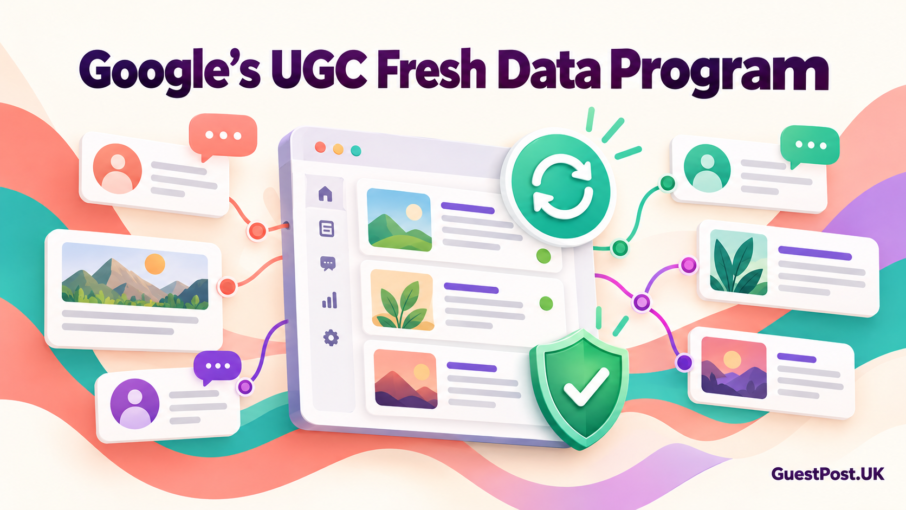
Google’s UGC Fresh Data Program is designed for eligible platforms that publish large volumes of fast-changing user-generated content. It gives approved participants a way to notify Google about newly created, updated or removed public pages more quickly.
UGC means user-generated content. Typical examples include large discussion forums, community platforms, reviews, question-and-answer websites and similar services where many users create pages every day.
The programme is not a general “instant indexing” tool for ordinary websites. It is intended for platforms with substantial, frequently changing public UGC, and Google decides whether an applicant is eligible.
For publishers, the important point is simple: the programme may help Google discover eligible new or changed UGC pages sooner, but it does not guarantee indexing, rankings, traffic or visibility in AI search results.
Google explains the eligibility and technical requirements in its official UGC Fresh Data Program documentation.
How the programme works
Approved participants can send Google structured notifications when publicly accessible UGC pages are:
- Created
- Updated
- Deleted
- Made unavailable
This helps Google understand that something has changed and may need to be crawled again. Google still decides whether to crawl, index and rank the content.
The programme is particularly relevant where a platform receives a high volume of genuine public activity. For example, a large forum may have new threads, replies and edited discussions appearing throughout the day. Delays in discovering that content can reduce Search’s usefulness for people looking for current answers.
A typical business blog doesn’t need this system just because it publishes articles regularly. Publishing useful content, maintaining a valid XML sitemap, using clear internal links and allowing Google to crawl the site remain the core indexing foundations for most websites.
What this means for guest-post publishers
The UGC Fresh Data Program does not change the rules for guest posting, sponsored articles or link building.
A contributed article should still be useful, relevant to the publication’s readers and properly reviewed before publication. Google’s spam policies continue to apply to all types of content, including content created by third parties.
For a moderated publishing platform, the most valuable lessons are not about chasing faster indexing. They are about maintaining a clear editorial process, checking submissions, preventing spam, and ensuring published articles are genuinely useful.
That is why GuestPost.UK’s free guest-post guidelines remain important. Content should be relevant, original and suitable for the publication where it appears. Submitting a page to Google or notifying it about a new URL does not turn poor-quality content into a valuable placement.
Faster discovery does not mean guaranteed indexing
It is understandable to want a newly published article to appear in Google quickly. However, no system can guarantee that Google will index every page or that it will perform well in search results.
Google still evaluates whether a page is accessible, original, useful and worth showing in its results. Google may not index a page if it is too similar to other content, has little standalone value, is blocked by technical settings, or comes from a website with broader quality issues.
For most publishers, these are the practical priorities:
- Publish original content that answers a genuine reader question.
- Keep article pages accessible to Googlebot and visitors.
- Use clear internal links from relevant category, blog or service pages.
- Include new URLs in the XML sitemap.
- Avoid duplicate pages and thin rewritten content.
- Moderate public submissions to reduce spam.
- Make commercial relationships and link attributes clear where appropriate.
Google’s broader spam policies also make it clear that buying or selling links for ranking purposes violates its rules. Approach paid editorial content as a visibility, relevance, and brand-coverage opportunity, rather than a guaranteed ranking shortcut.
A useful opportunity for community platforms
The programme may be valuable for large community publishers that create new, publicly visible content at scale. It could be relevant to a platform with thousands of active user discussions, reviews, comments or local recommendations every day.
For those platforms, quicker change notifications may support fresher search results when pages are genuinely useful and publicly available.
It does not replace technical SEO. A platform still needs sensible URL structures, clean navigation, reliable hosting, suitable spam prevention and strong content moderation.
This is especially important for websites that accept contributor content. If moderation is weak, open platforms can become vulnerable to irrelevant submissions, copied articles, and spammy links. Google has previously advised site owners to protect public areas from abuse and to use appropriate link attributes where needed.
What publishers should do now?
Publishers do not need to make an immediate technical change unless they operate the kind of large-scale UGC platform Google describes.
Instead, focus on the fundamentals that support sustainable visibility:
- Review whether contributors can submit low-quality or irrelevant content.
- Set clear quality and editorial rules.
- Check that accepted articles are placed in relevant categories.
- Keep author and publisher information transparent.
- Remove broken, duplicate or low-value pages.
- Ensure new articles are internally linked and included in the sitemap.
- Review website quality before accepting it into a publishing network.
Businesses looking to contribute useful, relevant articles can explore the GuestPost.UK free publication network. Publishers that want to understand the editorial standards can read the free guest-post guidelines.
Common questions
Is the UGC Fresh Data Program the same as Google’s Indexing API?
No. It is a separate programme for eligible platforms with large volumes of frequently changing public user-generated content. It is not a general tool for requesting the indexing of blog posts or service pages.
Will the programme make pages rank higher?
No. It may help Google discover eligible content changes more quickly, but it does not guarantee crawling, indexing, rankings or traffic.
Can a guest-post website use it?
Only if it genuinely meets Google’s eligibility criteria. A typical guest-post blog or editorial website should continue using normal SEO practices, including internal links, XML sitemaps and quality content.
Do you need to remove every contributor link?
No. The right treatment depends on the link’s relationship and purpose. Google recommends qualifying paid links with rel="sponsored" or rel="nofollow", while user-generated links can use rel="ugc" where appropriate.
Google’s UGC Fresh Data Program is worth watching, but it is not a shortcut. Strong editorial standards, original content and well-maintained websites remain the foundations of search visibility.