

Security software has traditionally created its own problem: too many security tools.
One product scans open-source dependencies. Another checks source code. Another monitors cloud configuration. Then you need something for exposed secrets, containers, APIs, penetration testing and runtime attacks.
Each system generates findings, alerts and dashboards. Development teams can end up spending almost as much time determining which warnings actually matter as fixing vulnerabilities.
Aikido Security takes a different approach.
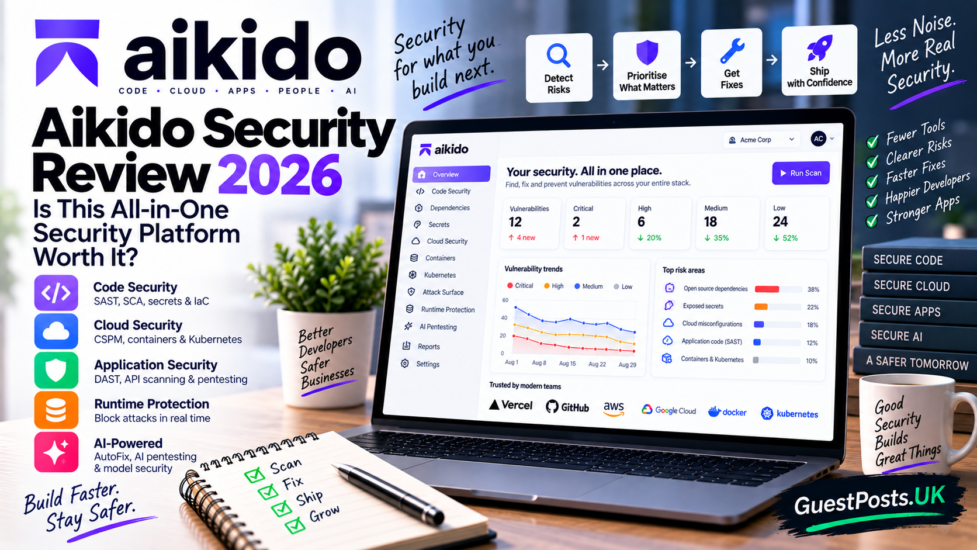
It attempts to bring code, cloud, application and runtime security into one developer-focused platform. Its current product covers software composition analysis, static code analysis, secret detection, cloud security, containers, infrastructure-as-code, dynamic testing, API scanning, attack-surface monitoring, AI pentesting and runtime protection.
That sounds comprehensive.
But breadth alone doesn’t make a security product useful. The important question is whether Aikido can turn all those scanners into actionable findings without burying developers in false positives.
After examining the platform, its current pricing and hundreds of public user reviews, it appears that this is where Aikido makes its strongest case.
What is Aikido Security?
Aikido is a developer-first application-security platform founded in 2022 and headquartered in Ghent, Belgium. Rather than specialising in a single part of application security, it aims to protect the software-development lifecycle from source code through cloud infrastructure to running applications.
Its core platform can scan:
- application source code;
- open-source dependencies;
- exposed credentials and secrets;
- infrastructure-as-code;
- container images;
- cloud environments;
- running web applications and APIs;
- external attack surfaces;
- developer devices and software supply chains.
The attraction isn’t merely having these functions available under one login.
Aikido correlates findings to determine which vulnerabilities are genuinely reachable or exploitable. That matters because vulnerability scanners can generate enormous lists of theoretical problems that don’t necessarily present the same practical risk.
Instead of treating every CVE as equally urgent, Aikido uses factors such as reachability and exploitability to help developers concentrate on issues that could actually affect the application.
For small development teams without dedicated security departments, that could be far more useful than another spreadsheet with 3,000 vulnerabilities.
Aikido covers far more than basic vulnerability scanning
Aikido’s platform is now effectively divided across Code, Cloud, Attack and Protect security layers.
The Code suite includes dependency scanning or SCA, malware detection, SAST, AI-assisted SAST, infrastructure-as-code checks and secrets detection. It can also generate software bills of materials and examine software licensing risks.
Cloud security extends into CSPM, virtual machines, containers, Kubernetes and infrastructure configuration. Aikido can continuously check cloud environments against security and compliance requirements and provide context about exposed workloads.
Attack covers more offensive testing: DAST, API scanning, attack-surface monitoring and autonomous penetration testing.
Protect then moves security into runtime, where Aikido says it can block malicious traffic, bots, OWASP Top 10 attacks and potentially dangerous payloads.
This breadth is why comparing Aikido to a single security product can be misleading.
It isn’t simply a SAST alternative.
It aims to replace or consolidate several security products at once.
SAST finds vulnerabilities inside your own code
Static Application Security Testing — SAST — analyses source code without needing to execute the application.
Aikido’s scanner looks for vulnerabilities such as SQL injection, cross-site scripting, buffer overflows and other insecure coding patterns. Custom SAST rules can also be created for risks specific to an organisation.
This becomes increasingly relevant as companies use AI to produce more software.
Tools such as Base44, which we reviewed immediately before this batch, can dramatically accelerate application development. But generating software faster also means organisations can generate security problems faster.
AI-written code still needs review.
Aikido’s IDE integrations are particularly interesting because developers can detect issues while they’re writing code, rather than discovering them days later in a separate security dashboard.
The free IDE functionality currently supports VSCode, Cursor and Windsurf, with SAST and secret detection available on the free plan for supported languages.
That is much closer to where security needs to move in an AI-coding environment.
SCA checks the code you didn’t write
Modern applications contain huge quantities of third-party software.
A developer might write 20% of an application while the remainder depends on open-source packages, libraries and frameworks.
That creates supply-chain risk.
Software Composition Analysis — SCA — examines those dependencies for known vulnerabilities, licensing problems and outdated components. Aikido combines dependency scanning with reachability analysis so teams can distinguish a vulnerable library that genuinely affects their application from a theoretical CVE in code that isn’t actually reached.
The platform also supports SBOM generation.
An SBOM — Software Bill of Materials — is effectively an inventory of the software components contained within an application. Aikido can export these in formats including CycloneDX, SPDX and CSV.
For organisations facing security questionnaires, enterprise procurement or compliance requirements, this is becoming increasingly important.
Secret detection could prevent some very expensive mistakes
One of the simplest development mistakes is also one of the most dangerous: putting a private credential directly into source code.
API keys, database passwords and cloud credentials can accidentally reach public repositories or other environments where they shouldn’t exist.
We recently covered this exact risk in our guide to securely handling a ChatGPT API key, where credentials should be stored server-side rather than exposed in browser code or public repositories.
Aikido scans Git repositories, development environments and CI workflows for secrets. Its current platform can also perform secret liveness detection, checking whether an exposed credential remains active and adjusting the severity accordingly.
That is a useful example of Aikido’s wider philosophy.
Finding a string that looks like a password is one thing.
Determining whether it is still usable is considerably more valuable.
Cloud security extends beyond the application itself
Secure code can still run inside insecure infrastructure.
A storage bucket accidentally exposed publicly, an overly permissive IAM policy or an incorrectly configured cloud service can create vulnerabilities even if the application code is clean.
Aikido’s cloud-security functionality covers CSPM, virtual machines, infrastructure-as-code, containers and Kubernetes environments. Its current Cloud suite also includes runtime exposure context and attack-path analysis designed to identify combinations of misconfigurations that could lead to an actual breach.
This is one reason the platform is more relevant to SaaS businesses than to ordinary website owners.
A simple WordPress publisher probably doesn’t need enterprise CSPM and Kubernetes scanning.
A SaaS company operating AWS infrastructure, dozens of repositories, APIs and containers could have an entirely different requirement.
AI pentesting is one of Aikido’s most ambitious features
Traditional penetration testing involves security specialists actively attempting to exploit an application.
It’s valuable but can be expensive and relatively infrequent. A business might commission a penetration test once or twice a year even though its developers deploy new code every day.
Aikido is trying to make this process continuous.
Its Attack suite uses autonomous AI-powered testing across running applications, infrastructure and APIs. The platform advertises conventional and continuous pentesting, with testing that can run when new software is deployed.
This doesn’t mean I’d automatically eliminate human penetration testers.
Complex business logic, unusual attack chains and contextual judgement can still benefit from experienced human security specialists.
The interesting proposition is frequency.
If automated pentesting catches obvious vulnerabilities on every deployment, human testers can spend more time investigating the difficult problems automation doesn’t find.
That is a much stronger use of AI than simply generating another security report.
AutoFix moves Aikido from detection towards remediation
Security products have historically been very good at telling developers they have problems.
Developers generally want to know something else:
How do I fix it?
Aikido’s AutoFix capabilities can propose fixes for detected issues. Its free Developer tier currently includes 10 AI AutoFixes per month, while the paid plans offer unlimited AutoFix usage under their published fair-usage limits.
Importantly, Aikido says its repository access is read-only. It doesn’t silently modify the customer’s source code; instead, it delivers proposed fixes through pull requests that developers review before merging.
That’s the architecture I’d want.
Security automation should accelerate remediation without bypassing code review.
Aikido is also moving into AI-specific security
Aikido’s scope has expanded significantly during 2026.
Its platform now includes AI tools and model detection as part of device and developer security, helping organisations monitor or block unapproved AI usage.
And today, 21 September 2026, Aikido announced an open-weight cybersecurity AI model designed to operate locally rather than requiring organisations to send sensitive code to external AI providers. Reuters reports that the model is intended for cybersecurity applications at a time when organisations are increasingly concerned about both AI-enabled attacks and sending proprietary source code into third-party cloud AI systems.
That’s a particularly relevant development.
One of the awkward questions surrounding AI security products is:
Do I need to expose sensitive code to another AI service in order to secure it?
Local models could reduce that tension for organisations with strict privacy or data-sovereignty requirements.
Aikido Security pricing in September 2026
Aikido has one of the more substantial free security plans we’ve encountered in this review series.
Its current pricing page shows the following structure:
| Plan | Current published starting price | Included users | Typical use |
|---|---|---|---|
| Developer | $0 forever | 2 | Individual developers/small projects |
| Basic | $300/month | 10 | Small development teams |
| Pro | $600/month | 10 | Growing teams |
| Advanced | $600/month shown at current configuration | 10 | More advanced security requirements |
| Enterprise | Custom | Custom | Large organisations |
Aikido’s pricing calculator can change according to the number of developers and selected configuration, so organisations should treat the displayed figures as starting/configuration prices rather than assuming every implementation costs exactly the amounts above. The pricing page also offers annual billing with a discount and separate/custom pricing for some modules and pentesting.
The free tier is surprisingly capable.
What do you get for free?
The Developer plan costs $0 and requires no credit card.
Its current fair-usage allowances include:
10 repositories, 2 container images, 1 domain, 1 cloud account, 10 AI AutoFixes per month and 250,000 protected requests per month.
It also includes access to core security functions including dependency scanning, SAST, secrets detection, cloud checks, licensing risks, outdated-software detection, infrastructure-as-code checks and DAST, although some advanced functionality and scanning coverage differ from paid plans.
That’s enough for an individual developer or small business to do meaningful security work rather than merely viewing a demonstration dashboard.
For comparison, Basic expands coverage to 100 repositories, 50 container images, three domains, three cloud accounts and 10 million protected requests monthly.
Pro increases that to 200 repositories, 100 containers, 10 domains, 10 cloud accounts and 20 million protected requests, while also introducing features such as attack-surface monitoring, malware detection and additional advanced security capabilities.
Is $300–$600 per month expensive?
For an ordinary website owner, yes.
For a software company, potentially not.
This is why context matters so much when reviewing security products.
If you’re protecting one WordPress marketing site, something such as Wordfence or another dedicated website-security product is much closer to the requirement. Our best WordPress plugins guide includes both Wordfence and Sucuri among the security options for WordPress websites.
Aikido becomes economically interesting when a development team would otherwise need separate products for SAST, SCA, secrets, CSPM, containers, DAST, SBOM generation and other security tasks.
At that point, tool consolidation becomes part of the ROI calculation.
Don’t compare $600 Aikido with a £99 WordPress security plugin.
Compare it with the combined cost — and management overhead — of the development-security products it might replace.
Aikido’s public reviews are unusually strong
Unlike TrafficPartner, where independent user evidence was thin, Aikido has a substantial public review footprint.
At the time of this review, G2 shows 263 reviews with an average rating of 4.6/5. The distribution is also noteworthy: 195 five-star reviews, 63 four-star reviews and only five three-star reviews, with no two- or one-star ratings shown in the current dataset.
Recent September 2026 reviewers repeatedly mention three strengths: reduced vulnerability noise, consolidation of multiple security products and responsive support.
One verified current user described how reachability analysis helped the team focus on genuinely exploitable vulnerabilities. Another highlighted consolidating AppSec across teams and using the IDE plugin to fix issues closer to development.
These are particularly relevant comments because they align with Aikido’s central product claim rather than simply praising the interface.
Gartner Peer Insights provides another useful signal
Gartner Peer Insights currently reports Aikido at approximately 4.8/5 across its broader review footprint, with recent 2026 reviews particularly positive about onboarding, developer workflows, support and actionable findings.
One theme appears repeatedly across both Gartner and G2: support quality.
That matters more in security software than it might in a basic productivity application. When a scanner identifies a critical vulnerability immediately before deployment, being able to determine whether the finding is genuine and how to address it can be commercially important.
No review platform proves that every customer will receive the same experience, but the combination of hundreds of G2 ratings and Gartner’s verified peer-review footprint provides much stronger independent evidence than vendor testimonials alone.
Aikido has grown extremely quickly
Aikido isn’t simply a small security startup anymore.
The company completed a roughly $60 million Series B financing in early 2026 that gave it unicorn status, according to legal advisers involved in the transaction.
In July, Aikido acquired US cybersecurity company Root, whose technology focuses on automated remediation of vulnerabilities in open-source software. The acquisition is intended to strengthen Aikido’s software-supply-chain remediation capabilities.
Rapid company growth doesn’t prove product quality.
It does, however, help explain why Aikido’s feature set is changing so quickly—and why an older review of the platform could now substantially understate what it does.
Aikido vs separate security tools
This is the comparison I’d make before purchasing.
| Requirement | Aikido approach | Separate-tool approach |
|---|---|---|
| Dependency vulnerabilities | SCA | Dedicated SCA product |
| Source-code vulnerabilities | SAST / AI SAST | Dedicated SAST |
| Secrets | Built in | Secret scanner |
| Cloud posture | CSPM | Cloud-security platform |
| Containers | Built in | Container scanner |
| Running applications | DAST | DAST product |
| APIs | API scanning | API-security product |
| Penetration testing | AI/continuous pentesting | External pentester/platform |
| Runtime | Protect | WAF/runtime-security product |
| Management | Unified findings | Multiple dashboards |
Aikido’s strongest argument is therefore not necessarily:
“Our SAST is better than every dedicated SAST product.”
It is:
“Do you really want to operate eight separate security products?”
For many development teams, that’s a compelling question.
Specialist enterprise organisations may still prefer best-of-breed products in individual categories. Smaller and mid-sized teams may value consolidation more heavily.
What I like most about Aikido
The strongest aspect isn’t actually the number of scanners.
It’s the focus on reducing noise.
A security dashboard containing 20,000 warnings can create the illusion of thoroughness while being practically useless. If developers don’t know which five vulnerabilities require immediate action, the tool hasn’t solved the operational problem.
Reachability analysis, automatic triage, exploitability context and remediation assistance all push Aikido towards prioritising the vulnerabilities that matter.
That philosophy is reflected strongly in current G2 feedback.
The free tier is another major advantage. A developer can connect a small project and actually experience the platform before committing hundreds of dollars per month.
What I would watch carefully
An all-in-one product inevitably creates compromises.
Security teams with exceptionally sophisticated requirements may find that a specialist product provides deeper capabilities in a particular discipline. An enterprise might therefore use Aikido for broad application-security management while retaining specialised tools for particular high-risk workloads.
The pace of feature development is another consideration.
Aikido is expanding from code security into cloud, AI pentesting, runtime protection, device security and AI-model security at considerable speed. That’s exciting, but buyers should evaluate the specific modules they need today, not purchase purely on roadmap momentum.
Finally, treat AI AutoFix as assisted remediation.
A generated fix should be reviewed, tested and passed through normal development controls before reaching production.
Security automation shouldn’t become security complacency.
Is Aikido useful for SEO agencies and website owners?
This is where we need to be realistic about GuestPost.UK audience.
If you run a typical content website, Aikido is probably overkill.
You still need secure hosting, WordPress updates, sensible access control, backups, malware protection and other conventional website-security practices.
Aikido becomes much more relevant when an SEO or digital agency starts building its own software.
Suppose an agency develops proprietary crawlers, client dashboards, AI SEO tools, APIs, marketplace systems or SaaS applications. Those products can contain API credentials, third-party dependencies, custom PHP or JavaScript, databases and cloud infrastructure.
The security requirement changes immediately.
This is particularly relevant as marketers increasingly build their own AI tools rather than purchasing everything from third parties. Our ChatGPT API key guide already explains why credentials in custom applications must remain protected server-side.
Aikido extends that principle from one API key to the entire application stack.
Who should use Aikido Security?
Aikido makes the strongest case for SaaS companies, software startups, development agencies and organisations running multiple applications, repositories or cloud workloads.
It’s particularly attractive to teams with security functionality scattered across several vendors.
Individual developers and early-stage startups should also look at the free tier. Ten repositories, a cloud account, domain scanning and basic application-security tooling for $0 makes experimentation relatively painless.
For organisations with dedicated security engineering departments and highly specialised requirements, the evaluation should be more rigorous: test Aikido’s individual scanners against the specialist products you already use and measure false positives, detection quality and remediation time.
Is Aikido Security worth it in 2026?
For a company actually developing software, Aikido deserves serious consideration.
It combines an unusually broad security stack with a developer-focused interface, meaningful free plan, automated prioritisation and increasingly sophisticated remediation tools.
More importantly, independent users appear to validate the core proposition. A 4.6/5 G2 rating across 263 reviews is a considerably stronger evidence base than the handful of reviews available for many newer AI products we’ve examined.
Its biggest advantage is consolidation.
Instead of finding a vulnerability in one dashboard, checking whether it matters in another system, creating a Jira task manually, and then asking a developer to determine the fix, Aikido tries to compress that workflow into one security layer.
GuestPost.UK rating: 4.5/5
For this particular batch of nine products, Aikido is one of the more mature and independently validated platforms we researched.
That doesn’t mean every website needs it.
A normal WordPress publisher probably doesn’t.
But once a business starts building applications, managing repositories, deploying containers, operating cloud infrastructure, or using AI to generate production code, security can no longer be an afterthought.
Aikido’s proposition is compelling because it tries to put security inside the development workflow rather than after it.
And with the free Developer plan, there is little reason to decide from screenshots alone: connect a non-critical project, run the scans, and see whether the vulnerabilities Aikido prioritises are genuinely useful to your developers.