
A few years ago, tracking brand visibility was relatively straightforward.
You monitored:
- Google rankings
- Organic traffic
- Backlinks
- Social media mentions
- Referral traffic
Today, there is a new visibility channel that many businesses are still ignoring.
Every day, millions of users ask questions such as:
- What is the best CRM software?
- Which SEO tools should I use?
- What are the top cybersecurity training providers?
- Which email outreach platform is best?
When ChatGPT provides answers, it effectively creates a shortlist.
If your brand appears, you gain visibility.
If it doesn’t, a competitor may win attention before a potential customer ever visits Google.
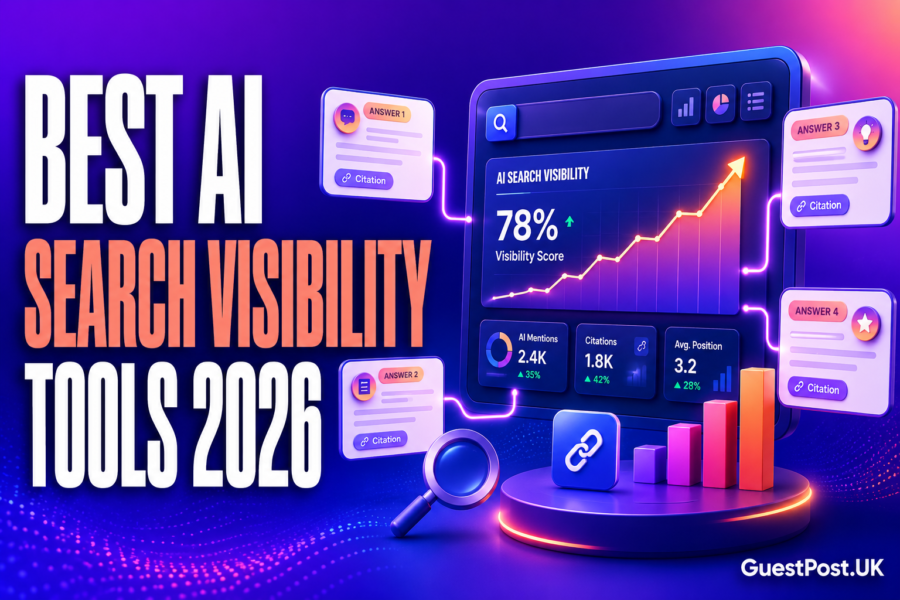
This has created a growing need for a new discipline: tracking brand mentions inside AI-generated answers.
Why ChatGPT Brand Mentions Matter
Many marketers still assume traditional rankings are enough.
That assumption becomes less accurate every year.
Consider this scenario.
A software company ranks second for an important keyword.
Historically, that position generated substantial traffic.
However, if ChatGPT consistently recommends a competing brand instead, part of the customer journey may bypass traditional search results entirely.
One SaaS founder described the issue perfectly:
“We were measuring who ranked. We weren’t measuring who got recommended.”
That distinction is becoming increasingly important.
What Counts as a Brand Mention in ChatGPT?
A brand mention occurs when ChatGPT references your:
- Company name
- Product name
- Service name
- Website
- Founder
- Brand entity
Examples include:
Direct Mention
“HubSpot is one of the most popular CRM platforms.”
Comparative Mention
“Many businesses compare Semrush and Ahrefs for SEO.”
Recommended Solution
“For outreach campaigns, Smartlead is often recommended.”
Industry Reference
“GuestPost.uk provides guest posting and outreach services.”
Each type contributes to overall AI visibility.
The Challenge of Tracking ChatGPT Mentions
Unlike traditional search rankings, ChatGPT doesn’t provide:
- Search Console data
- Analytics dashboards
- Impression reports
- Ranking reports
This creates several challenges.
Responses Change
The same question may generate different answers.
Personalisation Is Growing
Future AI systems may customise results.
No Official Brand Dashboard Exists
Unlike Google Search Console, there is currently no official platform for ChatGPT visibility.
Because of these limitations, businesses must use alternative methods.
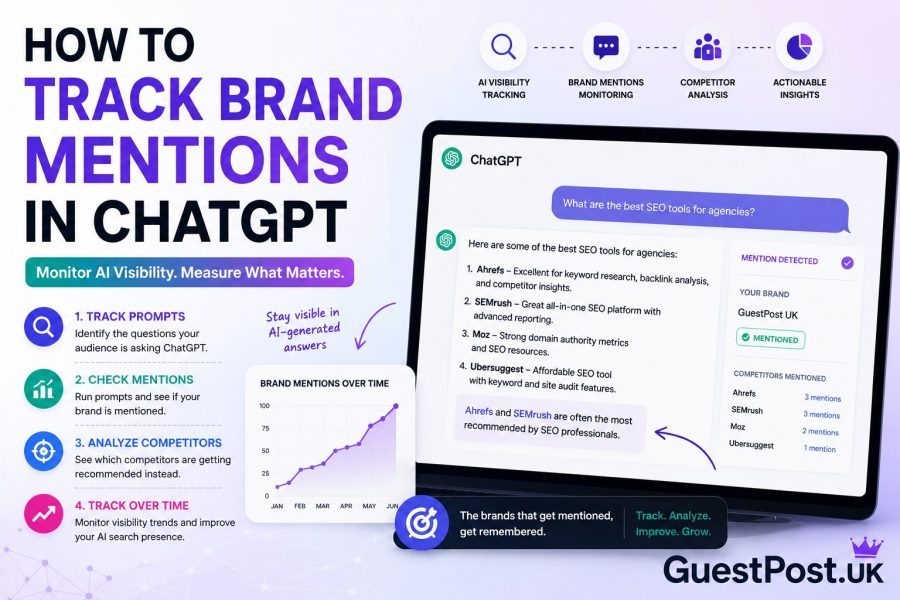
Method 1: Manual Prompt Testing
The simplest approach is also the most basic.
Create a list of industry-relevant prompts.
Examples:
- Best SEO agency in the UK
- Best guest posting services
- Best cybersecurity training provider
- Best CRM software
- Best project management tool
Ask ChatGPT each question and record:
- Which brands appear
- Position within the answer
- Competitors mentioned
- Sources referenced
This process can reveal visibility patterns.
However, it becomes difficult to scale.
Method 2: Create a Prompt Tracking Spreadsheet
Many GEO consultants now maintain prompt libraries.
A simple spreadsheet may include:
| Prompt | Brand Mentioned | Competitors | Date |
|---|---|---|---|
| Best SEO Tool | Yes | Ahrefs, Moz | June 2026 |
| Best Outreach Software | No | Smartlead, Instantly | June 2026 |
| Best Guest Posting Service | Yes | Competitor X | June 2026 |
Over time, this helps identify trends.
Method 3: Monitor Citation Sources
One of the strongest indicators of future visibility for ChatGPT is citation quality.
Brands frequently recommended by AI systems often appear across:
- Industry publications
- Research studies
- Trusted blogs
- Expert roundups
- News coverage
If your competitors are consistently cited by authoritative websites, AI systems may become more likely to reference them.
This is where digital PR and guest posting become valuable.
Method 4: Use GEO Monitoring Platforms
This is currently the most effective solution.
Several platforms have emerged specifically to track AI visibility.
Profound
Strong enterprise reporting and AI visibility monitoring.
Peec AI
Excellent citation intelligence and AI recommendation tracking.
Otterly AI
Useful prompt monitoring and AI mention tracking.
AthenaHQ
Strategic AI visibility analysis.
Goodie AI Search Analytics
Visibility trends and reporting.
Ahrefs Brand Radar
Brand recognition and entity visibility.
These tools automate much of the monitoring process.
The Connection Between Brand Mentions and Authority
One pattern appears repeatedly.
Brands that receive frequent mentions on ChatGPT tend to have strong authority signals.
Examples include:
- High-quality backlinks
- Industry recognition
- Expert authorship
- Consistent publishing
- Digital PR coverage
This suggests that AI visibility is often a by-product of strong overall marketing.
In many cases:
Good SEO → Strong Authority → Increased AI Visibility
A Real Example
Imagine two guest posting agencies.
Both offer similar services.
Agency A focuses primarily on backlinks.
Agency B focuses on:
- Backlinks
- Industry studies
- Expert commentary
- Thought leadership
- Digital PR
Which agency is more likely to appear in AI-generated recommendations?
In most cases, Agency B.
The reason is simple.
The brand becomes recognised as a source rather than merely a service provider.
Metrics Worth Tracking
When monitoring ChatGPT visibility, focus on:
Mention Frequency
How often does your brand appear?
Competitive Share
How often do competitors appear?
Recommendation Position
Are you listed first or fifth?
Topic Association
Which topics trigger your brand?
Citation Presence
Which sources support those mentions?
Together, these create a practical GEO measurement framework.
Common Mistakes Businesses Make
Tracking Too Few Prompts
A handful of prompts rarely provides enough data.
Ignoring Competitors
Visibility is relative.
Competitor monitoring is essential.
Chasing Mentions Without Building Authority
Mentions typically follow authority.
Not the other way around.
Treating GEO as Separate From SEO
The strongest GEO results often come from strong SEO foundations.
How to Increase Brand Mentions in ChatGPT
Tracking is only half the challenge.
Improvement matters more.
Strategies that frequently help include:
Publish Original Research
AI systems often value unique data.
Earn Authoritative Mentions
Industry publications matter.
Build Topic Clusters
Topical authority remains important.
Invest in Digital PR
Brand recognition influences AI visibility.
Create Comparison Content
Comparison pages frequently appear within AI-generated recommendations.
Become a Trusted Source
The brands most often recommended are often the brands most often cited.
The Future of ChatGPT Brand Tracking
Most marketers currently track:
- Rankings
- Traffic
- Leads
Over the next few years, many will also track:
- AI visibility
- Brand mentions
- Citation share
- Recommendation frequency
This evolution feels very similar to the early days of SEO analytics.
The businesses that begin measuring now may gain a significant advantage.
Frequently Asked Questions
Can you track ChatGPT brand mentions?
Yes. Manual prompt testing, GEO monitoring platforms, and citation analysis can all help measure AI visibility.
Which tools track ChatGPT mentions?
Profound, Peec AI, Otterly AI, AthenaHQ, Goodie AI Search Analytics, and Ahrefs Brand Radar are among the leading options.
Why are ChatGPT mentions important?
They influence brand visibility and recommendations during the research process.
Does ChatGPT use backlinks?
Not directly in the same way as Google, but authority signals, citations, and recognised sources appear influential.
Is GEO replacing SEO?
No. GEO complements SEO by focusing on visibility within AI-generated answers.
Final Verdict
Tracking brand mentions in ChatGPT is becoming an increasingly valuable activity for businesses that rely on online visibility.
While the tools and methodologies are still evolving, the direction is clear.
Brands are no longer competing solely for rankings.
They are competing for recommendations.
The organisations that understand this shift early, monitor their AI visibility, and actively build authority will be better positioned as AI-assisted search continues to grow throughout 2026 and beyond.