
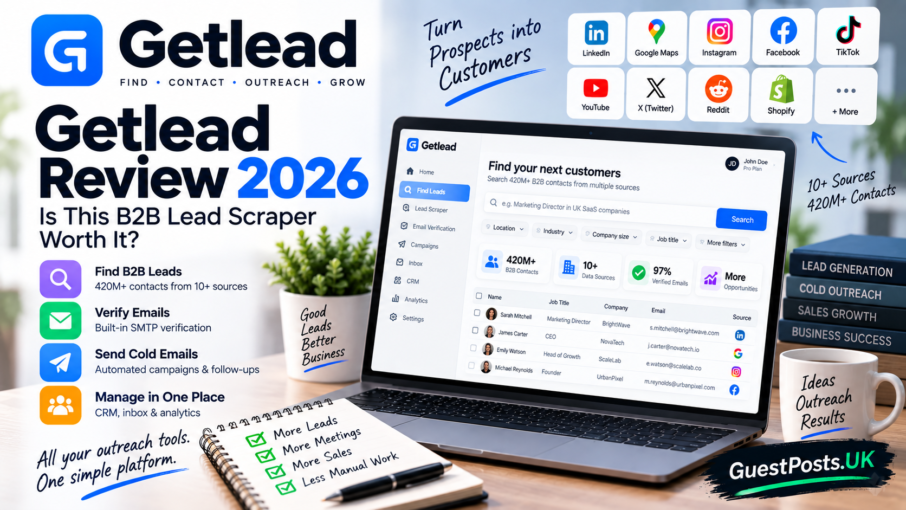
A typical outbound sales stack can become expensive surprisingly quickly. You need somewhere to find companies, another database to identify decision-makers, an email finder, a verifier, software to send cold emails, and perhaps a lightweight CRM to track replies.
Getlead’s pitch is essentially: why are you paying for all of those separately?
The platform combines B2B prospect discovery, lead scraping, a database of more than 420 million contacts, SMTP email verification, cold email sequences, inbox management, and CRM functionality. It can source prospects from LinkedIn, Google Maps, Instagram, Facebook, TikTok, YouTube, X, Reddit, Shopify and the wider web, depending on the plan.
On paper, that’s an unusually broad toolkit for a service starting at $19.90 per month.
But lead-generation software shouldn’t be judged by how many millions of contacts appear in a headline. What matters is whether it can find the right people, whether their contact information is valid, and whether the resulting outreach produces conversations rather than complaints or bounced emails.
So that’s where our Getlead review starts.
First, what happened to B2BLeadScrape?
This is worth clearing up because anyone who discovered the product through its Facebook advertising may encounter several different names and prices.
The advert we found promoted b2bleadscrape.com, with a roughly $10 lifetime offer. Some third-party software directories still list Getlead with a $9.90 one-time plan and larger lifetime tiers at $49.90 and $99.90.
The current product, however, operates primarily through Getlead / getle.ad, and its live pricing page now describes the service as a monthly or annual subscription. The Starter plan begins at $19.90 per month, while the higher tiers cost $99.90 and $199.90 per month.
That makes older reviews and adverts potentially misleading if you’re researching the product today.
It doesn’t necessarily mean anything improper happened; SaaS companies frequently change pricing models. It does mean you should judge Getlead by what is actually available at checkout now, not by an old lifetime-deal advert.
Getlead is really four tools packaged together
The easiest way to understand Getlead is to separate the workflow into four stages.
You find prospects.
You obtain and verify their contact information.
You contact them.
You manage what happens afterwards.
A lot of sales software specialises in only one of those jobs. Getlead wants to own the complete sequence.
For businesses already engaged in blogger outreach or B2B prospecting, the appeal is obvious. Moving lists between several tools creates additional cost, duplicate records and administrative work. If the same platform can discover, verify and contact a prospect, much of that friction disappears.
Whether consolidation is worthwhile depends on how well each individual component performs.
Lead scraping across 10+ sources
Getlead’s scraper currently advertises access to more than ten lead sources, including LinkedIn, Google Maps, Instagram, Facebook, TikTok, Shopify, YouTube, X, Reddit and the open web.
Rather than installing an extension that automates activity inside your personal LinkedIn or social account, Getlead says its system is database-backed and uses public search infrastructure. According to the company, it therefore doesn’t need your social login and avoids exposing your account to automated browsing behaviour.
That’s an important architectural difference.
If I were researching potential SEO clients in Manchester, for example, I could define the niche and location and use Getlead to build a prospect list. If I wanted to reach marketing decision-makers at UK SaaS companies, I could instead use its B2B database and filter by roles, industries, and company characteristics.
This is substantially faster than manually searching Google, visiting each website, finding a contact page and investigating the organisation one by one.
The danger is treating speed as the same thing as quality.
If your search produces 10,000 businesses but only 300 genuinely match your ideal customer profile, you haven’t found 10,000 leads. You’ve created a large cleaning job.
The 420 million-contact database sounds impressive – but test your niche
Getlead advertises a database containing more than 420 million B2B contacts. Search options include criteria such as job title, industry, company size and location.
That’s certainly large enough to attract attention, but database size is one of the least useful metrics when viewed in isolation.
Suppose you’re selling an enterprise service to UK cybersecurity companies with between 20 and 100 employees. You don’t care whether the database contains another 419 million people. You care whether it accurately identifies the perhaps 2,000–5,000 people who could realistically buy from you.
The correct test is therefore small and practical.
Search your actual ICP, export a sample and manually inspect perhaps 100 records. Check whether the person still works at the company, whether the job title is accurate, whether the company matches the requested criteria and whether the email address is valid.
That sample tells you considerably more than the headline database number.
Email verification is built into the workflow
This is one feature I like conceptually.
Getlead says scraped emails undergo SMTP verification before export and advertises up to a 97% “inbox-safe” rate.
The wording requires some care. SMTP verification can help determine whether an email address is capable of receiving mail, but it doesn’t guarantee 97% inbox placement in the conventional sense of deliverability. Whether an email lands in someone’s inbox, promotions tab or spam folder depends on considerably more than address validity.
Domain reputation, authentication, sending history, message content, complaint rates, sending volume and recipient engagement all matter.
So I’d interpret Getlead’s verification as an important list-hygiene mechanism, not a promise that 97 out of 100 cold emails will land in the primary inbox.
That’s still useful.
Sending to thousands of invalid addresses is one of the quickest ways to damage an outreach domain.
You can send the emails without leaving Getlead
After building and verifying a list, Getlead can move prospects directly into cold-email sequences.
Current functionality includes automated follow-ups, multiple sender inboxes on higher plans, scheduling, a unified reply inbox, and integrations with sending services, including Gmail, AWS SES, SendGrid, Resend, Mailgun, Postmark, and standard SMTP.
This is where Getlead begins competing not just with databases.
It effectively combines part of the role of Apollo or a lead database with that of tools such as Reply.io and Smartlead.
We have previously examined this workflow in our Reply.io review, where the emphasis is much more heavily on sales engagement and multichannel sequencing. Getlead’s differentiator is that its prospecting data and scraping capabilities are built into the same product as its sending infrastructure.
For smaller teams, convenience may outweigh the need for the deepest possible specialist feature set in every category.
Getlead pricing in September 2026
The current pricing is very different from the lifetime offer shown in the Facebook advertising that originally brought this tool to our attention.
Getlead now lists three main subscription levels:
| Feature | Starter | Pro | Ultra / Agency+ |
|---|---|---|---|
| Monthly price | $19.90 | $99.90 | $199.90 |
| Verified B2B leads/month | 1,000 | 70,000 | 180,000 |
| Lead scrapes/month | 1,000 | 50,000 | Unlimited |
| Email sends/month | 5,000 | 300,000 | Unlimited |
| Scraping sources | Basic | 9+ | All |
| SMTP verification | Yes | Yes | Yes |
| Automated follow-ups | Yes | Yes | Yes |
| Unlimited sender inboxes | No | Yes | Yes |
| Built-in CRM | Limited/basic | Yes | Yes |
| Team seats | 1 | 3 | 5 |
Annual plans currently provide two months free, bringing the published annual prices to $199, $999 and $1,999 respectively.
The jump from Starter to Pro is substantial, but so is the allowance. Moving from 1,000 to 70,000 database leads and from 5,000 to 300,000 monthly email sends turns the product from a small-business prospecting tool into something capable of supporting serious outbound volume.
I’d be cautious about viewing those limits as targets, though.
Having permission from your software to send 300,000 emails doesn’t mean sending 300,000 cold emails is a sensible marketing strategy.
The Starter plan is actually the most interesting one
At $19.90 per month, Starter is cheap enough for a freelancer, a small SEO agency, or a local business to test without much financial risk.
You receive 1,000 verified B2B leads, 1,000 lead scrapes and up to 5,000 sends per month, plus LinkedIn prospecting, automated follow-ups and CSV import/export.
A well-targeted business shouldn’t necessarily need tens of thousands of prospects.
If an SEO consultant identifies 200 genuinely suitable companies, creates a compelling offer, and contacts the right decision-maker at each one, that can be more commercially valuable than scraping 50,000 vaguely relevant businesses.
For agencies, this is similar to how we approach link-building services. Volume matters, but relevance and quality determine whether the activity creates value.
The cheap Starter plan therefore gives Getlead a reasonable entry point for validating the data, not merely the interface.
The Pro plan changes the economics considerably
Pro costs $99.90 per month and increases scraping to 50,000 leads, database access to 70,000 verified contacts and sending to 300,000 emails. It also adds unlimited sender inboxes, advanced reporting, and broader email service integrations.
For an agency already paying separately for a prospecting database, email verification and cold-email software, that could be competitive.
But compare total workflow cost, not merely subscription prices.
A specialist lead database may provide better data in your market. A specialist cold-email platform may provide stronger deliverability controls. Another CRM may integrate more cleanly with your sales process.
Getlead wins economically only if its combined functionality is good enough to genuinely eliminate some of those other subscriptions.
What about the “lifetime deal”?
This is where our research uncovered conflicting information.
Software Advice currently describes Getlead as offering lifetime plans beginning at $9.90, with Pro and Agency tiers priced at $49.90 and $99.90 as one-time payments.
Getlead’s current official pricing page, however, explicitly says the product is a subscription and lists monthly/annual pricing starting at $19.90. Its current scraper documentation likewise states: “Is this a subscription? Yes.”
Therefore, for this September 2026 review, we would not describe Getlead as a lifetime-deal product.
If you see an older $10 lifetime advertisement, verify exactly what offer and allowances are being sold before paying.
This is precisely why review articles need to be updated as SaaS products evolve.
What do independent Getlead reviews say?
This part requires considerably more caution than the product’s website might suggest.
Getlead’s current scraper page displays a “Trustpilot Rated 4.8/5 · 200+ reviews” claim and several very positive customer testimonials.
However, the old b2bleadscrape.com Trustpilot profile that we could independently locate currently has only one review and a 3.2 TrustScore. That review, dated 1 September 2026, is one-star and alleges that the customer found no suitable leads for their target city and had difficulty obtaining the advertised refund.
One negative review obviously cannot establish that the service is poor.
Equally, we wouldn’t treat testimonials displayed on Getlead’s own sales pages as equivalent to hundreds of independently verified public reviews.
There simply isn’t enough independently verifiable evidence from the sources we found to make a confident claim about overall customer satisfaction.
That’s a meaningful weakness for a product advertising very large user numbers.
There is also a refund-policy discrepancy worth watching
Interestingly, the current official refund policy is quite clear.
Getlead states that the first payment is refundable within 14 days, after which renewal payments are non-refundable. It says users can cancel at any time without a cancellation fee and retain access until the end of the paid billing period.
That doesn’t match the experience alleged in the single Trustpilot complaint.
We can’t determine what happened in an individual customer-support dispute, so it would be inappropriate to conclude that either account proves the other wrong. The practical advice is simpler: if the refund period matters to you, keep the checkout confirmation, record the purchase date and submit any request in writing within the stated 14-day window.
Getlead vs Apollo
Apollo is probably the most obvious comparison.
Both can help identify B2B contacts and support outbound activity, but they approach the market differently.
| Area | Getlead | Apollo |
|---|---|---|
| B2B database | 420M+ claimed | Large established database |
| Social/web scraping | Major feature | More database-led |
| Email verification | Included | Included/features vary |
| Cold-email sending | Included | Included |
| CRM/pipeline | Included | Included |
| Entry price | $19.90/month | Free + paid tiers |
| Independent review history | Limited/unclear | Extensive |
| Best argument | All-in-one value | Established sales intelligence ecosystem |
Getlead’s attraction is price and consolidation.
Apollo’s advantage is maturity, integrations and a much larger body of user experience from which buyers can judge data quality.
Rather than choosing based on the 420M headline, I’d run the same 100-company ICP through both products and manually compare the results.
Could we use Getlead for guest-post outreach?
Technically, yes.
Strategically, I’d be selective.
A scraper could help identify businesses, publishers, marketing agencies and potential partners. Email verification could clean prospect data, and the CRM could help organise conversations.
For high-quality guest posting, however, the actual outreach should remain targeted.
Publisher relationships are different from mass B2B sales prospecting. An editor receiving a pitch expects the sender to understand the publication, its audience and the type of content it accepts. Scraping 20,000 websites and pushing all of them into the same sequence is unlikely to produce the kind of relationships that support sustainable placements.
This is also why tools such as Postaga and Pitchbox deserve separate consideration. They are much more specifically oriented towards outreach and link-building workflows, whereas Getlead is designed around broader B2B prospecting and cold email.
Getlead could therefore be useful for finding and organising prospects while human research determines who genuinely deserves an email.
Where Getlead looks strong
The biggest advantage is unquestionably value.
At $19.90, the combination of a prospect database, scraper, verification, sending, and basic CRM functionality is difficult to ignore. Even the $99.90 Pro plan could be economically attractive if it genuinely replaces several subscriptions.
The database-backed scraping model is also preferable to requiring users to automate activity through their own logged-in social accounts. Built-in SMTP verification removes another step from the workflow, while moving directly from prospect discovery to campaigns makes the overall experience considerably cleaner.
For freelancers and small agencies that currently perform much of this work manually, the time saving could be substantial.
Where we’d be cautious
The first issue is independent validation. The public review evidence we could verify does not yet support the extremely positive picture presented on Getlead’s own website.
The second is pricing history. The move from heavily promoted lifetime offers to the current subscription model isn’t inherently problematic, but buyers should ensure they’re reading current documentation rather than old advertisements.
Third, lead volume can encourage poor habits. Access to 70,000 verified contacts doesn’t mean all 70,000 should receive an email. Relevant targeting, lawful processing, opt-out handling, domain reputation and sensible sending patterns still matter.
Finally, no database is perfectly current. People change jobs, businesses close, and inboxes disappear. The built-in verifier helps, but important prospects should still be manually qualified.
Is Getlead worth it?
At $19.90 per month, yes, I think Getlead is worth testing.
Not because it claims to have 420 million contacts.
Not because its advertising promises huge quantities of leads.
The reason to test it is that the entry price is low enough to answer the only question that really matters: whether Getlead contains accurate, relevant prospects for your particular market.
Buy one month of Starter. Define a narrow ICP. Pull perhaps 100–200 contacts and manually inspect them. Verify the job titles, companies, and addresses, then run a small, well-targeted campaign.
If the data holds up, the economics become very attractive.
If the database performs poorly in your niche, the fact that Getlead also includes a CRM, an email sender, and 10 scraping sources becomes largely irrelevant.
GuestPost.UK rating: 3.7/5
Getlead has the makings of a compelling all-in-one outbound platform. Its current $19.90 entry price, multi-source prospecting, 420M+ stated contact database, SMTP verification, campaign sending, and CRM create an unusually broad feature set for the money.
What prevents a higher rating is confidence, not functionality. The independent public-review footprint we could verify is weak, current official subscription pricing conflicts with older lifetime-deal listings, and some of the performance language on Getlead’s own pages is stronger than we’d accept without independent testing.
Our verdict: use Getlead as a low-cost experiment before treating it as your entire outbound infrastructure. If its data proves accurate for your ICP, it could replace several tools. If the leads aren’t good, nothing else in the platform can compensate for that.