
Content optimisation software can make a good brief faster, show what competing pages cover and help writers avoid publishing thin, unfocused work. It cannot, however, replace a clear point of view, first-hand experience or sound editorial judgement.
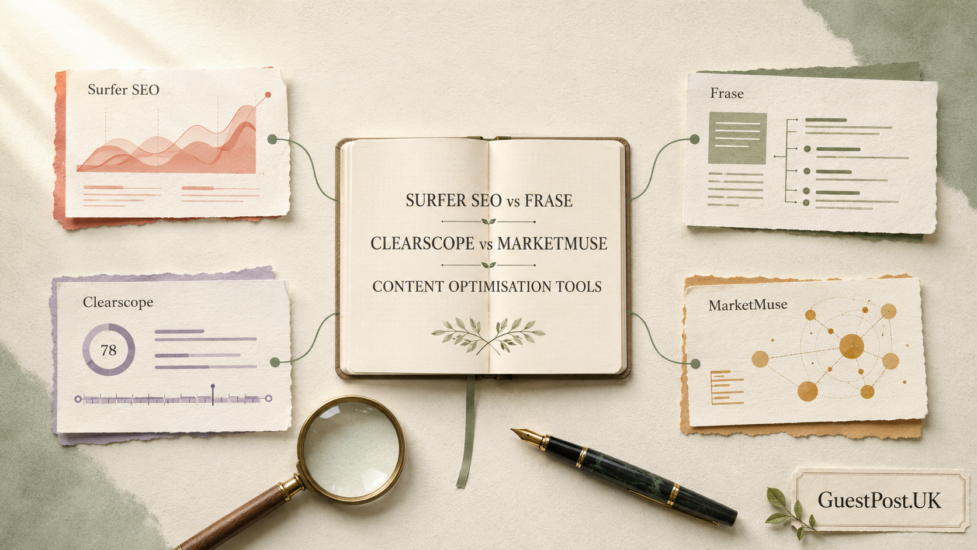
That distinction matters when choosing between Surfer SEO, Frase, Clearscope and MarketMuse. They are often grouped together as “SEO writing tools”, but they are built around different problems. One may suit a freelance writer producing a few articles each month; another may suit a content team managing hundreds of URLs.
The best choice is not necessarily the platform with the longest feature list. It is the one that removes the most expensive bottleneck in your existing content process.
If your team is still starting every assignment from a blank page, a proper SEO content brief generator may create more value than another content score. If your issue is underperforming pages, weak internal links or unclear topical coverage, the answer will be different again.
The quick answer
- Choose Frase when speed matters most: SERP research, outlines, drafting and optimisation in one approachable workflow.
- Choose Surfer SEO when you want a broader optimisation-led platform, especially if your process relies heavily on content scoring and repeatable publishing workflows.
- Choose Clearscope when editorial quality, ease of adoption, and clean writer collaboration matter more than having every possible feature in a single dashboard.
- Choose MarketMuse when the bigger challenge is strategic planning across an existing content library, not simply improving one draft at a time.
The real comparison starts with how each tool changes the work on a normal Tuesday.
Four tools, four working styles
| Tool | Best suited to | Core strength | Watch-out |
|---|---|---|---|
| Surfer SEO | Agencies and active publishing teams | Structured optimisation and content workflows | Scores can become a distraction if treated as the goal |
| Frase | Lean teams and writers | Fast research-to-draft process | Requires human expertise to make AI-assisted drafts distinctive |
| Clearscope | Editorial-led teams | Clear recommendations and a polished writing environment | Higher starting cost than lightweight tools |
| MarketMuse | Established sites with content depth | Topic planning, inventory analysis and strategic prioritisation | More than many small sites need |
Prices and plan limits change regularly. At the time of writing, Frase starts at $39 per month on an annual billing plan, Clearscope’s Essentials plan is listed at $129 per month, and Surfer’s AI visibility offering begins at $158 per month, billed annually. MarketMuse pricing and access are more sales-led, so it is worth requesting a current quote based on your domain count and workflow.
Start with the bottleneck, not the feature checklist
A common mistake is buying a tool because it promises “better rankings”. Every platform in this comparison can help produce more search-aware content. But the reasons content fails are rarely identical.
Perhaps writers are spending three hours opening competitor tabs before they can create an outline. Perhaps articles are being written quickly but lack subject coverage. Perhaps the site has 800 posts, and nobody knows which 40 are worth refreshing first.
Those are three separate operational problems.
Before subscribing, answer these questions:
- Are we trying to create new articles faster?
- Are we trying to improve the quality and consistency of articles before publication?
- Are we trying to decide which topics and existing pages deserve investment?
- Do writers need a simple interface, or do SEO specialists need deeper controls?
- Are we paying for production capacity that will never be used?
The answers narrow this comparison quickly.
Surfer SEO: best for optimisation-led production
Surfer SEO is designed for teams that want a structured route from keyword research and planning to a scored content draft. Its Content Editor is the centre of the workflow: enter a target query, review recommendations drawn from the search results and use the editor to shape the page around topical terms, structure and other on-page signals.
That makes it appealing to agencies. A strategist can create a repeatable process; writers receive clear guidance; editors have a framework for reviewing work before it goes live.
Surfer has also expanded beyond the classic content score. Its current product direction includes AI search analytics, visibility monitoring and AI-assisted workflows. This can be useful for teams that do not want separate tools for every stage of content execution.
Where Surfer is strongest
Surfer works well when your team needs consistency at volume. It is particularly useful for:
- Building repeatable article workflows across multiple clients
- Giving writers a measurable brief before they begin
- Refreshing pages that are close to competing but missing important coverage
- Creating a shared optimisation standard across a large freelancer network
- Combining content work with wider SEO and AI-search visibility activity
For an agency, the value is not that a score tells you whether writing is “good”. The value is that it creates a visible review step before a draft reaches a client.
Where Surfer needs discipline
The downside is familiar to anyone who has watched a writer chase a green score. A page can include every recommended phrase and still be bland, inaccurate or less useful than the results already ranking.
Use Surfer as a diagnostic layer, not a writing brief in isolation. Add the things competitor analysis cannot supply: original examples, client data, expert commentary, product knowledge and a clear answer to the searcher’s actual question.
That matters even more when writing for AI search. Pages that are easy to quote, well organised and genuinely specific have a better foundation than pages assembled to satisfy a checklist. Our guide to ranking in ChatGPT, Gemini and Perplexity explains the wider visibility work that sits around on-page optimisation.
Frase: best for getting from research to first draft quickly
Frase is built around momentum. It brings together SERP research, question discovery, outlining, writing assistance and optimisation so that a small team can move from a topic idea to an informed working draft without hopping between several tools.
Its appeal is practical: rather than producing an intimidating strategy dashboard, Frase helps a writer understand the shape of existing search results, gather common questions, and build a document ready for editorial input.
For freelancers, in-house marketers and small agencies, that simplicity can be valuable. A tool that is used consistently is more useful than a complex one that only the SEO lead understands.
Where Frase is strongest
Frase is a strong fit when the main constraint is research time. It can help you:
- Turn a keyword into a structured outline quickly
- Spot the sub-questions ranking pages repeatedly address
- Keep research, drafting and optimisation in one working document
- Give non-specialist writers a clearer starting point
- Create a more efficient process for modest monthly publishing volumes
It also makes sense for teams testing a more deliberate content workflow before committing to an enterprise platform.
The important limitation
Fast drafting is not the same as publish-ready writing. Frase’s AI features can shorten the distance between idea and draft, but the final article still needs fact-checking, brand voice, subject expertise and a reason to exist beyond “the competitors wrote this too”.
That is especially important for service businesses. A vague AI draft about SEO will not compete with a page that explains the real choices, costs and risks a buyer faces. If your team needs support turning useful briefs into commercially effective pages, our SEO services can help connect content production to technical SEO, intent and conversion goals.
Clearscope: best for editorial teams that value clarity
Clearscope has earned its reputation through a clean, writer-friendly optimisation experience. The platform focuses on helping teams create comprehensive, relevant content without making the process feel like an exercise in keyword repetition.
For many editorial teams, this is the point. Writers do not want another clunky reporting screen. They want to know what the reader expects, what related concepts should be considered and whether the draft is broadly complete.
Clearscope now positions itself around Google and AI-search discoverability, with capabilities spanning optimisation, topic exploration, monitoring and internal-linking support. But its core appeal remains its editorial usability.
Where Clearscope is strongest
Choose Clearscope when adoption across writers and editors is the priority. It is well suited to:
- Content teams that care about polished editorial workflow
- Brands where quality control matters more than sheer publishing speed
- Agencies producing fewer, higher-value pieces for demanding clients
- Teams that want useful guidance without overwhelming writers
- Collaboration between SEO specialists and subject-matter experts
The higher entry price can be easier to justify when each article carries significant commercial value. A B2B software company publishing two authoritative comparison pages a month may gain more from better editorial collaboration than from the cheapest possible per-article cost.
What to check before buying
Assess the number of reports, pages, prompts and users included in the plan you are considering. A platform can look affordable until a growing team hits limits halfway through the month.
Also test it with the people who will actually use it. If writers prefer a different environment, ask whether the integration and hand-off process is genuinely smooth. Software should reduce editorial friction, not create another approval queue.
MarketMuse: best for choosing what the site should do next
MarketMuse approaches content optimisation from a more strategic angle. While it can analyse and improve individual pages, it is particularly known for helping teams understand topical authority, content gaps, page inventory and priorities across a whole domain.
That makes it useful for established publishers, SaaS sites, ecommerce brands with large advice hubs and agencies working with mature websites. The question becomes less “How do we improve this article?” and more “Which 20 articles could produce the greatest return if we invest in them this quarter?”
Where MarketMuse is strongest
MarketMuse is likely to earn its place when you have enough content for prioritisation to matter. It can support:
- Identifying gaps in a topic cluster
- Comparing existing page coverage against competitive opportunity
- Deciding whether to refresh, consolidate, expand or create a page
- Planning content around subject depth rather than isolated keywords
- Building a more defensible editorial roadmap
This is a different proposition from a writing assistant. A small local business with six blog posts may not need it. A site with 1,500 articles, competing authors and unclear content debt may find it far more valuable than another document-level score.
The trade-off
MarketMuse can be more strategic than a small team requires. If you publish four articles each month and have no meaningful archive, prioritisation software may be solving tomorrow’s problem.
Start with the simplest system that fixes today’s workflow. You can graduate to portfolio-level planning when the volume, budget and complexity justify it.
Do not let the score write the article
All four platforms can expose useful patterns in the search results. None can decide what your brand should say.
The strongest SEO content usually includes evidence that cannot be found on the first page of Google: practitioner observations, screenshots, process details, proprietary data, customer questions, useful templates, or honest limitations.
A practical quality-control process should include:
- Checking every factual claim against a reliable source
- Removing filler written solely to increase word count
- Adding examples that reflect your audience’s real situation
- Ensuring headings answer the page’s promise rather than repeat variants of the keyword
- Reviewing internal links so readers can take the next sensible step
- Confirming the page has a clear owner who will update it when the topic changes
For example, an article about outreach software should naturally lead readers towards blogger outreach services or a relevant implementation guide. Internal links should be useful pathways, not decorative SEO signals.
Choose the tool that changes your bottleneck
Pick Frase if your writers need to research and structure useful drafts faster. It offers the clearest entry point for lean teams that want fewer tabs and a practical working document.
Pick Surfer SEO if you run a repeatable production operation and want a deeper optimisation workflow, particularly across agency or high-output environments. Use its scoring sensibly and retain editorial control.
Pick Clearscope if you are investing in high-quality content and want writers, editors and SEO specialists to work from a clean shared standard. It is the editorial-first option in this group.
Pick MarketMuse if your challenge is a large, under-managed content library and you need a defensible way to prioritise topic coverage, updates and new opportunities.
Whichever platform you choose, keep the tool in its proper place. It should make experienced people faster and more consistent. It should not turn your website into a collection of indistinguishable articles written to please a score.