
Why Agencies Need a Defined Guest Posting Workflow
Guest posting remains one of the most effective link building strategies available to SEO agencies. However, as client numbers grow, many agencies find guest posting increasingly difficult to manage.
A campaign for one client is relatively straightforward.
A campaign for twenty clients is a completely different challenge.
Without a structured workflow, agencies often encounter problems such as:
- Missed deadlines
- Poor communication
- Duplicate outreach
- Lost placements
- Weak reporting
- Inconsistent quality
The result is frustration for both agency teams and clients.
A well-defined guest posting workflow solves these challenges by creating a repeatable process that ensures every campaign follows the same quality standards from initial strategy through to final reporting.
The best agencies do not rely on individual talent alone. They build systems that consistently deliver results regardless of team size.
What Is a Guest Posting Workflow?
A guest posting workflow is the complete sequence of processes used to manage a guest posting campaign.
Rather than treating guest posting as a collection of disconnected tasks, a workflow creates a structured framework that guides every stage of the campaign.
A typical workflow includes:
- Planning
- Prospecting
- Outreach
- Content creation
- Placement management
- Quality assurance
- Reporting
The goal is simple:
Create a predictable process that delivers high-quality placements while maintaining efficiency and scalability.
Why Workflows Matter More Than Ever
As competition increases, successful guest posting requires much more than sending emails and publishing content.
Agencies must manage:
- Multiple clients
- Different industries
- Various anchor text strategies
- Editorial requirements
- Publisher relationships
- Reporting expectations
Without a workflow, complexity quickly becomes overwhelming.
The Seven Stages of a Successful Guest Posting Workflow
Every successful campaign follows a series of interconnected stages.
Stage 1: Campaign Planning
Strong campaigns begin before outreach starts.
Many agencies rush directly into prospecting without defining objectives.
This is a mistake.
Campaign planning establishes the strategic foundation for every decision that follows.
Defining Client Objectives
Different clients have different goals.
Examples include:
- Ranking service pages
- Increasing topical authority
- Growing organic traffic
- Improving local SEO
- Building brand awareness
Understanding these objectives helps shape outreach strategy.
Target Page Selection
Every guest post should support specific pages.
Common targets include:
- Service pages
- Product pages
- Category pages
- Resource pages
Choosing the right destination URLs improves campaign effectiveness.
Anchor Text Planning
Anchor text remains an important consideration.
A healthy campaign typically includes:
- Brand anchors
- URL anchors
- Partial-match anchors
- Generic anchors
Over-optimisation should be avoided.
Competitor Analysis
Competitor backlink analysis often reveals valuable opportunities.
By studying successful competitors, agencies can identify:
- Relevant publishers
- Industry websites
- Link acquisition patterns
This research frequently accelerates prospecting efforts.
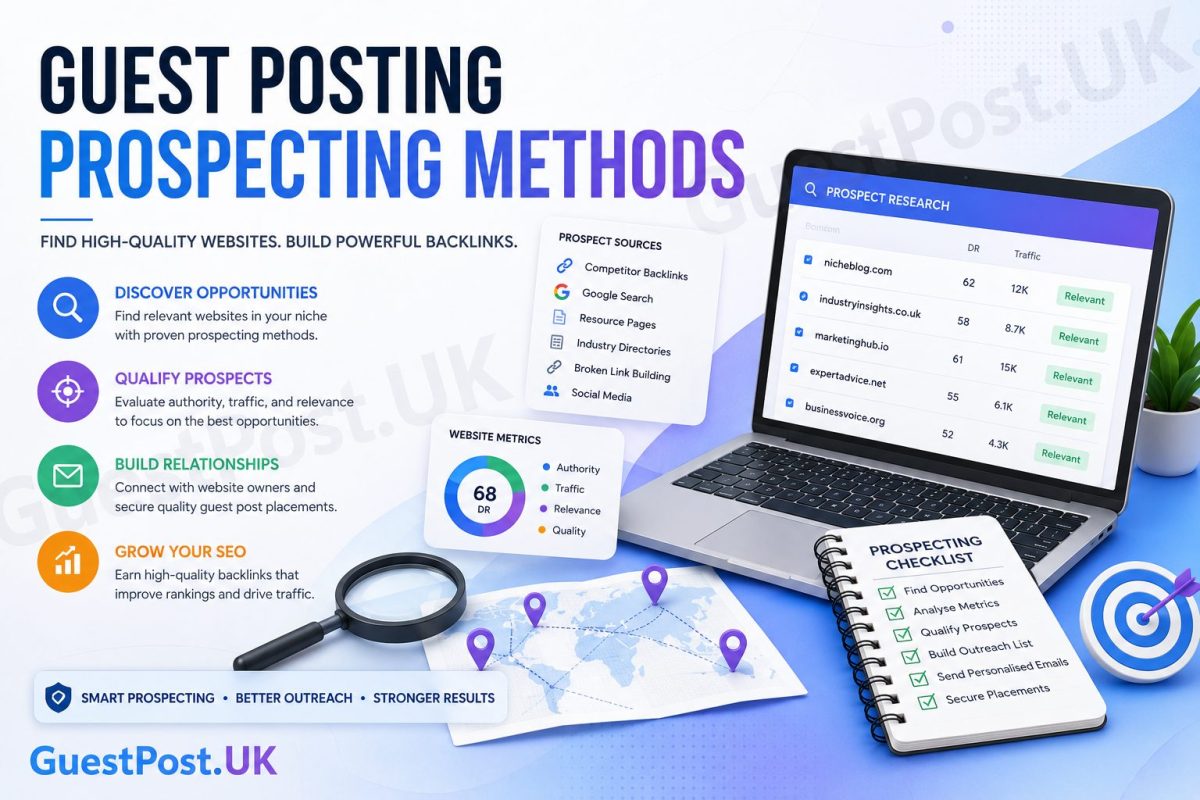
Stage 2: Prospect Research
Prospecting is the engine of guest posting.
Without a steady flow of qualified opportunities, campaigns cannot scale effectively.
Finding Relevant Websites
The most successful campaigns prioritise relevance.
A relevant placement often delivers greater value than a higher-authority but unrelated website.
Key prospecting sources include:
- Competitor backlinks
- Industry blogs
- Resource pages
- Business publications
- Niche communities
Prospect Qualification Criteria
Not every website deserves outreach.
Qualification criteria typically include:
- Niche relevance
- Traffic quality
- Content standards
- Domain authority
- Editorial quality
Strong qualification systems prevent wasted effort.
Prospect Database Management
Every agency should maintain a prospect database.
A useful database includes:
| Data Point | Purpose |
|---|---|
| Website URL | Prospect tracking |
| Contact Information | Outreach |
| Niche Category | Relevance assessment |
| Domain Metrics | Evaluation |
| Traffic Data | Quality assessment |
| Status | Workflow tracking |
Over time, this database becomes a significant competitive advantage.
Stage 3: Outreach and Relationship Building
Outreach is where opportunities become placements.
Many campaigns succeed or fail at this stage.
Outreach Templates
Templates improve efficiency.
However, successful outreach should never feel automated.
The best templates provide structure while allowing personalisation.
A typical outreach email includes:
- Personal introduction
- Relevant observation
- Value proposition
- Clear call-to-action
Personalisation Matters
Publishers receive numerous outreach emails every week.
Generic messages are often ignored.
Personalisation increases:
- Open rates
- Response rates
- Acceptance rates
Simple references to recent articles or industry topics can significantly improve performance.
Follow-Up Sequences
One outreach email is rarely enough.
Many placements are secured through follow-up communication.
An effective sequence often includes:
- Initial email
- Follow-up after 3–5 days
- Final follow-up after 7–10 days
Persistence often produces results.
Building Publisher Relationships
Long-term publisher relationships are one of the most valuable assets an agency can develop.
Strong relationships often lead to:
- Faster approvals
- Better pricing
- Repeat opportunities
- Greater flexibility
Relationship-building should be viewed as a strategic investment.
Stage 4: Content Production
Even the best placement loses value if the content is weak.
Content quality directly influences:
- Publisher acceptance
- Reader engagement
- SEO value
Creating Effective Content Briefs
A content brief should provide:
- Topic direction
- Target audience
- SEO considerations
- Internal references
- Editorial requirements
Clear briefs improve consistency.
Managing Writers
As campaigns grow, multiple writers may become involved.
Successful agencies establish:
- Writing guidelines
- Quality standards
- Review processes
This ensures content remains consistent across campaigns.
Editorial Review
Before submission, every article should undergo review.
Review criteria include:
- Accuracy
- Grammar
- Structure
- Readability
- Link placement
Quality assurance prevents avoidable issues.
Stage 5: Placement Management
Managing placements becomes increasingly important as campaign volume grows.
Publisher Communication
Timely communication improves relationships and reduces delays.
Key communication points include:
- Content submission
- Revision requests
- Publication confirmation
Tracking Publications
A placement tracking system should record:
- Publication date
- Live URL
- Anchor text
- Target page
Without tracking, campaigns quickly become difficult to manage.
Monitoring Deadlines
Publishers often operate on different timelines.
A structured system helps agencies monitor progress effectively.
Stage 6: Quality Assurance
Publishing a guest post does not mark the end of the workflow.
Quality assurance remains essential.
Link Verification
Every published article should be reviewed.
Verify:
- Link placement
- Link functionality
- Anchor text accuracy
Mistakes occasionally occur.
Indexing Checks
A published article provides greater value once indexed.
Agencies should monitor indexing status where appropriate.
Content Review
Occasionally, publishers modify content after publication.
Reviewing live placements helps identify issues early.
Stage 7: Client Reporting
Reporting transforms activity into measurable value.
Clients want evidence that campaigns are contributing to business growth.
What Clients Actually Want to See
Most clients care about:
- Rankings
- Traffic
- Leads
- ROI
They care less about operational details.
Reporting Metrics
Useful reporting metrics include:
| KPI | Importance |
|---|---|
| Referring Domains | Medium |
| Rankings | High |
| Traffic | High |
| Leads | High |
| Revenue Impact | Highest |
Reporting Frequency
Most agencies provide:
- Monthly reports
- Quarterly reviews
- Campaign summaries
Consistency builds trust.
Guest Posting Workflow Diagram
A simplified workflow looks like this:
Strategy
↓
Prospecting
↓
Outreach
↓
Content Creation
↓
Placement Management
↓
Quality Assurance
↓
Reporting
Each stage supports the next.
Weakness at any stage reduces overall campaign performance.
Agency Workflow vs Freelancer Workflow
The operational requirements differ significantly.
| Factor | Agency | Freelancer |
|---|---|---|
| Clients | Multiple | Limited |
| Processes | Structured | Flexible |
| Reporting | Formal | Informal |
| Scale | High | Medium |
| Team Collaboration | Essential | Limited |
| Automation | Common | Occasional |
Understanding these differences helps determine appropriate systems.
Best Tools for Each Workflow Stage
Prospecting Tools
Ahrefs
Pros
- Extensive backlink database
- Competitor research
- Prospect discovery
Cons
- Premium pricing
Semrush
Pros
- Comprehensive SEO toolkit
- Traffic insights
- Link opportunities
Cons
- Learning curve
Apollo
Pros
- Contact discovery
- Lead enrichment
Cons
- Data quality varies
Outreach Tools
Lemlist
Ideal for personalised outreach campaigns.
Reply.io
Strong automation capabilities.
Instantly
Popular for large-scale outreach.
Project Management Tools
Airtable
Flexible database management.
Notion
Excellent documentation system.
ClickUp
Strong workflow management.
Reporting Tools
Looker Studio
Visual reporting dashboards.
Ahrefs
SEO performance reporting.
Semrush
Comprehensive campaign insights.
Workflow Bottlenecks That Kill Campaigns
Poor Prospect Qualification
Low-quality prospects waste resources.
Weak Outreach
Poor messaging reduces response rates.
Slow Content Production
Content bottlenecks delay placements.
Lack of Tracking
Disorganised campaigns become difficult to manage.
Inconsistent Reporting
Clients expect reliable updates.
Weak reporting damages trust.
Agency Case Study Example
Imagine an SEO agency managing 50 active clients.
Each client requires:
- Two guest posts monthly
The agency must secure:
100 placements every month.
Without systems, this becomes chaotic.
Through documented workflows, specialised team roles, prospect databases, and reporting processes, the agency creates predictable outcomes.
The result is:
- Better efficiency
- Consistent quality
- Improved profitability
Systems become the foundation of growth.
AI and the Modern Guest Posting Workflow
Artificial intelligence is increasingly supporting workflow efficiency.
AI Prospect Research
AI tools can help identify relevant websites more quickly.
AI Content Brief Generation
Brief creation becomes faster and more consistent.
AI Reporting Assistance
Performance summaries can be produced more efficiently.
Human Oversight Remains Essential
Despite automation advances, successful campaigns still require:
- Strategic thinking
- Relationship building
- Editorial judgement
AI enhances workflows but does not replace expertise.
Guest Posting Workflow KPIs
Important workflow metrics include:
Placement Rate
Measures campaign effectiveness.
Response Rate
Indicates outreach performance.
Acceptance Rate
Reflects prospect quality and pitch quality.
Cost Per Placement
Monitors efficiency.
ROI
Measures overall business impact.
Workflow Maturity Model
Most agencies evolve through the following stages:
Level 1: Beginner
Manual and reactive.
Level 2: Structured
Basic systems introduced.
Level 3: Systemised
Documented processes.
Level 4: Scalable
Delegation and automation.
Level 5: Agency-Level Excellence
Predictable, efficient, and highly scalable operations.
Final Verdict
A successful guest posting campaign is rarely the result of individual effort alone.
The strongest agencies rely on structured workflows that transform complex processes into repeatable systems.
For freelancers, a simplified workflow may be sufficient.
For growing agencies, documentation, delegation, and automation become essential.
For enterprise-level teams, workflow optimisation often determines profitability and scalability.
The agencies that consistently outperform competitors are not necessarily those with the largest teams.
They are the agencies with the best systems.
Frequently Asked Questions
What is a guest posting workflow?
A guest posting workflow is the structured process used to manage campaigns from planning through reporting.
Why do agencies need workflows?
Workflows improve consistency, scalability, efficiency, and quality control.
What is the most important stage?
Campaign planning and prospect qualification often have the greatest impact on success.
Which tool is best for outreach?
Popular choices include Lemlist, Reply.io, and Instantly.
Can AI automate guest posting workflows?
AI can assist with many tasks but should not replace strategic decision-making.
How often should agencies report results?
Monthly reporting remains the industry standard.
What KPI matters most?
ROI, leads, and rankings are usually the most valuable metrics.
How do agencies scale guest posting campaigns?
By building systems, documenting processes, and maintaining quality standards.