
Whether you’re launching a brand-new website, growing an established business or managing SEO for multiple clients, you’ve almost certainly come across the term Domain Authority. It appears in SEO audits, backlink reports, outreach campaigns, and competitor analyses, often becoming one of the first metrics people use to evaluate a website’s strength. Yet despite its popularity, it remains one of the most misunderstood concepts in search engine optimisation.
Some website owners believe Domain Authority is a direct Google ranking factor. Others become obsessed with chasing a higher score without understanding what actually influences it. Both approaches can lead to wasted effort and poor SEO decisions. While Domain Authority is undoubtedly useful, it should be viewed as a benchmark rather than an objective in its own right.
The websites that consistently achieve high authority scores rarely do so because they are actively trying to increase the number displayed inside an SEO tool. Instead, they focus on creating outstanding content, earning high-quality backlinks, strengthening their brand reputation, and becoming recognised experts in their industry. The increase in Domain Authority is simply the result of doing those fundamentals exceptionally well.
Understanding this distinction is essential because successful SEO is no longer about isolated tactics. Search engines evaluate websites using hundreds of signals, many of which revolve around trust, expertise, relevance and authority. Domain Authority attempts to measure many of those qualities through a single, easy-to-understand metric, making it valuable for competitor research, outreach campaigns and long-term performance tracking.
In this comprehensive guide, you’ll learn exactly what Domain Authority is, why it matters, how it is calculated, what constitutes a good score, which authority checker tools deserve your attention and how proven SEO strategies such as guest posting, digital PR and topical authority can help strengthen your website over time. Whether you are completely new to SEO or already have years of experience, this guide will help you understand how Domain Authority fits into the bigger picture of modern search engine optimisation.
What Is Domain Authority?
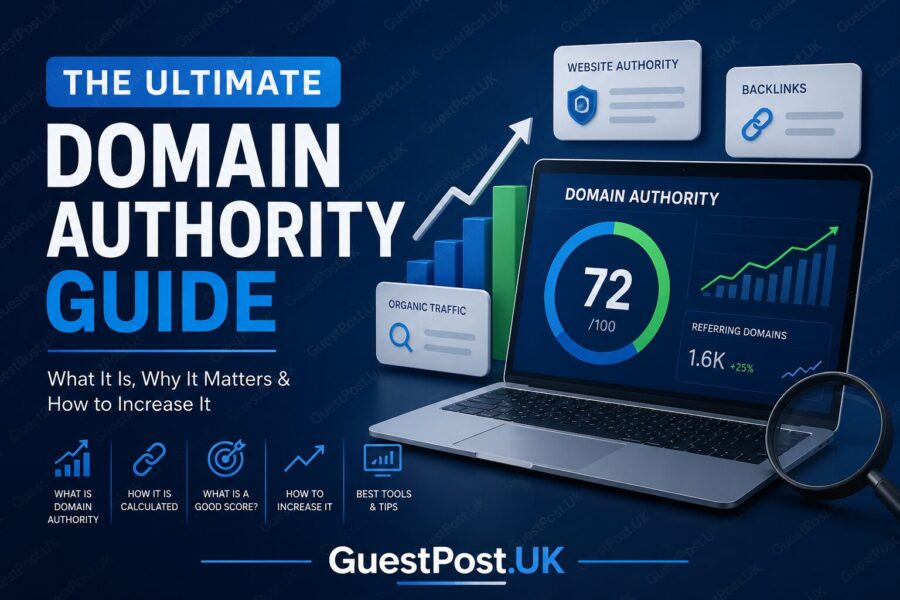
Domain Authority, commonly abbreviated as DA, is a predictive SEO metric developed by Moz that estimates how likely a website is to rank in search engine results when compared with other websites. It uses a logarithmic scale from 1 to 100, with higher scores generally indicating stronger authority and a greater ability to compete for competitive search terms.
Unlike metrics such as page speed, bounce rate or organic traffic, Domain Authority is not something that Google publishes or officially recognises. It is a proprietary metric created by Moz to help SEO professionals compare websites more effectively. Over time, it has become one of the most widely referenced authority metrics in the SEO industry and is frequently used in backlink analysis, outreach campaigns, and competitor research.
One reason Domain Authority became so popular is its simplicity. Rather than manually reviewing thousands of backlinks, SEO professionals can quickly compare two websites using a single score. While that score never tells the complete story, it provides a useful starting point for understanding the relative strength of a domain.
Imagine two websites competing for the same keyword. One has a Domain Authority of 24, while the other has a score of 61. Without looking at any other data, you can reasonably assume that the second website has built a stronger backlink profile over time and is likely to have earned greater trust across the web. That does not automatically mean it will rank above the first website for every search query, but it suggests it has a stronger foundation to compete.
This is why Domain Authority is best viewed as a comparative metric rather than an absolute measurement of SEO success. It helps answer questions such as:
- How strong is my website compared with competitors?
- Is my backlink profile improving over time?
- Which websites are worth approaching for guest posting?
- Are my link-building efforts producing meaningful results?
When used alongside other SEO metrics, Domain Authority becomes a powerful decision-making tool rather than simply another number on a dashboard.
Why Was Domain Authority Created?
To understand the value of Domain Authority, it helps to appreciate the challenge that SEO professionals faced before authority metrics became widely available.
Google has never publicly revealed the precise algorithm it uses to rank websites. While it has shared broad guidance around helpful content, backlinks, user experience and trust, the exact weighting of individual ranking signals remains confidential. This creates a challenge for marketers trying to measure a website’s strength or predict how difficult it might be to outrank competitors.
Moz developed Domain Authority to address this problem. Instead of attempting to replicate Google’s algorithm exactly, the company analysed enormous amounts of search data, backlink information and ranking patterns to create a machine-learning model capable of estimating a website’s ranking potential.
The result was a practical benchmark that allowed SEO professionals to compare websites consistently.
For example, if you are evaluating twenty websites for a guest posting campaign, manually analysing every backlink profile would take hours. Domain Authority provides an efficient way to identify which websites deserve closer investigation before performing more detailed analysis.
Although the algorithm has evolved significantly since its original release, its purpose remains the same today: helping SEO professionals make smarter decisions based on comparative authority rather than guesswork.
Why Domain Authority Matters in Modern SEO
Even though Domain Authority is not used directly by Google, it continues to play an important role in modern SEO because it reflects many of the same underlying qualities that search engines value.
Think of Domain Authority as the reputation score of your website.
Just as people naturally trust well-established brands with strong reputations, search engines tend to reward websites that consistently demonstrate expertise, attract quality backlinks and provide valuable information to users. Domain Authority attempts to quantify those characteristics through the strength of a website’s backlink profile and related authority signals.
A growing Domain Authority often indicates that a website is successfully building credibility across the web. That credibility can influence everything from backlink acquisition to digital PR opportunities and industry partnerships.
For businesses investing in long-term SEO, this matters because authority compounds over time.
A website that consistently earns editorial backlinks, publishes useful resources and becomes recognised within its niche often finds it easier to rank future content. New pages benefit from the trust already established by the domain, making it possible to compete for increasingly competitive search terms.
Conversely, websites with weak authority frequently struggle to gain traction, even when producing well-written content. Without external trust signals, it becomes much harder to convince search engines that your website deserves prominent visibility.
This is one reason why link building continues to play such an important role in SEO. High-quality backlinks remain among the strongest indicators that other websites genuinely value your content.
Where Domain Authority Fits Within Your SEO Strategy
One mistake many website owners make is treating Domain Authority as the primary objective of their SEO campaign.
In reality, Domain Authority should never become the goal.
The real objectives remain:
- Increasing qualified organic traffic.
- Generating more enquiries and sales.
- Building long-term brand visibility.
- Becoming a recognised authority within your industry.
Domain Authority simply acts as one indicator that these broader objectives are moving in the right direction.
Consider two businesses.
The first spends months chasing cheap backlinks purely to increase its authority score. The second invests in creating expert content, conducting digital PR campaigns, publishing guest articles on respected industry websites and earning editorial mentions naturally.
Both websites might experience an increase in Domain Authority, but only the second business is building sustainable authority that contributes to long-term rankings, stronger brand recognition and increased customer trust.
This distinction is crucial because SEO has evolved considerably over the past decade. Search engines now evaluate expertise, topical relevance and user satisfaction far more effectively than they once did. Authority is no longer built solely through backlinks; it is reinforced by the overall quality and credibility of your website.
Domain Authority Is Only One Piece of the Puzzle
A common misconception among beginners is that websites with higher Domain Authority will always outrank those with lower scores.
The reality is much more nuanced.
Imagine a national news website with a Domain Authority above 90 publishing a brief article about a highly specialised engineering topic. At the same time, a niche engineering consultancy with a Domain Authority of 38 publishes an exceptionally detailed guide written by experienced professionals.
Despite having a considerably lower authority score, the engineering consultancy may still outperform the larger publication because its content demonstrates greater expertise, relevance and usefulness for that specific search query.
This example highlights an important principle of modern SEO.
Search engines evaluate pages, not just domains.
Factors such as search intent, topical expertise, content quality, user experience and relevance frequently outweigh raw authority metrics.
Rather than asking, “How can I increase my Domain Authority?”, a more productive question is:
“How can I build a website that consistently deserves to earn authority?”
When you adopt that mindset, improvements in Domain Authority tend to occur naturally as a consequence of stronger SEO practices rather than as an isolated target.
Common Myths About Domain Authority
Because Domain Authority is discussed so frequently within the SEO industry, it has inevitably become surrounded by misconceptions. Understanding what DA does not measure is just as important as understanding what it does.
Myth 1: Google Uses Domain Authority as a Ranking Factor
This is by far the most common misunderstanding.
Google has repeatedly confirmed that it does not use Moz’s Domain Authority metric when ranking websites. Domain Authority is an independent score developed by Moz, not by Google.
However, the confusion arises because many of the signals that contribute to higher Domain Authority—such as earning high-quality backlinks and building a trusted online presence—also align with Google’s broader ranking principles.
Myth 2: A Higher Domain Authority Guarantees Higher Rankings
A stronger authority score can provide a competitive advantage, but it never guarantees rankings.
Search intent, page relevance, content quality, technical SEO, user experience and topical expertise all influence how individual pages perform in search results.
Myth 3: Domain Authority Can Be Increased Overnight
There are no shortcuts to sustainable authority.
Websites that genuinely improve their authority typically do so over months or years through consistent publishing, strategic link building, digital PR and brand development.
Promises of instant DA improvements should always be treated with caution.
Myth 4: Every Backlink Has Equal Value
Not all backlinks contribute equally to authority.
One editorial backlink from a respected, industry-relevant publication can provide significantly more value than dozens of links from low-quality or unrelated websites.
Quality consistently outweighs quantity.
What Is a Good Domain Authority Score?
After learning what Domain Authority is, the next question most website owners ask is remarkably simple:
“What is a good Domain Authority score?”
The honest answer is that there is no single number that automatically makes a website “good”. A Domain Authority score only becomes meaningful when viewed within the context of your industry, competitors and business objectives.
Many beginners believe they need a score of 70 or 80 before they can compete in Google. In reality, thousands of successful businesses generate substantial organic traffic with Domain Authority scores below 40. Equally, many websites with exceptionally high authority still struggle to rank because they publish poor-quality content or fail to satisfy search intent.
The objective should never be to chase an arbitrary number.
Instead, focus on whether your website is becoming more authoritative than the websites of the businesses you are directly competing against.
For example, imagine you own a local accounting practice serving one city. If the leading competitors all have Domain Authority scores between 22 and 35, reaching a score of 30 or above may place you in a highly competitive position. On the other hand, if you operate an international SEO software platform competing against companies such as Ahrefs, Semrush and Moz, your competitive benchmark will naturally be much higher.
This is why experienced SEO consultants rarely ask, “What is my Domain Authority?”
Instead, they ask:
- How does my authority compare with my competitors?
- Is my authority improving year after year?
- Are I earning better backlinks than last year?
- Is my website becoming more trusted within its niche?
Those questions provide far greater insight than the number itself.
General Domain Authority Benchmarks
Although every industry is different, the following ranges provide a useful guide.
| Domain Authority | General Interpretation |
|---|---|
| 1–10 | Brand-new websites with little or no backlink profile |
| 11–20 | Early-stage websites beginning to establish authority |
| 21–30 | Growing websites with steady SEO progress |
| 31–40 | Strong small businesses and niche publishers |
| 41–50 | Established businesses competing nationally |
| 51–60 | Highly authoritative websites with significant backlink profiles |
| 61–70 | Industry leaders and recognised brands |
| 71–80 | Major publishers and national organisations |
| 81–100 | Global brands, governments and internationally recognised websites |
These figures should always be treated as guidelines rather than targets.
Moving from DA 10 to DA 20 is often achievable within a year of consistent SEO work. Increasing from DA 60 to DA 70, however, may require years of sustained effort because authority grows logarithmically rather than linearly.
Domain Authority Expectations by Business Type
Different industries naturally attract different levels of authority.
A local electrician, solicitor or estate agent does not need the same backlink profile as a global software company.
Here is a simplified example.
| Website Type | Competitive DA Range |
|---|---|
| Local trades business | 15–30 |
| Regional service company | 20–40 |
| National business | 35–60 |
| SaaS company | 40–70 |
| Large eCommerce brand | 50–80 |
| National newspaper | 80+ |
The important lesson is that your competitors—not arbitrary online advice—should define your authority targets.
If every business ranking on page one has a Domain Authority around 28, there is little value in becoming obsessed with reaching 70.
Instead, concentrate on building enough authority to compete effectively within your market.
How Is Domain Authority Calculated?
One reason Domain Authority continues to be misunderstood is that many people imagine it is calculated using a simple mathematical formula.
In reality, it is considerably more sophisticated.
Moz uses machine learning models trained on vast datasets of websites and search results. Rather than counting backlinks alone, these models analyse numerous signals that help estimate how competitive a website is likely to be in organic search.
Because the algorithm evolves over time, the exact calculation remains proprietary.
However, several important factors contribute significantly.
Referring Domains
The number of unique websites linking to your domain remains one of the strongest indicators of authority.
Notice the emphasis on unique websites.
Suppose Website A receives 5,000 backlinks from a single directory.
Website B receives 500 backlinks from 200 different authoritative websites.
Website B almost always possesses the stronger authority profile because its backlinks demonstrate broader trust across the internet.
Search engines—and authority metrics—place significant value on diversity.
Quality of Backlinks
Backlinks vary enormously in value.
A contextual editorial backlink from a respected industry publication is generally worth far more than hundreds of automatically generated directory links.
Quality backlinks usually share several characteristics.
They come from websites that:
- publish useful content
- maintain editorial standards
- attract genuine visitors
- possess their own authority
- are relevant to your industry
These are precisely the types of backlinks that naturally contribute to long-term authority growth.
Relevance Matters
Not every backlink should be judged purely by authority.
Imagine an accounting firm receiving a backlink from a respected finance publication.
Now compare that with receiving the same backlink from an unrelated gardening blog.
Even if both websites have similar authority scores, the finance publication offers considerably greater contextual relevance.
Modern SEO increasingly rewards relevance alongside authority.
This is why niche guest posting campaigns often outperform large-scale, untargeted link-building efforts.
Overall Link Profile
Domain Authority evaluates an entire backlink profile rather than isolated links.
A healthy profile typically demonstrates:
- gradual growth
- diverse referring domains
- varied anchor text
- editorial placements
- topical relevance
Conversely, an unnatural profile may include:
- sudden spikes in backlinks
- repetitive anchor text
- large numbers of unrelated websites
- obvious link schemes
Building authority is therefore about developing a balanced and trustworthy backlink profile rather than simply accumulating links.
Internal Website Structure
Although backlinks remain the dominant influence, authority also flows throughout your own website.
A logical internal linking structure helps distribute authority between important pages.
For example, a comprehensive pillar page linking naturally to supporting articles creates a much stronger topical structure than isolated pages with little internal connectivity.
This is one reason why content clusters have become increasingly popular within SEO.
Instead of publishing disconnected articles, successful websites create networks of related content that reinforce one another.
The Biggest Factors That Influence Domain Authority
While Moz does not publish every detail of its algorithm, years of industry research have identified several recurring factors that consistently influence authority growth.
High-Quality Backlinks
Editorial backlinks remain the single most important driver.
These are links that have been earned because another publisher genuinely considers your content valuable.
Examples include:
- digital PR coverage
- expert interviews
- guest articles
- industry resources
- original research
- case studies
The more respected the referring website, the greater the potential benefit.
Consistent Link Growth
Healthy websites usually gain backlinks steadily.
Imagine plotting backlink growth on a graph.
One website receives 20–40 quality backlinks every month over three years.
Another receives 1,000 backlinks within a week, then almost completely stops.
The first pattern appears far more natural and sustainable.
Gradual growth almost always produces stronger long-term authority.
Strong Content
Authority rarely develops without useful content.
The websites that attract the highest-quality backlinks usually publish resources that people genuinely want to reference.
These include:
- ultimate guides
- original research
- industry statistics
- tutorials
- calculators
- free SEO tools
- comparison studies
Great content gives other websites a reason to link.
Without link-worthy content, acquiring quality backlinks becomes considerably more difficult.
Brand Recognition
Authority extends beyond backlinks.
Strong brands naturally attract:
- mentions
- citations
- reviews
- interviews
- podcast appearances
- conference speaking opportunities
These activities reinforce trust across the web.
While not every mention includes a backlink, widespread recognition often indirectly contributes to greater authority over time.
User Experience
Although Domain Authority itself focuses primarily on backlink signals, user experience supports the broader SEO ecosystem.
Visitors are more likely to recommend, reference and link to websites that provide:
- fast loading speeds
- intuitive navigation
- trustworthy design
- useful information
- excellent readability
The better the experience, the greater the likelihood of earning natural backlinks.
Why Domain Authority Changes Over Time
Many website owners become concerned when they notice their Domain Authority decreasing despite making no obvious changes.
This is perfectly normal.
Remember that Domain Authority is a relative metric.
Imagine you improve your backlink profile this year.
At the same time, hundreds of competitors improve theirs even more.
Although your website has become stronger, your comparative position may remain unchanged—or even decline slightly.
Authority should therefore be viewed as a moving benchmark rather than a fixed achievement.
Several factors can influence changes.
Your Competitors Improve
SEO is competitive.
As other websites gain authority, relative rankings naturally shift.
Lost Backlinks
If authoritative websites remove links pointing to your content, your authority may decrease.
This highlights the importance of earning diverse backlinks rather than relying heavily on a handful of referring domains.
Algorithm Updates
Moz periodically updates its authority models.
These updates can cause widespread changes across millions of websites.
A fluctuation does not necessarily indicate that your SEO campaign is failing.
Website Growth
Positive changes can also increase authority.
Publishing exceptional content, earning editorial mentions, launching digital PR campaigns and acquiring relevant backlinks all contribute to gradual improvements.
Domain Authority Trends: What Healthy Growth Looks Like
One mistake many businesses make is expecting authority to increase in a straight line.
In reality, growth resembles a series of gradual steps rather than a perfectly smooth upward curve.
A healthy authority journey often looks something like this:
Year 1
- Publish consistent content
- Optimise technical SEO
- Earn initial backlinks
- DA begins to grow steadily
Year 2
- Guest posting campaigns
- Digital PR activity
- Stronger internal linking
- Increased topical authority
- Faster authority growth
Year 3
- Brand recognition increases
- Natural backlinks become more common
- Larger publications begin referencing your content
- Authority compounds more quickly
This demonstrates one of the most encouraging aspects of SEO.
Authority is cumulative.
The effort invested today continues to produce benefits for years to come.
SEO Consultant Insight
One of the biggest differences between average websites and industry-leading websites is not the number of backlinks they purchase—it is the number of backlinks they no longer need to ask for.
Once a website becomes recognised as a trusted authority within its niche, journalists, bloggers and businesses begin referencing it naturally. At that stage, authority starts generating more authority, creating a powerful cycle of organic growth that becomes increasingly difficult for competitors to replicate.
How to Increase Domain Authority
By now, you’ve probably realised that increasing Domain Authority is not about manipulating a single metric. There is no secret formula, shortcut or software capable of instantly transforming a website from a DA 15 domain into a DA 60 authority.
Instead, the process mirrors how reputation is built in the real world.
Businesses earn trust by consistently delivering value, demonstrating expertise and receiving recommendations from respected sources. Websites work in much the same way. Search engines and authority metrics reward websites that become recognised, referenced and trusted over time.
The encouraging news is that the same activities that increase Domain Authority also contribute to better rankings, stronger brand awareness and higher organic traffic. Rather than treating Domain Authority as the end goal, think of it as a reflection of how successful your wider SEO strategy has become.
If you focus on building a genuinely authoritative website, the metric will usually take care of itself.
Build High-Quality Backlinks, Not Just More Backlinks
Ask ten experienced SEO professionals what influences Domain Authority the most, and almost all of them will mention backlinks.
However, not all backlinks deserve equal attention.
Years ago, link building often revolved around volume. Thousands of directory submissions, forum signatures and blog comments were once enough to improve rankings. Those tactics no longer provide sustainable value.
Today’s search landscape rewards quality over quantity.
One editorial backlink from a respected publication can contribute more to your authority than hundreds of low-quality links placed on irrelevant websites.
Imagine two businesses.
The first purchases 2,000 backlinks from unrelated blogs scattered across the internet.
The second earns ten contextual backlinks from recognised marketing publications after publishing original research.
Although the first website has accumulated far more links, the second has almost certainly built a stronger authority profile because trusted websites have effectively endorsed its content.
This illustrates one of the most important principles in modern SEO:
The quality of the websites linking to you matters far more than the number of backlinks you collect.
Characteristics of Valuable Backlinks
The strongest backlinks typically share several qualities.
They are:
- Editorially placed within useful content.
- Relevant to your industry or topic.
- Surrounded by natural context.
- Published on genuine websites with real audiences.
- Difficult to obtain through automation.
Whenever you evaluate a potential backlink opportunity, ask yourself a simple question:
“Would I still want this link if search engines didn’t exist?”
If the answer is yes because it introduces your business to a relevant audience, builds credibility or generates referral traffic, it is usually a worthwhile opportunity.
Why Guest Posting Still Works
Guest posting has been discussed extensively within the SEO industry, often generating conflicting opinions.
Some people mistakenly believe guest posting no longer works because Google has warned against low-quality, manipulative guest posting campaigns.
The important distinction lies in quality.
Publishing hundreds of thin articles across unrelated websites purely to acquire backlinks is very different from contributing genuinely useful expertise to respected publications within your industry.
Modern guest posting remains one of the most effective methods of building authority because it achieves several objectives simultaneously.
It helps you earn editorial backlinks, introduce your business to new audiences, strengthen topical authority, and demonstrate expertise to both readers and search engines.
For example, imagine an SEO consultancy publishing an in-depth article about AI search optimisation on a respected digital marketing publication. Readers benefit from practical advice, the publisher receives valuable content, and the consultancy earns a relevant editorial backlink. Everybody gains from the relationship.
That is precisely why high-quality guest posting continues to perform exceptionally well.
A Strategic Guest Posting Campaign
Rather than focusing on hundreds of placements, prioritise websites that demonstrate:
- Strong editorial standards.
- Genuine organic traffic.
- Relevant audiences.
- Consistent publishing.
- Industry credibility.
Ten placements on respected niche websites frequently outperform 100 placements on weak domains created solely to sell backlinks.
Digital PR: The Next Level of Authority Building
While guest posting remains an excellent strategy, digital PR often yields some of the most powerful backlinks.
Digital PR focuses on creating stories, research and expert insights that journalists genuinely want to publish.
Unlike traditional outreach, where you ask for a backlink, digital PR earns links because the content itself becomes newsworthy.
Examples include:
- Original industry research.
- Consumer surveys.
- Market reports.
- Expert commentary.
- Data visualisations.
- Seasonal trend analysis.
Imagine publishing research analysing thousands of SEO campaigns to identify which industries have benefited most from AI search optimisation.
Marketing websites, journalists, bloggers and business publications may all reference your findings, generating dozens of editorial backlinks from authoritative websites.
This is why digital PR has become a cornerstone of many enterprise SEO strategies.
Why Digital PR Supports Domain Authority
Editorial coverage often produces:
- Highly trusted backlinks.
- Diverse referring domains.
- Brand mentions.
- Increased topical relevance.
- Greater visibility across the web.
These benefits extend far beyond improving a single authority metric.
Digital PR helps establish genuine industry recognition.
Publish Content Worth Linking To
One of the simplest ways to understand modern SEO is this:
People link to useful resources.
If your website contains nothing beyond sales pages and service descriptions, earning natural backlinks becomes significantly more difficult.
The websites attracting the strongest backlink profiles usually publish resources that people actively want to reference.
Examples include:
- Ultimate guides.
- Original studies.
- Free SEO tools.
- Research reports.
- Statistics pages.
- Comprehensive tutorials.
- Templates and checklists.
These resources continue earning backlinks long after publication because they provide ongoing value.
Before creating content, ask yourself:
“Would another website naturally reference this article when explaining the topic?”
If the answer is no, consider how you can make the resource more comprehensive, original or practical.
Build Topical Authority, Not Just Individual Pages
Search engines have become increasingly sophisticated at recognising expertise within specific subject areas.
Publishing occasional articles on unrelated topics rarely creates a strong authority profile.
Instead, successful websites build interconnected content ecosystems.
Imagine an SEO website.
Rather than publishing isolated articles about marketing, finance, travel and technology, it creates comprehensive topic clusters around:
- Link building.
- Guest posting.
- Digital PR.
- AI SEO.
- Technical SEO.
- Keyword research.
- Content marketing.
Each article supports the others through thoughtful internal linking, gradually reinforcing the website’s expertise within search engine optimisation.
This concept is known as topical authority.
Over time, search engines gain greater confidence that the website genuinely understands its subject matter.
The Power of Content Clusters
For example:
Main Guide:
- Ultimate Domain Authority Guide
Supporting Content:
- Guest Posting Strategies.
- Digital PR Campaigns.
- Link Building Techniques.
- Domain Authority Checker Tools.
- SEO Metrics Explained.
- Backlink Audits.
Every supporting article strengthens the authority of the central guide while also helping readers explore related topics.
Strengthen Your Internal Linking
External backlinks often receive the most attention, yet internal linking remains one of the most underutilised authority-building techniques.
Every page that earns backlinks can pass some of its authority throughout your website.
A thoughtful internal linking structure ensures your most important pages receive the value they deserve.
For example, if one article attracts dozens of backlinks but contains no internal links, much of its potential influence remains isolated.
Now imagine that same article linking naturally to your service pages, pillar guides and supporting resources.
Suddenly, authority begins flowing throughout your website.
Internal Linking Best Practices
Focus on:
- Descriptive anchor text.
- Logical navigation.
- Related content.
- Commercial page support.
- Avoiding orphan pages.
Readers should naturally discover your next most valuable resource without having to search for it.
Build Your Brand Alongside Your Backlinks
Many SEO discussions focus almost exclusively on backlinks.
However, authority extends beyond links.
Search engines increasingly recognise businesses as entities rather than simply collections of webpages.
Well-known brands naturally accumulate:
- Reviews.
- Mentions.
- Interviews.
- Podcast appearances.
- Social discussions.
- Industry citations.
Even when some mentions lack backlinks, they still contribute to a stronger online presence.
This is one reason why businesses investing in branding often experience SEO benefits that extend beyond traditional link building.
Recognition creates trust.
Trust encourages citations.
Citations frequently become backlinks.
Technical SEO Supports Authority
Technical SEO will not directly increase your Domain Authority overnight, but it creates the foundation upon which authority can grow.
Imagine spending months earning exceptional backlinks only to discover that search engines struggle to crawl your website or that important pages remain unindexed.
Those backlinks become significantly less valuable.
Healthy websites typically demonstrate:
- Fast loading speeds.
- Mobile-friendly design.
- Secure HTTPS implementation.
- Clear navigation.
- Logical URL structures.
- XML sitemaps.
- Proper canonicalisation.
Technical excellence ensures the authority you earn can be fully utilised.
How Long Does It Take to Increase Domain Authority?
One of the most common questions in SEO is:
“How long will it take before my Domain Authority improves?”
The honest answer depends on your starting point, your industry and the quality of your SEO strategy.
Authority is rarely built quickly.
Instead, it develops gradually as your website earns trust through consistent publishing, quality backlinks and increasing brand recognition.
A realistic timeline might look something like this:
| Starting Authority | Typical Progress Timeline |
|---|---|
| DA 1–10 | Three to six months |
| DA 10–20 | Six to twelve months |
| DA 20–30 | Twelve to eighteen months |
| DA 30–40 | Twelve to twenty-four months |
| DA 40+ | Often several years of consistent growth |
These are not guarantees.
Some websites progress faster through exceptional content and digital PR, while others require considerably longer.
The important point is that authority compounds.
Every quality backlink makes future growth slightly easier.
Every excellent article creates another opportunity for citations.
Every successful outreach campaign expands your digital reputation.
Common Mistakes That Slow Authority Growth
Many businesses invest heavily in SEO without seeing meaningful improvements because they prioritise the wrong things.
Buying Cheap Backlinks
Low-cost backlink packages often generate hundreds of weak links rather than genuine authority.
Quality always wins.
Ignoring Relevance
A backlink from a highly relevant industry website frequently provides more value than a stronger but completely unrelated publication.
Publishing Thin Content
Backlinks cannot compensate for content that offers little value.
Exceptional resources naturally attract more citations.
Chasing Metrics Instead of Business Growth
Increasing Domain Authority is not the objective.
Generating more enquiries, customers and revenue should always remain the priority.
Authority simply supports those outcomes.
Inconsistent SEO Effort
Perhaps the biggest mistake of all is inconsistency.
Many websites publish enthusiastically for several months before abandoning their strategy altogether.
Authority rewards patience.
Businesses that consistently invest in content, outreach, and brand development for years almost always outperform those that search for shortcuts.
SEO Consultant Insight
One pattern appears repeatedly across successful SEO campaigns.
The businesses that eventually achieve Domain Authority scores of 50, 60 or even higher rarely begin by chasing those numbers.
They focus on becoming the most useful resource within their niche.
They publish better content than their competitors.
They build genuine industry relationships.
They earn editorial mentions rather than demanding backlinks.
Eventually, the authority metrics simply catch up with the reputation they have already established.
That is why the most effective way to increase Domain Authority is not to obsess over the score itself—it is to build a website that consistently deserves recognition. When your business becomes a trusted authority within its industry, stronger backlinks, higher visibility and improved Domain Authority naturally follow.
Perfect. This final part will complete the article and naturally funnel readers towards your commercial page without sounding overly promotional.
Best Domain Authority Checker Tools
Understanding your website’s authority is only part of the equation. You also need reliable tools that allow you to measure progress, compare competitors and identify opportunities for improvement.
Today, several leading SEO platforms provide their own authority metrics. While they all attempt to measure the strength of a website, each uses a different methodology, database and scoring model.
This often leads to confusion.
A website might have a Domain Authority (DA) of 38, a Domain Rating (DR) of 51 and a SEMrush Authority Score of 42. None of these figures is incorrect—they are simply measuring authority from different perspectives.
Rather than searching for the “perfect” metric, experienced SEO professionals compare several authority indicators together before making important decisions.
Let’s examine the most widely used tools.
Moz Domain Authority
Moz introduced Domain Authority and remains its original creator.
Its machine learning model analyses thousands of ranking signals, particularly backlink quality and referring domains, to estimate how competitive a website is likely to be in Google’s search results.
Although Google does not use Domain Authority directly, Moz’s metric has become an industry benchmark for evaluating websites during outreach campaigns and competitor analysis.
Advantages
- Industry-standard authority metric
- Excellent for competitor comparison
- Widely recognised by agencies and SEO professionals
- Easy to understand
Limitations
- Not a Google ranking factor
- Scores fluctuate as Moz updates its index
- Should never be used in isolation
Moz remains an excellent starting point, particularly if your primary objective is evaluating websites for guest posting or link-building opportunities.
Ahrefs Domain Rating (DR)
Ahrefs approaches authority differently.
Instead of Domain Authority, it measures Domain Rating (DR).
DR focuses primarily on the strength and quality of a website’s backlink profile. Because Ahrefs maintains one of the largest backlink databases in the industry, many link builders rely heavily on Domain Rating when evaluating backlink opportunities.
Unlike Moz, Ahrefs places considerable emphasis on link equity flowing between websites.
Advantages
- Outstanding backlink database
- Excellent reference domain analysis
- Strong competitor backlink research
- Highly respected within the SEO industry
Limitations
- Focuses primarily on backlinks
- Does not directly evaluate broader SEO performance
- DR should be interpreted alongside other metrics
If your primary responsibility involves outreach or link acquisition, Ahrefs remains one of the strongest platforms available.
SEMrush Authority Score
SEMrush does not use Domain Authority or Domain Rating.
Instead, it has developed Authority Score.
Authority Score combines backlink signals with additional indicators such as organic visibility and website trust to provide a broader picture of overall authority.
Many SEO consultants appreciate this broader perspective because websites are evaluated on more than just backlinks.
Advantages
- Combines multiple SEO signals
- Integrates naturally with Site Audit and Backlink Audit
- Excellent for agency reporting
- Useful competitor benchmarking
Limitations
- Different methodology from Moz and Ahrefs
- Authority Score cannot be directly compared with DA or DR
If you already use SEMrush for keyword research, competitor analysis or technical SEO, Authority Score provides valuable additional context.
Majestic Trust Flow and Citation Flow
Although less discussed today, Majestic continues to provide useful authority metrics.
Rather than calculating a single authority score, it focuses on:
- Trust Flow – the quality of backlinks.
- Citation Flow – the quantity of backlinks.
When analysed together, these metrics help identify whether a backlink profile appears natural or artificially inflated.
For example, a website with extremely high Citation Flow but very low Trust Flow may have accumulated a large number of low-quality backlinks.
Read Also: DA vs DR vs AS vs TF
Domain Authority Checker Comparison
| Tool | Authority Metric | Primary Strength | Best For |
|---|---|---|---|
| Moz | Domain Authority (DA) | Overall authority benchmarking | Outreach and competitor analysis |
| Ahrefs | Domain Rating (DR) | Backlink profile strength | Link building and backlink research |
| SEMrush | Authority Score | Overall SEO health and authority | Agencies and complete SEO audits |
| Majestic | Trust Flow / Citation Flow | Link quality analysis | Backlink profile evaluation |
Each platform offers valuable insights, which is why experienced SEO professionals rarely depend upon a single metric.
Which Authority Metric Should You Prioritise?
One of the most common questions clients ask is:
“Which metric should I trust?”
The answer is surprisingly straightforward.
Do not become overly attached to any individual authority score.
Instead, understand what each metric does well.
Use Moz Domain Authority When
- Comparing websites quickly.
- Evaluating guest posting opportunities.
- Monitoring authority growth.
Use Ahrefs Domain Rating When
- Researching backlinks.
- Finding referring domains.
- Analysing competitors’ link profiles.
Use SEMrush Authority Score When
- Running comprehensive SEO campaigns.
- Producing client reports.
- Combining authority with traffic and keyword performance.
In practice, most agencies use all three.
The objective is not to find identical scores.
The objective is to build a complete understanding of a website’s authority.
Domain Authority Trends: A Text-Based View
Imagine two websites beginning their SEO journey at exactly the same time.
Website A
- Publishes one article every six months.
- Purchases cheap backlinks.
- Performs little outreach.
- Rarely updates existing content.
Authority trend:
Year 1 → Small increase
Year 2 → Almost no growth
Year 3 → Plateau
Website B
- Publishes helpful content every week.
- Earns editorial backlinks.
- Invests in guest posting.
- Launches digital PR campaigns.
- Builds topical authority.
Authority trend:
Year 1 → Steady growth
Year 2 → Strong momentum
Year 3 → Compounding authority
This illustrates one of the most important principles in SEO.
Authority rarely grows in dramatic leaps.
Instead, it compounds gradually through consistent investment.
Frequently Asked Questions
Is Domain Authority a Google ranking factor?
No. Domain Authority is a proprietary metric developed by Moz. Google does not use it directly when ranking websites.
What is a good Domain Authority score?
A good score depends on your competitors and industry. Many local businesses perform well with scores between 20 and 40, while national brands often exceed 50 or 60.
Can Domain Authority decrease?
Yes. Lost backlinks, increased competition and updates to Moz’s algorithm can all influence your score.
How often does Domain Authority update?
Moz updates its index periodically, meaning scores can change even if you have not made major changes to your website.
Does guest posting improve Domain Authority?
Yes, when done correctly. Publishing high-quality guest articles on relevant, authoritative websites can strengthen your backlink profile and increase the number of referring domains over time.
How long does it take to improve Domain Authority?
Most websites require several months of consistent SEO work before noticeable improvements occur. Building authority is a long-term investment rather than a quick win.
Should I focus on DA, DR or Authority Score?
Use all three where possible. Each metric measures authority differently and provides valuable insights into different aspects of your website.
Key Takeaways
If you remember only a handful of points from this guide, make them these:
- Domain Authority is a comparative SEO metric, not a Google ranking factor.
- Authority is built through trust, relevance and high-quality backlinks rather than shortcuts.
- Strong content, digital PR and guest posting remain among the most effective long-term authority-building strategies.
- Compare your website against direct competitors rather than chasing arbitrary numbers.
- Consistency always outperforms quick fixes.
- Building genuine expertise and topical authority will improve far more than a single SEO metric.
The businesses that dominate search results rarely do so by focusing exclusively on Domain Authority.
They succeed because they become recognised experts within their industries, earn authoritative backlinks naturally and continually invest in producing genuinely valuable content.
Treat Domain Authority as a progress indicator—not the destination.
Ready to Build a Stronger Domain Authority?
Reading about Domain Authority is the first step.
Building it is where the real work begins.
At GuestPost.uk, we help businesses strengthen their online authority through ethical, long-term SEO strategies that prioritise quality over shortcuts. Whether you’re a small business looking to establish credibility or an established brand aiming to rank higher in search results, our team can help you develop a sustainable authority-building strategy.
Our services include:
- High-quality guest posting on genuine websites
- Blogger outreach campaigns
- Editorial link building
- Digital PR opportunities
- Niche-relevant backlink acquisition
- Content-led authority building
- GEO (Generative Engine Optimisation) support
If your goal is to grow from DA 20 to DA 30, from DA 30 to DA 40, or even to build towards DA 50+, the right strategy matters far more than simply acquiring more backlinks.
Every campaign should focus on earning trust, improving relevance and creating long-term value.
To learn more about practical authority-building strategies and how our team can help improve your website’s authority, visit our dedicated Domain Authority page:
There, you’ll find more information about improving Domain Authority, building authoritative backlinks and choosing the right SEO strategy for sustainable growth.
All in All!
Domain Authority remains one of the most valuable comparative metrics available to SEO professionals, but it should never be viewed in isolation. The strongest websites are not those with the highest scores—they are those that consistently earn trust through exceptional content, relevant backlinks, technical excellence and genuine expertise.
By focusing on these fundamentals, you won’t simply improve a number in an SEO tool. You’ll build a website that attracts more visitors, earns more recommendations, generates more enquiries, and continues to grow for years to come.
In the ever-changing world of SEO, that kind of authority is far more valuable than any single metric.