
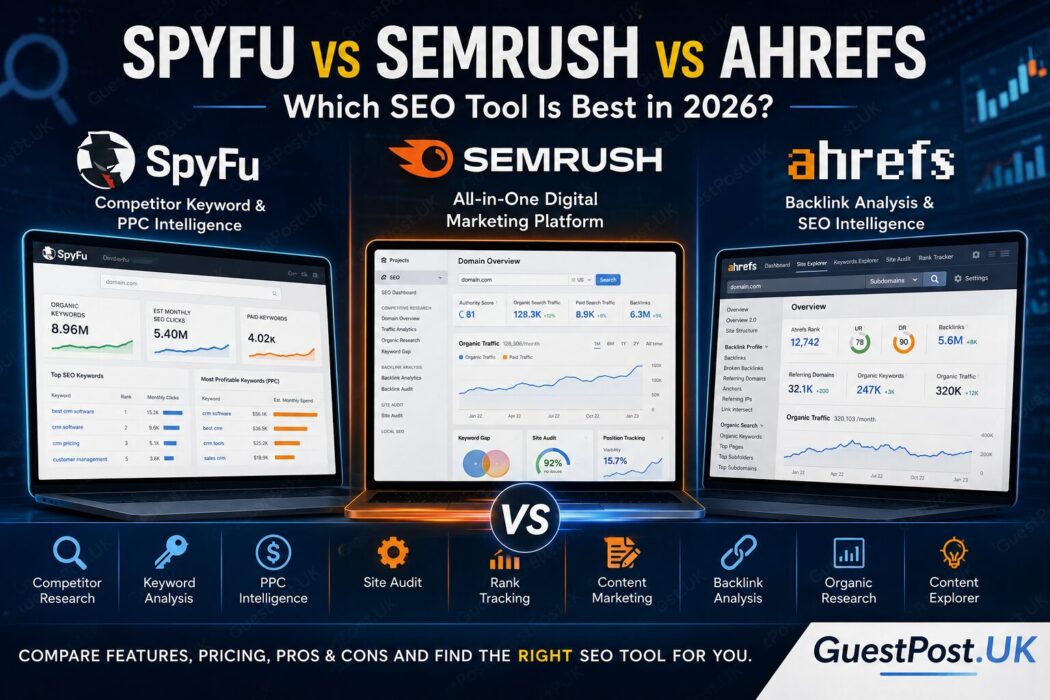
Choosing the right SEO platform has never been more important. Whether you’re running a personal blog, managing an eCommerce website, working within an agency or overseeing SEO for multiple clients, your choice of software can directly influence how efficiently you research keywords, analyse competitors, identify backlink opportunities and monitor search performance.
The challenge is that today’s market offers several outstanding platforms, each claiming to be the ultimate solution. Among them, three names appear in almost every conversation about professional SEO software: SpyFu, Semrush and Ahrefs.
Although these platforms share many similarities, they were not built with exactly the same priorities. SpyFu has built its reputation around competitor intelligence and PPC research. Semrush has evolved into a comprehensive digital marketing platform covering everything from keyword research to content marketing and technical SEO. Ahrefs, meanwhile, is widely recognised for maintaining one of the industry’s strongest backlink databases and has become the preferred choice for many link-building specialists.
At first glance, they may appear to offer identical functionality. They all provide keyword research, competitor analysis, backlink reports and rank tracking. However, once you begin using them in real SEO campaigns, the differences quickly become apparent.
One platform may save hours during competitor research. Another may uncover backlink opportunities that others overlook. A third might provide more accurate keyword clustering or better reporting for agency clients.
Choosing the wrong platform doesn’t necessarily mean your SEO campaign will fail, but it can mean spending considerably more time completing tasks that another tool handles far more efficiently.
This guide takes an objective look at all three platforms, comparing their strengths, weaknesses and practical applications rather than simply listing features. We’ll also explore the best SpyFu alternatives, explain how each platform uncovers competitor keywords and help you determine which solution offers the greatest value for your specific requirements.
By the end of this guide, you’ll understand not only which tool performs best overall, but also which one deserves a place in your own SEO workflow.
Why Are SpyFu, Semrush and Ahrefs Compared So Often?
The SEO software industry has grown rapidly over the past decade, yet relatively few platforms have established themselves as trusted choices for professional marketers.
SpyFu, Semrush and Ahrefs consistently appear at the top because they solve the same core problem:
They help businesses understand what their competitors are doing successfully in search engines.
Rather than relying on guesswork, these platforms allow marketers to analyse keywords, backlinks, rankings, paid advertising strategies and content performance using enormous datasets collected from search engines and the wider web.
However, each platform approaches competitor intelligence from a different perspective.
SpyFu was originally developed with a strong emphasis on competitive keyword research and Google Ads intelligence. It excels at uncovering historical advertising campaigns, identifying profitable keywords and showing how competitors allocate their PPC budgets.
Semrush has gradually expanded far beyond SEO. Today it functions as a complete digital marketing suite, combining keyword research, backlink analysis, technical SEO, content marketing, local SEO, PPC management and social media tools within a single platform.
Ahrefs, by comparison, built its reputation through backlinks. Its crawler and backlink database have become trusted resources for SEO professionals who rely heavily on link analysis, competitor backlink research and content discovery.
Understanding these differences is essential because no SEO platform is objectively “best” in every situation.
Instead, the right choice depends entirely on how you intend to use it.
A Quick Overview of All Three Platforms
Before comparing features individually, it’s useful to understand what each platform is designed to achieve.
| Platform | Best Known For | Ideal Users |
|---|---|---|
| SpyFu | Competitor keyword research and PPC intelligence | Small businesses, PPC marketers, competitor research |
| Semrush | All-in-one digital marketing platform | Agencies, businesses, in-house marketing teams |
| Ahrefs | Backlink analysis and SEO research | SEO professionals, link builders, publishers |
Although this table provides a useful summary, it barely scratches the surface.
Let’s examine each platform in greater detail.
SpyFu Overview
SpyFu has been helping marketers analyse competitors for well over a decade and remains one of the most recognisable names in competitive keyword research.
Unlike many SEO tools that attempt to do everything equally well, SpyFu has always focused heavily on revealing the strategies behind successful competitors.
Instead of simply telling you which keywords a website ranks for, SpyFu attempts to answer deeper questions.
Which keywords consistently generate traffic?
Which Google Ads campaigns have competitors been running for years?
Which terms are producing long-term commercial value?
Which competitors share the greatest keyword overlap?
This historical perspective makes SpyFu particularly valuable for businesses investing in paid search.
For example, if a competitor has continued bidding on the same keyword for several years, there’s a reasonable chance that the keyword generates profitable conversions. SpyFu allows marketers to identify these opportunities without spending thousands of pounds testing campaigns themselves.
That insight alone can significantly reduce wasted advertising spend.
Where SpyFu Excels
SpyFu performs particularly well when your priorities include:
- Competitor keyword research
- Historical PPC data
- Google Ads intelligence
- Keyword overlap analysis
- Affordable competitor research
Many small businesses choose SpyFu because it provides valuable competitive insights at a lower price point than some of its larger competitors.
Where SpyFu Is Less Competitive
Although SpyFu performs extremely well within its specialist areas, it is not quite as comprehensive as some larger platforms.
For example, users requiring advanced site auditing, extensive backlink databases or integrated content marketing tools may find themselves relying on additional software.
This does not make SpyFu a poor product.
It simply reflects its more focused philosophy.
Semrush Overview
If SpyFu is a specialist, Semrush is a complete digital marketing ecosystem.
Over the past several years, Semrush has expanded far beyond its origins as an SEO tool. Today it supports almost every aspect of online marketing, including keyword research, competitor analysis, technical SEO, backlink monitoring, content optimisation, PPC management, local SEO, social media scheduling and market research.
This breadth explains why Semrush has become particularly popular with agencies and marketing departments.
Instead of switching between multiple tools throughout the day, teams can manage much of their workflow within a single platform.
Imagine an SEO agency onboarding a new client.
Within a few minutes, Semrush can provide:
- Technical SEO audit
- Organic keyword rankings
- Competitor analysis
- Backlink profile
- Keyword gap analysis
- Position tracking
- Content recommendations
That integrated experience is one of Semrush’s greatest strengths.
Where Semrush Excels
Semrush is particularly strong in areas such as:
- Complete SEO campaigns
- Technical SEO auditing
- Keyword gap analysis
- Agency reporting
- Local SEO
- Content optimisation
- PPC management
Its wide range of features makes it especially attractive for businesses seeking an all-in-one marketing platform.
Potential Drawbacks
The platform’s greatest strength can also become one of its challenges.
With hundreds of reports and dozens of integrated tools, new users sometimes find Semrush overwhelming during the first few weeks.
Fortunately, once the interface becomes familiar, the extensive feature set quickly becomes a significant advantage.
Ahrefs Overview
Ahrefs has earned a reputation as one of the most respected SEO platforms in the industry, particularly among experienced SEO professionals and link-building specialists.
While Semrush attempts to cover almost every aspect of digital marketing, Ahrefs has remained firmly focused on search engine optimisation.
Its crawler is among the largest on the web, enabling the platform to maintain an exceptionally detailed backlink index.
For many professionals, this remains Ahrefs’ defining advantage.
Whether you’re analysing competitors, auditing backlinks or searching for link-building opportunities, Ahrefs consistently delivers detailed, reliable data that has made it an essential part of countless SEO workflows.
However, Ahrefs is far more than a backlink tool.
It also provides:
- Keyword research
- Rank tracking
- Site audits
- Content Explorer
- Keyword difficulty analysis
- Competitor research
One of its standout features is Content Explorer, which enables marketers to discover the most linked-to and most shared content within almost any topic.
For content marketers, this can become an invaluable source of inspiration.
Where Ahrefs Excels
Ahrefs performs exceptionally well for:
- Backlink analysis
- Link-building campaigns
- Content research
- SEO competitor analysis
- Organic keyword research
Many SEO consultants consider Ahrefs the benchmark for backlink intelligence.
Potential Drawbacks
Ahrefs focuses heavily on SEO rather than on becoming a complete digital marketing platform.
Businesses requiring extensive PPC management, social media scheduling or integrated advertising reports may need additional software.
For organisations focused almost exclusively on SEO, however, this narrower focus often becomes one of Ahrefs’ greatest strengths.
First Impressions: Which Platform Feels Most Complete?
After spending time with all three platforms, an interesting pattern begins to emerge.
SpyFu feels like a specialist competitor intelligence tool.
Semrush feels like an entire marketing department inside one platform.
Ahrefs feels like software built by SEO professionals specifically for SEO professionals.
None of these approaches is inherently better.
Instead, each reflects a different philosophy.
The remainder of this guide will compare these platforms feature by feature, examining how they perform in real-world SEO campaigns and helping you determine which solution offers the greatest value for your own business.
SpyFu vs Semrush: Which Platform Delivers More Value?
The comparison between SpyFu and Semrush appears in countless SEO forums, agency discussions and software reviews. On paper, both platforms promise competitor analysis, keyword research and PPC insights. However, once you begin using them in real marketing campaigns, the differences become much more obvious.
The easiest way to think about the comparison is this:
SpyFu specialises in understanding competitors. Semrush specialises in managing your entire digital marketing strategy.
That distinction shapes almost every feature each platform offers.
If your daily work revolves around uncovering profitable competitor keywords, analysing Google Ads campaigns and identifying market opportunities, SpyFu performs exceptionally well. If you also need technical SEO audits, local SEO, content optimisation, backlink analysis, social media tools and client reporting, Semrush becomes the more complete solution.
Neither approach is wrong.
The better platform depends entirely on the type of marketer you are and the problems you need to solve.
Keyword Research
Keyword research sits at the heart of both platforms, but they approach it differently.
SpyFu’s strength lies in competitor-first research.
Instead of beginning with a keyword and asking how difficult it might be to rank, SpyFu encourages you to start with a competitor. You simply enter a domain and immediately discover thousands of keywords that the business already ranks for or advertises against.
This approach is particularly useful when entering a competitive market.
Imagine launching a new accounting software company.
Rather than brainstorming keyword ideas from scratch, SpyFu allows you to analyse established competitors and identify the exact search terms driving their visibility.
Semrush also performs competitor keyword research extremely well, but combines it with significantly broader keyword discovery.
Alongside competitor analysis, users gain access to:
- Keyword Magic Tool
- Keyword Gap Tool
- Search intent classification
- Topic clusters
- Seasonal trends
- SERP feature analysis
- Keyword grouping
For businesses developing comprehensive SEO campaigns, this additional context often proves invaluable.
Winner
If your objective is discovering competitor keywords as quickly as possible, SpyFu remains one of the simplest and most effective solutions available.
For broader keyword planning and complete SEO campaigns, Semrush takes the lead.
Competitor Analysis
Competitor research is where SpyFu has built its reputation.
Rather than simply listing competitor keywords, the platform attempts to reveal the strategies behind successful websites.
Users can analyse:
- Shared keywords.
- Lost keyword opportunities.
- Historical rankings.
- Google Ads history.
- Estimated advertising budgets.
- Organic visibility.
This historical perspective provides insights that many competing platforms struggle to match.
For PPC marketers, this information can be particularly valuable.
Instead of experimenting blindly with advertising campaigns, businesses can identify keywords competitors have invested in consistently over several years.
Long-running campaigns often indicate commercial success.
Semrush approaches competitor analysis differently.
Rather than concentrating solely on search performance, it presents a broader marketing picture by combining:
- Organic competitors.
- Paid competitors.
- Traffic estimates.
- Market share.
- Backlink comparisons.
- Keyword gaps.
- Domain authority metrics.
This broader perspective makes Semrush particularly useful for evaluating the entire competitive landscape rather than individual campaigns.
Winner
For pure competitor intelligence, SpyFu remains outstanding.
For broader business analysis, Semrush offers considerably more depth.
PPC Research
Paid advertising has always been one of SpyFu’s strongest areas.
Its historical Google Ads database allows marketers to analyse:
- Advert copy.
- Estimated spend.
- Keyword history.
- Long-term advertising trends.
This historical visibility is particularly useful because successful advertisers rarely continue spending money on keywords that fail to deliver a return.
If a competitor has maintained advertising activity for several years, that data alone can provide valuable strategic direction.
Semrush also supports PPC research through advertising reports and keyword tools, but its emphasis is broader.
It integrates paid search alongside SEO, content marketing and competitive intelligence rather than making PPC its primary focus.
Winner
For dedicated PPC competitor analysis:
SpyFu wins comfortably.
Site Audits and Technical SEO
Technical SEO represents one of the biggest differences between these platforms.
SpyFu offers useful SEO insights, but technical auditing has never been its core strength.
Semrush, by contrast, includes one of the industry’s most comprehensive Site Audit tools.
Within minutes, users receive reports covering:
- Crawlability.
- Indexability.
- Core Web Vitals.
- HTTPS implementation.
- Duplicate content.
- Redirect issues.
- Internal linking.
- Structured data.
- Page performance.
For agencies managing multiple websites, these automated audits save significant amounts of time.
Technical SEO has become increasingly important following Google’s emphasis on user experience and website quality.
Having these reports integrated within the same platform simplifies campaign management considerably.
Winner
Semrush by a considerable margin.
Content Marketing
Creating content is no longer enough.
Businesses also need to understand:
- search intent
- topical authority
- keyword clustering
- content gaps
- optimisation opportunities
Semrush has invested heavily in this area.
Its content tools include:
- SEO Writing Assistant
- Topic Research
- Content Audit
- Keyword clustering
- SEO Content Templates
These features help marketers produce content more efficiently while aligning with current SEO best practices.
SpyFu offers useful keyword intelligence for content planning but does not attempt to become a dedicated content optimisation platform.
Winner
Semrush
User Experience
Software should help marketers work faster rather than introducing unnecessary complexity.
SpyFu deserves credit here.
Its interface remains refreshingly straightforward.
Reports are easy to locate, competitor analysis is intuitive and new users generally become productive very quickly.
Semrush, on the other hand, offers a significantly larger feature set.
While this provides enormous flexibility, the learning curve can initially feel overwhelming.
For experienced SEO professionals, this complexity becomes an advantage.
For beginners, however, SpyFu often feels more approachable.
Winner
- Beginners → SpyFu
- Experienced marketers → Semrush
SpyFu vs Ahrefs
SpyFu and Ahrefs represent two very different philosophies within SEO.
SpyFu focuses primarily on competitor intelligence and paid search research.
Ahrefs focuses on search engine optimisation itself.
The result is two platforms that overlap in some areas while remaining remarkably different in others.
If your primary objective is understanding how competitors generate traffic, SpyFu excels.
If your objective is to understand why competitors rank so well, Ahrefs often provides deeper answers.
Backlink Analysis
This is perhaps the clearest distinction between the two platforms.
Ahrefs has invested years into building one of the largest backlink databases in the industry.
Its backlink reports allow users to examine:
- Referring domains.
- Anchor text.
- Link growth.
- Broken backlinks.
- New and lost links.
- Link quality.
For link-building specialists, this information is indispensable.
SpyFu includes backlink analysis, but backlinks are not its primary strength.
Its real value lies elsewhere.
Winner
Ahrefs
Keyword Research
Both platforms perform keyword research well, although their strengths differ.
SpyFu encourages users to begin with competitors.
Ahrefs encourages users to explore search demand itself.
Ahrefs also provides exceptionally detailed keyword metrics, including:
- Search volume.
- Click estimates.
- Parent topics.
- Keyword Difficulty.
- Traffic potential.
This additional context makes Ahrefs particularly useful when planning large content strategies.
Winner
For content-driven SEO:
Ahrefs
For competitor-first research:
SpyFu
Content Discovery
One feature that consistently impresses SEO professionals is Ahrefs’ Content Explorer.
Instead of simply researching keywords, users can discover:
- Most linked pages.
- Trending content.
- High-performing topics.
- Popular publishers.
This makes brainstorming considerably easier.
Imagine creating a guide about AI SEO.
Rather than guessing which subjects attract links, Content Explorer reveals the pages already earning authority.
SpyFu does not attempt to compete directly in this area.
Winner
Ahrefs
Overall SEO Workflow
After spending several weeks using both tools, a clear pattern emerges.
SpyFu excels during the early stages of research.
It answers questions such as:
- Who are my competitors?
- Which keywords do they target?
- Which Google Ads campaigns work?
- Which terms overlap?
Ahrefs becomes invaluable during campaign execution.
It answers different questions.
- Which backlinks should I pursue?
- Which pages attract links?
- How difficult is this keyword?
- Which content opportunities exist?
Rather than replacing one another, many agencies use both together.
SpyFu identifies opportunities.
Ahrefs helps execute the SEO strategy.
Feature Comparison Table
| Feature | SpyFu | Semrush | Ahrefs |
|---|---|---|---|
| Competitor keyword research | ⭐⭐⭐⭐⭐ | ⭐⭐⭐⭐⭐ | ⭐⭐⭐⭐☆ |
| Organic keyword database | ⭐⭐⭐⭐☆ | ⭐⭐⭐⭐⭐ | ⭐⭐⭐⭐⭐ |
| PPC research | ⭐⭐⭐⭐⭐ | ⭐⭐⭐⭐☆ | ⭐⭐⭐☆☆ |
| Backlink analysis | ⭐⭐⭐☆☆ | ⭐⭐⭐⭐☆ | ⭐⭐⭐⭐⭐ |
| Technical SEO audits | ⭐⭐⭐☆☆ | ⭐⭐⭐⭐⭐ | ⭐⭐⭐⭐☆ |
| Content marketing tools | ⭐⭐⭐☆☆ | ⭐⭐⭐⭐⭐ | ⭐⭐⭐⭐☆ |
| Link building research | ⭐⭐⭐☆☆ | ⭐⭐⭐⭐☆ | ⭐⭐⭐⭐⭐ |
| Ease of use | ⭐⭐⭐⭐⭐ | ⭐⭐⭐⭐☆ | ⭐⭐⭐⭐☆ |
| Agency reporting | ⭐⭐⭐☆☆ | ⭐⭐⭐⭐⭐ | ⭐⭐⭐⭐☆ |
| Overall all-in-one capability | ⭐⭐⭐☆☆ | ⭐⭐⭐⭐⭐ | ⭐⭐⭐⭐☆ |
SEO Consultant Insight
One of the biggest mistakes businesses make is trying to find one tool that does everything perfectly.
In reality, every professional SEO platform has areas where it excels.
SpyFu shines when you want to reverse-engineer competitor strategies.
Semrush becomes the control centre for complete marketing campaigns.
Ahrefs remains one of the strongest platforms for backlink intelligence and organic SEO research.
The most productive SEO teams don’t ask, “Which tool is best?”
Instead, they ask:
“Which tool solves this particular problem better than the others?”
That mindset leads to far better decisions and significantly more effective SEO campaigns.
The Best SpyFu Alternatives
SpyFu has earned a strong reputation for competitor keyword research and PPC intelligence, but that does not necessarily make it the perfect choice for every business. Depending on your goals, budget and SEO experience, another platform may provide a better fit.
The good news is that today’s SEO software market offers several excellent alternatives, each with its own strengths. Some specialise in backlink analysis, others focus on technical SEO, while a few attempt to provide an all-in-one digital marketing ecosystem.
Rather than asking, “What is the best SpyFu alternative?”, the better question is:
“Which platform solves my biggest SEO challenge?”
The answer will vary depending on whether you’re a freelancer, an agency, an in-house marketing team, or a business owner.
Semrush – The Best All-in-One Alternative
If you want to replace SpyFu with a single platform that manages almost every aspect of digital marketing, Semrush is arguably the strongest option.
It combines:
- Competitor research
- Keyword research
- Backlink analysis
- Technical SEO audits
- Content marketing
- Local SEO
- PPC management
- Social media tools
- Reporting
For agencies or businesses managing multiple marketing channels, Semrush reduces the need for several separate subscriptions.
The trade-off is complexity. Because the platform includes so many features, the learning curve is steeper than with SpyFu.
Ahrefs – Best for Organic SEO and Link Building
If backlinks, content strategy and organic search are your priorities, Ahrefs remains one of the strongest alternatives.
Many SEO professionals rely on Ahrefs daily because of its:
- Extensive backlink database
- Keyword research capabilities
- Content Explorer
- Site Explorer
- Link-building reports
Unlike SpyFu, Ahrefs spends less time analysing competitors’ advertising history and considerably more time helping users improve organic visibility.
For businesses investing heavily in long-term SEO, this often proves to be a better fit.
SE Ranking – Best Value for Growing Businesses
SE Ranking has become increasingly popular among freelancers, consultants and small agencies looking for enterprise-level functionality without enterprise-level pricing.
Its feature set includes:
- Keyword tracking
- Competitor analysis
- Website audits
- Backlink monitoring
- Marketing plans
Although its database is not as extensive as those of Semrush or Ahrefs, many businesses find it offers excellent value for money.
Mangools – Best for Beginners
One of Mangools’ greatest strengths is simplicity.
Its tools are designed to make SEO accessible without overwhelming new users.
The suite includes:
- KWFinder
- SERPChecker
- LinkMiner
- SiteProfiler
- SERPWatcher
For bloggers, small businesses, and those new to SEO, Mangools often provides everything needed to start improving organic visibility.
Serpstat – A Balanced Alternative
Serpstat sits somewhere between SpyFu and Semrush.
It offers:
- Keyword research
- Competitor analysis
- Rank tracking
- Backlink analysis
- Site auditing
Many businesses choose Serpstat for its wide range of SEO tools at a competitive price.
Moz Pro – Best for Authority Tracking
Moz remains one of the industry’s most respected names, particularly for Domain Authority.
Although newer platforms have introduced more comprehensive feature sets, Moz continues to excel in:
- Domain Authority analysis
- Keyword research
- Link Explorer
- On-page optimisation
Businesses already familiar with Moz’s ecosystem may find it a natural alternative.
Which SpyFu Alternative Should You Choose?
Choosing an alternative should depend on your priorities rather than popularity.
| Goal | Recommended Tool |
|---|---|
| Competitor keyword research | SpyFu |
| Complete SEO platform | Semrush |
| Backlink analysis | Ahrefs |
| Budget-conscious businesses | SE Ranking |
| Beginners | Mangools |
| Balanced SEO suite | Serpstat |
| Domain Authority tracking | Moz Pro |
The important point is that no single platform dominates every category.
The most effective choice depends on the type of work you perform every day.
How to Find Competitors’ Keywords Like an SEO Professional
One of the biggest advantages of modern SEO software is the ability to learn from businesses that are already succeeding.
Instead of guessing which keywords might generate traffic, you can analyse competitors that already rank well and identify opportunities that they have proven to be valuable.
This process forms the foundation of many successful SEO campaigns.
Rather than starting with isolated keyword ideas, experienced SEO professionals often begin by asking:
“Who already owns the search results I want?”
Once those competitors have been identified, the real investigation begins.
Step 1: Identify Your True Search Competitors
Your business competitors are not always your SEO competitors.
For example, a local estate agency may compete commercially with several businesses in the same town.
However, in Google, they may also compete with:
- Property portals
- National estate agencies
- Local directories
- Mortgage comparison websites
The first task is identifying who consistently appears for your target keywords.
SEO tools make this process straightforward by analysing organic visibility across thousands of search terms.
Step 2: Analyse Competitor Rankings
After identifying competitors, review:
- Their highest-ranking pages
- Their most valuable keywords
- Traffic estimates
- Ranking history
- Content themes
Patterns quickly begin to emerge.
You may discover that competitors consistently publish:
- Ultimate guides
- Statistics pages
- Comparison articles
- Industry research
- Case studies
These observations often provide valuable inspiration for your own content strategy.
Step 3: Identify Keyword Gaps
Keyword Gap analysis has become one of the most powerful features offered by modern SEO platforms.
Instead of manually reviewing thousands of keywords, software automatically identifies search terms your competitors rank for but your website does not.
These gaps often represent excellent opportunities.
Imagine three competing SEO agencies all rank for:
- AI SEO tools
- Technical SEO checklist
- Digital PR strategy
If your website lacks content covering these topics, the software immediately highlights those missing opportunities.
This dramatically reduces keyword research time.
Step 4: Review Competitor Content
Finding keywords is only part of the process.
The next step is understanding why competitors rank so well.
Examine:
- Content depth
- Internal linking
- Media usage
- FAQs
- Search intent
- Page structure
Do not copy competitors.
Instead, identify areas where you can create something even more comprehensive or helpful.
Google increasingly rewards content that genuinely improves upon what already exists.
Finding Competitors’ Keywords with SpyFu
SpyFu makes competitor research particularly straightforward.
Simply enter a competitor’s domain.
Within seconds, you’ll discover:
- Organic keywords
- Paid keywords
- Ranking history
- Keyword overlap
- Estimated clicks
- Historical advertising campaigns
One feature many marketers appreciate is SpyFu’s historical keyword database.
Rather than viewing only current rankings, users can analyse how competitors’ strategies have evolved over time.
Long-term ranking trends often reveal which keywords consistently generate value.
Finding Competitors’ Keywords with Semrush
Semrush expands competitor research beyond keywords alone.
Its Keyword Gap tool allows users to compare several competing websites simultaneously.
For each competitor, you can identify:
- Missing keywords
- Shared rankings
- Weak positions
- Untapped opportunities
Combined with Organic Research and Traffic Analytics, this creates a remarkably detailed picture of the competitive landscape.
Finding Competitors’ Keywords with Ahrefs
Ahrefs approaches keyword research through Site Explorer.
By analysing any website, users gain access to:
- Organic keywords
- Top-performing pages
- Keyword difficulty
- Estimated traffic
- Traffic value
Because Ahrefs integrates keyword research closely with backlink analysis, it becomes easier to understand not only which pages rank but also why they rank.
A Practical Competitor Research Workflow
Imagine you’ve just signed a new client specialising in commercial cleaning services.
Rather than brainstorming keyword ideas immediately, an experienced SEO consultant might follow this process.
Step One
Identify five businesses consistently appearing on page one.
Step Two
Analyse each competitor using SpyFu or Semrush.
Step Three
Export their highest-performing keywords.
Step Four
Group keywords by topic.
Step Five
Review the strongest-performing content.
Step Six
Compare backlink profiles.
Step Seven
Develop a stronger content strategy that better satisfies search intent than competitors.
This structured approach removes much of the guesswork from SEO planning.
Instead of hoping particular keywords perform well, you’re building your strategy around evidence.
Which Platform Offers the Best Workflow?
After using all three platforms extensively, each tends to fit a slightly different stage of an SEO campaign.
SpyFu
Best for discovering opportunities.
Semrush
Best for managing campaigns.
Ahrefs
Best for improving SEO execution.
Many agencies, therefore, use a combination of platforms rather than relying exclusively on one.
SEO Consultant Insight
One habit separates experienced SEO professionals from beginners.
Beginners often research keywords in isolation.
Experienced consultants research competitors first.
Why?
Because competitors have already invested years—and often thousands of pounds—testing which keywords generate traffic, leads and revenue.
Modern SEO tools allow you to learn from that investment rather than starting with assumptions.
The objective is never to copy competitors.
It is to understand what works, identify opportunities, and create something that delivers even greater value to users.
That mindset consistently produces stronger SEO strategies than relying on keyword volume alone.
Excellent. This final section ties everything together, helps users make a purchase decision, and naturally encourages them to explore your existing SpyFu page and other SEO resources on GuestPost.UK.
Pricing Comparison
Pricing is often a deciding factor when choosing an SEO platform. While features and data quality are undoubtedly important, every business also needs to consider return on investment.
For freelancers or small businesses, affordability may take priority. Agencies, on the other hand, often value workflow efficiency more highly because saving several hours each week can easily justify a higher subscription cost.
The important point is that the cheapest platform is not always the most cost-effective, and the most expensive option is not automatically the best choice.
Instead, consider how frequently you’ll use the platform and whether its features genuinely replace other software in your marketing stack.
Pricing Overview
| Platform | Typical Pricing Position | Best Value For |
|---|---|---|
| SpyFu | Lower-cost | Small businesses, freelancers, PPC research |
| Semrush | Premium | Agencies, in-house marketing teams, complete SEO management |
| Ahrefs | Premium | SEO professionals, publishers and link builders |
Pricing changes periodically, so always review the latest plans before subscribing.
More importantly, compare value rather than just monthly cost.
A platform that saves ten hours of work every month may easily justify a higher subscription fee.
Pros and Cons
SpyFu
Pros
- Outstanding competitor keyword research.
- Excellent Google Ads intelligence.
- Historical PPC data unavailable in many competing tools.
- Easy-to-use interface.
- Affordable pricing.
- Strong keyword overlap analysis.
Cons
- Smaller backlink database than Ahrefs.
- Fewer technical SEO features than Semrush.
- Limited content marketing capabilities.
- Better suited to research than complete SEO management.
Semrush
Pros
- Comprehensive all-in-one marketing platform.
- Excellent keyword research.
- Powerful Site Audit.
- Outstanding reporting.
- Strong local SEO tools.
- Integrated content optimisation.
- Ideal for agencies.
Cons
- Steeper learning curve.
- Premium pricing.
- A large number of tools may overwhelm beginners.
Ahrefs
Pros
- Exceptional backlink database.
- Industry-leading link analysis.
- Excellent keyword research.
- Outstanding Content Explorer.
- Accurate competitor SEO insights.
- Powerful Site Explorer.
Cons
- Limited PPC functionality.
- Less comprehensive marketing ecosystem than Semrush.
- Premium pricing.
Which Tool Is Best for Different Users?
One of the biggest mistakes people make when choosing SEO software is searching for a universal winner.
In reality, every business has different priorities.
The right platform depends on the type of work you perform most frequently.
Best for Beginners
If you’re relatively new to SEO, SpyFu is often the easiest platform to learn.
Its reports are clear, competitor research is intuitive, and there are fewer distractions than on larger platforms.
You’ll spend less time learning software and more time analysing competitors.
Recommended: SpyFu
Best for Small Businesses
Small businesses usually require solid keyword research, competitor analysis and occasional backlink monitoring without paying for dozens of advanced features they’ll rarely use.
SpyFu provides excellent value here.
However, if your marketing activities extend into local SEO, content marketing and technical optimisation, Semrush may prove a better long-term investment.
Recommended: SpyFu or Semrush
Best for Agencies
Agencies typically manage multiple clients simultaneously.
This means they require:
- Technical audits.
- Reporting.
- Rank tracking.
- Local SEO.
- Competitor analysis.
- Backlink monitoring.
- Content planning.
Semrush was practically built for this environment.
Its integrated workflow allows agencies to manage complete SEO campaigns without constantly switching between software.
Recommended: Semrush
Best for Link Builders
If your primary responsibility involves outreach, digital PR or backlink acquisition, Ahrefs remains exceptionally difficult to beat.
Its backlink database and link analysis tools provide insights that many SEO professionals rely upon daily.
Recommended: Ahrefs
Best for Content Marketers
Content marketers need to understand:
- Keyword opportunities.
- Search intent.
- Topic gaps.
- Competitor content.
- Internal linking opportunities.
Semrush and Ahrefs both perform extremely well here.
Semrush provides broader content optimisation.
Ahrefs excels at identifying successful content that is already attracting links.
Recommended: Semrush or Ahrefs
Best Overall Value
This depends entirely on your objectives.
If your work revolves around competitor keyword research and PPC campaigns, SpyFu remains outstanding.
If you want one platform capable of managing nearly every aspect of digital marketing, Semrush offers exceptional value.
If backlinks and organic SEO are your priority, Ahrefs remains one of the strongest investments available.
Final Verdict
After comparing these platforms across competitor research, keyword analysis, backlink intelligence, technical SEO, PPC data and overall usability, one conclusion becomes clear.
There is no universal winner.
Each platform excels in different situations because each was designed with a different philosophy.
Choose SpyFu if:
- Competitor keyword research is your highest priority.
- You regularly analyse Google Ads campaigns.
- You want an affordable SEO platform.
- You prefer straightforward reports without unnecessary complexity.
Choose Semrush if:
- You want one platform for SEO, PPC and content marketing.
- You manage multiple websites or clients.
- Technical SEO audits are important.
- You need professional reporting and workflow tools.
Choose Ahrefs if:
- Backlink analysis is your primary focus.
- Link building forms a major part of your SEO strategy.
- You publish content regularly.
- You want one of the industry’s strongest backlink databases.
For many agencies and experienced consultants, the answer isn’t choosing one platform.
It’s choosing the right platform for each stage of the SEO process.
SpyFu identifies competitor opportunities.
Semrush manages comprehensive campaigns.
Ahrefs validates backlink opportunities and strengthens organic SEO.
Used together, they create an exceptionally powerful SEO toolkit.
Frequently Asked Questions
Is SpyFu better than Semrush?
SpyFu is stronger for competitor keyword research and historical PPC intelligence. Semrush offers a much broader feature set covering technical SEO, content marketing, reporting and digital marketing management.
Is SpyFu better than Ahrefs?
SpyFu performs better for competitor intelligence and advertising research.
Ahrefs is considerably stronger for backlink analysis, organic SEO and link building.
Which tool has the best keyword research?
All three perform well.
SpyFu excels at competitor keywords.
Semrush provides the most complete keyword ecosystem.
Ahrefs combines keyword research with backlink intelligence.
Which platform has the best backlink database?
Ahrefs is widely recognised as maintaining one of the industry’s strongest backlink databases.
Which SEO tool offers the best value?
In terms of affordability, SpyFu provides excellent value.
For complete SEO management, Semrush is difficult to beat.
For dedicated SEO professionals, Ahrefs remains an outstanding investment.
Can I use more than one SEO platform?
Absolutely.
Many agencies combine multiple tools because each platform provides unique insights.
Using several platforms often produces a more complete understanding of competitors and search performance.
How do SEO professionals find competitors’ keywords?
Most professionals use platforms such as SpyFu, Semrush or Ahrefs to analyse competitors’ organic rankings, keyword gaps, PPC campaigns and top-performing pages.
This approach is considerably faster and more accurate than manual keyword research.
Related GuestPost.UK Resources
If you’re looking to improve your SEO beyond competitor analysis, you may also find these resources useful:
- SpyFu Review and Features
- AI SEO Assistant
- AI Search Readiness Checker
- AI Search Trust Score
- AI Content Gap Finder
- AI Search Optimiser
- Link Building Guides
- Guest Posting Services
These resources can help you move from research into practical SEO implementation.
Ready to Strengthen Your SEO Strategy?
Choosing the right SEO software is only one part of building long-term search visibility.
The real competitive advantage comes from turning keyword research, competitor insights and backlink analysis into an actionable SEO strategy.
At GuestPost.UK, we help businesses do exactly that.
Whether you need help identifying keyword opportunities, building high-quality backlinks, improving topical authority or developing a scalable guest posting campaign, our team can support every stage of your SEO growth.
If this comparison has helped you decide that competitor analysis should become a larger part of your marketing strategy, you may also find our dedicated SpyFu resource useful.
You can also explore our growing collection of free SEO tools, AI-powered optimisation resources and practical guides designed to help businesses improve organic visibility and stay ahead of competitors.
Closing Thoughts
SpyFu, Semrush and Ahrefs have each earned their place among the industry’s leading SEO platforms for good reason. Rather than declaring a single winner, the smarter approach is to choose the tool that best matches your workflow, budget, and business objectives.
If competitor keyword research and PPC intelligence are your priorities, SpyFu remains an excellent choice. If you want an all-in-one marketing platform capable of managing almost every aspect of SEO, Semrush stands out as one of the most complete solutions available. For professionals focused on backlinks, technical SEO and organic search growth, Ahrefs continues to set the benchmark.
Ultimately, the software itself will never guarantee better rankings.
Success comes from how effectively you use the data it provides. The businesses that consistently outperform competitors are those that turn insights into action—publishing better content, earning stronger backlinks and continually refining their SEO strategy.
Choose the platform that supports those goals, and you’ll be investing in far more than software. You’ll be investing in sustainable, long-term search growth.