
“Submit 200 URLs a day” sounds like an attractive solution when new articles aren’t showing up in Google. Add an “instant indexing” label, and a technical notification service can easily be mistaken for a shortcut into search results.
The missing detail is eligibility.
Google’s Indexing API supports specific types of pages. Its quota describes how many requests a project can send—not how many blog posts Google promises to index.
That distinction matters for publishers, WordPress users and agencies paying for indexing support. Before comparing submission allowances, confirm whether the system fits the content you publish. If your immediate concern is an existing placement, our guide to checking whether a guest post website is indexed in Google explains the initial checks.
What the October Documentation Update Actually Says
Google’s documentation changelog records an Indexing API quota-page update on 16 October 2026. It describes the change as reflecting current limits and processes and removing an outdated form. The entry does not announce general eligibility for blogs or business pages.
This distinction matters when reading headlines about the update. Refreshed documentation can clarify a service without expanding its purpose.
For an ordinary publisher, the first question therefore remains: does this API support the pages being submitted?
Which pages qualify for the Indexing API?
Google’s quickstart limits the API to pages containing either:
JobPostingstructured data.- A
BroadcastEventembedded within aVideoObject.
The service helps Google receive notifications about short-lived material such as vacancies and livestreams.
A standard guest article does not qualify simply because it is new, commercially important or slow to appear in search.
Consider three publishing situations:
| Publishing situation | What the eligibility rule means |
|---|---|
| A recruitment website publishes a genuine vacancy | The page may fit the supported job-posting use case, subject to Google’s requirements. |
| A broadcaster publishes an eligible livestream page | The supported livestream structure may apply. |
| An agency publishes a link-building guide | Being a newly published article does not make it an eligible Indexing API page. |
Adding unrelated markup would not turn an editorial article into a genuine vacancy or livestream. The page’s actual purpose should determine how you implement it.
Google Indexing API Quotas: The Current Default Limits
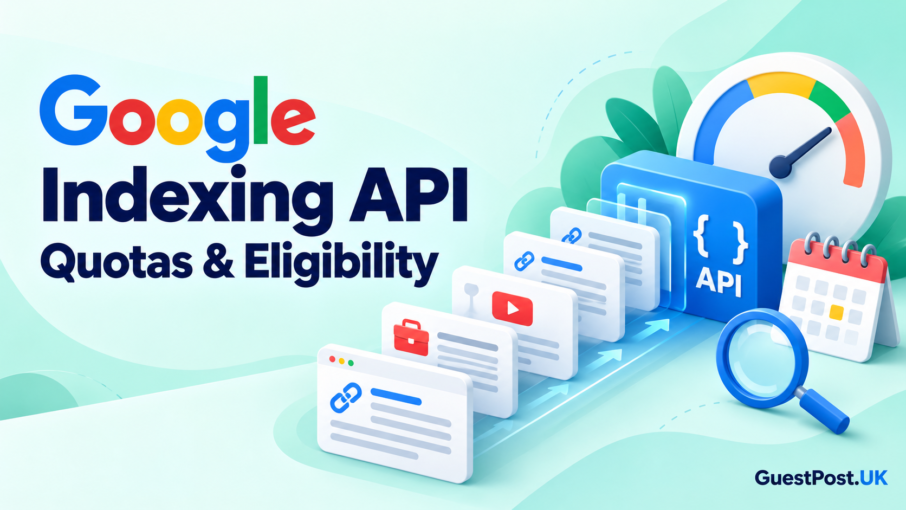
Google lists three default request limits, each measured per project:
| Request category | Default allowance | What it covers |
|---|---|---|
| Publish requests | 200 per day | Combined URL_UPDATED and URL_DELETED notifications |
| Metadata requests | 180 per minute | Read-only calls to getMetadata |
| All requests | 380 per minute | Requests across endpoints |
The daily allowance resets at midnight Pacific Time. Google also states that the Indexing API is available at no cost.
These figures describe different limits operating together. A daily allowance does not remove the per-minute restrictions.
Two hundred requests does not mean two hundred new articles
Suppose an eligible recruitment project sends 120 update notifications and 80 deletion notifications during the same quota day. Together, those account for 200 publish requests.
Repeated notifications for the same URL can also consume requests. Counting unique pages alone would therefore give the team an incomplete picture of usage.
For operational planning, distinguish between the number of URLs in your database and the number of API calls your application actually sends.
Batch requests still contain individual calls
Google allows up to 100 calls in a single HTTP batch request, reducing connection overhead. Batching does not turn the service into an unrestricted submission channel.
Google also warns that attempts to exceed quotas through multiple accounts or other means may lead to revoked access.
A legitimate implementation should manage its queue within the available allowance and avoid unnecessary repeat submissions.
Why a Successful Submission Is Not Proof of Indexing
The Indexing API lets an eligible site notify Google about new, changed or removed pages. Its notification-status function reports when Google received a notification. That receipt is different from evidence that a URL appears in the search index.
This distinction matters most when reviewing a tool’s dashboard. Labels such as “sent”, “accepted” and “indexed” describe different outcomes and should have different evidence behind them.
An agency receiving an indexing report should ask what each status means. Does “success” indicate a completed API call, or has the provider checked the page’s indexed state?
Keep the Google APIs separate
The Indexing API and the Search Console APIs have different jobs. Our Google Search Console API guide covers reporting, sitemap management and URL Inspection data.
For a publisher investigating missing articles, those diagnostic capabilities may be more relevant than a notification service designed for vacancies and livestreams.
Identifying that difference early prevents a common detour: spending time increasing submission capacity before figuring out why the page is missing from Search.
A Missing Article Needs a Diagnosis Before Another Submission
Imagine a publisher uploads ten articles. Seven appear in Google, while three remain absent. Sending all ten through another tool reveals little about what happened to the missing pages.
Investigate one affected URL first. Establish whether Google knows about it, whether it can retrieve the content and whether it has selected another URL as the canonical version.
Those findings determine the next step more effectively than a submission counter.
Inspect the exact URL in Search Console
Use URL Inspection on the published address, including the correct protocol and hostname. Record the reported indexing status and any explanation Google provides.
Where available, compare:
- The last crawl information.
- Whether crawling and indexing are permitted.
- The user-declared canonical.
- Google’s selected canonical.
- The result of a live accessibility test.
Keep the indexed-state information separate from the live test. A page working now doesn’t reflect what Google encountered on an earlier visit.
For larger investigations, a crawler can help identify patterns across affected URLs. Our Screaming Frog guide explains how to examine technical signals without confusing an indexable page with an indexed one.
Match the repair to the evidence
A blocked page needs its access settings reviewed. An unexpected canonical requires an investigation into duplication and URL consistency. A URL that returns intermittent errors needs delivery attention.
Google recommends checking Crawl Stats and URL Inspection when investigating availability problems. Its guidance also distinguishes successful crawling from subsequent inclusion in the index.
For example, a WordPress article might load correctly when an editor visits it but return errors during busy periods. Repeated submissions would leave that underlying problem unresolved.
If several recent articles are affected, compare their templates, publication dates and internal links. Shared characteristics can help narrow the investigation.
Use Submission Methods That Fit Ordinary Website Content
For a small number of new or substantially updated pages, Google directs verified site owners towards URL Inspection. For many URLs, its recommended discovery method is a sitemap.
Google says crawling may take days or weeks, and a request does not guarantee inclusion. Repeatedly requesting the same URL will not accelerate crawling.
Make discovery part of publication
A practical publishing process should leave a new article connected to the website.
Check that the final URL appears in the appropriate sitemap and can be reached through relevant navigation or contextual internal links. Confirm that a draft-stage restriction has not remained in place after publication.
For guest articles, the publisher should also place the piece within a suitable category and link to it where it helps existing readers. An article that is technically public but difficult to find deserves closer examination.
Run these checks before an agency buys additional submission support.
Separate your website from a third-party placement
Google states that its recrawl-request methods are for URLs you manage. An agency cannot use its own Search Console property to request indexing of an article hosted on an unrelated publisher’s domain.
Where a placement remains absent, contact the publisher with the exact URL and ask for its inspection findings. Useful questions concern crawl access, indexing directives, canonical selection and whether other recent articles have similar problems.
That conversation produces more actionable information than asking the publisher to “ping it again”.
Ask Indexing Providers What Their Reports Actually Measure
An indexing service may charge for monitoring, submission workflows, reporting or other work. Google’s API being free doesn’t automatically make those services worthless, but the fee needs a clear explanation.
Before ordering, ask the provider:
| Question | What the answer should clarify |
|---|---|
| Which submission method do you use? | Whether it is appropriate for the supplied page types |
| What counts as a successful result? | Whether success means submission, discovery or confirmed indexing |
| How do you check indexing? | The evidence supporting the reported status |
| When are checks performed? | Whether results are measured consistently |
| What happens to unsuccessful URLs? | The limits of retries, support and any refund terms |
Be cautious about reports that use “submitted” and “indexed” interchangeably. A completed request is an operational event; inclusion in Google is a separate result.
Judge services against a documented starting point
Record which URLs are absent before work begins. Keep the submission dates, later checks and any publisher-side changes.
Otherwise, a URL that would have appeared through normal discovery could be credited entirely to the paid service. Equally, a provider may be blamed for a page that the publisher accidentally blocked.
For recurring problems across a website, a focused SEO audit can identify shared causes before you spend more money on individual URLs.
The useful measure is how many suitable pages become discoverable and remain accessible—not how many requests a dashboard can send. Google Indexing API quotas describe capacity within a specific service. They don’t replace eligibility checks, technical investigation, or a sound publishing process.