
Before paying for a guest post, it is sensible to check whether the publisher’s website and its recent articles can appear in Google Search.
A website with a high DA or DR score is not automatically a good publishing opportunity. If Google isn’t indexing its content properly, the site has little real search visibility, or its newest posts are missing from search results, a placement may deliver less value than expected.
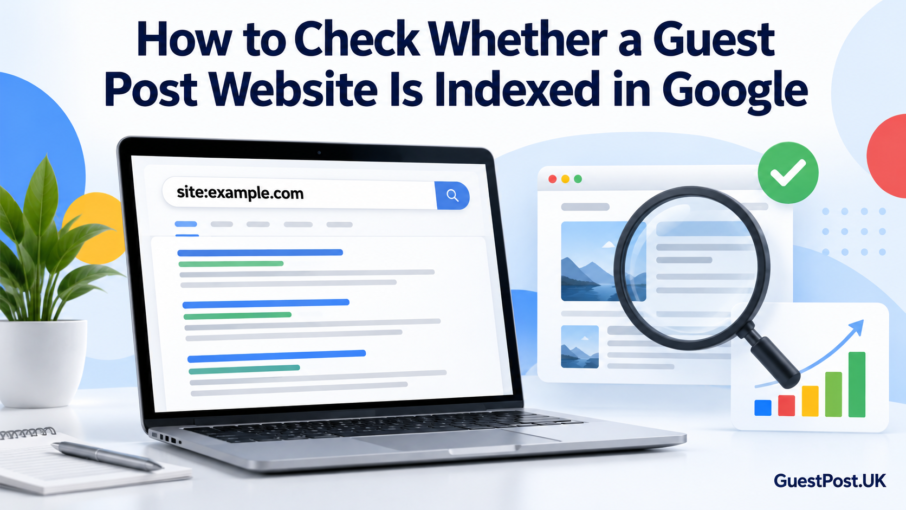
The quickest first check is Google’s site: search operator.
Use a Google site: search
In Google, search:
site:example.comReplace example.com with the website you are checking.
If Google returns results from the domain, this is a useful sign that at least some pages are indexed. You can then search for a more specific section, such as:
site:example.com/blog/Or search for a recent article title in quotation marks:
site:example.com "recent article title"Google confirms that the site: operator can show URLs from a particular domain, URL or URL prefix. However, it does not provide a complete count of every indexed URL, and results can be limited or appear in an unusual order. Treat it as a quick screening check rather than final proof of a website’s indexation. Read Google’s guidance on the site: operator.
Check the homepage and several recent articles
Do not stop after seeing one homepage result. Open the website and check whether Google also finds a selection of its newest articles.
Choose three to five recent posts and search each URL or title. Look for signs such as:
- The article appears when you search its exact title.
- The page has a normal Google result, title and description.
- The article is in a relevant category rather than a hidden or low-quality archive.
- The website’s content appears to be published consistently.
- Recent posts are being indexed, not only very old pages.
A website can have some indexed pages while still struggling to get newer content discovered. For a guest-post placement, recent editorial articles matter more than an old homepage that has been indexed for years.
Do not rely on indexed-page numbers alone
A search such as site:example.com may show “about” a certain number of results. Do not use that figure as an exact index count.
Google explains that site: results are not necessarily exhaustive, especially for larger websites. A domain with thousands of pages may show only a fraction of them in a simple search. Similarly, a small number of results doesn’t always mean the site has a penalty or technical problem.
Instead, use the search as one part of a broader review:
- Are recent pages visible?
- Is the content relevant to your industry?
- Does the site look editorially maintained?
- Does it have a real audience or organic visibility?
- Are outbound links used naturally and responsibly?
For websites you own, the most reliable check is Google Search Console’s URL Inspection tool. You cannot use that tool for a publisher’s site unless they grant you verified access, so buyers should avoid pretending that an external site: search gives the same level of certainty.
Look for warning signs before placing a guest post
Indexation is important, but it is not the only quality signal. Be cautious if you find any of the following:
- Very few recent articles appear in Google.
- Most visible pages are unrelated sponsored posts.
- Topics jump randomly between gambling, loans, health, crypto and celebrity news.
- The site publishes large volumes of thin content with little editing.
- The website’s own navigation makes article pages hard to find.
- The publisher cannot explain its editorial process or turnaround.
- The website seems to exist only to sell links.
A relevant, well-maintained publication with a smaller metric score can often be a better fit than a high-metric website with weak content standards.
Check relevance before authority metrics
If you are promoting a property business, a property, construction, business, or local-news publication may be more useful than a general website that accepts every possible topic.
The same principle applies to technology, legal, finance, health, travel and e-commerce campaigns. A placement should make sense to the publication’s readers and sit naturally alongside its existing content.
At GuestPost.UK, our Guest Posting Services and Blogger Outreach Services focus on finding relevant publishing opportunities rather than selecting websites solely by a single authority score.
Check traffic and real audience signals
A website can be indexed in Google without being a strong guest-post opportunity. Before choosing a publication, check whether it has a genuine audience and a clear editorial purpose.
Third-party SEO tools can estimate organic traffic, ranking keywords and backlink patterns. These figures are estimates, not guarantees, but they can help you compare several possible publishing websites.
Look beyond the largest traffic number. Ask whether the traffic appears relevant to the publication’s topic and whether recent content is receiving visibility. A UK business website with modest but consistent traffic may fit a local B2B campaign better than a broad site with irrelevant international visitors.
Useful checks include:
- Does the site rank for topics connected to its stated niche?
- Are its newest articles visible in search?
- Does the traffic trend look stable rather than suddenly inflated?
- Does the publication have useful category pages and clear navigation?
- Are real authors, contact details or editorial information available?
- Would a typical reader reasonably expect to see your article there?
For a campaign that needs a more thorough review, an outreach provider should assess relevance, content standards, indexation and available reporting—not simply sell a placement because a domain metric looks high.
Review outbound links and recent publishing standards
Open several recent articles before buying a placement. You are looking for a publication that publishes useful, readable content and treats commercial articles responsibly.
A good website does not need to reject every sponsored or contributed article. The important question is whether the site has editorial standards, publishes relevant material and avoids overwhelming readers with low-quality promotional content.
Warning signs include pages with repeated exact-match anchor text, copied articles, irrelevant commercial topics or an unusually high number of outbound links. These patterns can suggest the site is used mainly to manipulate rankings rather than serve readers.
Google’s guidance is clear that paid links intended to pass ranking credit are against its spam policies. Paid editorial placements should be transparent, relevant and handled in a way that reflects the commercial relationship. Read Google’s current spam policies.
That does not mean every sponsored article is poor quality. It means a sensible campaign should prioritise genuine editorial value, topical relevance and clear expectations between the advertiser and publisher.
Guest post website review checklist
Use this checklist before confirming a guest-post placement:
- Search
site:domain.comto confirm that Google can show pages from the domain. - Check the homepage and several recent articles, not just old URLs.
- Search for a recent article title to see whether fresh content is appearing in Google.
- Check whether the website’s topic is relevant to your business or campaign.
- Review estimated organic traffic and keyword visibility as supporting signals.
- Read recent articles to judge writing quality and editorial standards.
- Check whether commercial articles look natural and relevant.
- Avoid websites with excessive unrelated outbound links or thin content.
- Confirm the publication process, turnaround time, content requirements and reporting before placing an order.
No external check can guarantee that a placement will improve rankings. Google uses many signals, and you should never treat a single backlink as a guaranteed SEO result. The aim is to earn relevant, useful coverage on websites that real people can find and read.
Common questions
Can I use site: to see every page Google has indexed?
No. Google says that site: results are not always exhaustive, so use it as a quick screening method rather than an exact page count. For a website you own, use Search Console’s URL Inspection tool for a more reliable answer.
Does an indexed website automatically make a good guest-post website?
No. Indexation is only one signal. Also check topical relevance, recent publishing activity, content quality, traffic trends and how the website handles outbound links.
Why is a recent article missing from Google?
It may simply be new, not yet crawled or not selected for indexing. Technical settings, low-quality content, or a website-level issue can also block it. A buyer cannot diagnose this fully without access to the publisher’s Search Console.
Should I choose websites only by DA or DR?
No. Authority metrics are third-party estimates. Use them alongside real checks such as indexation, relevance, traffic quality, editorial standards and the placement’s likely value to readers.
Choose relevant guest-post opportunities
The best guest-post placements are relevant, well-presented, and useful to the publishing website’s audience. Indexation checks are a sensible starting point, but they work best when combined with a full editorial and relevance review.
If you are looking for suitable placements for a campaign, explore our Link Building Services or submit quality content through our free guest-post platform.