

A page does not need to fall from position three to page eight before it deserves attention.
Most content decay is quieter than that. Clicks soften over several months. A once-reliable article starts attracting less relevant queries. Competitors update their examples, products or pricing, while your page still answers last year’s version of the question.
This is where AI content refresh tools can help. The good ones do not simply rewrite old text. They help identify pages worth saving, explain what has changed around them and give an editor a useful starting point for a targeted update.
The bad use of AI is pressing “rewrite” on every old blog post. That creates a larger problem: a site full of freshly worded pages that are still strategically weak.
The better approach is to treat content refresh work as triage. First identify the reason a page is declining. Then choose the right intervention. Only then use a tool.
Not every traffic drop is content decay
Content decay is the gradual loss of a page’s organic performance and relevance over time. It is different from a sudden technical failure, a manual action or an entire-site ranking shift.
A declining URL can have several causes:
| What you are seeing | Likely issue | Best first move |
|---|---|---|
| Traffic and rankings both drift down slowly | Content freshness or stronger competitors | Review the SERP and update the page |
| Impressions rise but clicks fall | Snippet, title or intent mismatch | Review title, meta description and query mix |
| Rankings fall after competitors change their format | Search intent has shifted | Rebuild structure around current results |
| Rankings are stable but leads are down | Conversion problem | Improve proof, CTA and page journey |
| Many pages drop at once | Technical or site-wide issue | Audit before rewriting content |
| Two similar URLs share unstable rankings | Cannibalisation | Consolidate, redirect or clearly differentiate |
This distinction saves time. You do not fix a broken canonical, a slow page or an accidental noindex tag by adding another 800 words.
Before opening an AI writing tool, check Google Search Console, analytics, page indexing and the live URL. If the site-wide picture is unclear, start with an SEO audit rather than a content refresh queue.
The pages that deserve attention first
A refresh tool can surface dozens or hundreds of possible opportunities. The job is to avoid treating them equally.
The best candidates usually have three traits:
- They used to perform meaningfully better.
- The subject still matters commercially or supports an important topic cluster.
- A realistic improvement is possible.
A blog post that received six visits last year is rarely the first priority. A former top-ten page now slipping from positions 8 to 18, with a valuable service pathway and established backlinks, is a different story.
Create a simple opportunity score using:
- Previous organic traffic compared with the current period
- Current ranking range and keyword potential
- Number of impressions still available
- Commercial value of the topic
- Existing backlinks and internal links
- How outdated the page’s information, examples, or angle has become
- Estimated effort required to improve it
This creates a refresh queue based on likely return, not anxiety about a declining chart.
The best AI content refresh tools by job
The tools below solve different parts of the refresh process. Some help you spot declining pages; some help you inspect the current SERP; others help writers rebuild and optimise the updated article.
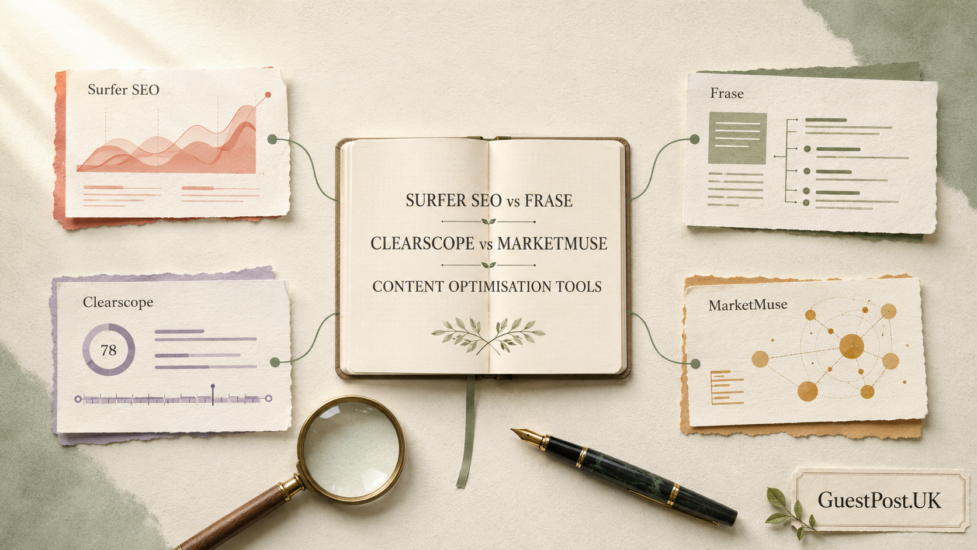
Surfer SEO: best for prioritised content auditing and re-optimisation
Surfer’s Content Audit is designed for teams with existing content that needs to be monitored and improved. It can analyse pages already on your site, bring current performance data into the workflow and highlight optimisation opportunities.
Its value is not just the score. The useful part is the connection between an existing URL, its current search landscape and a controlled editing process. Surfer says its audit data refreshes daily, while pages can be manually refreshed in the audit weekly. That makes it suitable for agencies and content teams that want a regular update rhythm rather than a once-a-year spreadsheet exercise.
Use Surfer when you need to:
- Monitor a portfolio of existing pages
- Find articles that need re-optimisation
- Compare an ageing article with current ranking-page expectations
- Give writers a structured refresh document
- Work through a planned queue each week
It is particularly practical when connected to Search Console data. That gives you a clearer view of which URLs are losing impressions, clicks or keyword positions.
The limitation is the usual one with optimisation platforms: do not treat the content score as a reason to edit. A score can reveal coverage gaps, but it cannot determine whether the page’s argument, examples, or customer relevance remain strong.
Clearscope: best for editorial-led updates
Clearscope is a good choice when the refresh work will be completed by experienced writers and editors rather than a large, heavily standardised content factory.
Its Content Inventory helps teams monitor, audit and refresh published content. You can select an existing page, review opportunities and work through an optimisation process without losing the editorial focus of the original piece.
That matters for pages where tone, authority and readability are as important as topical coverage. A technical guide, B2B resource or high-value comparison should not be flattened into a list of terms because an optimisation tool suggests them.
Choose Clearscope when:
- Your website contains valuable editorial content that needs careful updating
- Writers need a clean environment and clear guidance
- You want to improve existing pages without sacrificing brand voice
- The work involves subject-matter experts, editors and SEO specialists
- Quality matters more than producing the highest possible number of refreshes
Clearscope also supports broader monitoring and internal-linking work. That can be useful when a refreshed page needs to be reconnected to related articles, services and topic clusters.
Semrush: best for teams already using a broad SEO suite
Semrush makes sense when the content refresh process needs to sit alongside keyword research, rank tracking, competitor analysis, and broader site reporting.
Its current Content Optimizer is positioned around improving content for conventional SEO and AI-search visibility. This can be useful for teams that already use Semrush daily and do not want a separate subscription for every stage of the workflow.
The advantage is context. You can inspect keyword movement, look at competing pages, review a URL’s role in the wider site and then use the content tools to guide the update.
Semrush is strongest for:
- In-house teams with an established Semrush workflow
- Agencies managing SEO, PPC and content in one client environment
- Refreshes that require competitor and keyword research before editing
- Teams that want to track visibility beyond a single article score
- Content updates connected to wider commercial reporting
Do not assume every page needs to be “optimised for AI search” in the same way. A refreshed page needs to be clear, useful and technically accessible. For more detail on that wider goal, see our AI search optimisation checklist.
Ahrefs: best for finding decay before writing begins
Ahrefs is often the strongest starting point when your real problem is discovery rather than writing. Before a writer touches a page, you need to know which URLs are declining and why they were valuable in the first place.
Ahrefs defines content decay as a gradual decline in a page’s traffic and rankings over time. Its reports, Search Console integrations and newer AI-led workflows can help identify pages that have lost visibility compared with earlier periods.
That makes Ahrefs especially valuable for the diagnostic stage:
- Finding pages with a long, steady traffic decline
- Comparing historical organic performance
- Checking whether backlinks still support the URL
- Reviewing competitor movement and keyword gaps
- Prioritising updates based on realistic potential
Think of Ahrefs as the scout rather than the editor. It helps you build the refresh list. You may then use another platform, a structured content brief or an experienced writer to complete the actual update.
For agencies, this separation is healthy. It stops content production from deciding which pages matter.
Content Harmony and Keyword Insights: best for rebuilding the brief
Some refreshes do not need another content score. They need a better brief.
Content Harmony is useful where the existing page needs a structured rework based on current intent, questions, competitors and client requirements. Its templated research and brief workflow can help an agency turn a vague instruction—“this post is declining”—into a clear assignment.
Keyword Insights is particularly useful when several pages are underperforming due to an unclear site content architecture. Its SERP-based clustering helps identify where articles overlap, where a topic is under-served and which queries should genuinely live on the same page.
Use these tools when:
- You are refreshing groups of related articles, not isolated URLs
- Cannibalisation may be contributing to performance decline
- A client needs a new content plan, not cosmetic updates
- Writers need a precise brief before changing a successful older page
- You need to decide between updating, consolidating or creating a new supporting page
This is where many content refresh projects become more valuable than simple rewriting. The right outcome may be one stronger guide and two redirects, rather than three individually refreshed articles competing with each other.
Five diagnoses, five different refreshes
The phrase “update the content” is too vague to guide good work. Match the action to the problem.
1. The page is factually old
Refresh dates, prices, regulations, screenshots, product features, statistics and external references. Check every factual claim rather than relying on an AI summary of what changed.
This is common in software reviews, legal guidance, product comparisons and annual listicles.
2. The page answers yesterday’s search intent
The keyword may be the same while the results have changed. Perhaps users now expect a comparison table, a live tool, a pricing explanation or direct product recommendations instead of a long educational guide.
In this case, changing a few paragraphs will not be enough. Rebuild the structure.
3. The page is useful but thin
Add the information a reader needs to complete the task: examples, decision criteria, troubleshooting steps, original screenshots, templates or a short expert explanation.
Do not add generic FAQs only to increase length. Add the questions that solve genuine uncertainty.
4. The page has lost its internal support
Older content often becomes isolated as a site grows. Review incoming internal links, relevant service pages and newer supporting articles.
A guide on outreach tools, for example, may need a natural route to blogger outreach services. A page about authority building may need supporting context from guest posting services.
5. The page should not be refreshed at all
Sometimes the right decision is to consolidate, redirect, noindex or retire the URL. This may apply where content is duplicate, off-topic, obsolete beyond repair or too weak to justify further work.
AI tools should make this decision easier, not encourage you to preserve every old page forever.
A sensible refresh workflow for agencies
Use a monthly or quarterly cycle rather than waiting for a full content collapse.
Build the candidate list
Pull pages with declining clicks, impressions or rankings. Compare a meaningful period, such as the last 90 days against the previous 90 days, and exclude seasonal pages unless you are comparing like with like.
Investigate before assigning work
Check the current SERP, page intent, technical health, backlink profile, internal links and commercial value. Record the likely cause of decline.
Write a refresh brief
State what must change, what must stay and what evidence the client needs to provide. A refresh brief should prevent a writer from accidentally removing useful sections, existing rankings or successful conversion elements.
Update with controlled AI assistance
Use AI to summarise changes, propose question coverage, compare structures and create a first outline. Do not allow it to invent client experience, statistics or product details.
Quality-control and publish
Fact-check the page, review internal links, update metadata where justified and test the page on mobile. Our guide to quality-controlling AI content before publishing provides a practical final review process.
Measure what changed
Keep a record of the update date, edits made, target queries and baseline data. Review after enough time has passed for the page to be crawled, indexed and tested in search.
Choose the tool around the decision you need to make
Choose Ahrefs if you need to find and prioritise declining pages before committing writing resources.
Choose Surfer SEO if you want an ongoing audit and re-optimisation workflow for a managed content portfolio.
Choose Clearscope if the quality of the refresh depends on skilled editorial collaboration and you want a writer-friendly environment.
Choose Semrush if content refreshes need to live within a broader SEO, competitor, and visibility workflow.
Choose Content Harmony or Keyword Insights if the old page exposes a bigger issue with briefs, keyword clustering or site architecture.
The strongest content refresh is rarely the longest rewrite. It is the smallest set of changes that makes the page accurate, useful, easy to find and commercially connected again.