
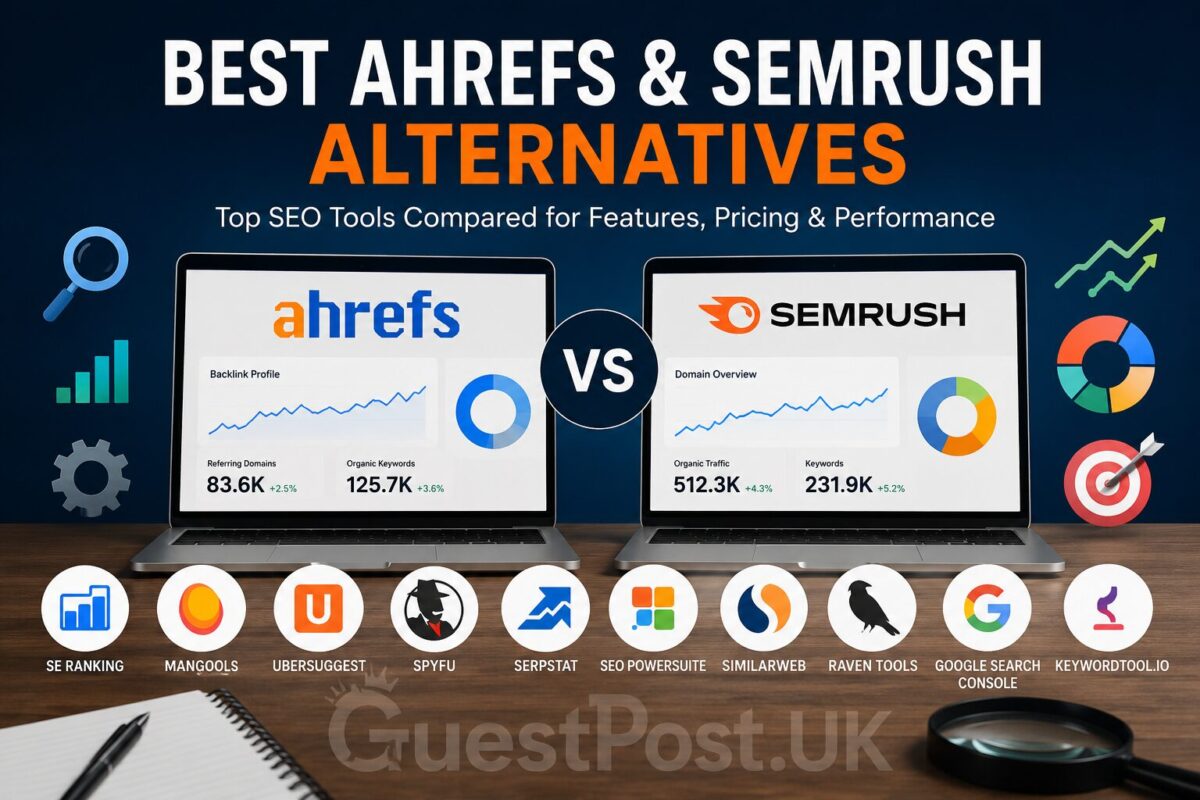
Choosing the right SEO platform can make a significant difference to your search visibility, content strategy, and overall marketing performance. While Ahrefs and Semrush remain two of the most popular SEO tools available, they are not always the perfect fit for every business. Subscription costs, feature requirements, ease of use, and reporting capabilities often lead marketers to explore other options.
Whether you’re a freelancer working with a limited budget, a growing agency managing multiple clients, or an in-house SEO team looking for better value, there are plenty of capable alternatives available. Some specialise in keyword research, while others excel at backlink analysis, rank tracking, technical SEO audits, or competitor intelligence. Many also include AI-powered features that streamline research and content optimisation.
This guide compares the 11 best Ahrefs and Semrush alternatives available in 2026. We’ll evaluate each tool based on its core features, pricing, strengths, weaknesses, and the type of user it’s best suited for. You’ll also discover which platforms offer genuinely useful free plans, making them excellent choices if you’re searching for a Semrush free alternative without compromising on essential SEO capabilities.
By the end of this comparison, you’ll have a clear understanding of which SEO platform aligns best with your goals, budget, and workflow.
Why People Look for Ahrefs and Semrush Alternatives
Ahrefs and Semrush have earned their reputations as industry-leading SEO platforms, offering comprehensive toolkits for keyword research, backlink analysis, site audits, competitor research, rank tracking, and content marketing. However, despite their extensive feature sets, they aren’t always the ideal solution for every website owner or marketing team.
Several factors encourage users to consider alternatives.
Cost
For many freelancers, bloggers, startups, and small businesses, the monthly subscription fees can be difficult to justify. While premium SEO software delivers exceptional value for larger organisations, businesses with tighter budgets often prefer tools that provide the features they actually need without paying for advanced functionality they’ll rarely use.
Simplicity
Ahrefs and Semrush contain hundreds of reports and datasets. While this level of detail benefits experienced SEO professionals, beginners may find the dashboards overwhelming. Many alternative platforms focus on cleaner interfaces and simplified workflows that reduce the learning curve.
Feature Priorities
Not every SEO campaign requires an all-in-one platform.
For example:
- Content marketers may prioritise keyword research.
- Link builders often need accurate backlink intelligence.
- Local SEO agencies rely heavily on rank tracking.
- Technical SEO specialists require comprehensive website audits.
- Digital PR teams may focus more on competitor analysis than content tools.
Choosing software that specialises in your primary workflow can often provide better value than paying for an extensive suite of features you rarely use.
Better Value for Agencies
SEO agencies frequently manage dozens or even hundreds of client websites. In these situations, reporting limits, user seats, API access, and project allowances become just as important as the core SEO data itself.
Some competitors offer more generous project limits or lower pricing for agencies managing multiple clients.
AI-Powered SEO
The SEO software landscape has changed dramatically over the past two years. Many newer platforms now include AI-powered assistants that help users:
- Generate keyword ideas
- Build content briefs
- Identify search intent
- Discover topical gaps
- Analyse competitors
- Improve content optimisation
- Automate SEO reporting
Businesses looking to improve productivity often compare these modern AI capabilities alongside traditional SEO metrics.
Free Alternatives Are Improving
Another major reason users explore alternatives is the growing number of high-quality free SEO tools.
While no completely free platform offers every feature found in Ahrefs or Semrush, combining several specialised tools can provide surprisingly comprehensive SEO insights without a significant monthly investment. For bloggers, students, and businesses just beginning their SEO journey, this approach can deliver excellent value.
The key is identifying which platform best matches your specific requirements rather than assuming the largest or most expensive solution is automatically the best choice. The ideal SEO tool depends on your goals, experience level, budget, and the type of work you perform most often.
What Makes a Good SEO Tool?
With dozens of SEO platforms on the market, selecting the right one isn’t simply about choosing the tool with the longest feature list. The best SEO software is the one that supports your workflow, helps you make better decisions, and delivers reliable data without unnecessary complexity.
Whether you’re looking for an Ahrefs alternative, a Semrush alternative, or a free SEO tool, there are several key factors worth evaluating before committing to a platform.
Keyword Research Accuracy
Keyword research is the foundation of every successful SEO campaign. A quality SEO platform should help you identify search terms your audience is actually using while providing reliable metrics to guide your strategy.
Look for tools that provide:
- Monthly search volume
- Keyword difficulty scores
- Search intent classification
- CPC and paid search data
- Related keyword suggestions
- Long-tail keyword opportunities
- Question-based keywords
- SERP feature analysis
The best platforms also update their keyword databases regularly, ensuring you make decisions using fresh search data rather than outdated estimates.
Backlink Analysis
Backlinks remain one of Google’s strongest ranking signals, making backlink intelligence one of the most valuable features in any SEO platform.
A strong backlink tool should help you:
- Discover referring domains
- Monitor new and lost backlinks
- Analyse anchor text distribution
- Identify toxic or spammy links
- Compare backlink profiles against competitors
- Find link-building opportunities
If link building forms a major part of your SEO strategy, backlink database size and update frequency become especially important when comparing tools.
Technical SEO Audits
Even the best content struggles to rank if a website has technical issues preventing search engines from crawling or indexing pages effectively.
A reliable SEO audit tool should detect problems such as:
- Broken links
- Redirect chains
- Missing metadata
- Duplicate content
- Slow-loading pages
- Core Web Vitals issues
- Crawl errors
- XML sitemap problems
- Indexability issues
- Structured data errors
Some platforms also prioritise issues based on their likely SEO impact, making it easier to tackle the most important fixes first.
Rank Tracking
Tracking keyword positions over time allows you to measure SEO progress and understand how algorithm updates or optimisation efforts affect visibility.
An effective rank tracker should offer:
- Daily or weekly updates
- Desktop and mobile rankings
- Local search tracking
- Historical ranking trends
- Competitor comparisons
- Visibility scores
- Keyword tagging and segmentation
Agencies and businesses managing multiple websites should also consider project limits and the number of keywords included in each subscription.
Competitor Research
Understanding what competitors are doing well can reveal opportunities you may otherwise overlook.
The best competitor analysis tools allow you to:
- Discover competitors’ top-performing pages
- Analyse keyword gaps
- Compare backlink profiles
- Track organic traffic trends
- Monitor paid advertising activity
- Identify newly ranking keywords
- Uncover successful content strategies
These insights often lead to quicker SEO wins than relying solely on your own website’s data.
Content Optimisation
Modern SEO extends well beyond keyword research. Many platforms now help users create content that better matches search intent and topical authority.
Useful content features include:
- AI-generated content briefs
- Topic clustering
- Semantic keyword suggestions
- Readability analysis
- Content scoring
- Competitor content comparisons
- Internal linking recommendations
These capabilities can significantly reduce the time required to plan and optimise articles while improving the likelihood of ranking for competitive search terms.
Reporting and Client Management
For SEO agencies and marketing teams, reporting can consume a significant amount of time.
Many alternatives now offer:
- White-label reports
- Automated scheduled reports
- Custom dashboards
- PDF exports
- API integrations
- Team collaboration features
- Client portals
Choosing a platform with strong reporting capabilities can save hours each month and provide clients with clearer insights into campaign performance.
Ease of Use
An extensive feature list means little if the platform is difficult to navigate.
Beginners often benefit from tools with:
- Clean dashboards
- Simple navigation
- Helpful tutorials
- Guided workflows
- Easy-to-understand reports
Experienced SEO professionals, on the other hand, may prefer advanced filtering, custom reporting, and greater control over datasets.
The ideal balance depends on your level of expertise and daily workflow.
Pricing and Value
Price should never be considered in isolation.
Instead, ask yourself:
- How many projects are included?
- How many keyword checks are available?
- Are backlink reports limited?
- How many users can access the account?
- Is API access included?
- Are AI features available?
- Does the platform include site audits?
- Can reports be white-labelled?
Sometimes a tool with a slightly higher monthly cost offers significantly better value through increased limits and additional functionality.
Customer Support and Learning Resources
Reliable support becomes increasingly important when SEO software forms part of your daily workflow.
Look for providers offering:
- Live chat support
- Extensive documentation
- Video tutorials
- Webinars
- Community forums
- Knowledge bases
- Fast response times
High-quality educational resources can also help teams adopt new features more effectively and maximise the return on their subscription.
Quick Comparison of the Best Ahrefs & Semrush Alternatives
| Tool | Best For | Free Plan | Keyword Research | Backlink Analysis | Site Audit | Rank Tracking | Starting Price |
|---|---|---|---|---|---|---|---|
| Moz Pro | Beginners & SMEs | ❌ | ✅ | ✅ | ✅ | ✅ | Paid |
| SE Ranking | Agencies & SMEs | Trial | ✅ | ✅ | ✅ | ✅ | Paid |
| Mangools | Bloggers & Freelancers | Trial | ✅ | Limited | Basic | ✅ | Paid |
| Ubersuggest | Budget SEO | Limited | ✅ | Basic | ✅ | ✅ | Low Cost |
| SpyFu | Competitor Research | Limited | ✅ | Limited | ❌ | ✅ | Paid |
| Serpstat | All-in-One SEO | Trial | ✅ | ✅ | ✅ | ✅ | Paid |
| SEO PowerSuite | Desktop SEO | Free Version | ✅ | ✅ | ✅ | ✅ | Free & Paid |
| Similarweb | Market Intelligence | Limited | Basic | ❌ | ❌ | ❌ | Paid |
| Raven Tools | Agency Reporting | Trial | ✅ | ✅ | ✅ | ✅ | Paid |
| Google Search Console | Website Owners | ✅ | Limited | ❌ | Basic | ✅ | Free |
| KeywordTool.io | Long-tail Keywords | Limited | ✅ | ❌ | ❌ | ❌ | Free & Paid |
Tip: No single platform is perfect for every SEO task. Many professionals combine two or more tools—for example, using Google Search Console for first-party performance data, KeywordTool.io for keyword discovery, and a more comprehensive platform such as SE Ranking or Serpstat for ongoing campaign management. This approach can provide excellent coverage while keeping costs lower than subscribing to multiple premium enterprise tools.
1. Moz Pro
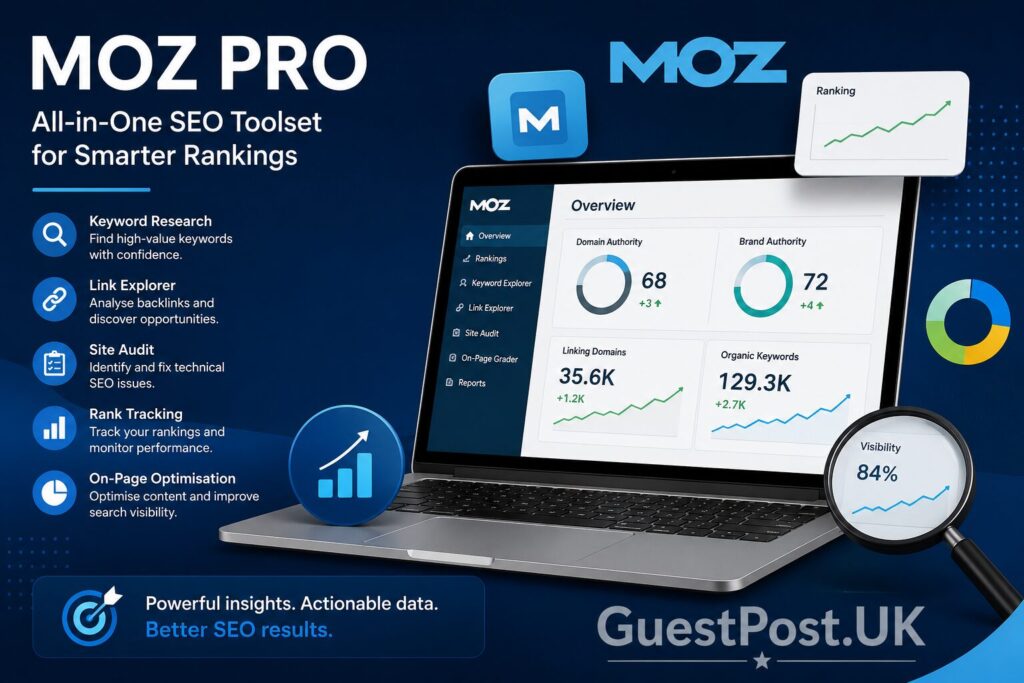
For many SEO professionals, Moz Pro is one of the first names that comes to mind when discussing alternatives to Ahrefs and Semrush. With over a decade in the SEO industry, Moz has built a strong reputation for reliable keyword research, link analysis, rank tracking, and website audits.
While newer competitors have introduced AI-powered features and larger datasets, Moz continues to appeal to marketers who value simplicity, accurate reporting, and an intuitive user experience. It’s particularly well suited to small and medium-sized businesses, freelancers, and in-house marketing teams that want a comprehensive SEO platform without the steep learning curve associated with some enterprise-level tools.
If you’re searching for a Moz alternative, you’ll likely compare it against platforms like SE Ranking or Serpstat. However, if you’re evaluating Ahrefs alternatives or Semrush alternatives, Moz remains one of the strongest established contenders.
Key Features
Moz Pro includes most of the tools required to manage an SEO campaign from a single dashboard.
Its toolkit includes:
- Keyword Explorer for discovering search opportunities
- Domain and Page Authority metrics
- Link Explorer for backlink analysis
- Comprehensive site crawl and technical SEO audits
- Rank tracking across desktop and mobile devices
- On-page optimisation recommendations
- Competitor keyword analysis
- Custom reporting and campaign tracking
One of Moz’s unique contributions to the SEO industry is its Domain Authority (DA) metric. Although Google does not use DA as a ranking factor, it has become a widely recognised benchmark for estimating the relative strength of a website’s backlink profile. Many SEO professionals, publishers, and outreach specialists continue to use it when assessing potential link opportunities.
Keyword Research
Moz’s Keyword Explorer remains one of its strongest features.
Instead of overwhelming users with thousands of keyword suggestions, it helps them identify opportunities that balance search volume, competition, and ranking potential.
For each keyword, users can typically access:
- Estimated monthly search volume
- Keyword difficulty
- Organic click-through opportunity
- Priority score
- Related keyword suggestions
- Question-based searches
- SERP analysis
This makes Moz particularly useful for content marketers planning blog articles, landing pages, and topical clusters.
Backlink Analysis
Although Ahrefs is often considered the benchmark for backlink databases, Moz still offers solid backlink intelligence.
Users can analyse:
- Referring domains
- Newly discovered backlinks
- Lost backlinks
- Anchor text distribution
- Spam Score
- Link opportunities
- Competitor backlink profiles
For businesses that rely heavily on digital PR or large-scale link building, Ahrefs may provide deeper backlink coverage. However, many SMEs find Moz’s data more than sufficient for day-to-day SEO activities.
Technical SEO Audits
Moz automatically crawls websites to identify technical issues that could affect organic performance.
Common recommendations include:
- Broken internal links
- Redirect errors
- Missing title tags
- Duplicate meta descriptions
- Thin content
- Crawlability issues
- Missing image alt attributes
- Indexation problems
Issues are organised by priority, making it easier for website owners to focus on fixes that are likely to have the greatest impact.
Rank Tracking
Rank tracking is another area where Moz performs consistently well.
Users can monitor:
- Daily keyword rankings
- Mobile and desktop results
- Local search performance
- Historical visibility trends
- Competitor rankings
- Search visibility over time
These reports help businesses measure the effectiveness of ongoing optimisation efforts and quickly identify ranking fluctuations.
Pricing
Moz Pro is available through several subscription tiers designed for freelancers, businesses, and agencies. Higher plans increase keyword tracking limits, campaign capacity, reporting options, and user access.
Although it isn’t the cheapest SEO platform available, its pricing is generally more accessible than enterprise-level solutions, making it a practical choice for organisations that need comprehensive SEO functionality without enterprise pricing.
Pros
- Easy-to-use interface suitable for beginners and experienced marketers
- Trusted Domain Authority metric
- Reliable keyword research tools
- Strong technical SEO auditing capabilities
- Comprehensive rank tracking
- Excellent educational resources through the Moz Learning Centre
- Suitable for freelancers, SMEs, and in-house marketing teams
Cons
- Backlink database is generally smaller than Ahrefs
- Fewer PPC and advertising insights than Semrush
- AI-powered content features are less advanced than some newer competitors
- Some competitor analysis reports are not as detailed as specialist platforms
Best For
Moz Pro is an excellent choice for:
- Small businesses
- Marketing teams
- Bloggers
- Freelancers
- Local SEO campaigns
- Businesses building their first structured SEO strategy
If your primary focus is publishing high-quality content, improving technical SEO, and tracking keyword performance, Moz provides a balanced toolkit that is straightforward to learn and use.
Moz Pro vs Ahrefs
Compared with Ahrefs, Moz offers a gentler learning curve and is often easier for beginners to navigate. It provides dependable keyword research, site audits, and rank tracking, but Ahrefs generally delivers a larger backlink index and more in-depth competitor intelligence.
Choose Moz Pro if you value simplicity and ease of use.
Choose Ahrefs if backlink analysis and large-scale competitor research are central to your SEO strategy.
Moz Pro vs Semrush
Semrush extends beyond SEO into areas such as PPC research, social media management, content marketing, and advertising analytics. Moz, by contrast, concentrates primarily on core SEO functionality.
If your work revolves around search engine optimisation rather than broader digital marketing, Moz’s focused approach may feel less cluttered and easier to master.
Overall Assessment
Moz Pro remains one of the most dependable Ahrefs alternatives available in 2026. While it may not boast the largest backlink database or the broadest marketing toolkit, it excels in usability, reliable SEO insights, and practical workflow management.
For freelancers, bloggers, local businesses, and growing companies seeking an all-in-one SEO platform without unnecessary complexity, Moz Pro continues to be a strong investment. However, agencies managing large-scale link-building campaigns or businesses requiring advanced PPC intelligence may find platforms like Ahrefs or Semrush better suited to their needs.
Overall Rating: ★★★★☆ (4.5/5)
Best for: Beginners, SMEs, in-house marketing teams, bloggers, and businesses looking for a user-friendly all-in-one SEO platform.
2. SE Ranking
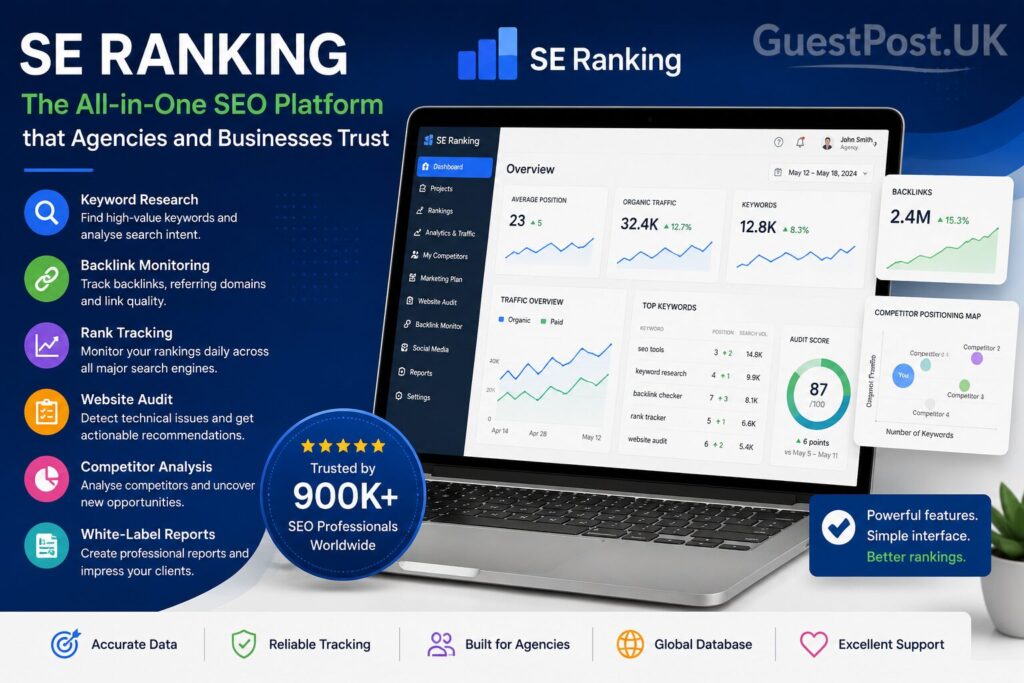
Among the many SEO platforms available today, SE Ranking has become one of the strongest competitors to both Ahrefs and Semrush. It offers an impressive balance of features, affordability, and ease of use, making it particularly attractive to freelancers, small businesses, agencies, and in-house SEO teams.
Unlike some platforms that focus heavily on a single area such as backlink analysis or keyword research, SE Ranking provides a well-rounded toolkit that covers almost every aspect of search engine optimisation. From keyword tracking and competitor analysis to technical audits and AI-powered content tools, it delivers excellent value without the premium price tag associated with some of the industry’s largest platforms.
If you’re looking for a Semrush alternative or a cost-effective Ahrefs alternative, SE Ranking deserves serious consideration.
Key Features
SE Ranking combines multiple SEO tools into a single platform, allowing users to manage campaigns without switching between different services.
Its feature set includes:
- Comprehensive keyword research
- Daily keyword rank tracking
- Website audits
- Backlink monitoring
- Competitor analysis
- On-page SEO checker
- Local SEO monitoring
- AI-powered content tools
- White-label reporting
- Marketing plan and SEO checklist
- Team collaboration features
The platform is continually updated, with new features and improvements released regularly, making it one of the fastest-evolving SEO solutions on the market.
Keyword Research
Keyword research is one of SE Ranking’s strongest capabilities.
Users can quickly discover:
- Search volume
- Keyword difficulty
- Search intent
- Cost per click (CPC)
- Competition levels
- SERP features
- Keyword trends
- Related keywords
- Long-tail keyword opportunities
- Question-based searches
The interface is clean and easy to understand, making it suitable for both beginners and experienced SEO professionals.
One advantage over some competitors is that keyword reports are presented in a logical, uncluttered format, allowing users to move from research to content planning more efficiently.
Competitor Research
SE Ranking provides detailed competitor intelligence that helps businesses identify opportunities to improve their organic visibility.
Users can analyse:
- Competitors’ organic keywords
- Estimated traffic
- Top-performing pages
- Keyword gaps
- Historical rankings
- Paid search visibility
- SERP overlap
- Traffic trends
This information makes it easier to understand why competitors are ranking and where new opportunities exist.
Backlink Monitoring
Backlink analysis continues to improve with every platform update.
Users can monitor:
- Referring domains
- New backlinks
- Lost backlinks
- Anchor text
- Domain trust metrics
- Backlink quality
- Toxic links
- Competitor backlink profiles
Although Ahrefs still maintains one of the industry’s largest backlink databases, SE Ranking offers more than enough depth for most businesses, agencies, and content marketers.
Website Audit
SE Ranking’s website audit tool performs a comprehensive technical analysis of your website.
It identifies issues including:
- Broken links
- Redirect errors
- Duplicate content
- Missing metadata
- Slow-loading pages
- Core Web Vitals
- HTTPS issues
- XML sitemap problems
- Crawlability errors
- Mobile usability issues
Each issue is prioritised based on severity, allowing website owners to address the most important problems first.
For many SMEs, the audit reports are easier to interpret than those generated by larger enterprise platforms.
Rank Tracking
Rank tracking is arguably SE Ranking’s standout feature.
The platform offers:
- Daily ranking updates
- Desktop and mobile tracking
- Local SEO tracking
- Google Maps rankings
- Multiple search engines
- Historical performance
- Competitor comparisons
- Keyword grouping
- Visibility scores
Agencies managing local SEO campaigns will particularly appreciate the detailed location-based tracking options.
AI Features
One area where SE Ranking has invested heavily is artificial intelligence.
Depending on your subscription, users can access AI-assisted tools for:
- Content brief creation
- SEO content optimisation
- Keyword clustering
- Search intent analysis
- Content scoring
- Writing assistance
These features can significantly reduce the time required to plan and optimise SEO content, making SE Ranking an increasingly attractive option for content-focused businesses.
Reporting
Reporting is another area where SE Ranking performs exceptionally well.
Users can generate:
- White-label reports
- Automated scheduled reports
- Custom dashboards
- Client portals
- Branded PDFs
- Agency reporting
For agencies managing multiple clients, these features can save many hours each month while presenting SEO performance in a professional, client-friendly format.
Pricing
One of SE Ranking’s biggest strengths is its pricing structure.
Compared with Ahrefs and Semrush, SE Ranking typically offers:
- Lower monthly subscription costs
- Flexible pricing plans
- Scalable keyword limits
- Generous project allowances
- Excellent value for growing businesses
For organisations looking to reduce software expenses without sacrificing core SEO functionality, SE Ranking consistently ranks among the best-value platforms available.
Pros
- Outstanding value for money
- Easy-to-use interface
- Excellent keyword tracking
- Comprehensive technical audits
- Strong competitor research
- Growing AI capabilities
- Powerful agency reporting
- Flexible pricing suitable for businesses of all sizes
Cons
- Backlink database is smaller than Ahrefs
- PPC research is less comprehensive than Semrush
- Some advanced reports require higher-tier subscriptions
- Brand recognition is still developing compared with long-established competitors
Best For
SE Ranking is an excellent choice for:
- SEO agencies
- Freelancers
- Small and medium-sized businesses
- In-house marketing teams
- Local SEO specialists
- Content marketers
- Businesses seeking an all-in-one SEO platform without enterprise pricing
It strikes an excellent balance between functionality, affordability, and usability.
SE Ranking vs Ahrefs
Ahrefs remains the stronger platform when it comes to backlink intelligence and advanced link-building research.
However, SE Ranking competes exceptionally well in areas such as:
- Rank tracking
- Technical SEO
- Keyword research
- Reporting
- Local SEO
- Overall affordability
If backlinks are your primary focus, Ahrefs still has an advantage.
If you want a balanced SEO platform at a lower cost, SE Ranking often provides better overall value.
SE Ranking vs Semrush
Semrush offers one of the broadest digital marketing ecosystems available, including PPC research, social media management, content marketing, and advertising analytics.
SE Ranking focuses more heavily on SEO itself.
Many users prefer SE Ranking because:
- The dashboard is easier to navigate.
- Pricing is significantly lower.
- Keyword tracking is excellent.
- Technical audits are easy to understand.
- Reports are highly customisable.
For businesses that don’t require Semrush’s wider marketing suite, SE Ranking can deliver almost everything needed for successful SEO campaigns at a considerably lower ongoing cost.
Overall Assessment
SE Ranking has evolved into one of the best Ahrefs alternatives and arguably one of the strongest Semrush alternatives available in 2026. It combines an intuitive interface with powerful SEO capabilities, reliable data, and competitive pricing, making it suitable for users ranging from solo consultants to established agencies.
While it doesn’t quite match Ahrefs for backlink depth or Semrush for advertising insights, it excels in delivering a comprehensive SEO toolkit that covers keyword research, rank tracking, technical audits, competitor analysis, and reporting—all at a price that represents excellent value.
For businesses seeking a capable all-in-one platform without the premium cost, SE Ranking is one of the easiest recommendations on this list.
Overall Rating: ★★★★★ (4.8/5)
Best for: SEO agencies, freelancers, SMEs, local SEO specialists, and businesses wanting enterprise-level functionality at a more accessible price.
3. Mangools
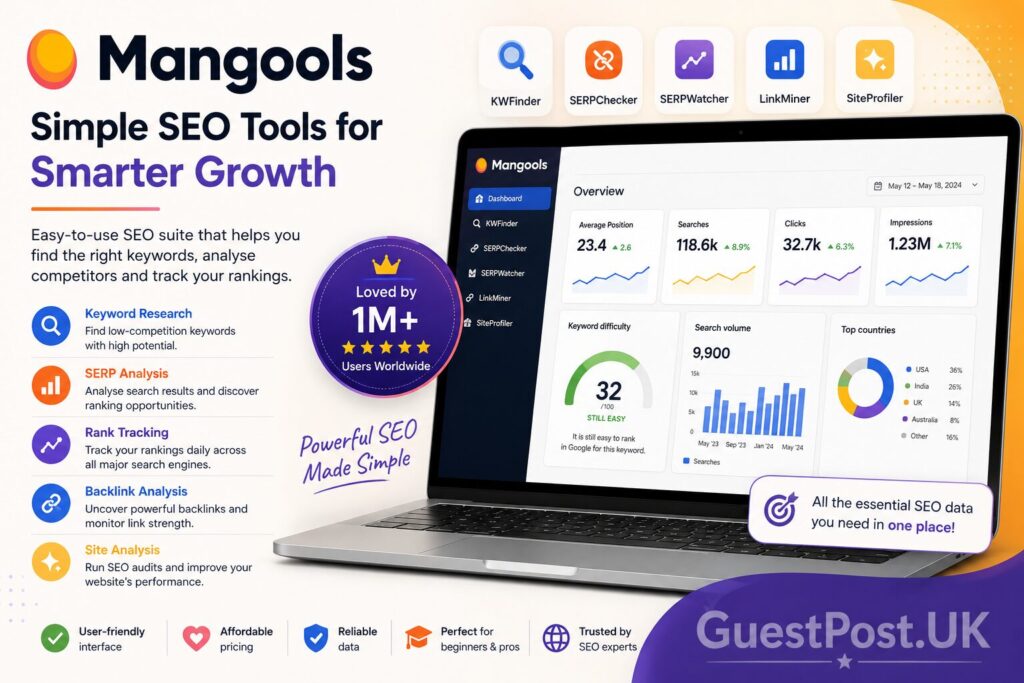
If you’re new to SEO or simply want a platform that’s easy to learn, Mangools is one of the most user-friendly alternatives to Ahrefs and Semrush. Rather than competing by offering hundreds of advanced reports, Mangools focuses on delivering essential SEO tools in a clean, intuitive interface.
The platform is made up of five integrated tools that cover keyword research, SERP analysis, backlink checking, rank tracking, and website profiling. This streamlined approach makes Mangools particularly appealing to bloggers, affiliate marketers, freelancers, small businesses, and content creators who want reliable SEO data without feeling overwhelmed.
While enterprise agencies managing hundreds of projects may require more advanced functionality, Mangools offers exceptional value for users who prioritise simplicity and productivity.
Key Features
Mangools consists of five core applications that work together seamlessly:
- KWFinder – Keyword research and long-tail keyword discovery
- SERPChecker – Detailed SERP analysis
- SERPWatcher – Keyword rank tracking
- LinkMiner – Backlink analysis
- SiteProfiler – Website authority and competitor overview
Each tool has a dedicated purpose, making navigation straightforward even for users with limited SEO experience.
Keyword Research with KWFinder
KWFinder is widely regarded as one of the easiest keyword research tools available.
Instead of overwhelming users with thousands of metrics, it presents the most useful information clearly, including:
- Monthly search volume
- Keyword difficulty
- CPC
- PPC competition
- Search trends
- Keyword suggestions
- Question keywords
- Autocomplete ideas
- Long-tail keyword opportunities
One of KWFinder’s biggest strengths is helping users uncover low-competition keywords that smaller websites have a realistic chance of ranking for.
For bloggers building topical authority or businesses targeting niche markets, this can significantly reduce the time spent identifying viable content opportunities.
SERP Analysis
SERPChecker provides valuable insight into the websites currently ranking for a keyword.
Users can analyse:
- Domain Authority
- Page Authority
- Citation Flow
- Trust Flow
- Backlink counts
- Estimated visits
- Social signals
- Featured snippets
- Local search results
This allows users to judge whether a keyword is realistically achievable before investing time in creating content.
Backlink Analysis
LinkMiner is Mangools’ backlink research tool.
Users can review:
- Referring domains
- Backlinks
- Anchor text
- Link strength
- Follow and nofollow links
- Deleted backlinks
- Competitor backlinks
While its database isn’t as extensive as Ahrefs, it provides more than enough information for bloggers, SMEs, and smaller SEO campaigns.
Businesses running large-scale outreach campaigns may still prefer Ahrefs, but many users find LinkMiner perfectly adequate for everyday backlink analysis.
Rank Tracking
SERPWatcher is designed to simplify keyword monitoring.
Features include:
- Daily ranking updates
- Desktop and mobile tracking
- Local SEO support
- Visibility index
- Performance trends
- Keyword grouping
- Email alerts
The dashboard is particularly easy to understand, making it suitable for users who want clear progress reports without complex analytics.
Website Analysis
SiteProfiler gives users a quick overview of any website’s SEO performance.
Reports include:
- Domain Authority
- Citation Flow
- Trust Flow
- Referring domains
- Backlink profile
- Popular content
- Competitor overview
This makes it useful when evaluating potential competitors or link-building opportunities.
Ease of Use
Ease of use is arguably Mangools’ greatest strength.
The platform avoids unnecessary complexity by presenting only the most relevant SEO metrics in a logical layout.
Even complete beginners can typically start performing keyword research within minutes.
Experienced SEO professionals may occasionally want more advanced reports, but many appreciate how quickly routine tasks can be completed.
Pricing
Mangools is positioned as one of the more affordable premium SEO platforms.
Compared with Ahrefs and Semrush, users generally benefit from:
- Lower monthly subscriptions
- Flexible plans
- Affordable upgrades
- Excellent value for bloggers and freelancers
For individuals or small businesses with limited budgets, Mangools provides many essential SEO features at a fraction of the cost of enterprise-level software.
Pros
- Extremely beginner-friendly interface
- Excellent keyword research through KWFinder
- Strong long-tail keyword discovery
- Affordable pricing
- Easy-to-read reports
- Fast performance
- Ideal for bloggers and niche websites
- Simple learning curve
Cons
- Smaller backlink database than Ahrefs
- Limited advanced competitor research
- Fewer agency reporting features
- Not designed for enterprise SEO
- Limited AI functionality compared with newer competitors
Best For
Mangools is an excellent choice for:
- Bloggers
- Affiliate marketers
- Freelancers
- Content creators
- Small businesses
- SEO beginners
- Niche website owners
If your primary goal is publishing optimised content rather than managing large-scale enterprise SEO campaigns, Mangools delivers an excellent balance of features and usability.
Mangools vs Ahrefs
Ahrefs remains the stronger platform for:
- Backlink analysis
- Technical SEO
- Enterprise reporting
- Large-scale competitor research
However, Mangools excels in:
- Ease of use
- Long-tail keyword research
- Affordability
- Simplicity
For many bloggers and freelancers, Mangools provides all the functionality they need without the complexity or cost of Ahrefs.
Mangools vs Semrush
Semrush offers a much broader marketing ecosystem that includes:
- PPC research
- Advertising intelligence
- Social media management
- Content marketing tools
- Market analysis
Mangools focuses almost entirely on core SEO.
If you simply need keyword research, backlink checks, SERP analysis, and rank tracking, Mangools often provides a faster and more enjoyable experience.
Businesses requiring broader digital marketing capabilities may still find Semrush the better choice.
Overall Assessment
Mangools proves that an SEO platform doesn’t need to be overloaded with features to be effective. Its clean interface, reliable keyword research, and affordable pricing make it one of the most accessible Semrush alternatives and Ahrefs alternatives on the market.
Although it lacks the enterprise-level depth of larger competitors, it delivers outstanding value for bloggers, freelancers, affiliate marketers, and small businesses focused on growing organic traffic. If you’re looking for an SEO tool that’s simple to use yet powerful enough for day-to-day optimisation, Mangools deserves a place near the top of your shortlist.
Overall Rating: ★★★★☆ (4.6/5)
Best for: Bloggers, affiliate marketers, freelancers, SEO beginners, and small businesses seeking an affordable, easy-to-use SEO platform.
4. Ubersuggest
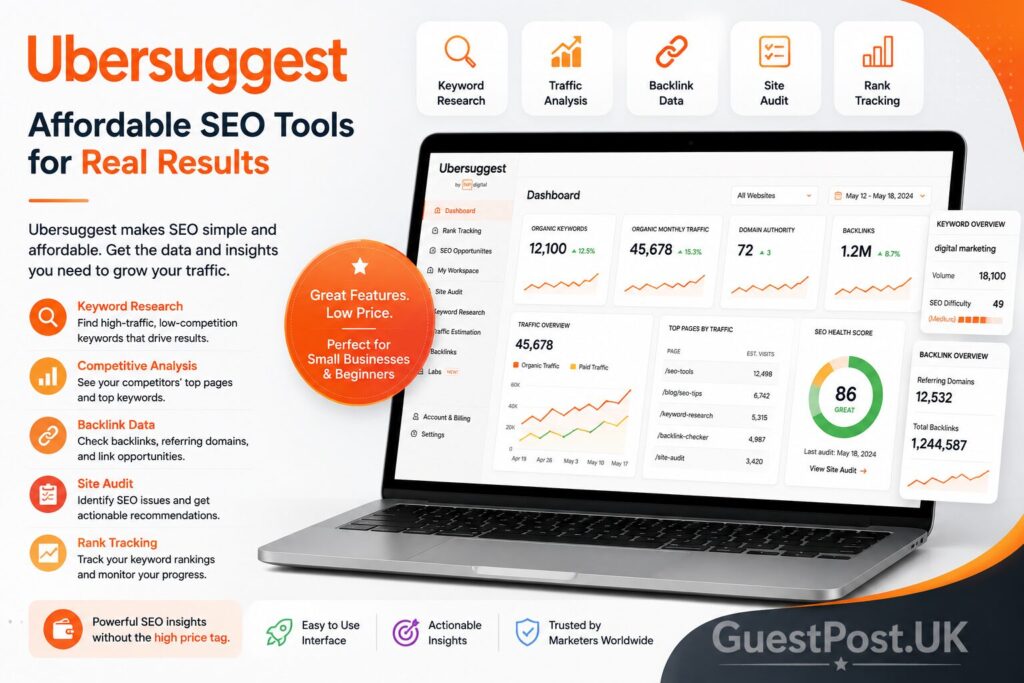
When discussing affordable SEO software, Ubersuggest is almost always part of the conversation. Originally launched as a keyword suggestion tool, it has evolved into a comprehensive SEO platform offering keyword research, backlink analysis, technical site audits, competitor insights, and AI-assisted content features.
Developed by digital marketer Neil Patel, Ubersuggest is aimed at users who want actionable SEO data without the higher monthly costs associated with enterprise platforms like Ahrefs and Semrush. It has become particularly popular among bloggers, freelancers, startups, and small businesses looking for a Semrush free alternative or a budget-friendly SEO solution.
If you’re just beginning your SEO journey or don’t need hundreds of advanced reports, Ubersuggest offers an excellent balance between affordability and functionality.
Key Features
Ubersuggest provides an all-in-one SEO toolkit that includes:
- Keyword research
- SEO difficulty analysis
- Competitor keyword research
- Backlink analysis
- Website SEO audits
- Rank tracking
- Content ideas
- AI writing assistance
- Traffic estimation
- SEO reports
Its interface is clean and beginner-friendly, making it easy to move between different tools without a steep learning curve.
Keyword Research
Keyword research remains one of Ubersuggest’s strongest capabilities.
For every keyword, users can typically view:
- Monthly search volume
- SEO difficulty
- Paid difficulty
- Cost per click (CPC)
- Seasonal trends
- Keyword suggestions
- Related searches
- Question keywords
- Long-tail variations
The platform is particularly useful for discovering low and medium-competition keywords, helping smaller websites identify opportunities that are easier to rank for.
If you’re planning a content strategy, pairing keyword research with a professional SEO audit can help prioritise topics that align with your website’s existing strengths and opportunities.
Competitor Analysis
Understanding what competitors rank for is an essential part of SEO, and Ubersuggest makes this process straightforward.
Users can analyse:
- Competitors’ top organic keywords
- Estimated traffic
- Best-performing pages
- Domain overview
- Keyword gaps
- Traffic trends
- Backlink growth
While its competitor data may not be as extensive as Ahrefs or Semrush, it provides more than enough insight for most SMEs and content marketers.
Backlink Analysis
Backlinks continue to influence search rankings, and Ubersuggest includes a useful backlink checker for monitoring your link profile.
Users can view:
- Referring domains
- Total backlinks
- New and lost links
- Domain authority metrics
- Anchor text
- Competitor backlinks
For businesses running large-scale outreach campaigns, dedicated backlink platforms like Ahrefs still offer deeper datasets. However, for everyday SEO management, Ubersuggest provides reliable backlink intelligence without the premium price.
If you’re actively building links, our Link Building Services can complement your SEO software by helping you acquire high-quality editorial backlinks.
Website Audit
Ubersuggest’s SEO audit scans your website for technical issues that could affect visibility in search engines.
The audit checks for:
- Broken links
- Missing meta titles
- Duplicate content
- Page speed issues
- Mobile usability
- HTTPS configuration
- Crawl errors
- XML sitemap issues
- Internal linking problems
The reports are designed with beginners in mind, explaining issues in plain English and often suggesting practical fixes.
If you’re managing a local business website, combining technical insights with a dedicated Local SEO Audit can uncover additional opportunities to improve your visibility in location-based searches.
Rank Tracking
Keeping track of keyword positions is essential for measuring SEO progress.
Ubersuggest allows users to monitor:
- Daily keyword rankings
- Mobile and desktop positions
- Historical ranking trends
- Visibility changes
- Competitor comparisons
Although its rank tracking isn’t as advanced as platforms like SE Ranking, it performs well for freelancers and businesses managing a moderate number of keywords.
AI and Content Tools
One area where Ubersuggest continues to improve is AI-assisted SEO.
Users can access features that help with:
- Content planning
- Topic ideas
- Keyword recommendations
- Content optimisation
- SEO writing assistance
These tools can speed up the content creation process, especially for marketers publishing articles regularly.
Once you’ve identified your target keywords, our collection of free SEO tools can help with additional optimisation tasks, including meta tags, structured data, and on-page improvements.
Pricing
Pricing is one of Ubersuggest’s biggest selling points.
Compared with Ahrefs and Semrush, it offers:
- Lower monthly subscription costs
- Budget-friendly plans
- Limited free usage
- Excellent value for individuals and SMEs
For users who don’t require enterprise-level reporting or extensive API access, Ubersuggest often represents one of the most cost-effective SEO platforms available.
Pros
- Affordable pricing
- Beginner-friendly interface
- Strong keyword research
- Useful website audits
- Competitor analysis included
- AI-assisted content features
- Limited free access available
- Excellent value for bloggers and small businesses
Cons
- Smaller backlink database than Ahrefs
- Less detailed competitor research than Semrush
- Fewer advanced reporting options
- Limited project capacity on lower-tier plans
- Enterprise agencies may outgrow its feature set
Best For
Ubersuggest is an excellent choice for:
- Bloggers
- Freelancers
- Startups
- Small businesses
- Content marketers
- Website owners learning SEO
- Budget-conscious marketing teams
Its combination of affordability and ease of use makes it one of the best entry points into professional SEO software.
Ubersuggest vs Ahrefs
Ahrefs remains the stronger choice for advanced backlink analysis, technical SEO, and enterprise-level research.
However, Ubersuggest has clear advantages in:
- Affordability
- Simplicity
- Learning curve
- Accessibility for beginners
If you’re managing a smaller website or building your first SEO strategy, Ubersuggest may provide everything you need at a significantly lower cost.
Ubersuggest vs Semrush
Semrush offers one of the broadest digital marketing ecosystems available, with extensive tools for PPC, advertising, social media, and market research.
Ubersuggest focuses primarily on SEO.
For users whose main goal is improving organic search performance rather than managing paid advertising campaigns, Ubersuggest provides a streamlined experience that’s easier to learn and considerably more affordable.
Overall Assessment
Ubersuggest has matured into a capable all-in-one SEO platform that delivers impressive value for its price. While it doesn’t rival Ahrefs in backlink depth or Semrush in marketing breadth, it covers the essentials exceptionally well, making it one of the most practical Semrush free alternatives for individuals and growing businesses.
For bloggers, freelancers, startups, and SMEs looking to improve their search visibility without committing to expensive enterprise subscriptions, Ubersuggest is a smart and cost-effective choice.
Overall Rating: ★★★★☆ (4.5/5)
Best for: Bloggers, freelancers, startups, small businesses, and anyone seeking an affordable SEO platform with a generous feature set.
5. SpyFu
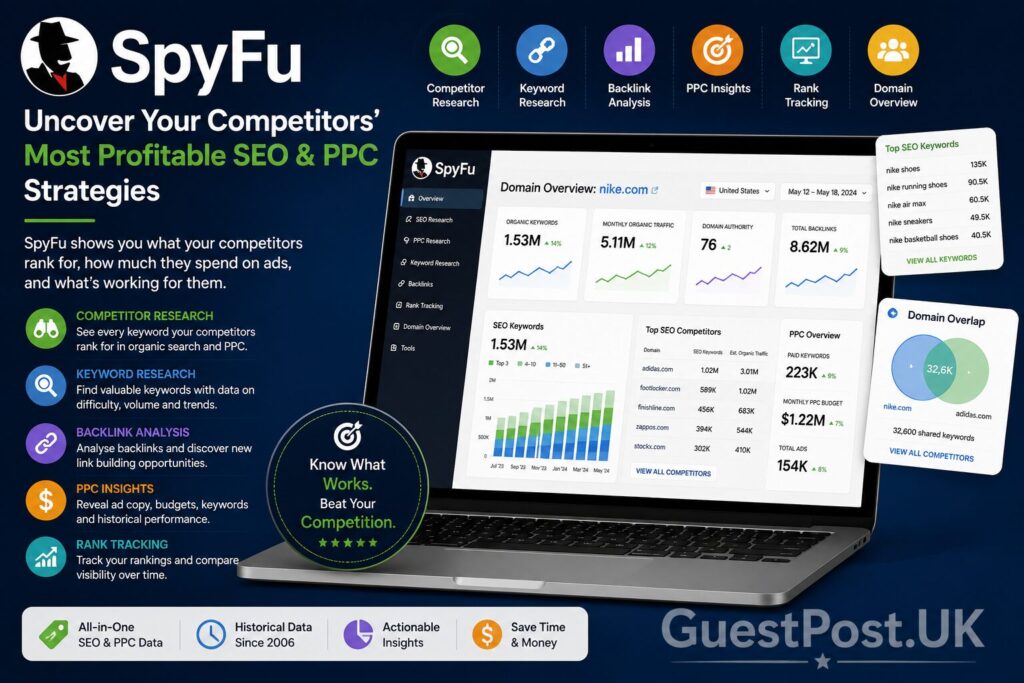
If competitor research is at the heart of your SEO strategy, SpyFu is one of the most compelling alternatives to Ahrefs and Semrush. Rather than trying to be an all-purpose SEO platform, SpyFu specialises in uncovering the organic and paid search strategies of your competitors.
For over a decade, marketers have used SpyFu to discover which keywords competitors rank for, how much they’re spending on Google Ads, where their backlinks come from, and which pages generate the most search traffic. This makes it particularly valuable for agencies, digital marketers, PPC specialists, and businesses operating in highly competitive industries.
If your goal is to reverse-engineer successful competitors rather than simply monitor your own website, SpyFu deserves serious consideration.
Key Features
SpyFu offers a focused collection of SEO and PPC tools, including:
- Competitor keyword research
- Organic keyword analysis
- Google Ads research
- PPC keyword tracking
- Backlink analysis
- Rank tracking
- Keyword grouping
- Domain comparison
- SERP history
- SEO reporting
Unlike many competitors, SpyFu places equal emphasis on both organic SEO and paid search campaigns, making it particularly useful for businesses investing in Google Ads alongside SEO.
Competitor Keyword Research
SpyFu’s greatest strength is revealing the keywords that drive traffic to competing websites.
Users can discover:
- Organic keywords
- Ranking positions
- Estimated monthly clicks
- Search volume
- Keyword difficulty
- Ranking history
- Newly acquired keywords
- Lost keyword rankings
This data allows marketers to identify proven keyword opportunities instead of relying solely on keyword brainstorming.
For businesses planning long-term organic growth, combining competitor insights with a professional SEO strategy helps prioritise keywords that offer realistic ranking opportunities.
PPC Intelligence
One feature that sets SpyFu apart from many competitors is its detailed Google Ads analysis.
Users can view:
- Paid keywords
- Estimated advertising spend
- Ad history
- Historical ad copy
- Competitor bidding behaviour
- PPC keyword opportunities
This information is particularly valuable for businesses running both SEO and PPC campaigns, as successful paid keywords often reveal profitable organic content opportunities.
Backlink Analysis
SpyFu includes backlink research features that allow users to explore link profiles and identify potential outreach opportunities.
Reports typically include:
- Referring domains
- Backlinks
- Link opportunities
- Competitor backlinks
- Anchor text
- Domain strength
Although the backlink database isn’t as comprehensive as Ahrefs, it provides useful information for competitor research and general link-building planning.
If your goal is to earn authoritative backlinks rather than simply analyse them, our Guest Posting Services can help secure placements on high-quality websites across multiple industries.
Keyword Tracking
SpyFu also offers keyword monitoring to measure SEO performance over time.
Users can track:
- Keyword rankings
- Visibility changes
- Ranking history
- Competitor movements
- Search trends
While rank tracking isn’t as advanced as dedicated platforms such as SE Ranking, it provides sufficient reporting for many SMEs and agencies.
Domain Comparison
One particularly useful feature is SpyFu’s domain comparison tool.
This enables users to compare multiple competitors side by side, revealing:
- Shared keywords
- Unique keyword opportunities
- Traffic estimates
- Ranking overlap
- Competitive gaps
For agencies developing SEO strategies, this feature can quickly highlight opportunities where clients can outperform competitors with targeted optimisation.
Reporting
SpyFu includes several reporting options suitable for freelancers and agencies.
Reports can include:
- SEO performance
- Competitor comparisons
- Keyword rankings
- PPC performance
- Backlink summaries
Although reporting isn’t as customisable as some enterprise platforms, it remains more than adequate for most marketing teams.
Pricing
SpyFu is generally positioned as a mid-range SEO platform.
Compared with Ahrefs and Semrush, users often receive:
- Competitive pricing
- Generous search allowances
- Strong value for competitor research
- Good functionality for SEO and PPC combined
Businesses focused primarily on competitive intelligence often find SpyFu offers excellent value compared with more expensive all-in-one suites.
Pros
- Excellent competitor analysis
- Industry-leading PPC intelligence
- Strong keyword history
- Easy-to-understand reports
- Good value for money
- Helpful domain comparison tools
- Reliable historical keyword data
Cons
- Smaller backlink database than Ahrefs
- Technical SEO audits are less comprehensive
- Limited AI-powered content features
- Interface feels less modern than some newer competitors
- Not designed as a full enterprise SEO platform
Best For
SpyFu is an excellent choice for:
- SEO agencies
- PPC specialists
- Digital marketing agencies
- Competitor research
- Market analysis
- Businesses running Google Ads
- Marketing consultants
If analysing competitors forms a significant part of your workflow, SpyFu delivers insights that few platforms match at its price point.
SpyFu vs Ahrefs
Ahrefs remains stronger for:
- Backlink analysis
- Technical SEO
- Content research
- Website auditing
SpyFu excels in:
- Competitor intelligence
- PPC analysis
- Historical keyword tracking
- Google Ads research
If backlinks and technical SEO are your priority, Ahrefs remains the better option. If understanding competitor marketing strategies is more important, SpyFu often provides greater value.
SpyFu vs Semrush
Semrush offers one of the broadest marketing ecosystems available, including SEO, PPC, social media, content marketing, and analytics.
SpyFu takes a more specialised approach.
Many marketers choose SpyFu because it focuses heavily on uncovering competitor strategies without requiring users to navigate dozens of unrelated tools.
For businesses whose primary objective is competitor research rather than managing every aspect of digital marketing, SpyFu offers a simpler and often more affordable solution.
Overall Assessment
SpyFu has earned its reputation as one of the best platforms for competitor intelligence. While it doesn’t attempt to replace every feature offered by Ahrefs or Semrush, it excels in the areas that matter most to marketers analysing rival websites and advertising campaigns.
Its combination of SEO insights, historical keyword data, PPC intelligence, and competitive pricing makes it one of the strongest Semrush alternatives for businesses that base their SEO strategy on understanding what already works in their market.
For agencies, consultants, and companies operating in competitive industries, SpyFu remains an invaluable research tool.
Overall Rating: ★★★★☆ (4.4/5)
Best for: SEO agencies, PPC specialists, digital marketers, consultants, and businesses focused on competitor analysis and Google Ads research.
6. Serpstat
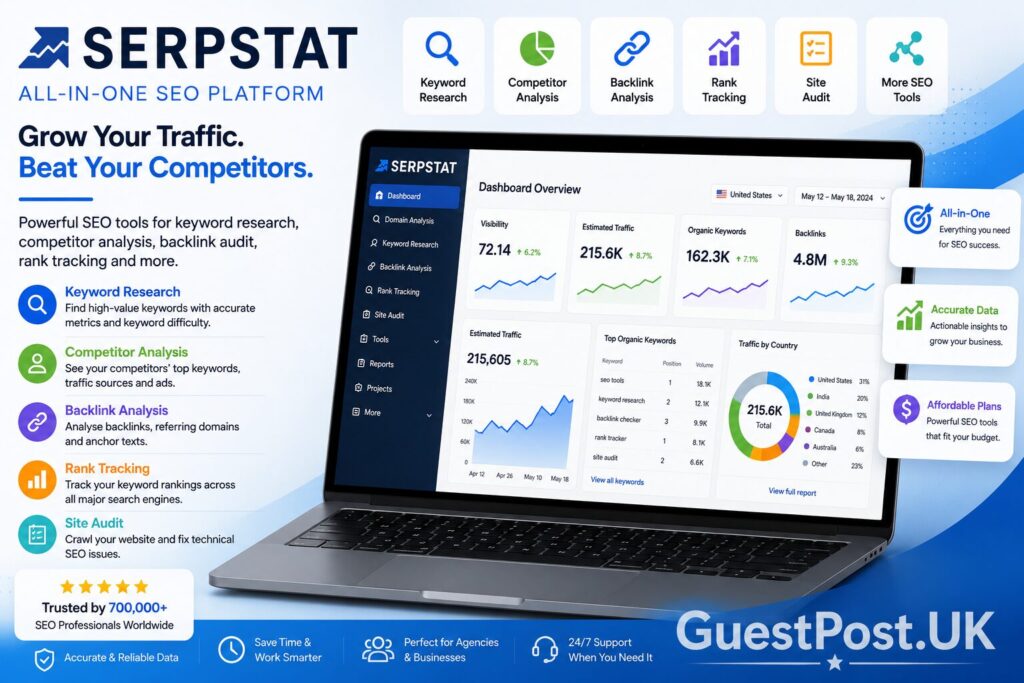
Over the past few years, Serpstat has evolved from a keyword research tool into a comprehensive SEO platform capable of competing with many of the industry’s biggest names. It combines keyword research, backlink analysis, technical SEO, rank tracking, competitor intelligence, and content optimisation into a single dashboard, making it one of the most complete Ahrefs alternatives and Semrush alternatives available today.
One of Serpstat’s biggest strengths is its balance between functionality and affordability. It offers a broad range of enterprise-level SEO features while remaining accessible to freelancers, growing agencies, eCommerce businesses, and SMEs that may find premium enterprise platforms outside their budget.
If you’re looking for an all-in-one SEO toolkit without paying top-tier subscription fees, Serpstat is well worth considering.
Key Features
Serpstat provides an extensive collection of SEO and digital marketing tools, including:
- Keyword research
- Competitor analysis
- Rank tracking
- Backlink analysis
- Website audits
- Content marketing tools
- Keyword clustering
- AI-assisted features
- Site structure analysis
- Team management
- API access (selected plans)
Its unified dashboard allows users to move seamlessly between keyword research, technical SEO, backlink monitoring, and reporting without switching platforms.
Keyword Research
Keyword research is one of Serpstat’s strongest capabilities.
For each keyword, users can access:
- Monthly search volume
- Keyword difficulty
- Search intent
- Cost per click (CPC)
- Competition level
- Keyword trends
- Related keywords
- Search questions
- Long-tail keyword suggestions
- SERP analysis
The platform also includes keyword clustering, making it easier to group related terms into topical content hubs—a strategy that aligns well with modern SEO best practices.
For businesses building topical authority, combining keyword clustering with our SEO Services can help create content strategies that target entire keyword groups rather than individual search terms.
Competitor Analysis
Serpstat offers detailed competitor research that enables users to understand why competing websites perform well in search results.
Users can analyse:
- Organic keyword rankings
- Estimated traffic
- Top landing pages
- Keyword gaps
- Domain comparisons
- Search visibility
- Historical ranking data
- Market competitors
This data helps identify opportunities where competitors are outperforming your website and highlights content gaps that can be addressed through better optimisation.
Backlink Analysis
Serpstat’s backlink tools have improved significantly in recent years.
Users can review:
- Referring domains
- Backlink growth
- Lost backlinks
- Anchor text
- Link quality
- Domain authority metrics
- Competitor backlinks
Although Ahrefs still leads the industry in backlink database size, Serpstat offers more than enough backlink intelligence for most SEO campaigns.
If link acquisition is part of your growth strategy, combining backlink research with our Blogger Outreach Services can help turn competitor insights into high-quality link-building opportunities.
Website Audit
Serpstat includes a comprehensive technical SEO auditing tool capable of scanning websites for hundreds of potential issues.
The audit identifies problems such as:
- Broken internal links
- Redirect loops
- Duplicate titles
- Missing meta descriptions
- Crawlability issues
- XML sitemap errors
- Robots.txt problems
- Page speed issues
- Core Web Vitals
- HTTPS configuration
- Structured data errors
Reports are organised by severity, allowing SEO professionals to prioritise fixes that are likely to deliver the greatest impact.
If you’re unsure where to begin, a professional SEO Audit can complement automated reports with expert recommendations tailored to your website.
Rank Tracking
Serpstat provides detailed keyword tracking across multiple locations and search engines.
Features include:
- Daily ranking updates
- Desktop and mobile rankings
- Local SEO tracking
- Historical ranking graphs
- Competitor tracking
- Visibility scores
- Keyword tagging
These reports make it easier to measure campaign performance and identify ranking fluctuations before they significantly affect traffic.
AI and Content Tools
Serpstat has expanded its AI capabilities to support content planning and optimisation.
Depending on the subscription, users can access features for:
- Keyword clustering
- Content brief generation
- AI-assisted writing
- Search intent analysis
- Topic suggestions
- Content optimisation
These tools can streamline content production, particularly for businesses publishing articles regularly or managing large editorial calendars.
After creating your content, our free SEO tools can help optimise metadata, improve on-page SEO, and identify additional enhancement opportunities before publication.
Reporting and Collaboration
Serpstat offers several reporting features suitable for agencies and larger teams.
Users can generate:
- White-label reports
- Automated scheduled reports
- Custom dashboards
- PDF exports
- Team workspaces
- Client reporting
These features simplify campaign management while helping agencies present SEO performance professionally.
Pricing
Pricing is one of Serpstat’s strongest advantages.
Compared with Ahrefs and Semrush, Serpstat typically offers:
- Lower monthly subscription costs
- Flexible pricing plans
- Good project allowances
- Scalable solutions for growing businesses
For agencies and SMEs seeking enterprise-style functionality at a more accessible price, Serpstat represents excellent value.
Pros
- Comprehensive all-in-one SEO platform
- Strong keyword research
- Excellent keyword clustering
- Reliable technical SEO audits
- Good competitor analysis
- Affordable pricing
- Helpful AI-assisted content features
- Suitable for agencies and growing businesses
Cons
- Backlink database isn’t as extensive as Ahrefs
- User interface can feel busy for beginners
- Some advanced features are limited to higher-tier plans
- PPC research isn’t as comprehensive as Semrush
Best For
Serpstat is an excellent choice for:
- SEO agencies
- Freelancers
- Content marketers
- Small and medium-sized businesses
- eCommerce websites
- In-house marketing teams
- Businesses wanting an affordable all-in-one SEO platform
It provides one of the best balances between functionality, pricing, and usability in today’s SEO software market.
Serpstat vs Ahrefs
Ahrefs remains the benchmark for backlink analysis and large-scale competitor research.
However, Serpstat competes strongly in areas such as:
- Keyword research
- Technical SEO
- Rank tracking
- Keyword clustering
- Pricing
If backlink intelligence is your highest priority, Ahrefs still has the edge. For users seeking a broader SEO toolkit at a lower cost, Serpstat offers excellent value.
Serpstat vs Semrush
Semrush continues to dominate in areas such as paid advertising research, social media management, and broader digital marketing tools.
Serpstat focuses more heavily on SEO itself.
Many businesses choose Serpstat because it delivers the core SEO features they use every day without paying for marketing modules they may never need.
For organisations primarily focused on improving organic search performance, Serpstat can be a highly cost-effective alternative.
Overall Assessment
Serpstat has quietly become one of the most capable all-in-one SEO platforms available. It combines keyword research, technical audits, competitor intelligence, backlink analysis, and AI-assisted content tools into a well-rounded solution that competes strongly with far more expensive platforms.
While it doesn’t quite match Ahrefs for backlink depth or Semrush for advertising intelligence, it excels in delivering comprehensive SEO functionality at a competitive price. For freelancers, agencies, SMEs, and eCommerce businesses looking to maximise value, Serpstat is one of the strongest Ahrefs alternatives and Semrush alternatives on the market.
Overall Rating: ★★★★☆ (4.7/5)
Best for: SEO agencies, eCommerce businesses, content marketers, SMEs, and professionals seeking a feature-rich all-in-one SEO platform without enterprise-level costs.
7. SEO PowerSuite
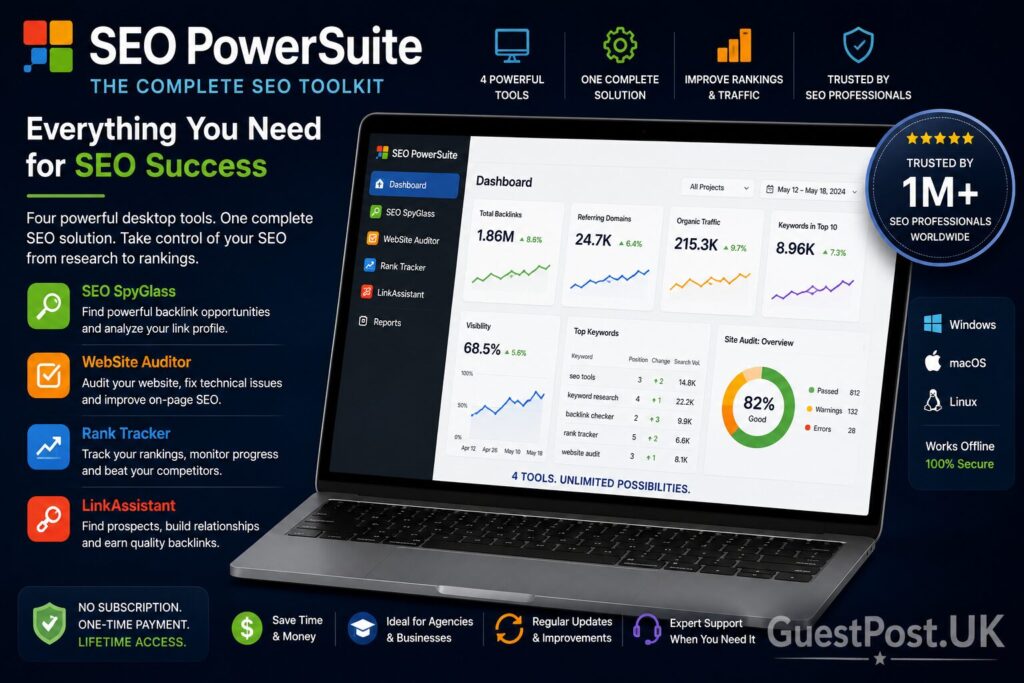
Unlike most SEO platforms that operate entirely in the cloud, SEO PowerSuite takes a different approach. It is a desktop-based SEO software suite that gives users access to powerful optimisation tools without many of the usage limits imposed by subscription-based platforms.
For SEO professionals who prefer owning their software rather than relying solely on cloud services, SEO PowerSuite remains one of the most capable Ahrefs alternatives available. It combines four dedicated applications covering keyword research, backlink analysis, website auditing, and rank tracking, making it a comprehensive solution for agencies, consultants, and experienced SEO specialists.
Another major advantage is its generous free version, making it an attractive option for users searching for a Semrush free alternative.
Key Features
SEO PowerSuite consists of four specialised applications:
- Rank Tracker – Keyword research and rank monitoring
- Website Auditor – Technical SEO and on-page optimisation
- SEO SpyGlass – Backlink analysis
- LinkAssistant – Link-building and outreach management
Together, these tools cover nearly every aspect of an SEO campaign while allowing users to store project data locally.
Rank Tracker
Rank Tracker is one of the most powerful keyword monitoring tools included in any SEO suite.
Users can:
- Discover keyword opportunities
- Track rankings across multiple search engines
- Monitor local SEO performance
- Compare competitor rankings
- Analyse keyword difficulty
- Group keywords into campaigns
- Monitor SERP features
- Generate historical ranking reports
Unlike many cloud-based tools that limit tracked keywords based on subscription tiers, SEO PowerSuite offers significantly greater flexibility, making it attractive for agencies managing numerous projects.
Website Auditor
Technical SEO is another area where SEO PowerSuite performs exceptionally well.
Website Auditor scans websites for hundreds of potential issues, including:
- Broken links
- Redirect chains
- Duplicate titles
- Duplicate content
- Missing metadata
- Internal linking problems
- Crawl depth
- Page speed issues
- Core Web Vitals
- Canonicalisation errors
- Structured data problems
One standout feature is its on-page optimisation recommendations, which compare your content against top-ranking competitors and suggest practical improvements.
If you’re planning a complete technical overhaul, our Professional SEO Audit service can complement automated reports with expert recommendations tailored to your business goals.
SEO SpyGlass
SEO SpyGlass focuses on backlink analysis.
Users can examine:
- Referring domains
- Backlink quality
- Anchor text
- Link penalties
- Link growth
- Competitor backlink profiles
- Toxic backlinks
- Domain authority metrics
Although Ahrefs still maintains one of the largest backlink indexes in the industry, SEO SpyGlass provides comprehensive backlink reporting suitable for most SEO campaigns.
For businesses actively building authority, pairing backlink analysis with our Link Building Services can help transform competitor research into sustainable link acquisition.
LinkAssistant
One feature that differentiates SEO PowerSuite from many competitors is LinkAssistant.
Instead of simply analysing backlinks, it helps users organise outreach campaigns by allowing them to:
- Discover link prospects
- Manage outreach contacts
- Track email conversations
- Monitor acquired backlinks
- Organise partnerships
- Evaluate link opportunities
For agencies and outreach specialists, having backlink research and outreach management within the same software can improve workflow efficiency.
Keyword Research
SEO PowerSuite offers extensive keyword research capabilities through Rank Tracker.
Users can access keyword suggestions from multiple sources, including:
- Google Keyword Planner
- Google Autocomplete
- Related searches
- Competitor analysis
- Question keywords
- Long-tail keyword suggestions
- Keyword difficulty
- Search volume estimates
This multi-source approach helps uncover opportunities that may be missed when relying on a single keyword database.
After building your keyword list, you can refine your content strategy using the free SEO tools available on GuestPost.UK to improve metadata, structure, and on-page optimisation.
Reporting
SEO PowerSuite includes robust reporting capabilities designed for agencies and consultants.
Reports can be customised to include:
- Ranking performance
- Website audits
- Backlink analysis
- Competitor comparisons
- White-label branding
- Automated report generation
This makes it suitable for businesses managing multiple SEO clients while maintaining professional reporting standards.
Pricing
Pricing is one of SEO PowerSuite’s biggest advantages.
Compared with cloud-based competitors, users benefit from:
- A generous free version
- Lower long-term costs
- One licence covering multiple applications
- Fewer keyword tracking limitations
- Excellent value for agencies managing many websites
For businesses concerned about recurring subscription fees, SEO PowerSuite offers a compelling alternative.
Pros
- Comprehensive desktop SEO suite
- Powerful technical SEO auditing
- Excellent rank tracking
- Strong reporting capabilities
- Link-building management through LinkAssistant
- Generous free version
- Lower long-term cost than many cloud platforms
- Suitable for agencies managing multiple projects
Cons
- Desktop software requires installation
- User interface feels less modern than some cloud-based platforms
- Collaboration is less convenient for distributed teams
- Backlink database isn’t as extensive as Ahrefs
- Learning curve is steeper for beginners
Best For
SEO PowerSuite is an excellent choice for:
- SEO agencies
- Experienced SEO professionals
- Freelancers
- Consultants
- Technical SEO specialists
- Businesses managing multiple websites
- Users seeking a powerful desktop solution
Its flexibility and lower long-term ownership costs make it particularly attractive for professionals who carry out SEO daily.
SEO PowerSuite vs Ahrefs
Ahrefs offers superior:
- Backlink database
- Cloud accessibility
- Content research
- Competitor backlink analysis
SEO PowerSuite excels in:
- Technical SEO audits
- Rank tracking
- Local project management
- Reporting
- Cost efficiency
If your work revolves around comprehensive technical SEO and ongoing campaign management, SEO PowerSuite represents outstanding value.
SEO PowerSuite vs Semrush
Semrush provides a broader marketing ecosystem that includes PPC, advertising intelligence, social media management, and content marketing tools.
SEO PowerSuite focuses almost exclusively on SEO.
Many professionals appreciate this specialised approach because it avoids paying for marketing features they rarely use while delivering excellent technical SEO functionality.
For businesses focused purely on improving organic search visibility, SEO PowerSuite can be a highly practical alternative.
Overall Assessment
SEO PowerSuite remains one of the most underrated SEO platforms available. Its desktop-first approach, comprehensive technical auditing, powerful keyword tracking, backlink analysis, and integrated outreach management make it a serious competitor to more expensive cloud-based solutions.
While it may not offer the same convenience as browser-based platforms or the backlink depth of Ahrefs, it compensates with flexibility, generous usage limits, and excellent long-term value. For agencies, consultants, and experienced SEO professionals looking for a powerful alternative without recurring enterprise-level subscription costs, SEO PowerSuite is an outstanding choice.
Overall Rating: ★★★★☆ (4.7/5)
Best for: SEO agencies, consultants, technical SEO specialists, freelancers, and businesses seeking a feature-rich desktop SEO platform with excellent long-term value.
8. Similarweb
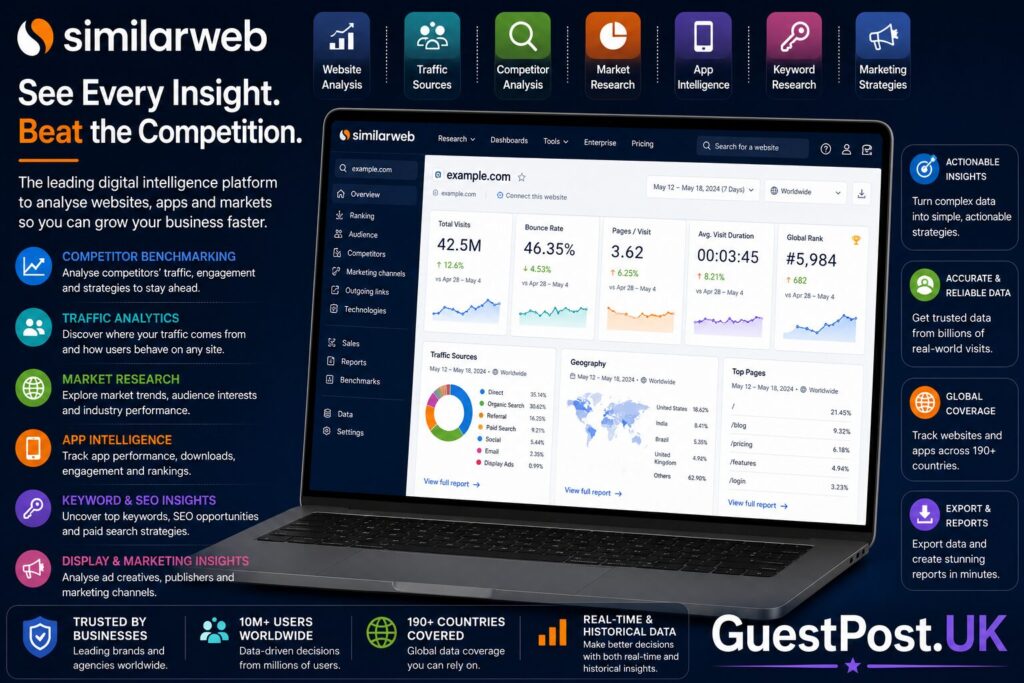
While most SEO tools focus primarily on keywords and backlinks, Similarweb takes a broader approach by helping businesses understand overall website performance, audience behaviour, and market trends. It combines traffic intelligence with competitor analysis, making it an excellent choice for marketers who want to understand where traffic comes from, how competitors grow, and which marketing channels perform best.
Unlike Ahrefs or Semrush, Similarweb isn’t designed to replace every SEO function. Instead, it complements traditional SEO tools by providing valuable business intelligence that extends beyond organic search.
For digital marketers, agencies, investors, and eCommerce businesses, Similarweb offers insights that many conventional SEO platforms simply don’t provide.
Key Features
Similarweb’s platform focuses on market and traffic intelligence, offering features such as:
- Website traffic estimation
- Competitor benchmarking
- Traffic source analysis
- Audience demographics
- Marketing channel performance
- Industry benchmarking
- Keyword insights
- Referral analysis
- Geographic traffic reports
- Mobile app intelligence (selected plans)
Rather than concentrating solely on rankings, Similarweb helps businesses understand the bigger picture of online performance.
Website Traffic Analysis
One of Similarweb’s biggest strengths is estimating website traffic across millions of websites.
Users can analyse:
- Monthly visits
- Traffic growth
- Visitor engagement
- Average visit duration
- Bounce rate
- Pages per visit
- Seasonal traffic trends
- Historical performance
This allows businesses to benchmark themselves against competitors and identify whether market leaders are growing or losing visibility.
Although traffic estimates should never be considered exact figures, they provide valuable directional insights for competitor analysis.
Traffic Sources
Understanding where competitors acquire visitors is often just as valuable as knowing which keywords they rank for.
Similarweb breaks traffic down into channels including:
- Organic Search
- Paid Search
- Direct Traffic
- Referral Websites
- Social Media
- Email Marketing
- Display Advertising
This information helps marketers understand whether competitors rely mainly on SEO or whether their growth comes from other acquisition channels.
For example, if a competitor receives a significant proportion of traffic from organic search, it may indicate an opportunity to strengthen your own SEO strategy through our SEO Services.
Competitor Benchmarking
Similarweb excels at comparing multiple websites side by side.
Users can evaluate:
- Market share
- Audience overlap
- Traffic trends
- Engagement metrics
- Marketing channel performance
- Growth rates
- Geographic reach
This makes it particularly valuable when preparing competitor reports or planning long-term digital marketing strategies.
Audience Insights
Unlike traditional SEO platforms, Similarweb also provides audience intelligence.
Depending on your subscription, users can access information such as:
- Visitor interests
- Geographic distribution
- Device usage
- Demographics
- Behaviour trends
- Cross-site audience analysis
These insights can help businesses create more targeted content and marketing campaigns.
Keyword Intelligence
Although keyword research isn’t Similarweb’s primary purpose, it still provides useful SEO insights.
Users can discover:
- Organic keywords
- Paid keywords
- Keyword trends
- Competitor keyword overlap
- Landing pages
- Search opportunities
For deeper keyword research and content planning, dedicated SEO platforms like Serpstat or SE Ranking generally provide more comprehensive data.
Once you’ve identified promising keywords, our free SEO tools can help optimise your pages before publication.
Industry Analysis
One feature that distinguishes Similarweb from many competitors is industry benchmarking.
Businesses can compare themselves against entire industries rather than individual competitors.
This allows users to identify:
- Market leaders
- Fast-growing competitors
- Industry traffic trends
- Emerging opportunities
- Seasonal demand
- Consumer behaviour changes
These insights are particularly valuable for enterprise businesses planning long-term growth strategies.
Reporting
Similarweb offers professional reporting suitable for agencies and marketing teams.
Reports include:
- Traffic summaries
- Competitor benchmarking
- Marketing channel analysis
- Industry reports
- Geographic performance
- Audience insights
These reports are especially useful when presenting strategic recommendations to stakeholders or clients.
Pricing
Similarweb is generally positioned as a premium market intelligence platform.
Compared with traditional SEO software:
- Entry-level access is available.
- Advanced plans can become expensive.
- Enterprise subscriptions unlock significantly more data.
- Pricing is often better suited to agencies and larger businesses.
For organisations that rely heavily on competitive intelligence, the additional investment can be worthwhile.
Pros
- Outstanding traffic intelligence
- Excellent competitor benchmarking
- Detailed marketing channel analysis
- Valuable audience insights
- Industry-wide benchmarking
- Strong visual reporting
- Useful for strategic planning
Cons
- Not a complete SEO platform
- Limited technical SEO capabilities
- Backlink analysis is minimal
- Keyword research is less comprehensive than Ahrefs or Semrush
- Premium plans can be expensive
Best For
Similarweb is an excellent choice for:
- Marketing agencies
- Enterprise businesses
- eCommerce companies
- Investors
- Market researchers
- Business analysts
- Digital strategy teams
It’s particularly useful for organisations making strategic decisions based on market performance rather than SEO metrics alone.
Similarweb vs Ahrefs
Ahrefs is considerably stronger for:
- Backlink analysis
- Technical SEO
- Keyword research
- Content gap analysis
- Link-building campaigns
Similarweb excels in:
- Website traffic estimation
- Audience analysis
- Market benchmarking
- Marketing channel insights
- Industry intelligence
If your focus is improving search rankings, Ahrefs remains the better choice. If you need to understand how competitors attract visitors across all channels, Similarweb offers insights that Ahrefs cannot.
Similarweb vs Semrush
Semrush combines SEO, PPC, content marketing, and advertising tools into one platform.
Similarweb focuses more on market intelligence.
Many larger organisations use both platforms together:
- Similarweb for strategic market insights.
- Semrush for SEO execution.
- Google Search Console for first-party performance data.
If your organisation regularly analyses competitors beyond search rankings, Similarweb can become an invaluable part of your marketing stack.
Overall Assessment
Similarweb is not a direct replacement for Ahrefs or Semrush, but that doesn’t make it any less valuable. Its strength lies in helping businesses understand how competitors generate traffic, which channels drive growth, and how entire markets evolve over time.
For agencies, enterprise businesses, investors, and eCommerce brands that need more than keyword rankings and backlink reports, Similarweb provides strategic insights that few platforms can match. When combined with a dedicated SEO platform, it becomes a powerful tool for making informed marketing decisions and identifying new growth opportunities.
Overall Rating: ★★★★☆ (4.5/5)
Best for: Marketing agencies, enterprise businesses, eCommerce brands, market researchers, investors, and organisations seeking comprehensive traffic and competitive intelligence.
9. Raven Tools
For agencies managing multiple SEO clients, reporting can often consume as much time as the optimisation work itself. Raven Tools was built with this challenge in mind, combining SEO, PPC, website auditing, and marketing reports into one platform that simplifies campaign management and client communication.
Unlike Ahrefs and Semrush, Raven Tools focuses heavily on reporting and data aggregation. Instead of trying to replace every specialist SEO platform, it connects data from multiple sources and presents it in clear, professional dashboards.
For digital agencies, consultants, and in-house marketing teams that regularly produce client reports, Raven Tools remains one of the most practical Semrush alternatives available.
Key Features
Raven Tools includes a broad collection of SEO and digital marketing features, including:
- Website audits
- Keyword rank tracking
- Backlink monitoring
- Competitor research
- Site performance analysis
- Marketing reports
- White-label reporting
- Google Analytics integration
- Google Search Console integration
- Google Ads integration
- Social media reporting
Its biggest strength is bringing data from multiple platforms into one easy-to-read reporting system.
Website Audits
Raven Tools includes a technical SEO auditing system capable of identifying issues that may affect search performance.
The audit checks for:
- Broken links
- Duplicate page titles
- Missing meta descriptions
- Redirect issues
- Crawl errors
- Thin content
- Page speed problems
- Mobile usability
- Internal linking opportunities
Reports prioritise issues by severity, helping businesses focus on improvements that are likely to deliver the greatest SEO impact.
For websites requiring a deeper technical review, our Professional SEO Audit service provides expert analysis alongside actionable recommendations.
Keyword Tracking
Raven Tools allows users to monitor keyword performance across multiple projects.
Users can track:
- Daily keyword rankings
- Desktop rankings
- Mobile rankings
- Local search visibility
- Historical ranking trends
- Competitor comparisons
- Search visibility metrics
Although its rank tracking isn’t as advanced as SE Ranking, it remains reliable for agencies managing ongoing SEO campaigns.
Backlink Monitoring
Backlink management is another important feature within Raven Tools.
Users can monitor:
- Referring domains
- Backlinks
- Link quality
- Lost backlinks
- New backlinks
- Anchor text
- Domain metrics
While backlink analysis isn’t as extensive as Ahrefs, it provides sufficient information for routine SEO management and client reporting.
Businesses looking to strengthen their backlink profile can combine these insights with our Link Building Services or Guest Posting Services to acquire high-quality editorial links.
Competitor Analysis
Raven Tools includes competitor research features that help businesses understand their position within search results.
Users can compare:
- Organic rankings
- Keyword performance
- Backlink profiles
- Website authority
- Search visibility
- SEO trends
Although competitor research is less detailed than SpyFu or Semrush, it provides enough information for most agency reporting requirements.
Marketing Reporting
Reporting is where Raven Tools truly stands out.
Users can create:
- White-label SEO reports
- Automated monthly reports
- Client dashboards
- Custom PDF reports
- Scheduled reporting
- Multi-channel marketing reports
Instead of manually exporting information from multiple platforms, agencies can consolidate everything into one professional report.
This can save significant time, particularly when managing dozens of clients simultaneously.
Third-Party Integrations
One of Raven Tools’ biggest advantages is its ability to integrate with other marketing platforms.
Supported integrations include services such as:
- Google Analytics
- Google Search Console
- Google Ads
- Social media platforms
- Call tracking solutions
- Various third-party marketing tools
This allows agencies to provide clients with a complete picture of digital marketing performance rather than SEO metrics alone.
If you’re using free SEO tools alongside professional software, Raven Tools can help consolidate reporting into a more manageable workflow.
Pricing
Raven Tools is generally priced for agencies and professional marketers.
Compared with Ahrefs and Semrush:
- Pricing is competitive.
- Reporting features offer excellent value.
- Multi-user functionality is well suited to teams.
- White-label reporting reduces reliance on separate reporting software.
For agencies, the time saved on reporting alone can justify the subscription cost.
Pros
- Excellent white-label reporting
- Strong agency-focused features
- Easy client dashboard creation
- Reliable technical website audits
- Integrates with multiple marketing platforms
- Good project management capabilities
- Professional report customisation
Cons
- Backlink database is smaller than Ahrefs
- Keyword research isn’t as comprehensive as Semrush
- AI-powered SEO features are limited
- Competitor analysis lacks the depth of specialist tools
- User interface feels dated in some areas
Best For
Raven Tools is an excellent choice for:
- SEO agencies
- Marketing agencies
- Freelance consultants
- In-house marketing teams
- Businesses producing regular client reports
- Multi-client SEO management
If reporting efficiency is a priority, Raven Tools remains one of the strongest options available.
Raven Tools vs Ahrefs
Ahrefs remains stronger in:
- Backlink analysis
- Keyword research
- Content gap analysis
- Competitor intelligence
Raven Tools excels in:
- Client reporting
- White-label dashboards
- Marketing integrations
- Multi-platform reporting
- Agency workflow management
For agencies that already use several marketing platforms, Raven Tools often becomes the central reporting hub.
Raven Tools vs Semrush
Semrush offers broader SEO, PPC, content marketing, and advertising functionality.
Raven Tools focuses primarily on campaign management and reporting.
Many agencies actually use Raven Tools alongside Semrush, leveraging Semrush for research and optimisation while using Raven Tools to automate client reporting and consolidate marketing data.
If reporting efficiency is more important than having every advanced SEO feature in one platform, Raven Tools is an excellent choice.
Overall Assessment
Raven Tools may not receive as much attention as Ahrefs or Semrush, but it fills an important niche within the SEO industry. Its strength lies in helping agencies organise data, automate reports, and present SEO performance professionally without spending hours creating reports manually.
While its keyword research and backlink analysis aren’t as advanced as the leading enterprise platforms, its reporting capabilities, third-party integrations, and agency-focused workflow make it a valuable addition to any digital marketing toolkit.
For agencies managing multiple clients and producing regular performance reports, Raven Tools remains one of the best Semrush alternatives available.
Overall Rating: ★★★★☆ (4.4/5)
Best for: SEO agencies, digital marketing agencies, consultants, and in-house marketing teams that prioritise automated reporting, client dashboards, and efficient campaign management.
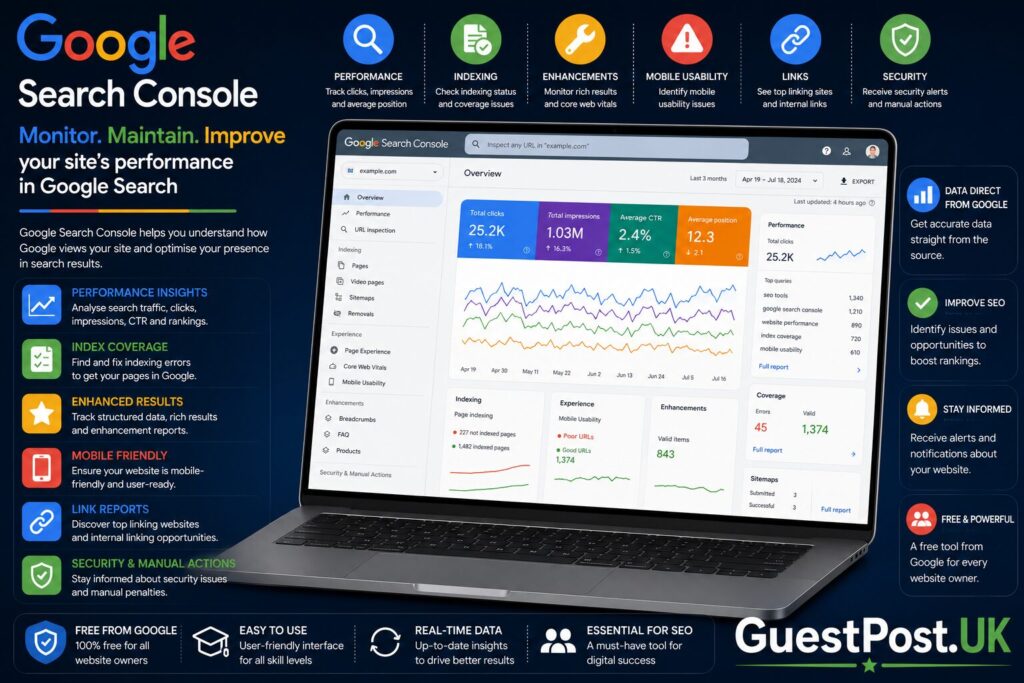
10. Google Search Console
Unlike every other tool on this list, Google Search Console (GSC) isn’t a third-party SEO platform—it’s Google’s own free service for monitoring your website’s performance in Google Search.
Every website owner should have Google Search Console connected, regardless of whether they use Ahrefs, Semrush, or any other SEO software. While it doesn’t provide competitor analysis or large-scale keyword databases, it offers something no third-party tool can: first-party data directly from Google.
If you’re looking for a Semrush free alternative, Google Search Console should be the foundation of your SEO toolkit. Although it won’t replace premium SEO software on its own, it’s an essential resource for understanding how Google sees your website.
Key Features
Google Search Console provides a wealth of information about your website’s search performance, including:
- Organic search clicks
- Impressions
- Average keyword positions
- Click-through rate (CTR)
- Page indexing status
- XML sitemap management
- Core Web Vitals
- Mobile usability
- Crawl errors
- Manual actions
- Security issues
- Rich result enhancements
Because this data comes directly from Google, it’s generally considered the most accurate source for measuring your website’s actual search performance.
Performance Reports
The Performance report is the feature most SEO professionals use daily.
It allows you to analyse:
- Total clicks
- Total impressions
- Average CTR
- Average search position
- Individual search queries
- Landing pages
- Countries
- Devices
- Search appearance
- Date comparisons
These reports help identify which pages are gaining visibility, which keywords are driving traffic, and where optimisation opportunities exist.
For example, if a page has thousands of impressions but a low click-through rate, improving the title tag and meta description could significantly increase traffic without improving rankings.
You can also enhance underperforming pages using our free SEO tools to optimise metadata, structured data, and on-page SEO elements.
Index Coverage
One of Google Search Console’s most valuable functions is showing exactly which pages Google has indexed.
Users can identify:
- Indexed pages
- Excluded pages
- Crawl anomalies
- Duplicate URLs
- Soft 404 errors
- Redirect issues
- Canonical problems
- Server errors
This makes it much easier to diagnose why certain pages fail to appear in search results.
For larger websites, resolving indexing issues can often produce faster SEO improvements than publishing additional content.
Core Web Vitals
Google Search Console also monitors Core Web Vitals, which measure user experience based on factors such as loading speed, responsiveness, and visual stability.
The reports highlight pages with:
- Poor performance
- Needs improvement
- Good user experience
Improving these metrics can enhance both user satisfaction and organic search performance.
Sitemap Management
Submitting an XML sitemap through Google Search Console helps Google discover and crawl your content more efficiently.
Users can:
- Submit new sitemaps
- Monitor crawl status
- Identify sitemap errors
- Track indexed URLs
Whenever you publish new articles or landing pages, ensuring your sitemap is updated can help search engines find fresh content more quickly.
URL Inspection Tool
The URL Inspection feature is invaluable for diagnosing issues with individual pages.
It allows users to check:
- Whether a page is indexed
- Last crawl date
- Mobile usability
- Canonical URL
- Structured data
- Crawling errors
- Live URL testing
This is often the first tool SEO professionals use when troubleshooting ranking or indexing problems.
Core SEO Monitoring
Google Search Console helps answer essential SEO questions such as:
- Which pages receive the most clicks?
- Which keywords generate impressions?
- Which pages are losing rankings?
- Which URLs aren’t indexed?
- Which mobile usability issues exist?
- Which structured data errors need fixing?
These insights are difficult to obtain elsewhere with the same level of accuracy.
To gain a complete picture of your website’s health, combine Google Search Console data with a comprehensive SEO Audit that examines technical issues beyond Google’s own reporting.
What Google Search Console Doesn’t Do
Although GSC is indispensable, it’s important to understand its limitations.
It doesn’t provide:
- Competitor keyword research
- Backlink databases
- Link-building opportunities
- Extensive keyword suggestions
- Domain comparisons
- Paid search intelligence
- Market research
- Historical competitor data
This is why many SEO professionals combine Google Search Console with platforms such as Ahrefs, SE Ranking, or Serpstat.
Pricing
One of Google Search Console’s greatest strengths is simple:
It’s completely free.
There are:
- No subscription fees
- No keyword limits
- No project limits
- No user restrictions
- No hidden charges
Every website owner should take advantage of it, regardless of budget.
Pros
- Completely free
- Data comes directly from Google
- Accurate keyword performance reporting
- Excellent indexing diagnostics
- Core Web Vitals reporting
- Easy sitemap management
- Essential for technical SEO
- Suitable for every website owner
Cons
- No competitor research
- No backlink database
- Limited historical data compared with premium platforms
- No advanced keyword discovery
- No outreach or reporting features
- Requires additional tools for comprehensive SEO research
Best For
Google Search Console is ideal for:
- Bloggers
- Small businesses
- SEO agencies
- eCommerce websites
- Local businesses
- Enterprise websites
- Developers
- Website owners of any size
In reality, there are very few websites that shouldn’t be using Google Search Console.
Google Search Console vs Ahrefs
Ahrefs is significantly stronger for:
- Backlink analysis
- Competitor research
- Keyword discovery
- Content gap analysis
- Link-building campaigns
Google Search Console excels in:
- First-party search performance data
- Indexing reports
- Crawl diagnostics
- Core Web Vitals
- Real keyword impressions and clicks
Many SEO professionals use Ahrefs for research and Google Search Console to measure actual performance after implementation.
Google Search Console vs Semrush
Semrush offers a comprehensive marketing platform covering SEO, PPC, competitor research, social media, and content marketing.
Google Search Console focuses exclusively on your own website’s relationship with Google Search.
Rather than choosing one over the other, they work best together.
Semrush helps identify opportunities, while Google Search Console confirms whether your optimisation efforts are delivering measurable results.
Overall Assessment
Google Search Console isn’t simply an alternative to Ahrefs or Semrush—it’s an essential companion to every SEO strategy. Because the data comes directly from Google, it provides an unmatched view of how your website performs in search results, highlighting indexing issues, keyword performance, technical problems, and opportunities to improve visibility.
Although it lacks competitor research and backlink analysis, no serious SEO professional should ignore the insights it provides. Whether you’re a blogger, freelancer, agency, or enterprise business, Google Search Console should form the foundation of your SEO toolkit.
Overall Rating: ★★★★★ (5.0/5)
Best for: Every website owner, SEO professional, agency, blogger, and business that wants accurate search performance data directly from Google.
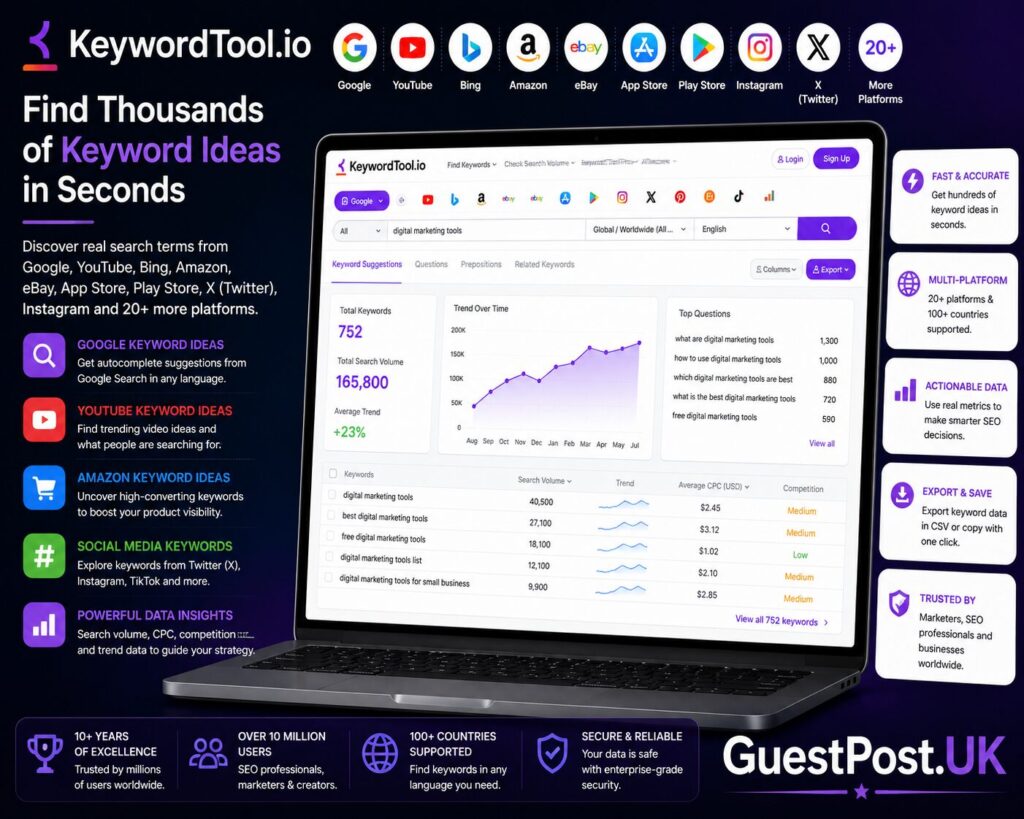
11. KeywordTool.io
If your primary objective is discovering long-tail keywords and content ideas, KeywordTool.io is one of the best SEO tools available. Rather than relying solely on traditional keyword databases, it generates keyword suggestions using Google Autocomplete and other search engine autocomplete data, helping users uncover search queries that people actively type into search bars.
Unlike Ahrefs or Semrush, KeywordTool.io isn’t designed to be a complete SEO platform. Instead, it specialises in keyword discovery, making it an excellent companion tool for bloggers, content marketers, affiliate websites, YouTubers, eCommerce businesses, and SEO professionals who publish content regularly.
For anyone searching for a Semrush free alternative specifically for keyword research, KeywordTool.io is one of the strongest options available.
Key Features
KeywordTool.io focuses on generating keyword opportunities from multiple search platforms, including:
- Google Search
- YouTube
- Bing
- Amazon
- eBay
- TikTok
- X (formerly Twitter)
- Apple App Store
Its multi-platform approach makes it valuable for businesses targeting organic traffic across different channels, not just Google Search.
Keyword Research
Keyword discovery is where KeywordTool.io truly shines.
Users can generate:
- Long-tail keywords
- Question-based keywords
- Related searches
- Autocomplete suggestions
- Preposition keywords
- Alphabetical keyword variations
- Localised keyword ideas
- Multi-language keyword research
Instead of producing hundreds of broad keywords, the platform uncovers highly specific search queries that often have lower competition and stronger user intent.
For content-driven websites, these long-tail opportunities can lead to quicker rankings and higher conversion rates.
Question Keywords
One of the platform’s most useful features is discovering questions that users ask online.
Examples include:
- How does…
- What is…
- Why does…
- Which is…
- Can I…
- Best way to…
These queries are excellent targets for:
- Blog posts
- FAQ sections
- Featured snippets
- Voice search optimisation
- AI search optimisation
Building content around real user questions is an effective way to increase topical authority and improve visibility in Google’s “People Also Ask” results.
After identifying these opportunities, you can strengthen your content using our free SEO tools to optimise headings, metadata, and on-page SEO before publishing.
Multi-Platform Research
Unlike many traditional SEO platforms, KeywordTool.io isn’t limited to Google.
Businesses can research keywords for:
- Google SEO
- YouTube videos
- Amazon product listings
- App Store optimisation
- eCommerce marketplaces
- Social media content
This makes it particularly valuable for businesses that rely on multiple traffic sources.
For example:
- An eCommerce store can optimise both Google SEO and Amazon listings.
- A creator can research YouTube video topics.
- A software company can improve App Store visibility.
- A retailer can discover product search behaviour across multiple platforms.
Local SEO Opportunities
KeywordTool.io also supports location-based keyword research.
Users can generate keyword ideas specific to:
- Countries
- Cities
- Languages
- Regional search behaviour
For businesses targeting local customers, these insights can be combined with our Local SEO Services to build content that attracts geographically relevant traffic.
Ease of Use
KeywordTool.io is designed around simplicity.
Users simply enter a keyword, choose a search platform, and receive hundreds of keyword suggestions within seconds.
The interface is:
- Clean
- Fast
- Beginner-friendly
- Easy to navigate
- Free from unnecessary complexity
Even users with little SEO experience can quickly build extensive keyword lists.
Pricing
KeywordTool.io offers both free and premium plans.
The free version allows users to:
- Generate keyword suggestions
- Explore autocomplete ideas
- Discover long-tail phrases
Premium plans unlock:
- Search volume
- CPC data
- Competition metrics
- Bulk keyword exports
- Additional filtering options
For users who only need content ideas, the free version can already provide substantial value.
Pros
- Excellent long-tail keyword discovery
- Strong autocomplete research
- Supports multiple search platforms
- Beginner-friendly interface
- Fast keyword generation
- Useful question-based keyword research
- Great for content planning
- Helpful free version
Cons
- Not a complete SEO platform
- No backlink analysis
- No technical SEO audits
- No competitor backlink research
- Rank tracking isn’t included
- Premium subscription required for full keyword metrics
Best For
KeywordTool.io is an excellent choice for:
- Bloggers
- Affiliate marketers
- Content writers
- SEO copywriters
- YouTubers
- eCommerce businesses
- Amazon sellers
- Digital marketers
If your workflow revolves around publishing high-quality content, KeywordTool.io can become one of your most valuable research tools.
KeywordTool.io vs Ahrefs
Ahrefs provides:
- Comprehensive keyword databases
- Backlink analysis
- Technical SEO
- Content gap research
- Competitor analysis
KeywordTool.io specialises in:
- Long-tail keywords
- Google Autocomplete
- Question keywords
- Content ideation
- Multi-platform keyword discovery
Many SEO professionals actually use both tools together—Ahrefs for competitive analysis and KeywordTool.io for uncovering fresh content opportunities.
KeywordTool.io vs Semrush
Semrush offers a complete digital marketing suite covering SEO, PPC, social media, and competitor analysis.
KeywordTool.io focuses almost entirely on keyword generation.
If your primary goal is planning blog posts, creating content clusters, or finding long-tail search opportunities, KeywordTool.io offers a faster and more focused workflow than many larger platforms.
Overall Assessment
KeywordTool.io isn’t intended to replace Ahrefs or Semrush entirely, but it excels at one of the most important stages of SEO: discovering the keywords your audience is actively searching for. Its ability to generate long-tail phrases, question-based searches, and autocomplete suggestions across multiple platforms makes it an invaluable tool for content creators and marketers.
For bloggers, affiliate marketers, eCommerce businesses, and anyone publishing content at scale, KeywordTool.io is one of the best companion tools available. Combined with a comprehensive SEO platform and a well-planned content strategy, it can help uncover ranking opportunities that broader SEO suites may overlook.
Overall Rating: ★★★★☆ (4.5/5)
Best for: Bloggers, content marketers, SEO copywriters, YouTubers, affiliate marketers, and eCommerce businesses focused on long-tail keyword research and content planning.
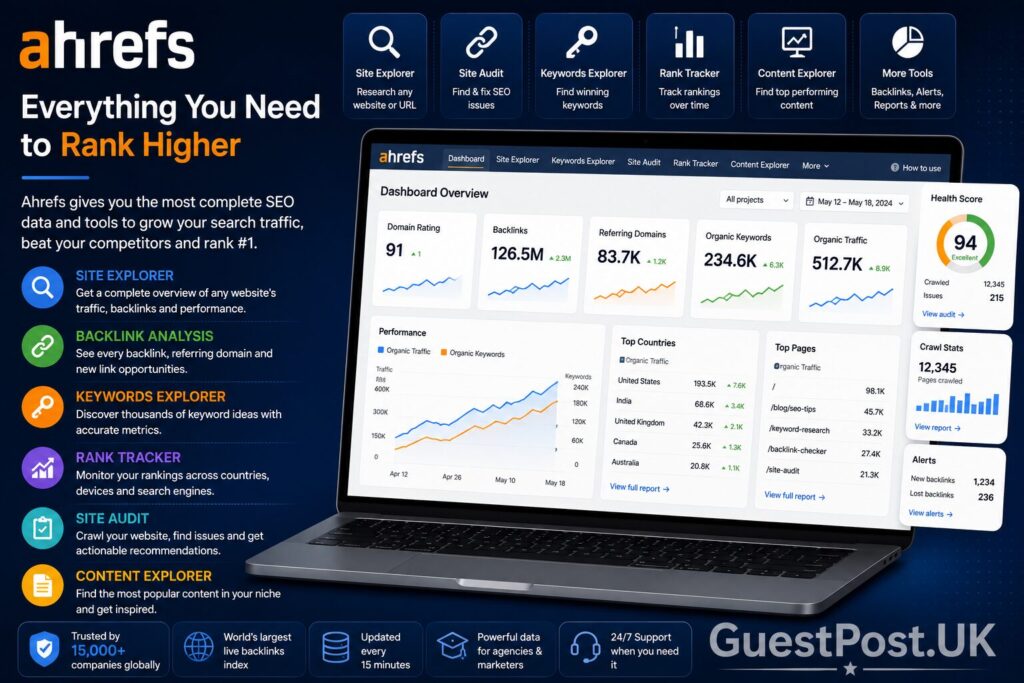
Which Ahrefs Alternative Is Best?
After comparing the leading SEO platforms, one question remains:
Which Ahrefs alternative is actually the best?
The answer depends entirely on your goals, budget, and workflow. Ahrefs is widely regarded as one of the industry’s leading SEO platforms, particularly for backlink analysis and competitor research, but it isn’t necessarily the best choice for everyone.
Below are our recommendations based on different use cases.
Best Overall Alternative: SE Ranking ⭐⭐⭐⭐⭐
If you’re looking for the closest all-round replacement for Ahrefs, SE Ranking is our top recommendation.
It combines:
- Excellent keyword research
- Reliable backlink monitoring
- Comprehensive technical audits
- Daily rank tracking
- Competitor analysis
- AI-powered SEO tools
- White-label reporting
- Affordable pricing
For freelancers, agencies, and growing businesses, SE Ranking delivers outstanding value without sacrificing essential SEO functionality.
Best for:
- SEO agencies
- SMEs
- Freelancers
- In-house marketing teams
Best Budget Alternative: Ubersuggest
If affordability is your main concern, Ubersuggest offers one of the best price-to-feature ratios available.
It includes:
- Keyword research
- Site audits
- Competitor analysis
- Rank tracking
- AI-assisted content features
While it doesn’t match Ahrefs in backlink depth, it provides enough functionality for many bloggers and small businesses.
Best for:
- Bloggers
- Startups
- Small businesses
- Beginners
Best for Beginners: Mangools
If you’ve never used professional SEO software before, Mangools offers the smoothest learning curve.
Its clean interface makes tasks such as:
- Finding keywords
- Tracking rankings
- Checking backlinks
- Analysing competitors
far easier than many enterprise platforms.
If simplicity matters more than having hundreds of advanced reports, Mangools is an excellent choice.
Best for Backlink Analysis
If backlinks are your highest priority, few platforms currently match Ahrefs.
However, among the alternatives reviewed, these stand out:
- SE Ranking
- Serpstat
- SEO PowerSuite
While their backlink databases aren’t quite as extensive, they still provide reliable insights for most SEO campaigns.
If you’re actively acquiring backlinks, it’s equally important to focus on quality rather than quantity. Our Link Building Services help businesses secure high-authority editorial links that support long-term organic growth.
Best for Technical SEO
Technical SEO professionals should consider:
- SEO PowerSuite
- Serpstat
- SE Ranking
All three platforms provide detailed website audits, helping identify issues such as:
- Crawl errors
- Broken links
- Duplicate content
- Core Web Vitals
- Internal linking
- Indexing problems
For businesses that need expert guidance beyond automated reports, our SEO Audit service delivers tailored recommendations based on your website’s specific challenges.
Best for Competitor Research
If understanding competitor strategies is your primary objective, SpyFu is difficult to beat.
It excels at analysing:
- Organic keywords
- Paid keywords
- Historical rankings
- Google Ads campaigns
- Competitor trends
It’s particularly valuable for agencies and businesses operating in highly competitive industries.
Best for Agencies
Managing multiple SEO clients requires more than keyword research.
Agencies typically need:
- White-label reports
- Client dashboards
- Team collaboration
- Project management
- Flexible reporting
- Multiple user accounts
Our recommendations are:
🥇 SE Ranking
🥈 Raven Tools
🥉 SEO PowerSuite
Each platform offers features designed specifically for agencies while keeping reporting efficient and professional.
Best Free Ahrefs Alternative
If you don’t want to pay for SEO software immediately, combining several free tools can provide surprisingly powerful insights.
A recommended free toolkit would include:
- Google Search Console – Search performance and indexing
- KeywordTool.io – Long-tail keyword ideas
- SEO PowerSuite Free – Technical SEO and rank tracking
- GuestPost.UK SEO Tools – Free SEO Tools for on-page optimisation, metadata, schema, and technical SEO tasks
Together, these tools cover many of the core activities needed to improve your website’s organic visibility.
Best Ahrefs Alternatives at a Glance
| Requirement | Recommended Tool |
|---|---|
| Best Overall | SE Ranking |
| Best Budget Choice | Ubersuggest |
| Best for Beginners | Mangools |
| Best Technical SEO | SEO PowerSuite |
| Best Competitor Research | SpyFu |
| Best Reporting | Raven Tools |
| Best Market Intelligence | Similarweb |
| Best Keyword Discovery | KeywordTool.io |
| Best Free Option | Google Search Console |
| Best Value for Agencies | SE Ranking |
Our Recommendation
If you could only choose one Ahrefs alternative, SE Ranking would be our overall recommendation.
It offers the best balance of:
- Features
- Pricing
- Ease of use
- Reporting
- Technical SEO
- Keyword research
- Competitor analysis
- Scalability
However, no single SEO platform is perfect for every business.
Many experienced SEO professionals use a combination of tools—for example, Google Search Console for first-party performance data, KeywordTool.io for content ideation, Similarweb for market intelligence, and SE Ranking or Serpstat as their primary SEO platform. This layered approach often provides broader insights than relying on a single tool alone while helping businesses make more informed SEO decisions.
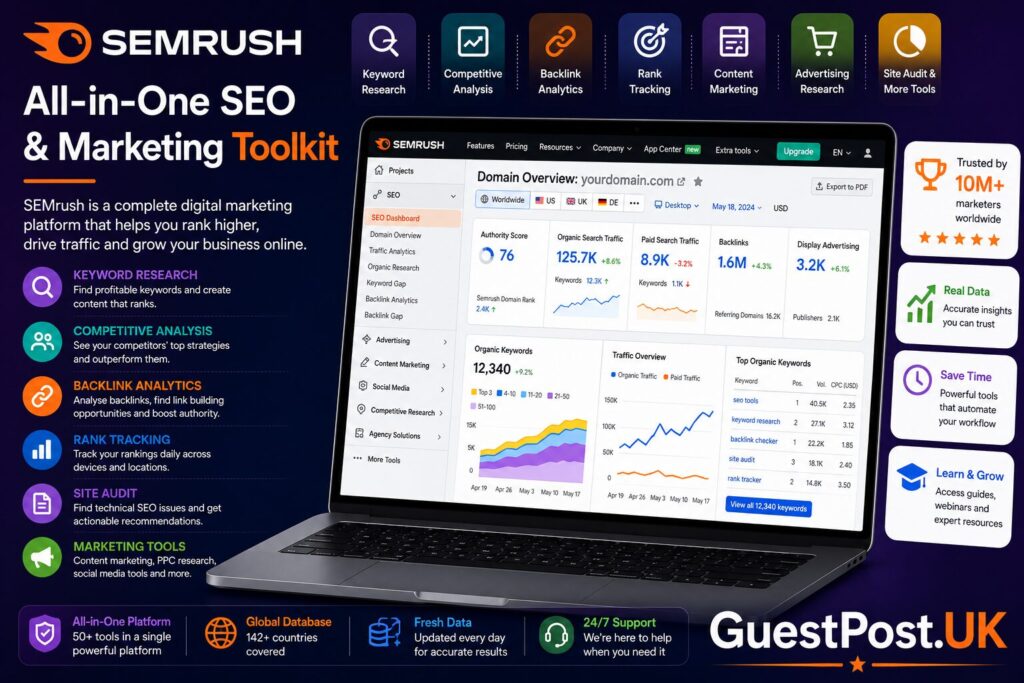
Which Semrush Alternative Is Best?
Semrush has earned its reputation as one of the most comprehensive digital marketing platforms available. It combines SEO, PPC, content marketing, social media management, competitor research, local SEO, and reporting into a single ecosystem.
However, that breadth comes with two common trade-offs: cost and complexity. Many businesses end up paying for features they rarely use, while others simply need a platform focused on SEO rather than an all-in-one marketing suite.
If you’re looking for the best Semrush alternative, the right choice depends on how you use SEO software. Below are our recommendations based on different business needs.
Best Overall Semrush Alternative: SE Ranking ⭐⭐⭐⭐⭐
If we had to recommend just one platform as an alternative to Semrush, SE Ranking would take the top spot.
It delivers almost everything most businesses require, including:
- Keyword research
- Competitor analysis
- Website audits
- Backlink monitoring
- Rank tracking
- Local SEO tracking
- White-label reporting
- AI-powered content tools
While Semrush still offers a broader collection of marketing features, SE Ranking focuses on the tools most SEO professionals actually use every day.
For many freelancers, agencies, and SMEs, that makes it the better overall value.
Best for:
- SEO agencies
- Small businesses
- Marketing teams
- Freelancers
- Growing websites
Best Semrush Alternative for SEO Only
Not every business needs social media scheduling, advertising research, or influencer marketing tools.
If your primary goal is improving organic rankings, these platforms deserve consideration:
🥇 SE Ranking
🥈 Serpstat
🥉 SEO PowerSuite
All three focus heavily on core SEO activities rather than expanding into unrelated marketing channels.
This means less time navigating dashboards and more time improving search performance.
Best Budget Alternative
For businesses working with tighter budgets, paying hundreds of pounds every month for SEO software isn’t always practical.
Our top affordable recommendations are:
Ubersuggest
Ideal for:
- Bloggers
- Startups
- Small businesses
- Solo marketers
It offers excellent keyword research, technical audits, competitor analysis, and rank tracking at a considerably lower cost than Semrush.
Mangools
Another excellent option for users who prioritise ease of use alongside affordability.
It provides everything required for:
- Keyword research
- SERP analysis
- Basic backlink research
- Rank tracking
without overwhelming users with enterprise-level complexity.
Best Free Semrush Alternative
No free tool replaces Semrush completely.
However, combining several free platforms can produce surprisingly comprehensive SEO insights.
A recommended toolkit includes:
- Google Search Console for keyword performance and indexing
- KeywordTool.io for long-tail keyword discovery
- SEO PowerSuite Free for technical SEO and rank tracking
- GuestPost.UK SEO Tools for on-page optimisation, schema generation, metadata improvements, and technical SEO checks
For bloggers, local businesses, and startups, this combination provides substantial functionality without requiring an expensive monthly subscription.
Best for Agencies
SEO agencies require more than keyword research.
They also need:
- White-label reports
- Client dashboards
- Multiple users
- Project management
- Reliable reporting
- Flexible keyword limits
Our recommendations are:
🥇 SE Ranking
🥈 Raven Tools
🥉 Serpstat
These platforms help agencies scale their operations while keeping reporting efficient and professional.
If your agency also provides outreach and authority building, our Guest Posting Services and Blogger Outreach Services can support your clients’ off-page SEO strategies.
Best for Local SEO
Businesses targeting customers in specific cities or regions should prioritise platforms with strong local ranking capabilities.
The best options are:
- SE Ranking
- Google Search Console
- Ubersuggest
These platforms make it easier to monitor:
- Local keyword rankings
- Mobile search visibility
- Google Maps performance
- Geographic search trends
To maximise local visibility, combining software with professional Local SEO Services can deliver stronger long-term results.
Best for AI-Powered SEO
Artificial intelligence is rapidly becoming part of modern SEO workflows.
Several platforms now offer AI features that assist with:
- Content briefs
- Keyword clustering
- Search intent analysis
- Content optimisation
- Writing assistance
Among the tools reviewed, the strongest AI capabilities come from:
🥇 SE Ranking
🥈 Serpstat
🥉 Ubersuggest
These tools can reduce the time required to plan and optimise content while maintaining SEO best practices.
Best for Content Marketing
Content-focused websites need more than keyword research—they need tools that help identify topics, organise keyword clusters, and uncover search intent.
Our recommendations are:
- KeywordTool.io
- Mangools
- SE Ranking
These platforms make it easier to:
- Discover long-tail keywords
- Build topical clusters
- Find question-based searches
- Plan editorial calendars
Once you’ve planned your content, our SEO tools can help optimise each article before publication.
Best for Enterprise Businesses
Large organisations often require:
- Multiple user accounts
- Extensive project limits
- API access
- Advanced reporting
- Team collaboration
- Large keyword databases
For enterprise users, our recommendations are:
- Similarweb
- SE Ranking
- SEO PowerSuite
These platforms offer the scalability and reporting capabilities needed to manage complex SEO campaigns across multiple websites.
Best Semrush Alternatives at a Glance
| Requirement | Recommended Tool |
|---|---|
| Best Overall | SE Ranking |
| Best Budget Choice | Ubersuggest |
| Best for Beginners | Mangools |
| Best for Agencies | SE Ranking |
| Best for Local SEO | SE Ranking |
| Best for Content Marketing | KeywordTool.io |
| Best for AI Features | SE Ranking |
| Best Technical SEO | SEO PowerSuite |
| Best Enterprise Solution | Similarweb |
| Best Free Option | Google Search Console |
Our Recommendation
Semrush remains an outstanding platform, particularly for businesses that rely on SEO, PPC, advertising research, and broader digital marketing within a single ecosystem. However, its extensive feature set isn’t necessary for everyone.
For most freelancers, agencies, SMEs, bloggers, and content marketers, SE Ranking offers the best balance of functionality, usability, and affordability. It covers the core SEO tasks that drive rankings while remaining easier to learn and significantly more cost-effective than many enterprise solutions.
Ultimately, the best approach isn’t always replacing Semrush with a single platform. Many successful SEO professionals build a toolkit tailored to their workflow—for example, using Google Search Console for first-party search data, KeywordTool.io for content ideas, SE Ranking for campaign management, and specialised tools where deeper analysis is required.
Choosing software that aligns with your business objectives, budget, and day-to-day workflow will almost always deliver better long-term results than simply selecting the platform with the longest feature list.
Free vs Paid SEO Tools: Which Should You Choose?
One of the biggest questions businesses ask before investing in SEO software is whether a free tool is enough or if it’s worth paying for a premium platform.
The answer depends on your goals, website size, and how competitive your industry is.
For some website owners, free SEO tools provide everything needed to improve rankings. For others, investing in a paid platform can save hours of work each week and uncover opportunities that free tools simply cannot provide.
Rather than viewing this as an either-or decision, many successful SEO professionals combine both free and paid tools to build a more effective workflow.
When Free SEO Tools Are Enough
If you’re just starting with SEO, there’s no need to spend hundreds of pounds every month on software.
Free tools can help you:
- Monitor website performance
- Discover basic keyword opportunities
- Identify technical SEO issues
- Track page indexing
- Improve on-page optimisation
- Generate structured data
- Optimise metadata
For example, a combination of:
- Google Search Console
- KeywordTool.io
- SEO PowerSuite Free
- GuestPost.UK SEO Tools
can cover a large proportion of essential SEO tasks without any subscription costs.
This setup is particularly suitable for:
- Personal blogs
- Local businesses
- New websites
- Students learning SEO
- Small portfolio websites
- Freelancers starting their first projects
Limitations of Free SEO Tools
Although free tools are incredibly valuable, they usually come with restrictions.
Common limitations include:
- Limited keyword searches
- Smaller datasets
- Restricted backlink reports
- Limited historical data
- No competitor analysis
- Fewer exports
- No white-label reporting
- Limited automation
As your website grows, these limitations become more noticeable.
For example, if you’re trying to analyse hundreds of keywords or manage multiple client websites, relying entirely on free tools can become time-consuming.
Benefits of Paid SEO Platforms
Premium SEO software is designed to help businesses work more efficiently while providing deeper insights.
Paid platforms typically offer:
- Larger keyword databases
- Comprehensive backlink analysis
- Advanced competitor research
- Daily rank tracking
- Website audits
- AI-powered content tools
- White-label reporting
- Team collaboration
- API integrations
- Automated reporting
These features don’t just provide more data—they also reduce manual work and help businesses make better-informed SEO decisions.
Time Is Money
One of the biggest advantages of paid SEO software isn’t necessarily the data itself—it’s the time it saves.
Consider a typical content workflow.
Without a premium platform, you might need to:
- Research keywords using one tool.
- Analyse competitors using another.
- Audit your website elsewhere.
- Track rankings separately.
- Export reports manually.
- Combine everything into spreadsheets.
With an all-in-one platform such as SE Ranking or Serpstat, these tasks can often be completed from a single dashboard.
For agencies managing dozens of clients, that efficiency can save many hours every month.
Better Competitor Analysis
Understanding competitors is one area where paid platforms significantly outperform free alternatives.
Premium tools allow you to discover:
- Competitors’ highest-ranking pages
- Organic keyword gaps
- New ranking opportunities
- Backlink profiles
- Lost backlinks
- Content strategies
- Historical ranking changes
These insights help businesses identify opportunities much faster than relying on trial and error.
If you’re planning to outperform competitors in search results, combining competitor research with a tailored SEO strategy can help turn insights into measurable growth.
Better Link-Building Opportunities
Backlink research is another area where premium software has a clear advantage.
Paid platforms provide access to:
- Referring domains
- Anchor text analysis
- Link growth history
- Competitor backlinks
- Toxic link identification
- Link intersect reports
These features make it much easier to plan outreach campaigns and improve website authority.
Businesses looking to strengthen their backlink profile can also benefit from professional Link Building Services and Guest Posting Services, particularly when targeting competitive keywords.
Who Should Use Free SEO Tools?
Free SEO tools are generally sufficient for:
- New bloggers
- Hobby websites
- Students
- Small local businesses
- Businesses with limited budgets
- Website owners learning SEO
If your website only publishes occasional content and targets low-competition keywords, free tools can often deliver excellent results.
Who Should Invest in Paid SEO Software?
Premium platforms become worthwhile when you’re:
- Managing multiple websites
- Running an SEO agency
- Publishing content regularly
- Building backlinks consistently
- Competing in competitive industries
- Monitoring hundreds of keywords
- Producing client reports
- Scaling SEO campaigns
In these situations, the productivity gains alone often justify the subscription cost.
Free vs Paid SEO Tools Comparison
| Feature | Free Tools | Paid SEO Platforms |
|---|---|---|
| Keyword Research | Basic | Advanced |
| Search Volume Data | Limited | Comprehensive |
| Competitor Analysis | Limited | Extensive |
| Backlink Analysis | Basic | Comprehensive |
| Technical SEO Audits | Basic | Advanced |
| Rank Tracking | Limited | Daily & Historical |
| AI Features | Rare | Increasingly Common |
| White-Label Reports | ❌ | ✅ |
| Team Collaboration | ❌ | ✅ |
| API Access | ❌ | Available on many plans |
| Automation | Limited | Extensive |
| Best For | Beginners & Small Websites | Agencies, Businesses & SEO Professionals |
Can You Combine Free and Paid Tools?
Absolutely—and many experienced SEO professionals do exactly that.
A practical workflow might look like this:
- Google Search Console for first-party search performance and indexing.
- SE Ranking or Serpstat for keyword research, technical audits, and campaign management.
- KeywordTool.io for discovering long-tail content opportunities.
- GuestPost.UK SEO Tools for quick on-page optimisation, schema generation, and technical checks.
This combination provides a broader perspective than relying on a single platform while helping you keep software costs under control.
Our Recommendation
If you’re launching a new website or learning SEO, start with high-quality free tools. They provide enough functionality to understand search performance, optimise your pages, and build a solid SEO foundation without any financial commitment.
As your website grows, your requirements will naturally become more advanced. Managing larger content libraries, analysing competitors, monitoring hundreds of keywords, and building authoritative backlinks all become easier with a premium platform.
For most businesses, the ideal solution isn’t choosing between free and paid tools—it’s using each where it delivers the greatest value. Free tools offer reliable first-party insights and essential optimisation features, while premium platforms provide the advanced research, automation, and scalability needed to compete in increasingly competitive search results.
How to Choose the Right SEO Platform
With so many SEO tools available, it’s easy to assume there’s one platform that’s best for everyone. In reality, the ideal choice depends on your business goals, budget, experience level, and daily workflow.
A blogger publishing two articles a month doesn’t need the same software as an agency managing 100 client websites. Likewise, an eCommerce retailer tracking thousands of product keywords has very different requirements from a local business targeting one city.
Before subscribing to any SEO platform, consider how you’ll actually use it. Paying for features that never get used is rarely a good investment.
Below are our recommendations based on different types of users.
Best SEO Tool for Bloggers
Bloggers primarily need tools that help them:
- Discover low-competition keywords
- Build topical authority
- Optimise articles
- Monitor rankings
- Generate content ideas
Recommended platforms:
🥇 KeywordTool.io
🥈 Mangools
🥉 Ubersuggest
These tools make it easier to find long-tail keywords, identify search intent, and plan content that has a realistic chance of ranking.
After publishing, you can further optimise each article using the GuestPost.UK SEO Tools to improve metadata, schema, and on-page SEO.
Best SEO Tool for Freelancers
Freelance SEO professionals need software that balances affordability with professional functionality.
Key requirements include:
- Keyword research
- Technical audits
- Competitor analysis
- Rank tracking
- Client reporting
Our recommendations:
🥇 SE Ranking
🥈 Serpstat
🥉 Ubersuggest
These platforms offer comprehensive SEO functionality without the higher subscription costs associated with enterprise software.
Best SEO Tool for Small Businesses
Small businesses often have limited marketing budgets, so every investment needs to deliver measurable value.
Look for platforms offering:
- Easy setup
- Website audits
- Local SEO tracking
- Keyword research
- Competitor monitoring
- Straightforward reporting
Our recommendations:
🥇 SE Ranking
🥈 Ubersuggest
🥉 Mangools
If you’re targeting customers within a specific region, combining your software with professional Local SEO Services can help improve your visibility in local search results.
Best SEO Tool for Agencies
Agencies have more demanding requirements than individual website owners.
Typical priorities include:
- Multiple client projects
- White-label reports
- Team collaboration
- Large keyword limits
- Automated reporting
- Client dashboards
- Scalable pricing
Recommended platforms:
🥇 SE Ranking
🥈 Raven Tools
🥉 SEO PowerSuite
These solutions help agencies manage campaigns efficiently while presenting professional reports to clients.
If your agency also offers authority-building services, our Blogger Outreach Services and Guest Posting Services can complement your SEO campaigns.
Best SEO Tool for eCommerce Websites
Online stores face unique SEO challenges.
Instead of tracking a handful of pages, eCommerce businesses often manage:
- Thousands of product pages
- Category pages
- Product variations
- Seasonal keywords
- Technical SEO issues
The best choices include:
🥇 Serpstat
🥈 SE Ranking
🥉 Similarweb
These platforms provide strong technical SEO capabilities alongside keyword monitoring and competitor analysis.
Best SEO Tool for Local Businesses
Whether you own a law firm, restaurant, dental practice, estate agency, or local service business, local SEO requires specialised tracking.
Look for features including:
- Local keyword rankings
- Google Maps tracking
- Mobile rankings
- Location-based reporting
- Competitor visibility
Recommended platforms:
🥇 SE Ranking
🥈 Google Search Console
🥉 Ubersuggest
Businesses wanting to maximise local visibility should also consider a professional Local SEO Audit to identify opportunities beyond what software alone can reveal.
Best SEO Tool for Content Marketing
Content marketers require tools that support every stage of the publishing process.
These include:
- Keyword discovery
- Search intent analysis
- Topic clustering
- Competitor research
- Content optimisation
Our recommendations:
🥇 KeywordTool.io
🥈 SE Ranking
🥉 Mangools
These platforms help create comprehensive content strategies designed around real user search behaviour.
Best SEO Tool for Enterprise Businesses
Large organisations often require enterprise-grade capabilities such as:
- API access
- Unlimited users
- Advanced reporting
- Large keyword databases
- Team collaboration
- Multi-location tracking
- Enterprise security
Recommended platforms:
🥇 Similarweb
🥈 SE Ranking
🥉 SEO PowerSuite
These tools provide the scalability required for complex SEO campaigns involving multiple teams and large websites.
Questions to Ask Before Buying SEO Software
Before choosing any platform, ask yourself the following:
- Do I mainly need keyword research or an all-in-one SEO platform?
- How many websites will I manage?
- Will I need client reporting?
- Is backlink analysis important to my strategy?
- How many keywords do I need to track?
- Will multiple team members use the software?
- Do I need AI-assisted content tools?
- Is local SEO a priority?
- What’s my monthly software budget?
Answering these questions will often eliminate several platforms immediately, making the decision much easier.
Comparison by User Type
| User Type | Recommended Tool |
|---|---|
| Bloggers | KeywordTool.io |
| Freelancers | SE Ranking |
| Small Businesses | SE Ranking |
| Agencies | SE Ranking |
| eCommerce | Serpstat |
| Local Businesses | SE Ranking |
| Content Marketers | KeywordTool.io |
| Enterprise Companies | Similarweb |
| Beginners | Mangools |
| Budget-Conscious Users | Ubersuggest |
Final Recommendation
The best SEO platform isn’t necessarily the one with the most features—it’s the one that fits your workflow and helps you achieve your objectives efficiently.
If you’re a beginner, prioritise ease of use over advanced functionality. If you’re running an agency, focus on reporting, scalability, and collaboration. If content marketing is your priority, invest in tools that excel at keyword discovery and topical research. And if you’re managing a large business, ensure the platform can scale with your growth.
For most users, SE Ranking stands out as the strongest all-round choice thanks to its balance of affordability, comprehensive features, and ease of use. However, many experienced SEO professionals combine multiple platforms—for example, Google Search Console for first-party performance data, KeywordTool.io for content ideation, Similarweb for market intelligence, and a primary SEO platform for day-to-day optimisation.
Ultimately, selecting the right software is about building an SEO toolkit that supports your goals today while remaining flexible enough to grow with your business tomorrow.
Frequently Asked Questions About Ahrefs and Semrush Alternatives
What is the best Ahrefs alternative?
The best Ahrefs alternative for most users is SE Ranking. It provides keyword research, backlink monitoring, rank tracking, technical SEO audits, competitor analysis, and white-label reporting at a more affordable price than Ahrefs. If your focus is content marketing or long-tail keyword discovery, KeywordTool.io and Mangools are also excellent choices.
What is the best Semrush alternative?
For businesses looking for a balance between features, usability, and pricing, SE Ranking is our top recommendation. It includes the core SEO tools most professionals use every day without the complexity and higher subscription costs associated with larger all-in-one marketing platforms.
Is there a free alternative to Semrush?
There isn’t a single free tool that replaces Semrush completely. However, combining several free tools can cover many essential SEO tasks.
A practical free toolkit includes:
- Google Search Console
- KeywordTool.io (Free)
- SEO PowerSuite Free
- GuestPost.UK SEO Tools
Together, these tools can handle keyword research, technical SEO, indexing, and on-page optimisation for many websites.
Which SEO tool is best for beginners?
Mangools is one of the most beginner-friendly SEO platforms available. Its clean interface, straightforward reports, and intuitive workflow make it easy to learn without feeling overwhelmed by advanced features.
Which SEO tool has the best backlink database?
Ahrefs is widely recognised for having one of the industry’s largest and most comprehensive backlink databases. Among the alternatives discussed in this guide, SE Ranking, Serpstat, and SEO PowerSuite provide strong backlink analysis suitable for most businesses.
Is Google Search Console enough for SEO?
Google Search Console is an essential SEO tool, but it isn’t sufficient on its own for comprehensive SEO management.
It excels at:
- Monitoring search performance
- Checking indexing status
- Identifying crawl issues
- Measuring Core Web Vitals
- Inspecting URLs
However, it doesn’t provide advanced competitor analysis, comprehensive keyword research, or backlink intelligence. Most SEO professionals combine it with additional software for a complete workflow.
Which SEO software offers the best value for money?
If you’re looking for the strongest balance between functionality and cost, SE Ranking offers excellent value. It includes keyword research, technical audits, backlink monitoring, rank tracking, competitor analysis, and reporting at a price that’s often more accessible than enterprise platforms.
Which SEO tool is best for agencies?
Agencies typically require white-label reporting, project management, and support for multiple clients.
Our recommendations are:
- SE Ranking
- Raven Tools
- SEO PowerSuite
These platforms provide scalable features that help agencies manage campaigns efficiently while producing professional client reports.
Which SEO platform is best for bloggers?
For bloggers and content creators, KeywordTool.io, Mangools, and Ubersuggest are excellent options. They focus on long-tail keyword discovery, content planning, and search intent analysis, making it easier to identify topics that can attract consistent organic traffic.
Can I use multiple SEO tools together?
Yes. In fact, many experienced SEO professionals use a combination of tools rather than relying on a single platform.
A typical workflow might include:
- Google Search Console for search performance
- SE Ranking for SEO management
- KeywordTool.io for content ideas
- Similarweb for competitor and market insights
- GuestPost.UK SEO Tools for quick optimisation tasks
This approach provides a more complete picture of your website’s performance and opportunities.
Is Ahrefs better than Semrush?
Neither platform is universally better—they serve slightly different priorities.
- Ahrefs is often preferred for backlink analysis and link research.
- Semrush offers a broader suite of digital marketing tools, including PPC research, content marketing, social media management, and local SEO.
The better choice depends on your specific requirements, budget, and workflow.
How do I choose the right SEO platform?
Start by identifying your priorities:
- Keyword research
- Backlink analysis
- Technical SEO
- Local SEO
- Competitor analysis
- Content marketing
- Agency reporting
- Budget
If you’re unsure where to begin, start with a free trial of two or three platforms and compare how well they fit your workflow. The platform that saves you the most time while providing the insights you need is usually the right choice.
All in All!
Choosing the right SEO software is an investment in your website’s long-term growth. While premium platforms like Ahrefs and Semrush remain industry leaders, there are now many capable alternatives that deliver excellent results at a lower cost or with a simpler user experience.
For most businesses, SE Ranking stands out as the best all-round alternative thanks to its comprehensive feature set, competitive pricing, and ease of use. Bloggers and content marketers may prefer KeywordTool.io or Mangools, while agencies often benefit from platforms such as Raven Tools or SEO PowerSuite.
Remember that SEO success isn’t determined by the software alone. Consistently publishing high-quality content, maintaining a technically sound website, earning authoritative backlinks, and understanding your audience will always have a greater impact than the choice of platform.
Whether you choose a free toolkit or invest in a premium subscription, the key is to use your chosen tools consistently and base your decisions on reliable data. Combined with a well-planned SEO strategy, the right software can help you increase visibility, attract qualified traffic, and achieve sustainable long-term growth.
If you’re looking for expert assistance beyond software, explore our SEO Services, SEO Audit, and Link Building Services to strengthen every aspect of your search engine optimisation strategy.