
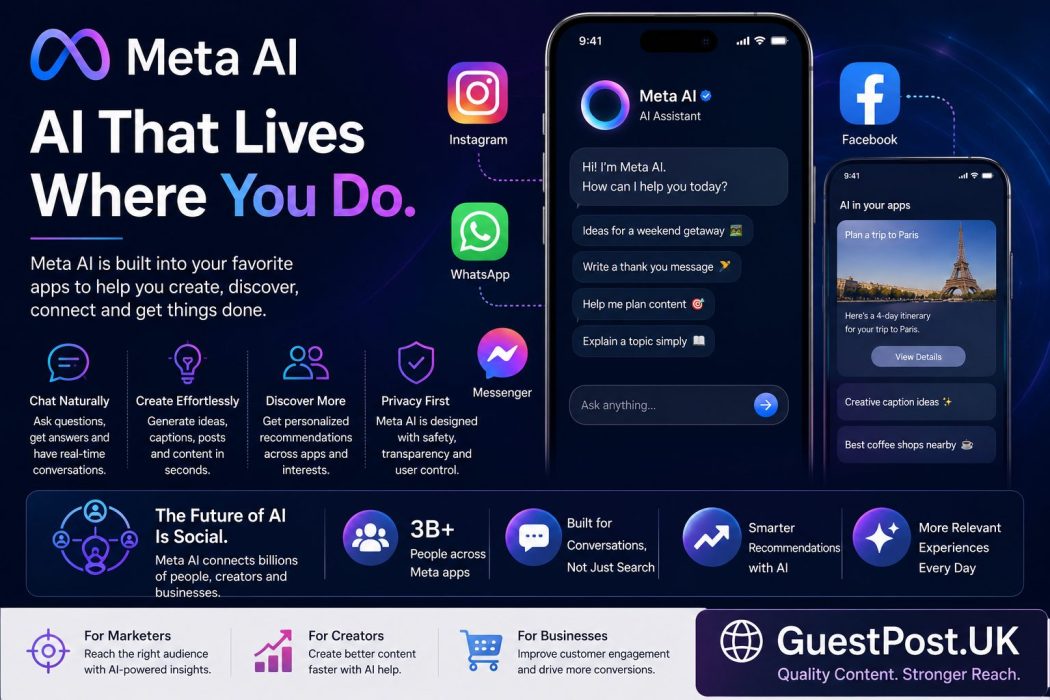
Meta AI Is Playing a Completely Different Game
Google wants AI inside search.
Microsoft wants AI inside productivity.
OpenAI wants AI inside conversations.
Meta wants AI inside human behaviour itself.
That is what makes Meta AI so important.
Unlike most AI systems competing around:
- search
- research
- productivity
- office workflows
Meta AI is deeply connected to:
- Messenger
- social discovery
- digital communication
That changes everything.
Because Meta already owns where billions of people spend their time daily.
What Is Meta AI?
Meta AI is Meta’s artificial intelligence assistant integrated across Meta platforms and products.
Instead of existing as a standalone AI website, Meta AI is gradually becoming embedded directly into:
- Messenger
- Meta smart devices
- future AR and VR products
That integration strategy is incredibly important.
Most AI companies are trying to attract users to AI tools.
Meta is bringing AI directly into existing habits.
Why Meta AI Could Become More Mainstream Than Many People Expect
This is the part many SEO professionals underestimate.
Most normal users do not actively seek AI tools every day.
But billions already use:
If AI is built naturally into those environments, adoption becomes effortless.
That gives Meta an enormous advantage:
distribution.
And distribution often matters more than technology itself.
Meta AI Feels More “Social” Than Other AI Systems
Google Gemini feels connected to search.
ChatGPT feels connected to reasoning.
Perplexity feels connected to research.
Meta AI feels connected to people.
That sounds abstract, but it matters psychologically.
Meta AI is designed around:
- conversations
- messaging
- recommendations
- sharing
- content discovery
- social interaction
This creates a very different AI experience.
Meta AI and the Future of Social Search
One of the most overlooked trends right now is this:
Young users increasingly search social platforms before Google.
People already use:
- TikTok for recommendations
- Instagram for discovery
- Reddit for opinions
- YouTube for tutorials
Meta understands this behavioural shift clearly.
Meta AI could become:
- a recommendation engine
- a conversational discovery assistant
- a shopping guide
- a social search layer
all at once.
Meta AI Is Quietly Changing How Content May Spread
Traditional SEO was built around:
- rankings
- websites
- keywords
- backlinks
Meta AI introduces a different possibility:
AI-powered social discovery.
Imagine users asking:
- “Best cafes in Brussels?”
- “Good skincare brands?”
- “Best AI tools for students?”
- “What laptop should I buy?”
inside social apps directly.
That creates an entirely different visibility ecosystem.
What Meta AI Is Actually Good At
Instead of another generic feature list, let’s talk about realistic strengths.
Meta AI for Everyday Users
This is where Meta may become extremely powerful long-term.
Most people do not need:
- advanced prompting
- coding workflows
- research systems
They want:
- quick answers
- recommendations
- content help
- social interaction
- convenience
Meta AI fits that behaviour perfectly.
Meta AI for Social Content
Meta AI is especially useful for:
- captions
- post ideas
- message drafting
- creative prompts
- social replies
- content brainstorming
This aligns naturally with Meta’s platforms.
Meta AI for Creators
Creators may increasingly use Meta AI for:
- content ideation
- audience engagement
- post generation
- comment assistance
- visual inspiration
- trend analysis
This could reshape social media marketing significantly.
Meta AI for Businesses
Businesses may use Meta AI for:
- customer interactions
- automated messaging
- ad assistance
- content generation
- recommendation systems
Because Meta already dominates social advertising globally, integrating AI could become highly influential for marketers.
Why Meta AI Could Affect SEO More Than People Think
At first glance, Meta AI does not seem directly related to SEO.
But actually, it may reshape:
- discovery behaviour
- traffic sources
- recommendation systems
- content visibility
- brand searches
The internet is slowly shifting from:
“searching websites”
toward:
“asking platforms.”
That changes optimisation strategies dramatically.
Meta AI and the Rise of “Platform SEO”
Traditional SEO focused heavily on Google.
But modern visibility increasingly depends on:
- TikTok SEO
- YouTube SEO
- Instagram discoverability
- Reddit visibility
- AI platform recommendations
Meta AI accelerates this trend.
Brands may increasingly need optimisation strategies for:
- social AI discovery
- conversational recommendations
- platform authority
- engagement relevance
This is much broader than traditional search.
Meta AI Reviews
Meta AI reviews are mixed but extremely interesting.
Many casual users enjoy:
- convenience
- accessibility
- integration inside the apps they already use
Meanwhile, power users sometimes compare Meta AI unfavourably to:
- ChatGPT
- Claude
- Perplexity
because Meta AI is not always designed for deep reasoning workflows.
That is intentional.
Meta AI focuses more heavily on mainstream adoption.
What Users Like About Meta AI
Easy Access
Users do not need separate platforms constantly.
Meta AI exists inside familiar apps.
Social Integration
This is Meta AI’s biggest strength.
The AI feels naturally connected to communication.
Simpler Experience
Meta AI often feels easier for casual users than advanced AI systems.
Fast Content Assistance
Quick captions, replies and social prompts work well.
Common Criticisms of Meta AI
Privacy Concerns
Because Meta already handles massive amounts of user data, privacy concerns remain a major point of discussion.
Not as Deep as ChatGPT or Claude
Advanced users sometimes find Meta AI less sophisticated for:
- long reasoning
- technical writing
- complex workflows
Ecosystem Dependence
Meta AI works best inside Meta platforms.
AI Trust Concerns
Some users remain cautious about Meta’s role in AI-driven recommendation systems.
Meta AI vs ChatGPT
| Area | Meta AI | ChatGPT |
|---|---|---|
| Main identity | Social AI assistant | Conversational AI assistant |
| Best for | Casual users and creators | Deep reasoning and workflows |
| Social integration | Massive | Limited |
| Writing depth | Moderate | Excellent |
| Platform reach | Huge | Huge |
| Core strength | Distribution | Conversational intelligence |
Meta AI vs Google Gemini
| Area | Meta AI | Google Gemini |
|---|---|---|
| Main ecosystem | Social platforms | Search and productivity |
| Discovery focus | Social recommendations | Information retrieval |
| Productivity tools | Limited | Extensive |
| Best for | Mainstream social usage | Google ecosystem users |
Meta AI vs Claude
| Area | Meta AI | Claude |
|---|---|---|
| Writing quality | Moderate | Excellent |
| Social integration | Massive | Minimal |
| Long-form workflows | Moderate | Excellent |
| Best use case | Social interaction | Editorial writing |
Meta AI and Digital Marketing
Meta AI could become extremely important for:
- influencer marketing
- social SEO
- conversational commerce
- recommendation visibility
- creator discovery
This may create a future where:
social visibility becomes as important as traditional SEO visibility.
Meta AI and Guest Posting
This is an interesting future discussion.
If AI systems increasingly recommend:
- creators
- brands
- articles
- products
then brand authority across the web matters even more.
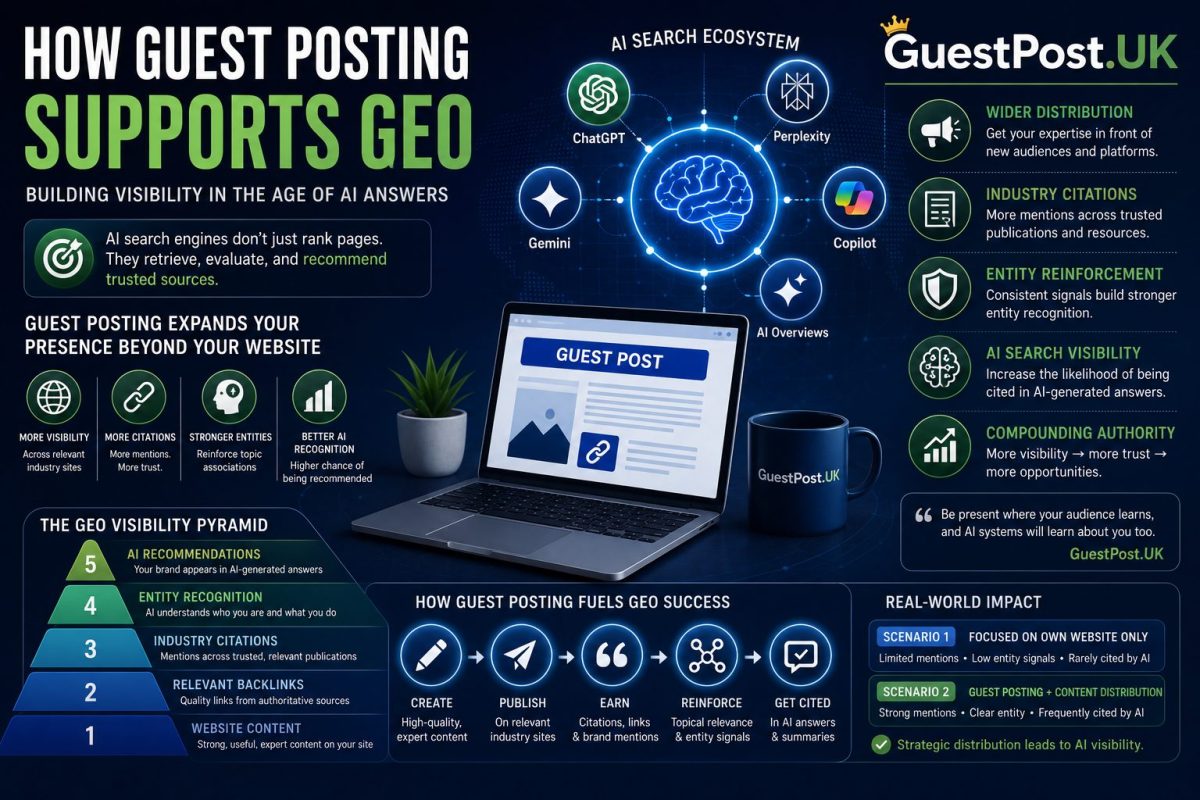
Guest posting may help strengthen:
- entity recognition
- brand trust
- semantic relevance
- topical authority
not just for Google, but potentially for AI recommendation systems as well.
The Hidden Risk of Meta AI
Meta’s biggest advantage is also its biggest concern:
scale.
If Meta successfully integrates AI deeply into social behaviour, it could massively influence:
- recommendations
- visibility
- discovery
- information consumption
That creates important conversations around:
- AI influence
- algorithmic visibility
- data privacy
- content manipulation
This debate will likely grow significantly.
Text-Based Graph: Where Meta AI Competes
Traditional Search AI
██████████████████
Research AI
██████████████
Social AI & Discovery
██████████████████████████
Meta AI’s biggest opportunity is clearly social AI integration and mainstream consumer adoption.
The Real Battle Meta AI Is Fighting
Meta is not necessarily trying to beat Google in search.
Meta is trying to own:
- attention
- interaction
- recommendation
- social discovery
through AI.
That is a completely different battlefield.
Final Verdict: Meta AI May Become the Most “Invisible” AI Giant
Many AI systems require users to intentionally visit AI platforms.
Meta AI may become powerful precisely because users barely notice it happening.
It will simply exist:
- inside chats
- inside feeds
- inside recommendations
- inside conversations
That frictionless integration could make Meta AI one of the most widely used AI systems in the world.
For marketers, SEOs and creators, that possibility should not be ignored.
Because if discovery increasingly happens inside AI-enhanced social ecosystems, the future of visibility will extend far beyond Google rankings alone.
Meta AI FAQs
What is Meta AI?
Meta AI is Meta’s artificial intelligence assistant integrated across platforms such as Instagram, WhatsApp, Facebook and Messenger.
Is Meta AI better than ChatGPT?
Meta AI is stronger for social integration and mainstream accessibility, while ChatGPT is stronger for deep reasoning and advanced workflows.
Does Meta AI affect SEO?
Indirectly, yes. Meta AI may reshape social discovery, recommendation systems and platform visibility.
Is Meta AI free?
Many Meta AI features are available for free inside Meta platforms.
Why is Meta AI important?
Meta AI matters because Meta already controls massive social ecosystems with billions of active users.
Can Meta AI create content?
Yes. Meta AI can assist with captions, replies, social posts and creative content ideas.
What are the best Meta AI alternatives?
Top alternatives include ChatGPT, Google Gemini, Claude AI and Perplexity AI.
Will Meta AI change digital marketing?
Very likely. Meta AI could significantly influence social discovery, recommendation systems and AI-powered engagement.