
AI visibility is becoming one of the questions clients ask before they even ask about keyword rankings.
They want to know whether their brand appears in ChatGPT, Gemini, Perplexity and Google’s AI-led results. More importantly, they want an agency to explain what that visibility means, which competitors are being cited instead, and what practical SEO work can improve the situation.
That is where AI visibility platforms come in. They don’t replace solid SEO, useful content, technical health, or earned mentions. They give agencies another way to measure how brands appear when people search through answer engines rather than traditional blue links.
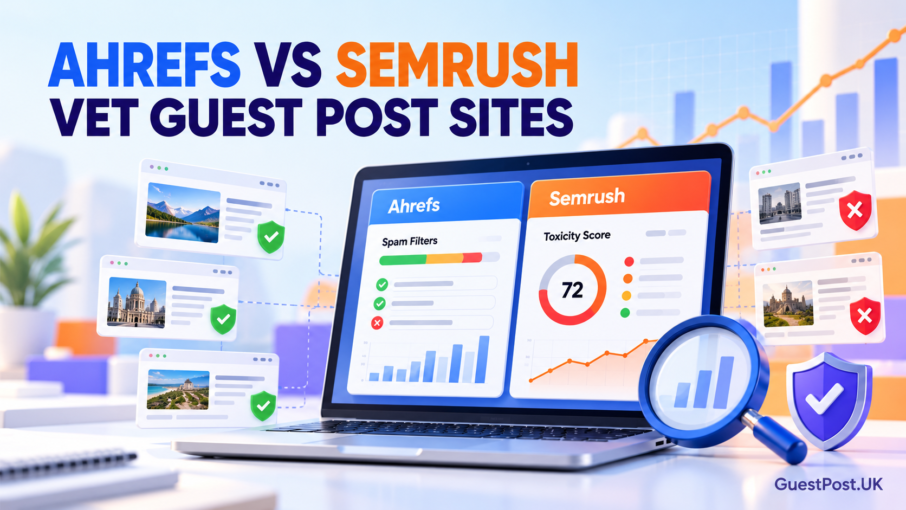
For agencies already managing organic search, the most relevant options are Semrush One, Ahrefs Brand Radar and HubSpot AEO. Each takes a different approach:
- Semrush One combines traditional SEO, AI visibility and competitive research in one subscription.
- Ahrefs is strongest for teams that want deep search, link and citation research alongside AI prompt tracking.
- HubSpot AEO is built for marketers who want a simpler AI-visibility view connected to wider marketing and CRM activity.
This comparison focuses on what matters for an SEO or guest-posting agency: useful data, pricing logic, reporting, client workflows and the actions that come after the dashboard.
What should an agency expect from an AI visibility tool?
A useful platform should do more than show a vague score.
At minimum, it should help you answer five client questions:
- Which prompts matter to this business?
A local service company, B2B SaaS platform and e-commerce store should not all monitor the same queries. - Does the brand appear in AI answers?
Mentions alone are not enough. You need to see the context, competitors and sources that appear around the answer. - Which websites are being cited?
Citation patterns can reveal missing content, missing authority or an opportunity for a stronger link-building campaign. - What should change next?
The output should lead to better pages, clearer expert content, relevant digital PR, better internal links or stronger third-party coverage. - Can the agency report on it without overpromising?
AI answers change regularly. Treat visibility as a directional trend, not as a guaranteed ranking position or a direct lead count.
A sensible AI visibility report sits alongside keyword data, organic clicks, conversions, backlinks and content performance. It should never replace the wider SEO audit process.
Semrush One: best for agencies wanting one combined SEO and AI workflow
Semrush One is the most natural fit for an agency already using Semrush for keyword research, rank tracking, competitor analysis and site audits.
Its advantage is not that it tracks AI prompts in isolation. The real value is having traditional search data and AI visibility data in the same workspace. An account manager can move from a client’s lost keyword visibility to AI prompt gaps, competitor mentions, content opportunities and technical checks without switching platforms.
What Semrush One does well
Semrush One combines the standard SEO toolkit with AI Visibility features. Depending on the plan, this can include:
- AI brand-performance tracking
- Prompt tracking across major AI search experiences
- Competitor comparison and citation research
- AI-readiness checks within site auditing
- Keyword, backlink and traditional ranking data
- Content research and optimisation features
- Reporting options for agency work
For a client using guest posting services, this helps by creating a clearer story around off-site visibility. You can identify where competitors are repeatedly referenced, assess the type of pages being cited, then build a campaign around better resources, expert contributions, relevant publisher placements and genuinely useful content.
Semrush One pricing and suitability
As of November 2026, Semrush One starts around $199 per month on monthly billing, with higher plans increasing websites, tracked keywords and daily AI prompts. The standalone AI Visibility toolkit starts lower, but the full bundle makes more sense when an agency also needs traditional SEO data.
That makes Semrush One a stronger choice for:
- Small-to-mid-sized agencies managing several SEO clients
- Teams already paying for Semrush
- Businesses wanting SEO, competitor research and AI visibility in one report
- Campaigns where content, technical SEO and digital PR need to work together
Its main limitation is cost. If a client only wants to monitor a small set of AI prompts, the full platform can be more than they need.
Ahrefs Brand Radar: best for research-led SEO and link-building teams
Ahrefs approaches AI visibility differently. Its strength has always been search demand, backlinks, content gaps and competitor research. Brand Radar adds a layer that helps agencies understand how brands and websites appear across AI-generated answers.
For GuestPost.uk’s audience, this is particularly relevant because the most valuable question is often not simply, “Are we visible in AI?” It is, “Which domains, articles, brands and citations are influencing the answer?”
That question connects directly with publisher research, digital PR and smarter guest-posting decisions.
What Ahrefs does well
Ahrefs gives agencies a broader research environment around AI visibility. Depending on the plan and add-ons, it can help with:
- AI prompt tracking across platforms such as Google AI Overviews, AI Mode, ChatGPT, Gemini, Perplexity and Copilot
- Brand mentions and competitor comparisons
- Citation and source discovery
- Backlink analysis and broken-link opportunities
- Content gap research
- Site audits and technical issue tracking
- Keyword and SERP research
This makes Ahrefs especially useful when an agency needs to turn AI findings into a link acquisition plan. If competitor brands are repeatedly cited because they own useful guides, tools, original data or well-placed expert content, the answer is rarely to publish a generic article. Instead, create a stronger asset and promote it properly.
Combining Brand Radar with a publisher quality check can help agencies avoid chasing placements purely because of headline authority metrics. Relevance, audience fit, editorial standards and topical context still matter.
Ahrefs pricing and suitability
Ahrefs’ Lite plan starts at roughly $129 per month, with higher plans adding more projects, tracked keywords, history and AI prompt capacity. Brand Radar is also available as a more specialised product, and custom prompt packages are available for teams that mainly need AI tracking.
Ahrefs is a strong fit for:
- Link-building and digital PR agencies
- SEO consultants who already rely heavily on backlink and content-gap data
- SaaS teams researching competitors and cited domains
- Agencies producing detailed prospecting or authority-building plans
For a full guest-posting workflow, it also works well alongside tools such as the Guest Post Site Finder and Outreach Email Generator. Ahrefs identifies the opportunity; your campaign process turns that insight into credible content, publisher targets and outreach.
HubSpot AEO: best for marketing teams that want simplicity and CRM context
HubSpot AEO is the most straightforward option of the three.
It is designed for teams that want to understand whether their brand appears in AI answers, which competitors are mentioned, what sources influence those answers and what content or marketing action could improve visibility. Its core appeal is that it sits closer to wider marketing activity than to deep technical SEO research.
For an agency client already using HubSpot for leads, campaigns and customer data, that can be genuinely useful. AI visibility does not have to sit in a separate spreadsheet owned only by the SEO team. It can become part of a wider picture that includes traffic, content, sales conversations and pipeline.
What HubSpot AEO does well
HubSpot AEO focuses on monitoring how a brand appears across ChatGPT, Gemini, and Perplexity. It includes:
- Daily prompt tracking
- Brand visibility scoring
- Competitor monitoring
- Citation analysis
- Sentiment and recommendation context
- Suggested actions to improve visibility
- Marketing and CRM context for HubSpot users
The platform is less about exhaustive backlink analysis or keyword research. It focuses on making AI-search visibility understandable for marketers who need a clear starting point.
That makes it useful for clients who ask, “Why are competitors appearing in AI answers instead of us?” but do not need a full enterprise SEO platform.
For example, a SaaS business may discover that AI tools regularly cite competitor comparison pages, practical templates and expert-led guides. The next step may be to improve its own pages, create stronger SaaS SEO content, and earn relevant mentions through targeted blogger outreach.
HubSpot AEO pricing and suitability
As of November 2026, HubSpot AEO starts at around $50 per month for 25 daily prompts across three answer engines. It is also included with some higher HubSpot Marketing Hub subscriptions.
This makes HubSpot AEO a sensible choice for:
- Marketing teams already using HubSpot
- Agencies managing smaller AI visibility projects
- Businesses that want a clear dashboard without deep SEO-tool complexity
- Clients that care about connecting AI visibility with lead-generation activity
The trade-off is depth. HubSpot AEO is not a replacement for a full SEO research platform. Agencies that need backlink intelligence, broad keyword research, technical crawling and detailed competitive analysis will usually need another platform alongside it.
Semrush One vs Ahrefs vs HubSpot AEO: the practical difference
The right choice depends less on which logo looks most impressive in a client deck and more on what the agency needs to do after finding an opportunity.
Choose Semrush One if you need one connected SEO workspace
Semrush One is the best fit when your agency wants one platform for organic search, technical audits, keyword tracking, AI prompt monitoring and competitor research.
It is particularly strong for an agency managing ongoing SEO retainers. A strategist can use it to identify content gaps, inspect ranking competitors, track AI mentions, and report progress without moving data between several tools.
Best for: full-service SEO agencies and businesses that want SEO plus AI visibility in one subscription.
Choose Ahrefs if links, content gaps and cited sources are central to your work
Ahrefs is the better choice for research-heavy campaigns. It is especially effective when AI visibility needs to lead to stronger content assets, smarter digital PR, competitor backlink analysis or a targeted authority-building campaign.
For GuestPost.uk-style campaigns, its value is in the chain of evidence: identify who is visible, see which sources are cited, investigate why those sources earn attention, then build a better content and placement strategy.
Best for: link-building agencies, digital PR teams, SEO consultants and SaaS brands competing in difficult markets.
Choose HubSpot AEO if the client needs simple, actionable AI visibility tracking
HubSpot AEO is the cleanest option for a business that wants to begin monitoring AI-search visibility without introducing a complicated research platform.
It works best when the marketing team already uses HubSpot and wants AI insights close to campaigns, CRM information and reporting.
Best for: HubSpot users, marketing-led teams and smaller AI-visibility projects.
A simple agency decision framework
Before buying any AI visibility platform, ask these questions:
- Do we already pay for Semrush or Ahrefs?
- Which AI platforms matter most to this client’s customers?
- Are we tracking a handful of commercial prompts or hundreds of informational queries?
- Do we need backlink and cited-domain research as well?
- Will the client understand and use the report?
- Can we turn the findings into content, technical SEO, PR or link-building actions?
For many agencies, the answer is not to buy every platform. Choose the tool that best fits the existing workflow, then build a repeatable reporting method around it.
A useful monthly AI visibility report could include:
- Brand mentions across priority prompts
- Competitor mentions and share of voice
- New or lost cited pages
- The strongest content gap discovered
- One technical or on-page improvement
- One authority-building or outreach action
- A clear explanation of what changed and what did not
This approach keeps AI reporting connected to genuine SEO work. It also avoids promising that one new mention in an AI answer will automatically produce leads.
AI visibility is not a separate marketing channel
The strongest way to improve AI visibility is usually to improve the same signals that help a business perform across search more broadly:
- Publish accurate, genuinely useful pages
- Demonstrate first-hand experience and subject expertise
- Build clear topic clusters around commercial services
- Improve technical accessibility and internal linking
- Earn relevant mentions from credible websites
- Keep important guides refreshed as tools, pricing and buyer needs change
That is why AI visibility tracking should connect to a wider Google AI Search Optimisation plan, not replace it.
A business that creates useful content but has weak internal structure can use the Keyword Cluster Generator and Content Planning Tools to turn research into clearer topic groups. A business with strong content but limited authority may need a more focused link-building strategy.
The best choice for most agencies
For a full-service agency already managing SEO retainers, Semrush One is the most complete all-round option. It combines traditional SEO work and AI visibility in a way that is simple to report on.
For agencies where backlinks, content gaps, competitive research and digital PR drive the strategy, Ahrefs is the stronger research engine. It offers more depth when the real task is to understand why competitors are being cited and how to build comparable authority.
For marketing teams that want an affordable, simple view of AI visibility—especially existing HubSpot users—HubSpot AEO is a practical starting point.
The platform matters, but what you do afterwards matters more. Use the data to find meaningful gaps, improve pages, create stronger content assets and earn relevant coverage. That is where visibility turns into long-term search value.