

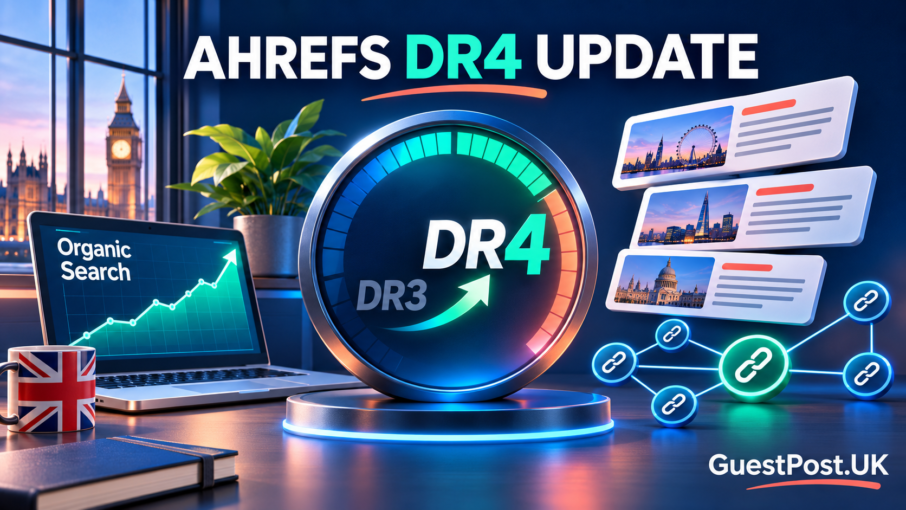
Ahrefs is preparing to launch a major update to its Domain Rating metric, commonly known as DR. The update, called DR4, is scheduled to roll out across the Ahrefs interface on 1 December 2026.
For anyone who buys, sells or evaluates guest posts, this matters. Some websites may see their DR rise, fall or disappear from the metric without any meaningful change to their content, rankings or real-world editorial value.
That matters even more in guest posting, where DR is often used as a quick filter when comparing publishing opportunities. A high number can help with initial research, but it has never told the full story. With DR4, relying on it alone could become even more misleading.
What is changing in Ahrefs DR4?
Ahrefs has confirmed two major changes to how its Domain Rating model works.
First, it will use a smaller and more selective pool of websites when calculating DR. Links from sites that Ahrefs estimates receive organic search traffic will carry more influence than before.
Second, subdomains will receive their own DR scores instead of automatically inheriting the root domain’s authority.
For example, a page hosted on a large platform may previously have appeared to benefit from the platform’s overall DR. Under DR4, that subdomain will be assessed more independently according to its own backlink profile.
Ahrefs has also said that domains it labels as spam may experience larger DR drops. This does not mean every site with a lower score is spam, but it does mean the new model aims to reduce the apparent strength of low-quality backlink networks.
The key point is simple: a DR change after December is not automatically evidence that a website has improved or deteriorated.
Why guest post buyers should pay attention
Informed buyers already know that DR is a third-party metric, not a Google ranking factor. Google does not use Ahrefs Domain Rating to decide where a page should rank.
However, DR remains widely used in outreach, link-building campaigns and guest-post marketplaces because it gives a fast snapshot of a website’s backlink profile. The problem begins when it becomes the only decision-making factor.
After DR4 launches, two publishers may look very different on paper despite no meaningful change in their ability to publish a useful, relevant and indexed article. A site’s DR could drop because:
- its backlinks are now valued differently by Ahrefs;
- the websites influencing its score are filtered differently;
- its subdomain is assessed separately from the root domain;
- competitors’ metrics have changed within a relative scoring model;
- links associated with low-quality or spam-labelled domains carry less influence.
This means an agency or business should not automatically remove a publisher from its shortlist because its DR falls after the update. Equally, a higher DR should not be treated as proof that a placement will be valuable.
A strong guest-post opportunity usually depends on a combination of topical relevance, genuine audience signals, editorial quality, sensible outbound-link patterns, indexation, and the quality of the specific page where a link will appear.
DR is still useful — but it needs context
DR should remain a supporting metric. It can help identify established sites, compare broad backlink strength and spot opportunities that deserve closer review.
But it cannot tell you whether a publication is relevant to your business, whether it has a genuine readership, whether its articles are indexed, or whether the site sells excessive outbound links.
For example, a relevant UK business publication with modest DR, clear editorial standards, and genuine organic visibility may be a better placement than an unrelated high-DR website filled with sponsored content and thin articles.
At GuestPost.uk, publisher selection should therefore continue to look beyond a single score. The strongest placements make sense for the reader, fit the client’s topic, and appear on websites with visible editorial substance.
Ahrefs’ DR4 announcement confirms that the update is a change to Ahrefs’ own backlink metric—not a Google algorithm update.
How DR4 could affect guest post marketplace comparisons
The DR4 rollout may create a short period of confusion across the guest-posting industry. Publishers that previously promoted a certain DR may see a different figure in Ahrefs after 1 December, while older reports, screenshots and outreach lists may still show DR3 data.
That does not necessarily mean the earlier number was wrong. It means Ahrefs has changed the way it calculates the metric.
For marketplace buyers, the sensible response is to compare like with like. Avoid comparing a newly updated DR4 score with an old DR3 score when making a decision. Instead, review the wider quality picture and assess comparable publishers using the same version of the metric.
This is especially important for websites hosted on subdomains. Under the previous model, some subdomains could appear stronger because they inherited the authority of a major root domain. DR4 will give many of these sites a more individual assessment.
That is a positive change for serious link builders. It should be easier to separate an independently strong subdomain from a page that looks authoritative only because of the platform it sits on.
A practical checklist for assessing publishers after DR4
Before ordering a guest post, use DR as one part of a broader review.
1. Check topical relevance
A relevant publication is more likely to provide a natural context for the link and expose the content to an appropriate audience.
A link to an accounting firm from a credible UK business, finance or entrepreneurship publication is generally more meaningful than a link from an unrelated entertainment or lifestyle website, regardless of which site has the higher DR.
2. Look for real organic visibility
Estimated organic traffic isn’t perfect, but it can indicate that Google is indexing and ranking a website’s content.
Check whether the website has visible rankings, a genuine content archive and articles that appear in Google search results. A publisher with modest traffic may still be valuable if it is highly relevant and editorially credible.
3. Review recent articles
Read several recent posts rather than judging a website from its homepage alone.
Look for signs of genuine editorial activity, including:
- clear article structure and useful information;
- named authors or a visible editorial identity;
- sensible categories and topic coverage;
- articles that are indexed and receive some visibility;
- content written for readers rather than solely to host links.
Be cautious when a site has large volumes of thin, repetitive or unrelated sponsored articles.
4. Check outbound-link patterns
A credible publisher may accept sponsored work or contributor articles. That alone is not a problem.
The concern is when almost every article appears to exist only to place commercial links, especially across unrelated industries. Excessive exact-match anchors, gambling-related material, low-value commercial pages and a lack of editorial standards can all be warning signs.
5. Assess the placement itself
The quality of the individual article matters as much as the domain.
A useful guest post should be relevant, well written, properly formatted and placed within a suitable category. The link should fit naturally in the content and direct readers to a genuinely helpful page.
A contextual link inside a relevant article can be more valuable than a prominent link placed on an unrelated page.
What GuestPost.uk clients should do now
There is no need to panic, change campaigns or discard existing publisher lists before Ahrefs DR4 goes live.
Instead, treat December as a period for careful comparison. Check a sample of previously approved publishers once the new figures appear and identify whether any changes reflect a real quality concern or simply the new metric model.
GuestPost.uk should continue to prioritise publishers using a balanced review process:
- relevance to the client’s sector and audience;
- real content quality and editorial standards;
- visible indexation and organic-search signals;
- a sensible backlink and outbound-link profile;
- transparent placement terms;
- DR and other SEO metrics as supporting indicators.
Looking beyond Domain Rating
Ahrefs DR4 is a meaningful update because it changes how one of the industry’s most-used backlink metrics is calculated. Some scores will move, particularly for spam-labelled domains and subdomains that previously inherited strength from a root domain.
That is confirmed by Ahrefs. The likely impact on individual guest-post publishers, however, should be treated as an informed assessment until the update is fully live.
The right response is not to chase whichever DR number looks best. It is to make better decisions using relevance, editorial quality, organic visibility and placement context alongside third-party SEO data.
For guest-post campaigns that are built for readers as well as rankings, that has always been the stronger approach.