
Reading about strategy is useful.
Watching it work is far more valuable.
One of the biggest problems with the current wave of GEO content is that it rarely moves beyond theory. You’ll find countless articles explaining entity optimisation, AI search visibility and topical authority, yet very few demonstrate how these principles translate into day-to-day business decisions.
That gap matters.
Business owners don’t invest in Generative Engine Optimisation because they enjoy publishing more articles or improving structured data. They invest because they want to become the business that artificial intelligence chooses to recommend when customers ask for advice.
Understanding that difference changes the conversation completely.
The following examples are realistic implementation scenarios based on common business situations. They are not presented as client case studies or guaranteed outcomes. Instead, they illustrate how organisations in different industries could strengthen the signals that AI systems increasingly rely upon when deciding which brands deserve attention.
As you work through each example, notice something important.
The tactics vary.
The industries vary.
The budgets vary.
The underlying objective never changes.
Every successful strategy focuses on making the business easier to understand, easier to trust and easier to recommend.
That consistency is no coincidence.
It is exactly how Generative Engine Optimisation should be approached.
Case Study One — Local Trades Business
The Challenge
Imagine an emergency plumbing company based in Manchester.
The business has traded successfully for more than fifteen years.
Customers leave positive reviews.
Existing clients recommend the company regularly.
The website appears reasonably well for searches such as:
- Emergency plumber Manchester
- Boiler repair Manchester
- 24-hour plumber near me
On paper, everything looks healthy.
However, when prospective customers ask AI assistants questions such as:
“Who are the best emergency plumbers in Manchester?”
or
“Can you recommend a reliable plumber available tonight?”
the business is rarely mentioned.
This surprises the owner.
After all, they’ve invested heavily in traditional SEO.
So what went wrong?
Looking Beyond Rankings
The problem isn’t necessarily visibility in Google.
It’s visibility outside Google.
From an AI system’s perspective, this plumbing company has a relatively narrow digital footprint.
Its expertise exists almost entirely on its own website.
There are very few independent signals reinforcing its reputation elsewhere.
While customers clearly trust the company, artificial intelligence has limited evidence that the wider industry does.
That distinction is subtle, yet incredibly important.
The GEO Strategy
Rather than chasing more keywords, the business changes direction.
Instead of publishing another generic service page, it begins demonstrating expertise.
Over several months it creates genuinely useful resources covering topics homeowners regularly search for, including emergency plumbing advice, seasonal maintenance guides, common boiler faults and water damage prevention.
At the same time, the company contributes practical advice to local newspapers, home improvement websites and regional community publications.
Local journalists begin quoting its engineers during severe winter weather whenever frozen pipes become a news story.
The company also publishes detailed project stories showing how complex plumbing emergencies were diagnosed and resolved.
These are not sales pages.
They are educational resources that showcase experience.
Gradually, something changes.
The business is no longer just another plumbing company.
It becomes a recognised local authority on plumbing.
AI Confidence Scorecard
| Signal | Before | After Strategy |
|---|---|---|
| Topical Coverage | ⭐⭐ | ⭐⭐⭐⭐⭐ |
| Local Authority | ⭐⭐ | ⭐⭐⭐⭐ |
| Brand Recognition | ⭐ | ⭐⭐⭐⭐ |
| Industry Mentions | ⭐ | ⭐⭐⭐⭐ |
| AI Citation Potential | ⭐ | ⭐⭐⭐⭐⭐ |
Notice that rankings were never the primary objective.
Recognition was.
Case Study Two — Employment Law Firm
The Challenge
A specialist employment law practice serves clients across the Midlands.
Its solicitors possess extensive experience handling workplace disputes, unfair dismissal claims and discrimination cases.
Yet despite that expertise, AI assistants rarely recommend the firm.
Potential clients asking questions such as:
“Who is the best employment solicitor in Birmingham?”
typically receive recommendations for larger national firms.
The immediate reaction might be to increase advertising or publish more location pages.
However, neither addresses the underlying issue.
Building Professional Credibility
Legal services operate in an industry where trust outweighs almost everything else.
People rarely choose a solicitor based solely on keyword rankings.
They look for reassurance.
Artificial intelligence attempts to do exactly the same.
Instead of expanding hundreds of service pages, the firm focuses on demonstrating expertise.
Its solicitors begin publishing commentary on significant employment tribunal decisions.
They contribute expert opinion to HR magazines.
They appear on business podcasts discussing changes in employment legislation.
Industry publications begin citing their legal analysis whenever new workplace regulations are introduced.
Slowly, their expertise becomes visible beyond the firm’s own website.
The Bigger Lesson
The law firm hasn’t simply improved its website.
It has strengthened its professional reputation.
AI systems now encounter consistent evidence showing that recognised publications trust these solicitors enough to quote them.
That independent validation becomes significantly more persuasive than another optimised landing page.
AI Confidence Scorecard
| Signal | Before | After Strategy |
|---|---|---|
| Professional Expertise | ⭐⭐⭐ | ⭐⭐⭐⭐⭐ |
| Industry Recognition | ⭐ | ⭐⭐⭐⭐ |
| Media Visibility | ⭐ | ⭐⭐⭐⭐ |
| Trust Signals | ⭐⭐ | ⭐⭐⭐⭐⭐ |
| Recommendation Potential | ⭐⭐ | ⭐⭐⭐⭐⭐ |
Case Study Three — SaaS Company
The Challenge
A software company develops a project management platform aimed at creative agencies.
Its product is excellent.
Customers are loyal.
Retention rates remain high.
Despite this, whenever businesses ask ChatGPT:
“What are the best project management tools for marketing agencies?”
the software rarely appears.
Competing platforms dominate almost every recommendation.
Interestingly, the problem isn’t product quality.
It’s discoverability.
Escaping the Feature Trap
Like many SaaS businesses, the company had invested almost exclusively in feature-focused content.
Every page explained what the software could do.
Very little explained how agencies could improve their operations.
In other words, the company was marketing its product rather than educating its audience.
That distinction became the turning point.
Instead of writing another article announcing a new feature, the business began publishing resources that agency owners genuinely wanted to read.
Topics included:
- Improving creative workflows.
- Managing remote design teams.
- Reducing project bottlenecks.
- Agency profitability benchmarks.
- Client communication frameworks.
- Productivity research.
None of these pages aggressively promoted the software.
Instead, they positioned the company as an expert in agency operations.
That shift naturally created opportunities for industry blogs, marketing publications and business podcasts to reference the research.
The software stopped looking like another tool.
It became associated with expertise.
And that’s exactly the type of signal AI systems increasingly value.
Case Study Four — E-commerce Brand
The Challenge
An online retailer specialises in premium outdoor clothing.
Its products rank well for several commercial keywords, paid advertising generates consistent sales and the business has built a loyal customer base.
Yet something interesting begins happening.
Potential customers stop searching exclusively through Google.
Instead, they ask questions like:
“What’s the best waterproof jacket for hiking in Scotland?”
or
“Can you recommend a durable winter jacket under £250?”
The responses generated by AI assistants rarely mention the retailer.
Instead, users are presented with a mixture of established outdoor brands, editorial buying guides and specialist publications.
The retailer quickly realises something important.
People are no longer searching for products.
They’re searching for advice.
Shifting From Catalogue to Knowledge Hub
Like many e-commerce businesses, the website was built around products.
Every effort had gone into creating category pages, product descriptions and promotional campaigns.
Very little content existed for customers who were still researching.
The company decided to reverse its approach.
Rather than asking:
“How do we sell more jackets?”
It asked:
“How do we become the outdoor expert that people trust before they buy?”
The marketing strategy changed dramatically.
Instead of publishing another seasonal promotion, the business invested in long-form buying guides, equipment comparisons and practical advice written by experienced hikers.
Customers could now learn:
- How waterproof ratings actually work.
- Which fabrics perform best in different weather conditions.
- How to layer clothing for winter hiking.
- How to care for technical outdoor garments.
- Which equipment suits beginners compared with experienced walkers.
The result was a website that educated first and sold second.
Ironically, that educational approach often led to more sales because visitors trusted the recommendations.
Why This Matters for AI Search
Artificial intelligence is designed to answer questions.
A retailer that explains why someone should choose a particular product becomes far easier to recommend than one that simply lists specifications and prices.
The objective shifted from becoming another online shop to becoming a trusted buying advisor.
AI Confidence Scorecard
| Signal | Before | After Strategy |
|---|---|---|
| Product Expertise | ⭐⭐ | ⭐⭐⭐⭐⭐ |
| Educational Content | ⭐ | ⭐⭐⭐⭐⭐ |
| Citation Potential | ⭐ | ⭐⭐⭐⭐ |
| Consumer Trust | ⭐⭐ | ⭐⭐⭐⭐⭐ |
| AI Recommendation Potential | ⭐⭐ | ⭐⭐⭐⭐⭐ |
Case Study Five — SEO Agency
The Challenge
A digital marketing agency has achieved respectable Google rankings for several competitive services.
Organic traffic is healthy.
Lead generation is consistent.
However, when businesses ask AI assistants:
“Which agencies specialise in Generative Engine Optimisation?”
the agency is rarely mentioned.
The leadership team assumes the solution is straightforward.
Publish more service pages.
Target additional keywords.
Improve internal linking.
These activities certainly help, but they don’t solve the real problem.
The agency is visible.
It isn’t memorable.
Becoming the Agency Others Reference
Rather than producing more generic SEO articles, the agency begins creating genuinely original resources.
It develops proprietary frameworks explaining how AI evaluates authority.
It publishes annual research examining changes in AI search visibility.
Its consultants contribute expert commentary to industry publications.
Conference presentations are turned into downloadable guides.
White papers become public resources.
Journalists begin requesting opinions whenever AI search developments make the news.
Other SEO professionals start referencing the agency’s frameworks.
Eventually, something significant happens.
The agency stops competing purely through rankings.
It becomes recognised for its thinking.
That shift transforms the business from another service provider into an industry authority.
The Lesson
Most agencies invest heavily in client work while neglecting their own authority.
Yet the agencies most frequently recommended by AI systems are often those contributing new ideas rather than simply delivering existing services.
Recognition follows contribution.
AI Confidence Scorecard
| Signal | Before | After Strategy |
|---|---|---|
| Industry Recognition | ⭐⭐ | ⭐⭐⭐⭐⭐ |
| Thought Leadership | ⭐ | ⭐⭐⭐⭐⭐ |
| Original Research | ⭐ | ⭐⭐⭐⭐ |
| Expert Reputation | ⭐⭐ | ⭐⭐⭐⭐⭐ |
| AI Authority | ⭐⭐ | ⭐⭐⭐⭐⭐ |
Case Study Six — Restaurant Group
The Challenge
A regional restaurant group enjoys excellent customer reviews.
Locals recommend it regularly.
Weekend bookings remain strong.
Yet visitors planning a trip ask AI assistants:
“Where should I eat in York?”
or
“Recommend an independent Italian restaurant in York.”
The restaurants rarely appear.
Looking Beyond Reviews
Most restaurant websites concentrate on menus, opening hours and reservation forms.
Useful information, certainly—but not enough to establish broader authority.
The group decided to tell its story.
Chefs began sharing recipes.
The business documented relationships with local suppliers.
Seasonal ingredients became the focus of educational content.
Food journalists were invited to behind-the-scenes events.
Local newspapers covered sustainability initiatives.
Travel bloggers featured the restaurants in city guides.
The restaurants became associated with local food culture rather than simply somewhere to book a table.
AI systems now had a much richer understanding of the brand.
AI Confidence Scorecard
| Signal | Before | After Strategy |
|---|---|---|
| Local Authority | ⭐⭐ | ⭐⭐⭐⭐⭐ |
| Brand Story | ⭐ | ⭐⭐⭐⭐ |
| Editorial Coverage | ⭐ | ⭐⭐⭐⭐ |
| Community Recognition | ⭐⭐ | ⭐⭐⭐⭐⭐ |
| Recommendation Potential | ⭐⭐ | ⭐⭐⭐⭐⭐ |
Case Study Seven — B2B Manufacturer
The Challenge
An engineering company manufactures specialist industrial equipment.
Its products are technically outstanding.
However, very little educational content exists online.
Potential buyers researching solutions encounter distributors, trade magazines and consultants long before discovering the manufacturer itself.
Sharing Knowledge Instead of Specifications
Historically, the company’s website focused almost entirely on technical specifications.
From a buyer’s perspective, this information arrived too late.
Prospective customers first wanted answers to broader questions.
How should different manufacturing systems be compared?
Which technologies were becoming obsolete?
What common mistakes delayed factory automation projects?
The company began publishing detailed technical resources written by its engineers.
Industry journals referenced the research.
Universities cited white papers.
Trade conferences invited the engineering team to present findings.
Instead of simply manufacturing equipment, the company became recognised for advancing industry knowledge.
Why This Matters
B2B organisations often underestimate the commercial value of educational content.
Teaching creates trust long before purchasing decisions are made.
AI systems increasingly recognise this pattern.
AI Confidence Scorecard
| Signal | Before | After Strategy |
|---|---|---|
| Technical Expertise | ⭐⭐⭐ | ⭐⭐⭐⭐⭐ |
| Educational Authority | ⭐ | ⭐⭐⭐⭐⭐ |
| Industry Mentions | ⭐ | ⭐⭐⭐⭐ |
| Professional Recognition | ⭐⭐ | ⭐⭐⭐⭐⭐ |
| AI Visibility | ⭐⭐ | ⭐⭐⭐⭐⭐ |
Case Study Eight — Healthcare Provider
The Challenge
A private healthcare clinic employs highly experienced consultants.
Patients leave excellent feedback.
Medical outcomes are strong.
Despite this, AI assistants tend to recommend larger healthcare organisations when users ask medical questions.
The issue is not competence.
It is confidence.
Healthcare demands particularly high standards of trust.
Demonstrating Medical Authority
The clinic avoided publishing generic health articles written for search engines.
Instead, every educational resource was produced or reviewed by qualified clinicians.
Medical explanations referenced recognised guidance.
Research findings were interpreted in plain English.
Patient education became a central part of the website.
Consultants contributed to professional publications and participated in healthcare conferences.
Gradually, the clinic’s digital presence reflected the expertise already present within the organisation.
The Wider Lesson
In sensitive sectors such as healthcare, finance and law, trust cannot be manufactured.
It must be demonstrated consistently through expertise, transparency and professional recognition.
Artificial intelligence increasingly mirrors this expectation.
AI Confidence Scorecard
| Signal | Before | After Strategy |
|---|---|---|
| Professional Credibility | ⭐⭐⭐ | ⭐⭐⭐⭐⭐ |
| Expert Content | ⭐⭐ | ⭐⭐⭐⭐⭐ |
| Medical Trust Signals | ⭐⭐⭐ | ⭐⭐⭐⭐⭐ |
| Public Recognition | ⭐ | ⭐⭐⭐⭐ |
| AI Confidence | ⭐⭐ | ⭐⭐⭐⭐⭐ |
A Pattern Begins to Emerge
Although these businesses operate in entirely different sectors, their journeys reveal the same underlying principle.
None became stronger candidates for AI recommendations by chasing shortcuts.
Instead, they improved their ability to answer three fundamental questions that every AI system attempts to resolve:
- Does this organisation genuinely understand its subject?
- Do other trusted sources recognise its expertise?
- Would recommending this business help the user?
Every successful GEO strategy ultimately strengthens those three answers.
That is where sustainable AI visibility begins—not with technical tricks, but with earned credibility.
What Every Successful GEO Strategy Has in Common
By now, you have probably noticed that none of the case studies relied on a secret optimisation technique.
There was no hidden prompt.
No special schema markup.
No shortcut that suddenly persuaded ChatGPT or Gemini to recommend a business.
Instead, every organisation followed the same progression.
They became easier to understand.
They became easier to trust.
And eventually, they became easier to recommend.
That observation leads to perhaps the most important lesson in Generative Engine Optimisation.
AI systems don’t reward websites. They reward confidence.
The more evidence available to support your expertise, the more comfortable an AI model becomes using your business as part of its answer.
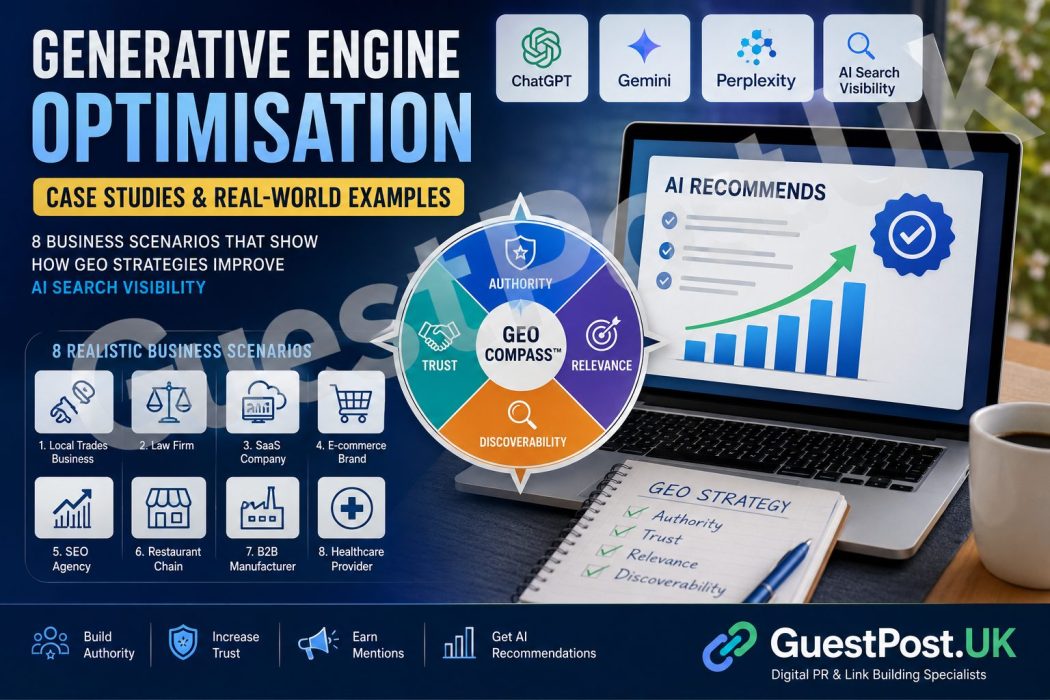
The GuestPost.uk GEO Compass™
Over the past few articles, we’ve explored dozens of GEO concepts. Rather than viewing them as separate activities, it helps to think of them as one connected system.
We call this the GuestPost.uk GEO Compass™.
                    AUTHORITY
                        ▲
                        │
                        │
TRUST ◄─────────────────┼─────────────────► RELEVANCE
                        │
                        │
                        ▼
                 DISCOVERABILITY
Every successful Generative Engine Optimisation campaign strengthens these four pillars.
Authority
Authority answers a simple question:
“Does this organisation genuinely know what it is talking about?”
Authority grows through:
- Original research
- Expert content
- Industry recognition
- Comprehensive knowledge hubs
- Thought leadership
- Editorial backlinks
Without authority, even technically excellent websites struggle to become trusted references.
Trust
Trust is built through consistency rather than marketing claims.
AI systems look for signals such as:
- Transparent company information
- Expert authors
- Reviews
- Case studies
- Contact details
- Independent mentions
- Reliable information
Businesses cannot simply claim to be trustworthy.
They must demonstrate it repeatedly.
Relevance
Relevance extends beyond keywords.
AI attempts to understand whether your expertise genuinely matches the user’s question.
Publishing one article on artificial intelligence does not make a company an AI specialist.
Publishing an entire knowledge ecosystem does.
This is why topical depth continues to outperform isolated content.
Discoverability
Even outstanding content cannot be recommended if AI systems struggle to find or understand it.
Discoverability includes:
- Technical SEO
- Internal linking
- Clear site architecture
- Entity optimisation
- Structured data
- Crawlability
Strong discoverability allows your expertise to become visible.
The GEO Maturity Model™
Every organisation sits somewhere on a journey.
Very few businesses begin as recognised authorities.
Instead, they gradually progress through predictable stages.
LEVEL 1
Website Exists
        │
        ▼
LEVEL 2
Helpful Educational Content
        │
        ▼
LEVEL 3
Recognised Brand Entity
        │
        ▼
LEVEL 4
Industry Authority
        │
        ▼
LEVEL 5
Frequently Referenced by AI
The mistake many organisations make is trying to jump directly from Level One to Level Five.
Authority doesn’t work that way.
Every stage strengthens the next.
Businesses that patiently build these foundations usually outperform those chasing quick wins.
How Would Your Business Score?
The following exercise provides a simple way to assess your current GEO maturity.
Give yourself a score from 1 to 5 for each category.
| Category | Score (1–5) |
|---|---|
| Topical Authority | |
| Educational Content | |
| Brand Recognition | |
| Editorial Mentions | |
| Digital PR | |
| Industry Expertise | |
| Customer Trust | |
| Reviews & Testimonials | |
| Entity Optimisation | |
| Internal Linking | |
| Technical SEO | |
| Original Research |
12–24 Points
Your website is still building its foundations.
Focus on creating genuinely useful content and improving your digital presence before worrying about advanced GEO tactics.
25–40 Points
You have begun establishing authority, but important opportunities remain.
This stage often benefits most from digital PR, guest posting and entity development.
41–60 Points
Your business demonstrates many of the characteristics associated with recognised industry leaders.
The next step is maintaining consistency while expanding your authority into adjacent topics.
The Biggest GEO Mistakes We Continue to See
Working with businesses across different industries reveals several recurring patterns.
Interestingly, these mistakes rarely involve technical SEO.
Instead, they usually stem from strategic misunderstandings.
Mistake One — Treating GEO as an SEO Update
Generative Engine Optimisation is not another Google algorithm update.
It represents a broader shift in how information is discovered, evaluated and recommended.
Businesses approaching GEO as a collection of technical tweaks often overlook the much larger opportunity.
Mistake Two — Publishing Without Purpose
Many websites continue producing articles simply because they believe frequent publishing equals growth.
Quantity alone rarely creates authority.
Every new page should strengthen your reputation rather than simply increase your page count.
Mistake Three — Ignoring Brand Recognition
Some organisations invest thousands of pounds improving their own websites while almost nobody outside the business knows they exist.
Recognition matters.
A respected brand mentioned across trusted publications sends stronger signals than an anonymous website containing hundreds of articles.
Mistake Four — Confusing Visibility With Credibility
Being visible is valuable.
Being believable is even more important.
AI systems increasingly distinguish between the two.
The businesses most likely to succeed are those that earn confidence through expertise rather than simply attracting attention.
Looking Ahead
Artificial intelligence will continue evolving.
The exact methods ChatGPT, Gemini, Perplexity and future AI platforms use to retrieve and evaluate information will undoubtedly change.
However, the underlying principles are unlikely to disappear.
Helpful organisations will continue outperforming unhelpful ones.
Recognised experts will continue outperforming anonymous publishers.
Businesses trusted by people will usually become businesses trusted by AI.
That makes Generative Engine Optimisation less about chasing technology and more about becoming genuinely valuable.
Technology changes.
Credibility compounds.
Ready to Build a GEO Strategy That Lasts?
If your objective is simply to publish more AI content, countless tools can help.
If your objective is to become one of the businesses that artificial intelligence confidently recommends, you need a different approach.
At GuestPost.uk, we help businesses develop long-term Generative Engine Optimisation strategies centred around genuine authority rather than short-term tactics.
Our services include:
- Generative Engine Optimisation (GEO)
- AI Search Optimisation
- Digital PR campaigns
- Editorial guest posting
- Brand mention strategies
- Entity optimisation
- Topical authority planning
- AI-focused content strategy
Whether you’re an ambitious start-up, an established business or a digital marketing agency, we can help you build a stronger presence across ChatGPT, Google AI Overviews, Gemini, Perplexity and other emerging AI search platforms.
Request Your Free GEO Consultation
Email: info@guestpost.uk
Telephone: 0161 531 1523
Website: https://guestpost.uk
Contact: https://guestpost.uk/contact/
Let’s build a strategy that doesn’t simply improve rankings—it builds lasting digital authority.
Frequently Asked Questions
Are these real GEO case studies?
No. These are realistic implementation scenarios designed to demonstrate how different organisations can apply Generative Engine Optimisation principles in practice. They are based on common business challenges rather than individual client campaigns.
Which industries benefit most from GEO?
Almost every industry can benefit. However, sectors that rely heavily on trust, expertise and informed purchasing decisions—such as SaaS, professional services, healthcare, finance, manufacturing and digital marketing—often see the greatest long-term value.
Do small businesses have a chance of appearing in AI-generated answers?
Yes. AI search does not exclusively favour large brands. Smaller organisations that demonstrate specialist expertise, build topical authority and earn recognition within their niche can become highly visible for relevant queries.
How long does it take to improve AI search visibility?
There is no fixed timeframe. Progress depends on your existing authority, competition, industry and the consistency of your GEO strategy. Businesses should view Generative Engine Optimisation as a long-term investment rather than a short-term campaign.
Is digital PR more important than backlinks?
Neither should be considered in isolation. Digital PR often creates editorial mentions, brand recognition and high-quality backlinks simultaneously, making it one of the most effective ways to strengthen AI trust signals.
Should every business create original research?
Not necessarily, but every business should contribute something unique. Original research, proprietary frameworks, customer insights, practical methodologies and industry analysis all help differentiate your content from competitors.
Can AI recommend a business that isn’t ranked first on Google?
Yes. AI systems evaluate far more than search rankings alone. Authority, expertise, brand recognition, topical relevance and independent validation all influence whether a business is referenced within AI-generated responses.
All in All!
The organisations featured throughout this guide differed in size, sector and commercial objectives.
Yet they all succeeded by embracing the same philosophy.
They stopped asking how to optimise individual pages.
They started asking how to become organisations that deserved to be trusted.
That shift in thinking is what separates sustainable Generative Engine Optimisation from short-lived tactics.
As AI search continues to mature, the businesses that invest in reputation, expertise and meaningful contributions will almost certainly outperform those still searching for shortcuts.
The future of search belongs to organisations that earn recommendations—not just rankings.