
AI-assisted content is now part of normal marketing workflows. Teams use it to turn notes into drafts, improve structure, rewrite introductions, build outlines, create FAQs and speed up research. The real question for an agency is not whether a page contains AI-influenced wording. It is whether the finished page is accurate, useful, distinctive and capable of helping the business achieve a real search or commercial goal.
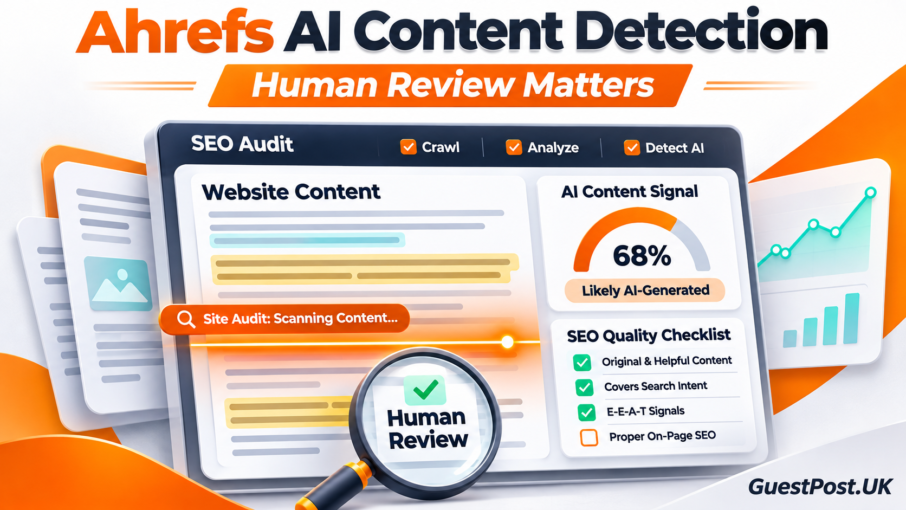
That is why Ahrefs’ AI-content indicators should be treated as an audit signal, not a pass-or-fail judgement.
Ahrefs Site Audit can help agencies review AI-content levels across a site and inspect pages that may need closer attention. This can be useful when a website has published a large volume of content quickly, inherited an older content library or wants to compare the consistency of its content programme against competitors.
But no AI detector can reliably tell you whether a page deserves to rank, earns trust or genuinely helps its reader. A page may show signs of AI assistance and still be excellent. Another page may be entirely human-written but generic, inaccurate, repetitive or commercially weak.
The correct use of the feature is to identify where human review should start.
What does Ahrefs AI content detection show?
Ahrefs uses AI-content indicators within Site Audit to help users understand the level of AI-like text present across a crawled website. This lets teams see the wider pattern rather than checking pages individually with separate tools.
For an agency, this can be helpful in several situations:
- A client has published hundreds of new pages in a short period.
- A content team has used multiple writers, freelancers or AI tools.
- A website has old articles that may now feel thin or repetitive.
- You are reviewing a competitor’s content approach.
- You need to prioritise pages for editorial quality checks.
- You want to identify sections of a site that need more expert input.
The key word is prioritise. The indicator can help you decide where to look first. It should not be used to make automatic decisions about removing pages, rejecting a writer or labelling content as low quality.
Why an AI score is not a quality score
AI-content detection and content quality are different things.
A detection score may react to predictable language patterns, repetitive sentence structure, common phrases or highly polished but generic wording. Those patterns can appear in AI-assisted writing, but they can also appear in templated human writing, product descriptions, legal copy or large editorial teams following the same brief.
A good SEO audit should ask broader questions:
- Does the page match the searcher’s likely intent?
- Are the facts accurate and current?
- Does it include real expertise, first-hand experience or useful examples?
- Is there a clear reason for someone to choose this page over competing results?
- Does the page support a meaningful business goal?
- Is the content well linked to other relevant pages on the site?
- Is the article written for people, or mainly produced to fill a keyword gap?
A page with low AI signals can still fail every one of these tests. Equally, a page that began with an AI-assisted outline may perform well if a knowledgeable person adds original insight, validates the details and shapes it for the intended audience.
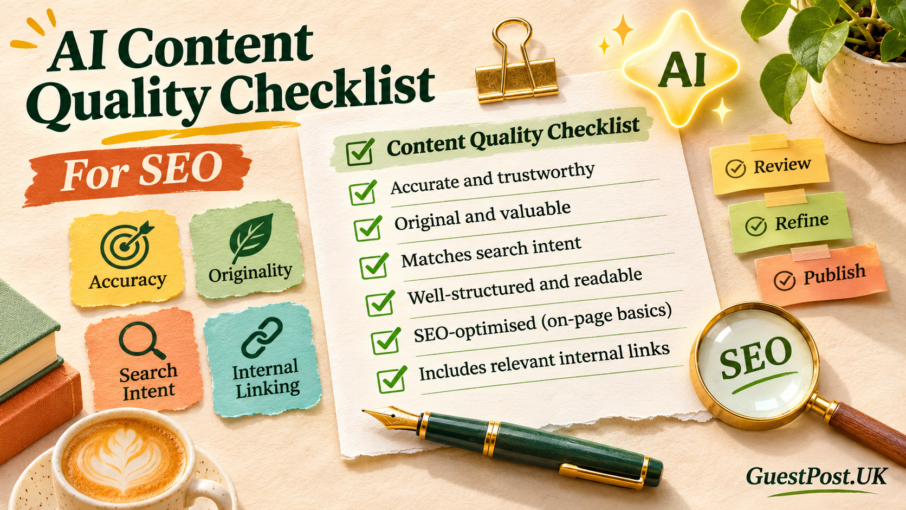
For a broader review framework, use our AI Content Quality Checklist for SEO. It focuses on the things that matter after a draft exists: usefulness, accuracy, originality, intent and commercial purpose.
When should an agency use the data?
The strongest use case is a large-site audit where manually reviewing every article is unrealistic.
Imagine a SaaS business with 800 blog posts, product guides and comparison pages. The agency may see that one section of the site has a far higher concentration of AI-like writing than the rest. That does not prove the pages are bad. It simply gives the agency a useful question to investigate:
Was this content created too quickly, without enough editorial review or unique expertise?
The next step is to sample the affected pages. Read them as a visitor would. Check whether they repeat similar points, make unsupported claims, answer the wrong question or lack the product knowledge that a buyer needs.
This is much more valuable than reacting to a percentage alone.
Use AI detection alongside real SEO signals
An AI-content indicator becomes more useful when combined with actual page performance.
Review whether the affected pages are:
- Receiving impressions but very few clicks.
- Ranking poorly for their target topics.
- Losing traffic after an update or content refresh.
- Competing against one another for similar keywords.
- Earning little engagement or generating no meaningful conversions.
- Missing internal links from stronger related pages.
- Thin compared with the topic’s real level of complexity.
Google Search Console can reveal the search queries and landing pages involved, while Ahrefs can provide a broader view of rankings, backlinks, and competitor content. Google Analytics can then show whether visitors actually engage, enquire, or convert.
A practical AI-content review workflow for agencies
A sensible agency workflow uses AI-content indicators to create a review queue, then applies editorial and SEO judgement to the pages that matter most.
Start with pages that have the greatest potential business impact:
- Core service pages
- Product and category pages
- Comparison pages
- High-traffic blog posts
- Articles ranking just outside the first page
- Pages with high impressions but weak click-through rates
- Content that supports lead generation or revenue
Spending hours reviewing low-priority archive pages has little value when an important commercial landing page remains weak, unclear, or out of date.
A practical review process can look like this.
1. Identify patterns, not isolated pages
Look for sections of the website where AI-content indicators are consistently high. This may reveal a batch of articles created from one template, a topic cluster written too quickly or a content source that needs stronger editing.
Do not assume that every page needs rewriting. First, compare the pages with their performance data and business importance.
If a page is helpful, accurate, ranking well and converting, it may only need a light editorial review. If it is generic, underperforming and weakly connected to the rest of the site, it may need a deeper refresh.
2. Read the page for usefulness
An editor should be able to answer one question after reading the page:
Would this genuinely help the intended visitor make a better decision or complete a useful task?
Review whether the article:
- Gives a direct answer early rather than delaying the useful information.
- Includes examples, explanations or steps that are specific to the topic.
- Avoids repeating the same point in different wording.
- Uses headings that guide the reader through a logical journey.
- Explains limitations, trade-offs or situations where advice may not apply.
- Includes a natural next step, internal link or relevant service where appropriate.
Generic writing often sounds polished but adds very little. It uses broad statements, predictable headings and safe recommendations that could apply to almost any business. That is the type of content worth improving, regardless of whether it was produced by a person or an AI tool.
Add the expertise a generic draft cannot provide
The best way to improve AI-assisted content isn’t to rewrite every sentence. It is to add the knowledge that a general-purpose draft cannot naturally create.
For SEO and guest-posting content, this might include:
- A real campaign scenario and what was learned from it.
- Practical criteria used to review a publisher opportunity.
- A clear explanation of when a strategy is not suitable.
- Common mistakes seen in outreach or content planning.
- A framework that helps a reader compare options.
- Relevant examples of what a good page, pitch or placement should include.
- Updated details that show a specialist has reviewed the article.
This is where agencies can create a genuine advantage. Rather than publishing more generic pages, help clients develop fewer, stronger resources that demonstrate experience and give users a reason to trust the site.
Do not use AI detection as a removal list
A high AI-content indicator should not automatically lead to a page being removed, noindexed or rewritten from scratch.
That approach can create more harm than good. A page may have valuable rankings, backlinks, internal-link equity and useful information even if its language feels formulaic. Removing it without review can create unnecessary traffic losses and broken user journeys.
Instead, classify pages into simple actions:
| Review outcome | Recommended action |
|---|---|
| Useful, accurate and performing well | Keep it; make only small editorial or freshness improvements. |
| Useful but generic or outdated | Refresh it with stronger examples, clearer structure and current information. |
| Relevant but thin | Expand it into a more complete answer or connect it to a supporting content cluster. |
| Overlapping with another page | Consider merging, redirecting or clearly separating the search intent. |
| Low value, inaccurate and unsupported | Replace it with a substantially better page or remove it only after checking traffic and links. |
This approach protects useful assets while improving genuinely weak pages.
Use internal links to strengthen revised content
When refreshing an article, make internal links part of the work rather than an afterthought.
A useful guide may link to a related tool, service, comparison article or supporting resource. This helps visitors continue their journey and shows search engines how the site’s topics are connected.
For example, an article about AI-assisted content quality can link naturally to. The links should add value for the reader. Avoid forcing a link into every paragraph or using identical anchor text repeatedly.
What should agencies report to clients?
A useful AI-content audit report should not focus only on a percentage or a tool score. It should explain the quality and business risk behind the findings.
A clear client report can include:
- The number of pages reviewed and the site sections prioritised.
- Pages that need a factual or freshness review.
- Pages that appear repetitive, thin or poorly matched to search intent.
- Existing high-value pages that should be preserved and improved carefully.
- Content clusters with overlap or keyword cannibalisation risk.
- Priority improvements for commercial pages and high-impression articles.
- Recommended internal links, new supporting content and editorial owners.
This gives the client something practical to act on. It also keeps the conversation focused on content performance and quality rather than anxiety around whether AI was used.
Use the tool as a starting point, not a verdict
Ahrefs AI-content detection can make large content audits more manageable. It helps agencies spot patterns, organise review work and compare sections of a website that may need attention. Its value comes from what happens next: human review, subject knowledge, performance data and better editorial decisions.
The goal is not to make a page look less like it was assisted by AI. The goal is to make the page more useful, more accurate, more distinctive, and better able to help the right visitor.