
Running one advertising campaign isn’t particularly complicated. Running campaigns across Google, Facebook, Instagram, TikTok, LinkedIn, and other channels while creating enough fresh advertising material, monitoring budgets, testing audiences, and reporting results is a different matter entirely.
That fragmentation is what Plai is trying to remove.
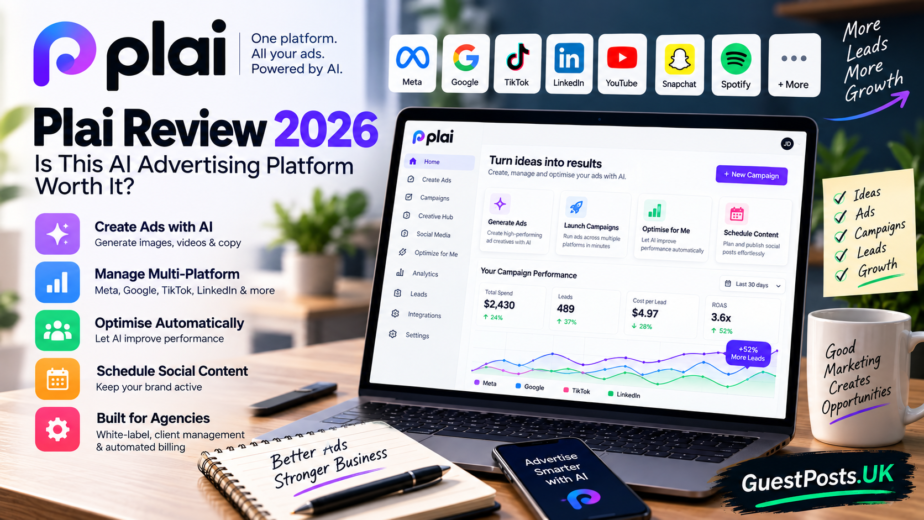
Plai positions itself as an AI advertising and marketing platform from which businesses can create campaigns, generate images and videos, publish social content, monitor advertising performance and automatically optimise campaigns across multiple networks. The company says more than 25,000 businesses have used the platform and more than 200,000 campaigns have been launched through it. Those are Plai’s own published figures, but they demonstrate that this is no longer an experimental AI advertising application.
The breadth of the platform is immediately attractive. A small company that previously had to manage Meta Ads Manager, Google Ads, creative software, and a social scheduler can theoretically perform much of that work from a single interface.
For an agency, Plai goes considerably further. White-labelling, multiple client workspaces, automated billing, and custom domains allow agencies to effectively overlay their own branding on the advertising platform.
There is a trade-off, though. Advertising platforms are complicated partly because digital advertising is. Simplifying the interface doesn’t eliminate bidding strategy, conversion tracking, audience quality, creative fatigue or poor offers.
So, is Plai genuinely making paid advertising more efficient, or is it merely hiding the difficult parts behind AI?
What does Plai actually replace?
This is the first question I’d ask before considering a subscription.
Plai is not simply an AI ad-copy generator. Its current feature set spans advertising creation, creative production, social publishing, campaign optimisation, keyword research, landing pages, and agency management. Supported advertising channels include Meta, Google, TikTok, LinkedIn, YouTube, Snapchat, Spotify, and Bing, while advertising on Amazon, X, and Pinterest is listed as a forthcoming integration.
That means the potential stack reduction is substantial.
A business might currently use Meta Ads Manager for Facebook and Instagram, Google Ads for Search and YouTube, another platform for TikTok, an AI image generator for creatives and a scheduling tool for organic social posts. Plai attempts to place many of those activities within a single environment.
It doesn’t actually replace the underlying advertising networks. Your Meta campaign is still a Meta campaign, and your Google Search campaign is still being served by Google. Plai acts as a management and automation layer above them.
That distinction matters when considering both cost and control.
Plai’s biggest selling point is campaign creation
Paid advertising software often assumes the person using it already understands advertising terminology.
Plai tries not to.
Its Easy Mode, for example, reduces Meta campaign creation to three broad stages: describe what you’re promoting, upload or generate the creative, and choose the budget. Users can select objectives such as leads, messages, calls or website traffic, while more experienced advertisers can switch back to fuller targeting and placement controls when necessary.
For a local business owner, that is considerably less intimidating than opening Meta Ads Manager for the first time.
Plai’s wider Meta integration supports Facebook, Instagram, Messenger and WhatsApp campaigns, including image/video ads, carousel campaigns, catalogue advertising and lead-generation formats. The platform can generate visuals, copy, targeting suggestions and lead forms without requiring the advertiser to build each component independently.
Google support is also broad. Plai currently lists Search, Display, Performance Max, Demand Gen, call ads, Local Services, Shopping and YouTube among the campaign types it can help manage.
This makes Plai particularly appealing to marketers who know what they want to achieve but don’t necessarily know how every advertising interface achieves it.
AI creative generation has become a much bigger part of Plai
The platform’s creative capabilities are no longer limited to generating a few headlines.
Plai’s Creative Hub can generate advertising images, video content, voiceovers, AI-UGC-style avatar videos, memes, and reusable templates. Its Brand Context feature is intended to learn information such as brand voice, visual identity and targeting so that subsequent material remains more consistent.
That potentially solves a genuine advertising problem: creative volume.
Even a successful campaign can deteriorate when audiences repeatedly see the same advertisement. Producing ten new variations manually every week becomes expensive, particularly for small businesses and agencies managing multiple clients.
AI makes experimentation much cheaper.
The danger is assuming that more creatives automatically means better creatives. A technically polished AI image paired with generic copy can still perform terribly. Likewise, producing 50 variations of a weak proposition doesn’t fix the underlying offer.
This is where the same principle we apply to SEO content services also applies to advertising: automation can accelerate production, but strategy still determines what is worth producing.
“Optimise for Me” is arguably more important than the creative generator
Creating an advertisement is only the beginning. Most of the money is won or lost after the campaign starts running.
Plai’s Optimise for Me feature analyses Meta and Google campaign performance daily and can create new creatives, remove underperforming audiences, placements, keywords, and locations, and then focus spend on combinations that produce stronger results. At a broader level, its optimisation folders can redistribute budgets towards better-performing campaigns across channels.
This is potentially much more valuable than AI-generated ad copy.
Imagine a business has five campaigns across Google and Meta. Two consistently generate leads at £18, another produces leads at £40, and two barely convert. An automated system that identifies the difference and reallocates budget can have a direct financial impact.
I’d still be cautious about completely unattended optimisation, particularly with large budgets.
Algorithms optimise towards the conversion signals they’re given. If conversion tracking is poorly configured, automation can become extraordinarily efficient at optimising towards the wrong outcome.
Before relying heavily on automated paid acquisition, businesses should ensure their landing pages and measurement are sound. Our SEO audit service approaches organic performance from a different channel, but the underlying principle is identical: reliable decisions require reliable data.
Plai also handles organic social publishing
This feature makes Plai more interesting as a general marketing platform.
Users can generate and schedule organic social content across networks, including Instagram, Facebook, and LinkedIn, from the same dashboard used for paid campaigns.
For a one-person business, that consolidation is useful. Instead of switching between an ad manager, AI writer, design application and social scheduler, campaigns and posts can share the same brand context and creative assets.
Larger marketing teams may prefer specialist tools for each discipline. Smaller businesses often value convenience more than having the most advanced possible scheduler.
Plai clearly targets the latter use case as well as agencies.
Keyword research is useful, but it isn’t a Semrush replacement
Plai includes a keyword research tool for Google Search campaigns, including search volume and targeting ideas.
That makes sense inside an advertising workflow. If you’re creating a Google Search campaign, leaving Plai simply to obtain keyword ideas would undermine the point of the unified interface.
I wouldn’t, however, choose Plai primarily for keyword research.
A specialist SEO platform provides considerably deeper organic competitor analysis, backlink intelligence and keyword research. Our existing Semrush guide covers the research environment required when SEO, rather than advertising, is the primary objective.
Plai’s keyword functionality should therefore be viewed as campaign support, not as a replacement for an entire SEO intelligence platform.
Agencies may actually have the strongest reason to use Plai
This is where the product becomes more commercially interesting.
Plai supports separate brand/client workspaces, white-labelled interfaces, custom domains, reusable templates and GoHighLevel integration. Agencies can effectively provide clients with access to an advertising platform carrying the agency’s own branding.
Then there is billing.
Through Plai’s SaaS Configurator, agencies can connect Stripe and create their own subscription plans. Alternatively, they can charge clients a percentage of advertising spend. Plai can calculate the management fee as it is incurred, deduct it from a prepaid client balance, and automatically recharge that balance.
That transforms Plai from an advertising tool into something closer to agency infrastructure.
An SEO or digital marketing agency could theoretically sell an advertising service under its own brand without building a proprietary ad-management platform. That is considerably more interesting than simply saving ten minutes while creating a Facebook advert.
It’s also why agencies considering white-label SEO services or other outsourced fulfilment models may find Plai’s approach familiar: the commercial value comes from scaling delivery without having to build every part of the infrastructure internally.
How much does Plai cost?
Plai’s current public pricing page lists three principal monthly subscriptions plus custom services.
| Plan | Monthly price | Workspaces | Main use |
|---|---|---|---|
| Brand | $97 | 1 | Individual businesses |
| Agency | $297 | Up to 8 | Agencies/multiple brands |
| Pro | $497 | Unlimited | Scaling agencies |
| Done For You | From $3,000 | Custom | Managed growth service |
| Custom | From $3,000 | Custom | Enterprise/custom workflows |
The Brand tier includes unlimited campaign creation, management of existing campaigns, cross-platform analytics, social scheduling, the Creative Hub and lead management. Agency adds features including multiple workspaces, AI optimisation rules, budget optimisation, white-labelling and AI video creative. Pro adds unlimited workspaces, automated client billing, advanced white-label customisation and a dedicated account manager.
Plai also currently shows annual options, including a $0 Free plan, Brand Builder at $790 per year, and an Agency white-label package at $2,490 per year. The Free tier allows two monthly ad campaigns across more than 11 platforms, alongside limited creative generation and optimisation.
There is a pricing discrepancy worth knowing about
During our research, Plai’s help centre showed a different plan table from the main pricing page, including a $147/month Starter tier rather than the $97 Brand tier currently displayed publicly. The help article also describes somewhat different workspace allowances.
Because the main pricing page appears to represent the current customer-facing offer, we’ve used that pricing above.
Nevertheless, check the checkout price and the included features before paying, particularly if you arrive via an advert or a promotional landing page.
That is preferable to presenting conflicting documentation as though it doesn’t exist.
The subscription does not include your advertising budget
This deserves its own explanation because newcomers can easily misunderstand SaaS advertising pricing.
If you pay Plai $97 per month, that does not mean you have $97 of Facebook or Google advertising included.
Plai charges for its software.
Your advertising spend is billed separately by the advertising network using the payment method linked to your Meta, Google, TikTok, or other ad account.
The public pricing page currently states that $20,000 per month of Plai-managed ad spend is included within the subscription pricing, after which a 2.5% fee applies. That refers to the amount of advertising spend the platform manages before an additional Plai fee applies; it does not mean Plai gives you $20,000 to spend on ads.
For businesses new to paid advertising, that distinction is essential.
What do actual Plai users say?
Independent feedback is mixed rather than uniformly positive.
At the time of our research, Plai has a 3.7/5 TrustScore from 14 Trustpilot reviews. Eight of those reviews were submitted within the previous 12 months, so there is at least some relatively recent feedback.
Positive reviewers praise automated A/B testing, campaign optimisation and the white-label platform. One January 2026 reviewer who said they had previous Facebook advertising experience reported strong client results and particularly liked Plai’s automated targeting and optimisation.
Negative feedback tells a different story. Complaints include difficulty using the interface, Google Ads integration issues, dissatisfaction with AI-generated advertising and concerns around trial billing. A reviewer in August 2026 reported finding the software difficult to use and being charged after signing up for a trial.
These comments need context. Fourteen reviews remain a small sample size, and individual advertising results are influenced by budgets, offers, industries, landing pages, tracking, and campaign setup. A five-star review reporting exceptional ROI doesn’t prove Plai will reproduce it for another company, just as a failed campaign doesn’t necessarily prove the software caused the failure.
The billing criticism is more straightforward to evaluate. Plai’s help documentation says its seven-day trial automatically converts to the selected paid subscription and charges the payment method supplied at signup. It also states that campaigns cannot actually be published during the trial.
Users should therefore understand the trial terms before entering payment information.
Plai vs running ads directly through Meta and Google
This is perhaps the most useful comparison.
Going directly through Google Ads or Meta Ads Manager gives you maximum native control and doesn’t require an additional Plai subscription. Experienced PPC professionals may prefer that because they already understand campaign structures, conversion events, bidding, exclusions, audiences and reporting.
Plai’s value proposition is abstraction.
| Area | Plai | Native ad platforms |
|---|---|---|
| Multi-platform management | One interface | Separate interfaces |
| AI creative generation | Built in | Varies by network |
| Organic social scheduling | Included | Fragmented |
| Beginner campaign setup | Simplified | More complex |
| Advanced native control | Good but abstracted | Maximum |
| Cross-platform optimisation | Core benefit | Manual/separate |
| White-label agency platform | Yes | No |
| Additional software fee | Yes | No |
A skilled PPC specialist who spends all day in Google and Meta may not need Plai.
A small agency handling several channels for eight clients might view the same $297 subscription completely differently.
Could Plai replace a marketing agency?
Not really.
It can replace parts of the production and campaign management workload that an agency traditionally handles.
That’s not the same thing.
Plai can generate a landing page, but it doesn’t inherently know whether the company’s proposition is commercially compelling. It can generate 20 advertising creatives, but it doesn’t have a firsthand understanding of why customers buy the product. It can shift budget towards a campaign producing more conversions, but it relies on the conversion data supplied to it.
The same distinction exists with modern AI SEO tools. Tools can automate analysis and production. Commercial strategy remains considerably harder to automate.
Businesses that understand their market may therefore get much more from Plai than businesses hoping AI will discover the entire marketing strategy for them.
The strongest and weakest parts of Plai
The strongest aspect is consolidation. Creating ads, generating creatives, scheduling social content, analysing performance, and managing multiple networks from a single environment genuinely reduce operational friction. For agencies, white-labelling and automated billing make the platform substantially more valuable.
The automation also appears deeper than simply placing a chatbot inside a dashboard. Budget allocation, creative testing, and campaign optimisation are areas where AI can potentially save significant amounts of repetitive work.
The weakest aspect is that simplicity can create false confidence. Advertising becomes easier to launch, but not necessarily easier to make profitable. Users still need correct conversion tracking, a viable offer, appropriate budgets and enough patience to collect meaningful data.
The mixed independent reviews also prevent us from treating Plai’s ease-of-use claims as universally established. Some customers clearly find the platform valuable; others report precisely the complexity that Plai promises to remove.
Who should use Plai?
Plai makes the strongest case for small marketing agencies, local businesses, freelancers and marketers managing several advertising channels without a large specialist PPC team.
A local company that wants Facebook lead ads, Google Search campaigns, and regular social posts but doesn’t want three separate workflows is almost exactly the customer Plai appears to be designed for.
Agencies have an even stronger potential use case. Multi-brand workspaces, reusable templates, white-labelling, and automated billing could reduce both campaign management time and administrative overhead.
By contrast, an experienced enterprise PPC team already operating sophisticated native campaigns may find Plai’s abstraction less valuable. Such teams often want granular platform-specific control rather than a simpler common interface.
Is Plai worth it in 2026?
I’d test Plai based on time saved and advertising performance, not on how impressive the AI-generated creative looks.
Take an existing campaign whose performance you already understand. Recreate or import it into Plai, then measure how much faster the workflow becomes. Examine the targeting, generated creatives and optimisation decisions rather than automatically accepting them.
If Plai saves several hours per week while maintaining or improving cost per lead, $97 per month is easy to justify for a business. For an agency managing several advertising clients, $297 can become inexpensive if the white-label and automation features remove substantial fulfilment work.
If you’re already highly proficient with native ad platforms and don’t need multi-channel management, the additional software layer may offer much less value.
GuestPost.UK rating: 4.1/5
Plai is broader and more mature than the phrase “AI ad generator” suggests. Multi-platform campaign creation, automatic optimisation, creative production, social scheduling and unusually strong agency functionality give it a legitimate reason to exist alongside Google and Meta’s own advertising interfaces.
It isn’t an automatic route to profitable advertising, and its mixed public reviews plus the current discrepancy between its pricing and help documentation are reasons to test carefully before committing.
For beginners and agencies, though, Plai solves a genuine problem: digital advertising has become spread across too many platforms, interfaces and repetitive workflows.
Making all of that easier to manage may ultimately be more useful than any individual AI feature.