
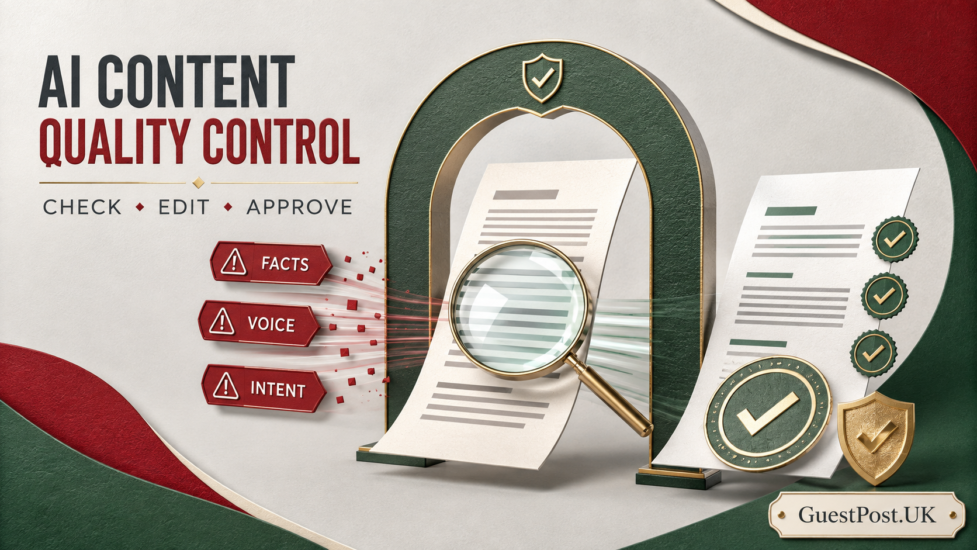
An AI draft can look finished long before it is safe to publish.
It may have tidy headings, sensible-looking references and a confident tone. Yet a closer read can uncover an outdated statistic, a made-up product feature, a generic paragraph that could describe any business, or a call to action pointing towards the wrong service.
For an agency, that is not a minor editing issue. It is a client-risk issue.
The useful question is not, “Was this written with AI?” The useful question is, “Would we publish this if a knowledgeable client, customer and competitor all read it carefully?”
Google’s position is clear: using generative AI to help create content is not inherently a problem, but publishing many pages without adding value can breach its scaled-content abuse policy. The standard remains helpful, reliable, people-first content. Google’s guidance on generative AI content is worth sharing with every writer and account manager involved in AI-assisted work.
A good quality-control process turns AI from an uncontrolled production shortcut into a supervised research and drafting assistant.
Treat the first draft as source material, not deliverable copy
The fastest way to lower standards is to label an AI draft “finished” because it is grammatically clean.
A better agency workflow gives the first draft a different status: source material awaiting verification and editorial judgement. This small change affects how everyone handles it. Writers are less tempted to defend weak passages; editors are more willing to cut whole sections; clients are not asked to approve claims nobody has checked.
Before anyone edits wording, ask four questions:
- Is this page worth publishing for the client’s audience?
- Does it answer the query more clearly or more usefully than the existing results?
- Does it contain information the client can genuinely stand behind?
- Does it have a role in the site’s wider commercial and internal-link structure?
If the answer to any of these is no, do not polish the draft. Rework the angle first.
The red-flag scan: find what can embarrass the client
Run a quick review before investing time in line editing. This is where you identify problems that should stop publication.
Look for:
- Exact figures with no source or date
- Statements such as “the best”, “leading”, “guaranteed” or “proven” that the client cannot substantiate
- Product functions, prices, regulations or policies that may have changed
- Named tools, competitors or locations mentioned without a clear reason
- Advice that could create legal, medical, financial or safety risk
- Oddly specific examples that do not appear to come from the client
- Generic case studies, testimonials or quotes that nobody can verify
- Repeated paragraphs saying the same thing with slightly different language
AI often produces plausible detail. Plausible is not the same as true.
For high-risk subjects, verification should be completed by someone qualified to assess the claim. An editor can check whether a sentence has a source; they cannot safely decide whether legal guidance or a clinical recommendation is accurate.
Build a claim ledger for commercially important pages
Not every blog post needs a formal spreadsheet. Every high-value page should have one.
A claim ledger is a simple table that lists the statements most likely to influence a reader’s decision. This includes pricing, performance claims, dates, accreditations, results, regulations, product capabilities and comparisons.
| Claim in the draft | Source supplied? | Checked by | Keep, change or remove? |
|---|---|---|---|
| “Setup takes less than one day” | Client onboarding data | Account manager | Change to a qualified statement |
| “Used by 500 UK businesses” | Current CRM export | Client contact | Keep with date |
| “Complies with new regulations” | No reliable source | Subject-matter expert | Remove until verified |
| “Cuts costs by 40%” | Old case study | Client contact | Add context or remove |
This process is particularly valuable for landing pages, software reviews and comparison content. A weak claim in an informational article can harm trust; a weak claim on a lead-generation page can create a sales problem as well.
Check whether the article has a real point of view
AI is good at creating a balanced-sounding overview. It is less good at deciding what the reader genuinely needs to know.
Read the opening and each main section with the client’s name hidden. Could the same article be published by five competitors without changing much? If yes, it has not yet earned its place on the site.
Add something only this client can provide:
- A practical process the team uses
- A screenshot, example or template
- A mistake customers often make before approaching them
- A clear explanation of what the service does not include
- First-hand testing observations
- A short expert comment from an actual team member
- A relevant data point from the business
- A comparison based on real workflow experience
This is not decoration. It gives the page substance.
For example, a generic article about link building might explain that quality matters more than volume. A stronger version could show how a proper guest posting service evaluates relevance, editorial standards and link placement before recommending a publisher.
Test the search intent before optimising anything
An AI model can produce an excellent guide for the wrong type of query.
Search the primary term manually and inspect the results. Are people being served product pages, local services, tutorials, listicles, definitions or comparison pages? Does the page need a direct answer at the top? Is the searcher trying to learn, compare or buy?
Then test the article against that intent.
A page targeting “how to choose an SEO agency” should help someone make a decision. It needs criteria, warning signs and realistic questions to ask. It should not take 800 words to define SEO.
A page targeting “SEO audit service” should make the deliverable, process and likely outcomes clear. It should naturally guide appropriate readers towards an SEO audit, rather than burying the commercial action beneath generic explanations.
This is where AI-assisted articles often become overlong. They attempt to cover every related idea because the model is trying to be comprehensive. Good editing is often the act of removing information that belongs on another page.
Replace empty authority with evidence
Watch for sentences that sound authoritative but give the reader nothing to assess.
Examples include:
“A strong strategy can transform your online presence.”
“Businesses should use the latest technology to stay ahead.”
“Quality content is essential for long-term success.”
These statements are not necessarily false. They are simply too vague to help anybody.
Replace them with a reason, an example, a condition or an action.
Instead of saying that content quality matters, explain what the writer should check:
- Does the page answer the main question in the first section?
- Does it use terms a genuine customer would recognise?
- Does it distinguish advice from evidence?
- Does it provide steps that fit the client’s actual service or product?
- Does it help a reader decide what to do next?
A page does not need to sound academic. It does need to be specific.
Edit for the client’s voice, not the model’s voice
AI drafts often reveal themselves through rhythm rather than obvious errors. The writing may be relentlessly balanced, overly polished or full of phrases such as “in today’s fast-paced landscape”, “it is important to note” and “by leveraging”.
Those phrases are not the only issue. The bigger problem is sameness.
During the edit, vary the pace. Use a short sentence after a technical explanation. Let a paragraph make one point rather than four. Replace abstract nouns with the thing a customer sees, does, pays for or worries about.
Ask the client for a small voice guide if one does not already exist:
- Words they naturally use
- Terms they never use
- The level of technical detail their audience expects
- Whether they are direct, formal, conversational or specialist
- Phrases that must be used carefully because of legal or brand restrictions
For UK clients, also ensure the article is written in proper British English. That means more than changing “optimize” to “optimise”. Check terminology, spelling, dates, measurements, examples and local expectations throughout.
Do an SEO pass only after the human pass
SEO should strengthen a useful page, not rescue an empty one.
Once the article is fact-checked and genuinely client-specific, review:
Title, main heading and opening answer
The title should accurately promise what the page delivers. The H1 and opening should make the subject immediately clear without repeating the exact key phrase in every sentence.
Heading order
Headings should guide a reader through decisions or steps. Avoid headings created only to accommodate keyword variations.
Internal links
Add links where they help the reader continue their task. A guide on making content more useful for answer engines could link naturally to answer engine optimisation. A broader content strategy article may point to SEO services.
Do not insert six internal links simply because there is space. One useful, relevant link is better than several forced ones.
Images and supporting assets
Check that images reflect the content, have helpful alt text where appropriate and do not make claims the article cannot support. Avoid decorative stock imagery where a diagram, screenshot or original example would clarify the point better.
Technical publishing checks
Confirm the final page has the correct URL, meta title, meta description, category, featured image and indexation settings. Check the mobile preview and ensure the main content is easy to find.
Google’s guidance on page experience reinforces this broader view: strong information still needs to be easy to access and use.
Give every article an accountable owner
AI makes it possible to publish more content. It does not remove responsibility for it.
For each client article, record:
- Who drafted it
- Who completed the factual review
- Who approved client-specific claims
- Who performed the final SEO and publishing checks
- When the page should be reviewed again
This is especially important for reviews, pricing pages, compliance topics, and rapidly changing software. A page can be accurate on publication day and misleading six months later.
For agencies offering AI-search work, this process should sit alongside regular visibility monitoring. A page that earns citations in ChatGPT or appears in AI-driven results still needs correct information, clear sourcing and a good destination experience. Our GEO services focus on that wider picture rather than treating AI visibility as a quick content-volume exercise.
A release rule your team can actually use
Before publishing AI-assisted content on a client website, require a clear answer to this sentence:
“We would be comfortable explaining every important claim in this article directly to the client and their customer.”
If the answer is yes, publish with confidence.
If the answer is “probably”, “the AI said it” or “it sounds right”, the article is not ready. Send it back through the relevant stage: fact-checking, strategy, client input, editing or SEO review.
That discipline does not slow a good agency down. It prevents rushed publishing from becoming expensive rework, lost trust and a library of pages nobody is proud to defend.