

A weak content brief creates expensive problems later.
The writer misunderstands the audience. The article misses the commercial angle. Important questions are left out. The editor spends an hour explaining what should have been clear from the beginning. Then the client receives a draft that technically includes keywords but does not do the job.
Content Harmony is built around preventing that situation.
Its workflow is not centred on producing text as quickly as possible. It is centred on researching what a page needs to cover, turning that research into a usable brief and checking whether the final draft follows the agreed direction.
That makes it a particularly good fit for SEO agencies, content strategists and in-house teams managing several writers. It is less useful for people who only want a quick content score while writing.
The Content Harmony approach
Content Harmony organises its process around a single “Content Workflow”. Each workflow contains three connected pieces:
- A Keyword Report
- A Content Brief
- A Content Grader
The Keyword Report collects the research. The brief turns selected data into instructions for a writer. The grader provides a final check before publication.
This is a more strategist-led approach than tools that begin with a writing editor. It assumes that good content is planned before it is written.
That distinction matters. A score can tell a writer that a phrase is missing. It cannot, by itself, explain what the audience needs, which sources deserve trust, what makes the client credible or how the article should support a wider commercial journey.
What the Keyword Report gives you
The report is the research layer. It brings together the elements that usually require several browser tabs and a lot of copying into a Google Doc.
Content Harmony looks at areas such as:
- Search intent
- Ranking-page patterns
- Competitor headings
- Related phrases and topics
- Questions people ask
- Image and video use in results
- Entities and important subtopics
- Potential authoritative sources
This is especially helpful for teams producing content in unfamiliar industries. A strategist can quickly see whether the SERP is dominated by product pages, detailed guides, comparison articles, videos or local results.
For example, a search for “best standing desk” has a different intent and expected format than a search for “how to set up a standing desk”. One likely needs commercial comparison content; the other needs practical guidance. Content Harmony helps make that distinction visible before a writer starts drafting.
The report should guide your decisions, not dictate them. If every top-ranking article uses the same headings, do not copy the outline word-for-word. Use the findings to identify what must be covered, then add better expertise, examples, proof and structure.
The brief editor is the strongest feature
Content Harmony’s brief builder is the reason many agencies choose the platform.
It uses a customisable block editor. Strategists can add notes, headings, checklists, tables, comments, writer instructions and selected research findings. Data highlighted in the Keyword Report can be added directly to the brief, eliminating the repetitive copy-and-paste process that often slows content operations.
A useful brief can include:
- Page goal and conversion objective
- Target reader
- Search intent
- Suggested title and angle
- Recommended heading structure
- Required questions to answer
- Original examples or proof needed
- Internal linking instructions
- Appropriate external sources
- Tone and style notes
- Things to avoid
- CTA direction
This lets an agency tailor the same research workflow to different clients. A legal-service article, a local-business guide and a SaaS comparison page should not all receive the same generic template.
That flexibility is important. Good briefs provide direction without making every article sound identical.
For an internal alternative, GuestPost.UK’s SEO content brief generator can help organise requirements. Content Harmony adds deeper research and workflow management for teams producing content at scale.
Content Grader: useful, but not the finish line
The Content Grader checks how closely a draft matches the topics, phrases and coverage identified in the workflow.
This can catch genuine omissions. Perhaps a writer has not answered a common question, covered an important entity or addressed a key product consideration. It can also help editors compare the draft with the original brief.
The danger is treating a high score as proof that content is ready.
A page can score well and still be bland, inaccurate or commercially weak. It may repeat competitor points without offering anything new. It may use relevant language but fail to answer the reader’s real question clearly.
Use grading as a quality-control prompt:
- What important topic is missing?
- Is the omission genuinely relevant?
- Has the article explained it clearly?
- Does the claim need an authoritative source?
- Is the content better than the current results, or merely similar?
That preserves the useful part of optimisation without turning the writing process into a keyword-density exercise.
Content Harmony pricing
Content Harmony prices its service by the number of Content Workflows a team needs each month. All plans include unlimited users and unlimited projects, which is a strong advantage for agencies with several writers, editors and client stakeholders.
Current published pricing includes:
| Monthly workflows | Monthly price | Approximate cost per workflow |
|---|---|---|
| 5 | $50 | $10 |
| 12 | $99 | About $8 |
| 25 | $199 | About $8 |
| 50 | $299 | About $6 |
| 100 | $599 | About $6 |
| 150 | $799 | About $5 |
Enterprise plans start at $1,000 per month for teams that produce more than 200 workflows.
A $10 trial provides ten Content Workflow credits with no automatic subscription afterwards. This is a useful way to test it on real briefs rather than a demo topic.
The value calculation is not difficult. If a strategist spends 2 hours manually building a brief, the platform may pay for itself quickly. If the team already has a disciplined briefing process and only publishes a few pages each quarter, it may not be necessary.
Where Content Harmony fits best
Content Harmony is strongest for teams that already take content quality seriously.
It works well for:
- SEO agencies managing several writers or clients
- Editorial teams producing regular content calendars
- Content managers trying to reduce rewrites
- In-house teams expanding into new topic areas
- Sites that need stronger consistency between research, briefs and drafts
- Strategists who want to hand writers more useful instructions
It is especially helpful when content production involves several people. A shareable, evidence-led brief reduces the likelihood that the strategist, writer, editor, and client each hold different assumptions about the same article.
Where it can fall short
Content Harmony may feel unnecessary if you mainly need a live writing editor and occasional optimisation suggestions. It is also not a complete SEO suite.
You will still need other sources for:
- Backlink analysis
- Full keyword discovery
- Rank tracking
- Technical crawling
- Search Console performance analysis
- Digital PR and outreach research
The platform can also encourage imitation if it is used lazily. If a strategist treats the SERP report as a template to copy, the finished article may look very similar to every competing page.
The solution is simple: add information competitors cannot provide. That might be original experience, customer examples, expert quotes, product testing, regional knowledge, first-party data or a genuinely clearer explanation.
Content Harmony alternatives
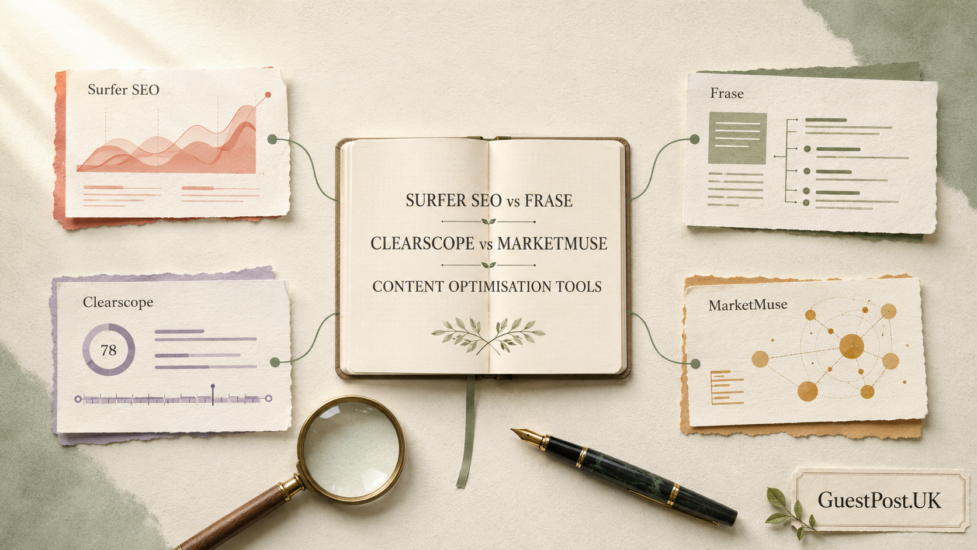
Surfer SEO is a stronger choice for teams that want a content editor at the centre of the process. It is well suited to writers optimising drafts in real time.
Clearscope is a good option for content teams that want a clean grading experience and editorial-friendly interface.
Frase is more affordable for teams seeking basic research, outlines, and optimisation without a heavy content operations workflow.
Keyword Insights is more specialised in large-scale SERP-based keyword clustering and content planning. It works well before Content Harmony, when an agency needs to decide which pages should exist in the first place.
Ahrefs and Semrush remain more useful for broad SEO research, competitive analysis and link data.
A better way to test it
Do not test Content Harmony on an easy, low-value blog topic.
Choose a page where your current process has struggled: a service page that needs rewriting, a high-priority guide with unclear search intent or a topic where writers often produce inconsistent drafts.
Build one complete workflow. Review the report. Create a detailed brief. Give it to a writer without extra verbal instructions. Then compare the first draft with a piece created under your usual process.
Look for changes in:
- Time spent researching
- Number of editorial revisions
- Accuracy of the search intent
- Quality of internal-link suggestions
- Content differentiation
- Writer confidence and clarity
- Final usefulness to the reader
Content Harmony is worth it when it makes the writer’s job easier without making the final work more generic.
For agencies, its real benefit is not speed alone. It is creating a dependable editorial system: research is visible, requirements are documented, writers receive clearer direction, and content has a better chance of being useful before optimisation ever begins.