
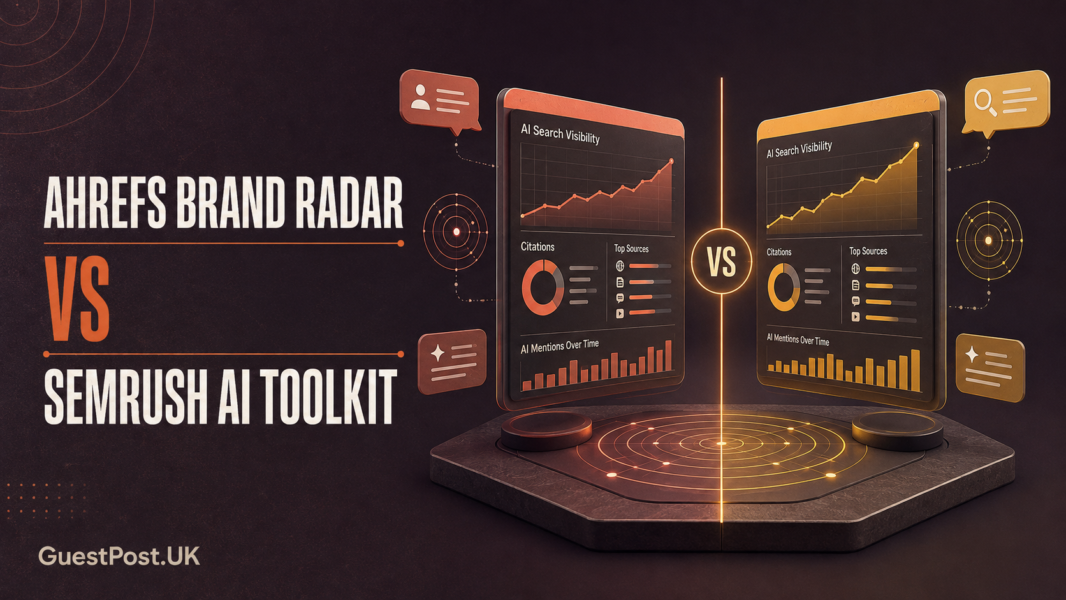
Ahrefs Brand Radar and Semrush AI Visibility Toolkit are two serious options for brands trying to understand how they appear in AI search. Both can show whether ChatGPT, Google AI answers and other platforms mention your business, cite your pages or recommend a competitor instead.
The right choice is not simply the one with the largest dashboard. It depends on how you currently work, how much monitoring depth you need and whether you want AI visibility reporting to sit alongside your existing SEO workflow.
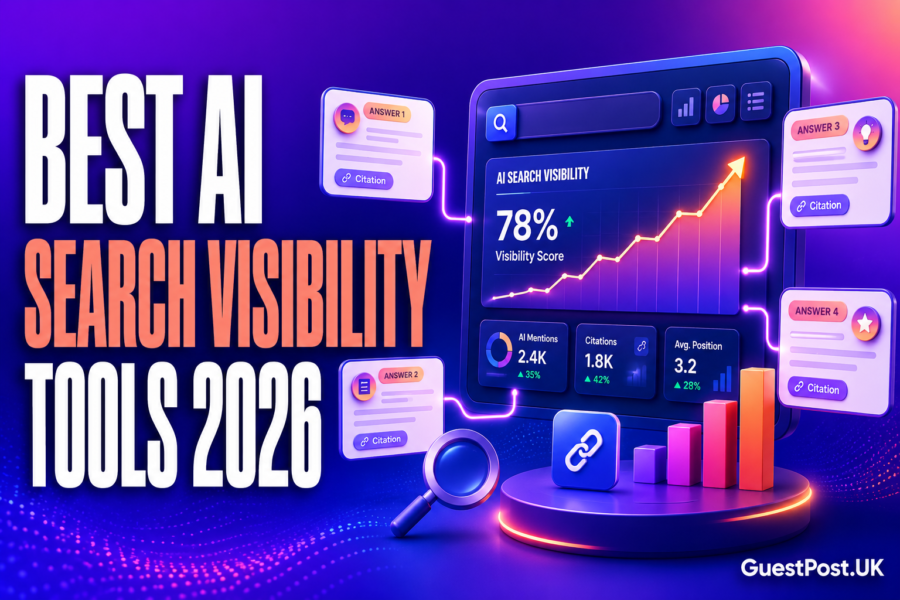
If you are still getting to grips with the category, our guide to the best AI search visibility tools explains where both products sit alongside newer specialist platforms. This comparison focuses on the more practical question: whether to choose Ahrefs Brand Radar or Semrush AI Toolkit.
The short answer
Choose Ahrefs Brand Radar if you want large-scale AI-search research, broad competitor discovery and a close connection between AI visibility, backlinks, organic search and content opportunities.
Choose the Semrush AI Visibility Toolkit if you already use Semrush, want a more guided brand-performance view, and need AI monitoring to feed directly into wider site audits, position tracking, and reporting.
For most smaller businesses, Semrush’s entry price is easier to justify. For agencies and in-house teams that need to research a market before deciding which prompts to track, Ahrefs Brand Radar has the more distinctive discovery proposition.
“The useful question is not ‘are we visible in AI?’ It is ‘where are we being recommended, who is winning the same conversations, and what evidence supports that recommendation?’”
That is where these tools become more valuable than manually typing a handful of prompts into ChatGPT.
Ahrefs Brand Radar at a glance
Ahrefs Brand Radar is built around a very large database of search-backed prompts. Rather than beginning only with the prompts you have chosen, it lets you research how brands, products, people and competitors appear across a much wider AI-search landscape.
This is particularly useful when you know your visibility is weak but do not yet know which questions matter most.
What Ahrefs Brand Radar does well
Brand Radar tracks brand mentions, share of voice, cited pages and cited domains across major AI platforms. It also gives users a way to see the sources behind AI answers, making it useful for link building, digital PR, and content planning rather than just reporting.
Its strongest features include:
- Research across a large index of search-backed prompts
- Brand, competitor, product, person and regional analysis
- AI visibility, mentions and citation reporting
- Cited-page and cited-domain discovery
- Custom prompt tracking for priority commercial questions
- Connections with Ahrefs’ Site Explorer, Keywords Explorer, Site Audit and backlink data
- Additional web, YouTube, TikTok and Reddit visibility data while those features remain in beta
The major advantage is context. If a competitor is repeatedly mentioned in AI responses, an Ahrefs user can investigate the pages, links, topics, and search demand driving that visibility without constantly switching between platforms.
That makes it a strong option for teams already using Ahrefs for technical SEO and off-page analysis. An SEO audit can identify whether a site has weak foundations; Brand Radar can then help show whether those weaknesses are reflected in the sources and competitors being surfaced by AI answers.
Where Ahrefs can feel less straightforward
The depth can be intimidating when the goal is simply to report on a defined group of prompts each month. Brand Radar is designed to help you explore a market, so it may be more than a small local business needs at the outset.
Pricing is also the bigger hurdle. Ahrefs lists Brand Radar at $199 per month for one AI platform, while its all-platform option is $699 per month. That is a meaningful investment, especially if you only need to monitor a small group of service-led questions.
Semrush AI Visibility Toolkit at a glance
The Semrush AI Visibility Toolkit is designed to turn AI visibility into an accessible, repeatable brand performance workflow. It focuses on how a brand appears in AI-generated answers, its share of voice, citations, perception, and competitors.
For an existing Semrush customer, the appeal is simple: AI visibility is available within the same broader environment as keyword research, rank tracking, site audits and competitive analysis.
What Semrush AI Toolkit does well
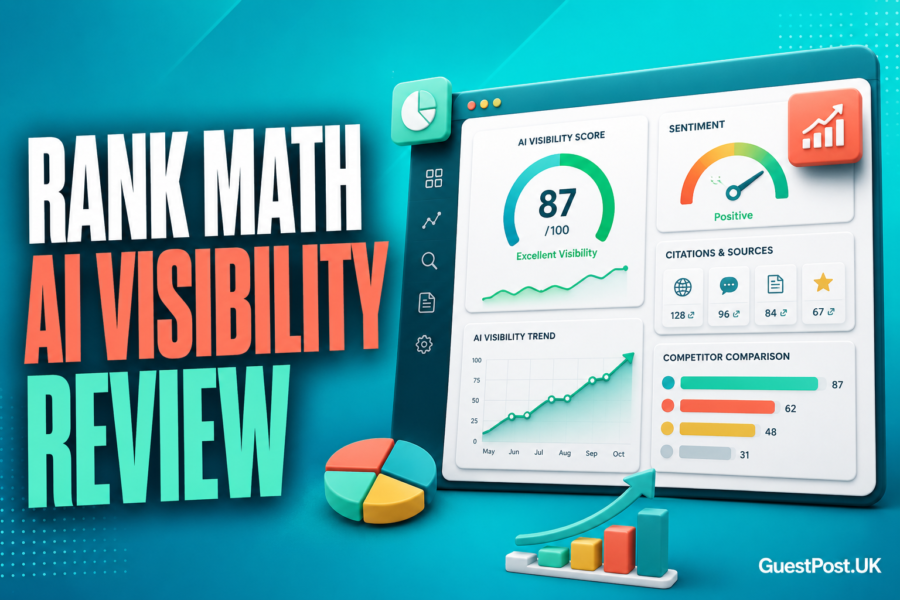
The toolkit gives users an AI Visibility Score and lets them review metrics including mentions, cited pages, citations, estimated audience and share of voice. It also includes prompt research and prompt tracking, helping teams move from “we think these questions matter” to an ongoing list of monitored questions.
Useful features include:
- Brand Performance reporting for a selected domain
- AI Visibility Score and trend reporting
- Mentions, cited pages and citation analysis
- Competitor research and share-of-voice comparison
- Prompt Research for discovering relevant AI-search questions
- Daily tracking for selected custom prompts
- Perception and sentiment insights
- AI Search Checks within Site Audit for eligible pages
This makes Semrush particularly practical for a marketing manager who needs an understandable monthly report. It is also useful for teams that want technical findings and visibility reporting in one place rather than treating AI search as an entirely separate discipline.
A business offering services across multiple locations may find this integrated approach helpful. It can connect AI-search insight with the work already being done through SEO services and content optimisation.
Where Semrush can be limiting
The base AI Visibility Toolkit plan includes one domain for Brand Performance analysis and 25 tracked prompts. That may be enough for a single brand, but agencies managing several clients or large organisations tracking many product lines will need to carefully consider additional costs and limits.
It is also more structured around a monitored brand and a chosen set of prompts. That is excellent for consistent reporting, but it may not offer the same immediate, wide-angle discovery experience as Brand Radar when you are researching a completely new market.
Feature comparison: Ahrefs Brand Radar vs Semrush AI Toolkit
| Area | Ahrefs Brand Radar | Semrush AI Visibility Toolkit |
|---|---|---|
| Best for | Broad AI-search discovery and SEO-led analysis | Ongoing brand reporting within a Semrush workflow |
| AI visibility research | Large search-backed prompt index with zero-setup exploration | Brand and prompt-led research with structured reports |
| Competitor analysis | Strong for finding who appears across a wide AI topic set | Strong for benchmark and share-of-voice comparisons |
| Citations | Identifies cited pages and domains behind answers | Tracks citations, cited pages and brand-performance signals |
| Custom prompts | Available, with checks included on the all-platform plan | 25 daily tracked prompts on the base plan |
| Technical SEO connection | Works alongside Ahrefs Site Audit and SEO data | AI Search Checks are included within Semrush Site Audit limits |
| Wider SEO ecosystem | Excellent for backlinks, content and organic research | Excellent for all-round SEO management and reporting |
| Entry pricing | $199 per month for one AI platform | $99 per month per domain, billed annually |
Which tool has better AI-search data?
Ahrefs has the more compelling proposition for discovery. Its database is built on search-backed prompts, so you can investigate an existing pool of questions rather than relying solely on a manually created tracking list.
That matters for commercial research. A SaaS company might know it wants to rank for “best CRM software”, for example, but it may not know the dozens of comparison, pricing, migration and industry-specific questions that influence the buying journey.
Semrush takes a more operational approach. Its Prompt Research and Brand Performance features are well-suited to teams that have already identified their important topics and now want to track progress, compare competitors, and report on movement.
Neither approach replaces human judgement. A tool can show that a competitor is frequently cited, but it cannot determine whether the reason is their original research, stronger product pages, independent reviews, media coverage, or a better-known brand. That analysis still needs to inform the strategy.
Pricing and value for money
The Semrush AI Visibility Toolkit starts at $99 per domain per month when billed annually. The base plan includes one domain for Brand Performance, 25 tracked prompts and specified daily report allowances. It can also be bundled with Semrush One plans, which combine SEO and AI visibility features.
Ahrefs Brand Radar starts at $199 per month for a single AI platform. Its all-platform option is $699 per month and includes access across supported AI platforms plus 2,500 monthly custom-prompt checks.
On price alone, Semrush is the easier starting point. It gives a business a practical reporting framework without immediately committing to a high-cost research platform.
Ahrefs can still offer better value if its data changes how you work. For an agency running content campaigns, competitor research and blogger outreach for several clients, identifying the domains and pages that AI answers repeatedly cite can lead directly to more useful campaign ideas.
Which is better for agencies?
Agencies should consider the workflow rather than choosing purely on headline features.
Ahrefs Brand Radar is better suited to agencies that:
- Carry out deep competitor and topic research
- Sell digital PR, content strategy or authority-building work
- Need to explain why certain publishers, resources or content formats matter
- Already use Ahrefs as their core SEO research tool
- Want to discover opportunities before creating a client prompt list
Semrush AI Visibility Toolkit is better suited to agencies that:
- Already manage clients in Semrush
- Need repeatable monthly visibility reports
- Want AI-search metrics alongside audits and rank tracking
- Prefer lower entry costs for individual client accounts
- Need a simpler workflow for account managers and clients
For either tool, the best reports combine data with action. If a brand is absent from high-value AI answers, the solution may involve clearer service pages, stronger evidence, original resources and a more credible off-site footprint. That is the practical link between AI visibility and guest posting services: the aim is not just to gain links, but to earn relevant third-party signals that can support wider brand discovery.
Which tool should you choose?
Choose Ahrefs Brand Radar if you need deeper AI-search research, want to understand the wider citation landscape and already rely on Ahrefs for organic and off-page SEO. It is the stronger choice when discovery is the job.
Choose Semrush AI Visibility Toolkit if you want a more contained and affordable monitoring system, especially if Semrush is already central to your SEO reporting. It is the stronger choice when ongoing measurement is the priority.
The sensible approach is to start with the commercial questions that genuinely influence leads and revenue. Track a manageable set, review the competitors and sources that appear in those answers, then use the findings to improve content, technical clarity, and authority. AI-search visibility is not a separate shortcut; it is another way of seeing whether your existing marketing signals are strong enough to be recommended.