
For more than two decades, businesses have focused on one goal: ranking on Google’s first page.
Entire marketing strategies have been built around improving keyword rankings, earning backlinks, and increasing organic traffic from traditional search engines. While those principles remain valuable, the way people search for information is changing rapidly.
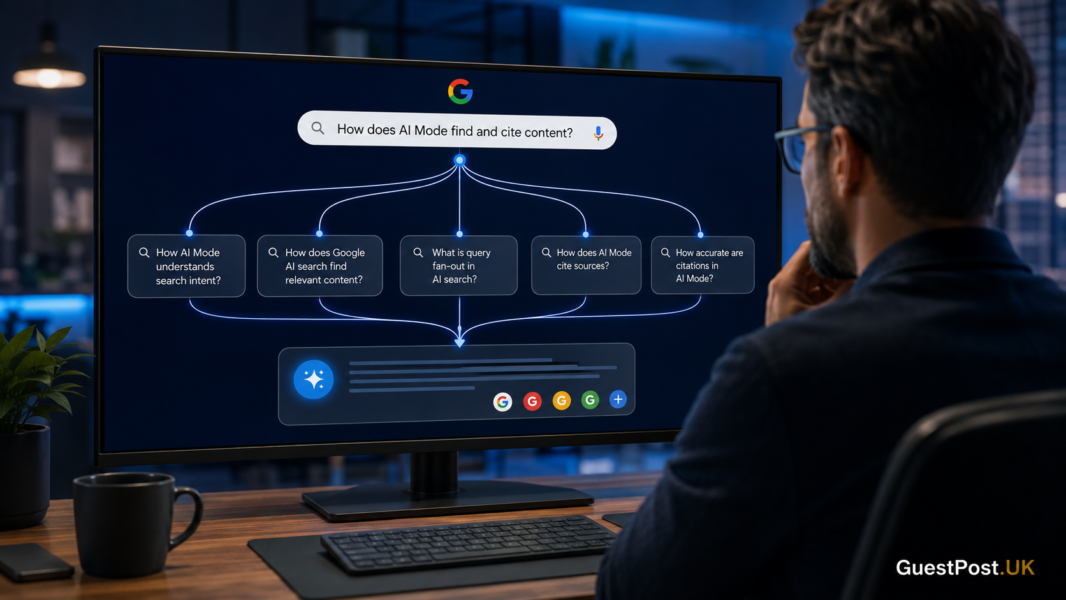
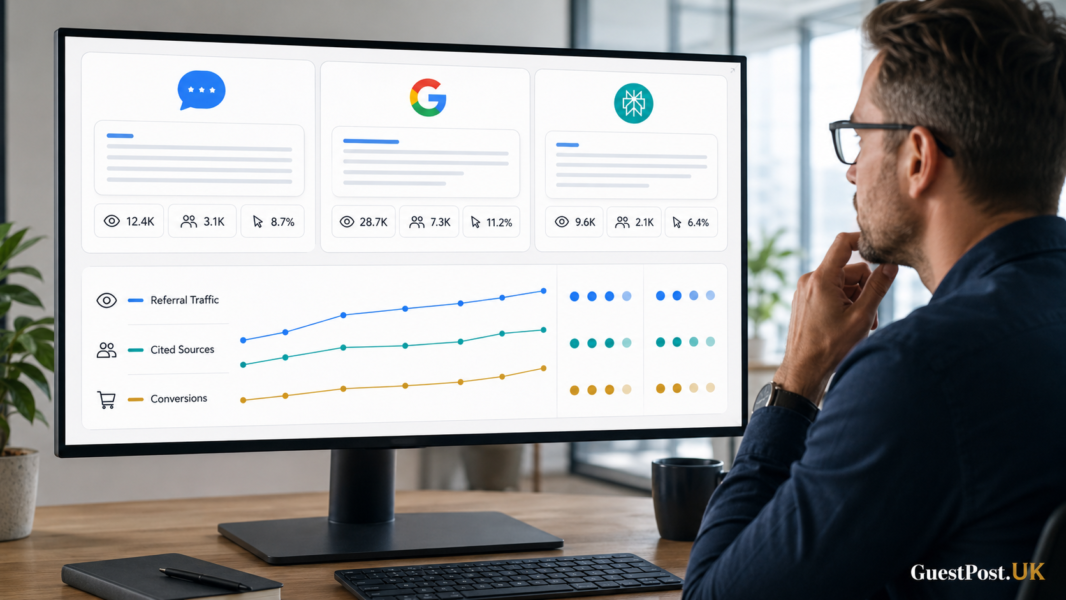
Millions of users now ask ChatGPT, Google Gemini, Perplexity and other AI-powered assistants questions that they would previously have typed into Google. Instead of receiving a list of ten blue links, they receive a detailed, conversational answer generated in seconds.
This shift represents one of the biggest changes in search since Google’s launch.
The question businesses should now be asking is no longer simply:
“How do I rank on Google?”
It is increasingly becoming:
“How do I make sure AI recommends my business?”
That is where AI Search Optimisation and Generative Engine Optimisation (GEO) come into play.
Rather than optimising solely for search engine algorithms, businesses now need to optimise for AI systems that analyse authority, expertise, brand recognition and trust before deciding which sources deserve to be referenced in their responses.
If your competitors are consistently being recommended by ChatGPT or appearing in Google AI Overviews while your business is absent, you’re already losing valuable visibility.
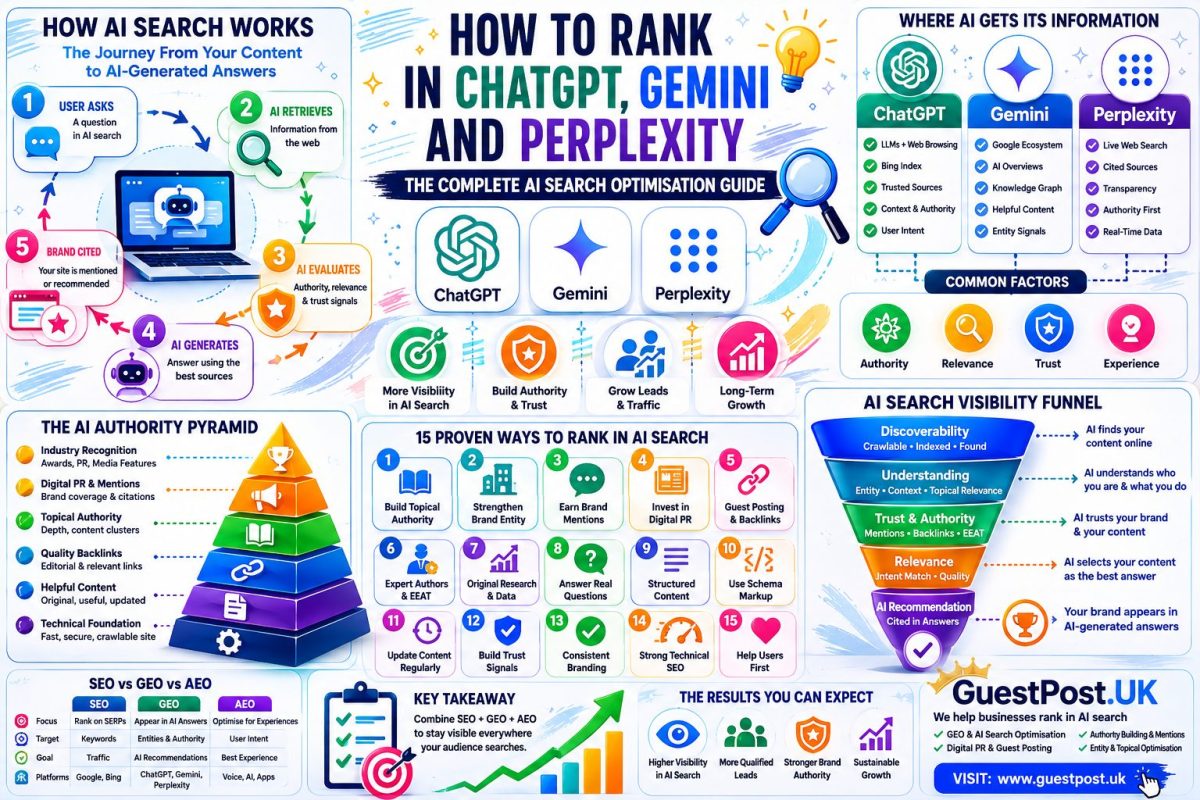
This guide explains exactly how AI search platforms work, what influences their recommendations, and the practical strategies that can help improve your chances of being cited across ChatGPT, Gemini and Perplexity.
Why AI Search Is Changing Digital Marketing
Traditional search engines were designed to help users find websites.
AI search platforms are designed to answer questions.
Although that difference sounds simple, it fundamentally changes how businesses compete for online visibility.
Previously, success depended on convincing users to click your website.
Now, AI attempts to answer the user’s question immediately, often without requiring them to visit any website at all.
Imagine someone searching:
- Best accounting software for small businesses
- How can I improve my website’s authority?
- Which SEO agency should I hire?
- Best CRM for estate agents
- How do I reduce cloud hosting costs?
Instead of reviewing ten different articles, users increasingly receive one detailed AI-generated answer containing only a handful of recommended businesses, products or sources.
If your organisation is not among those recommendations, potential customers may never discover your website.
This is why businesses must begin thinking beyond traditional rankings and focus on becoming trusted sources that AI systems are confident enough to recommend.
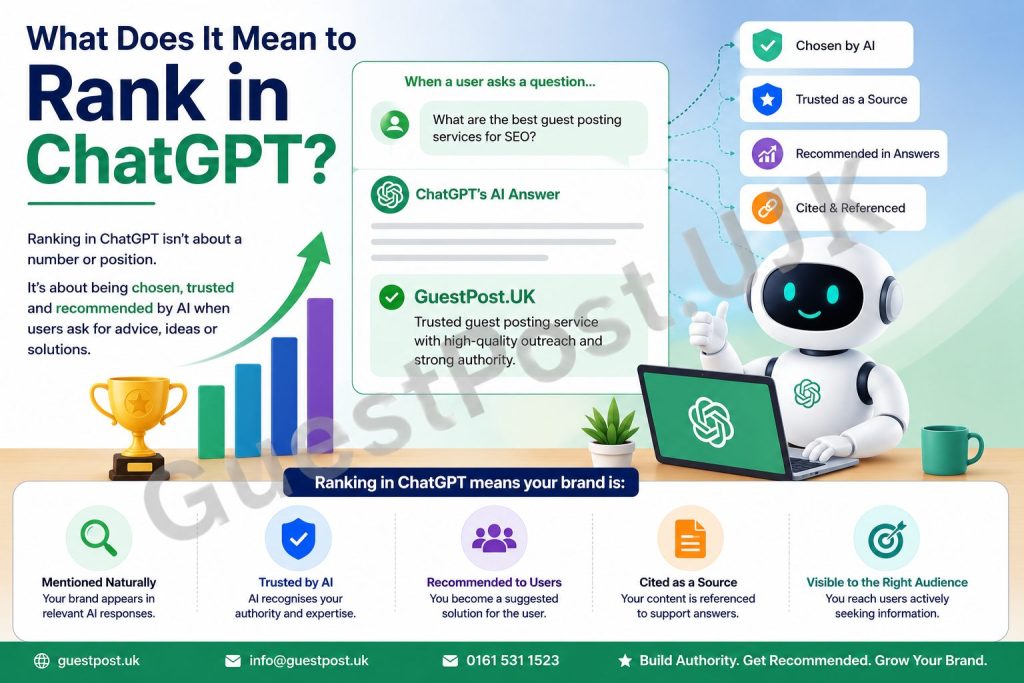
What Does It Mean to Rank in ChatGPT?
Many people assume ChatGPT works like Google.
It does not.
There is no public leaderboard, ranking report or position tracker that tells you whether your website is “number one” inside ChatGPT.
Instead, success means your business is:
- Mentioned naturally within AI-generated responses.
- Referenced as a trusted source.
- Cited when relevant topics are discussed.
- Recommended alongside recognised competitors.
- Used to support factual answers.
Unlike traditional search rankings, AI visibility depends far more on authority and context than on individual keyword positions.
Businesses that consistently demonstrate expertise across multiple trusted sources are significantly more likely to appear in AI-generated conversations.
How ChatGPT Finds Information
One of the biggest misconceptions surrounding AI search is that ChatGPT simply scans the internet in the same way as Google.
In reality, the process is far more sophisticated.
Depending on the version being used, ChatGPT combines its underlying language model with retrieval systems capable of accessing current web information.
Rather than matching pages against keywords alone, AI evaluates information based on relevance, context and trust.
When producing an answer, ChatGPT may consider:
- Highly authoritative websites
- Industry-leading publications
- Well-established organisations
- Trusted editorial content
- Consistent brand information
- Expert resources
- Reliable factual references
Its goal is not to identify the page with the highest keyword density but to generate the most useful answer for the user.
This is why simply publishing hundreds of AI-generated blog posts rarely results in meaningful AI visibility.
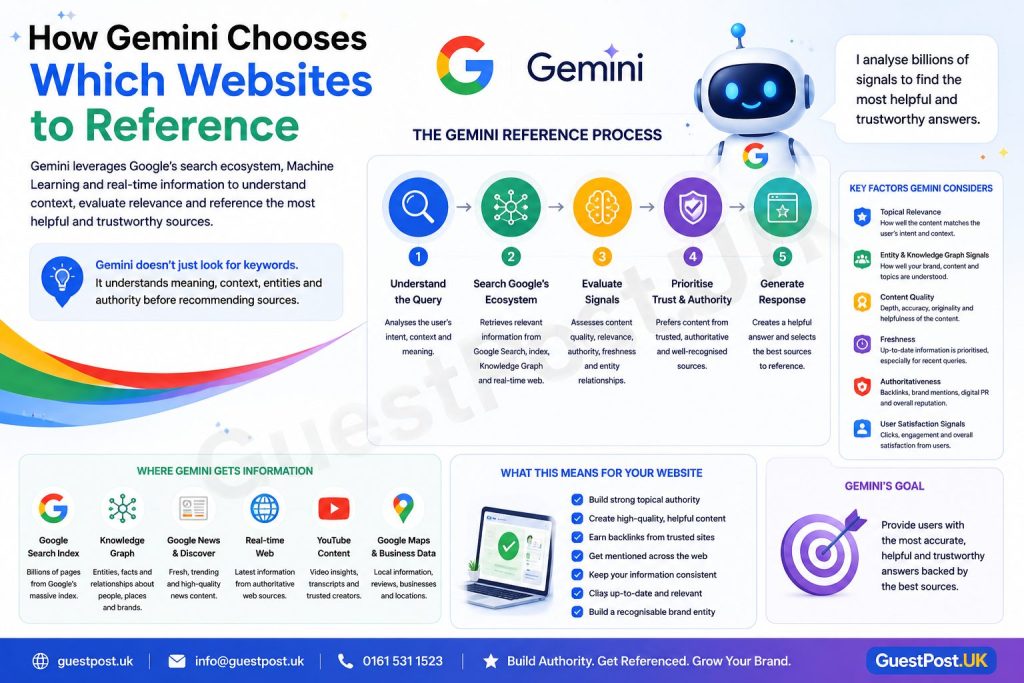
How Gemini Chooses Which Websites to Reference
Google Gemini operates within Google’s wider search ecosystem.
Unlike traditional search, however, Gemini attempts to understand the intent behind a question before generating a natural response.
Google already possesses enormous amounts of information about:
- Websites
- Businesses
- Products
- People
- Organisations
- Locations
- Knowledge Graph entities
Gemini uses these relationships to produce responses that are contextually relevant rather than simply keyword-driven.
Businesses that already demonstrate strong authority across Google’s ecosystem often enjoy an advantage because Google understands who they are and how they relate to specific industries.
This makes entity optimisation increasingly important.
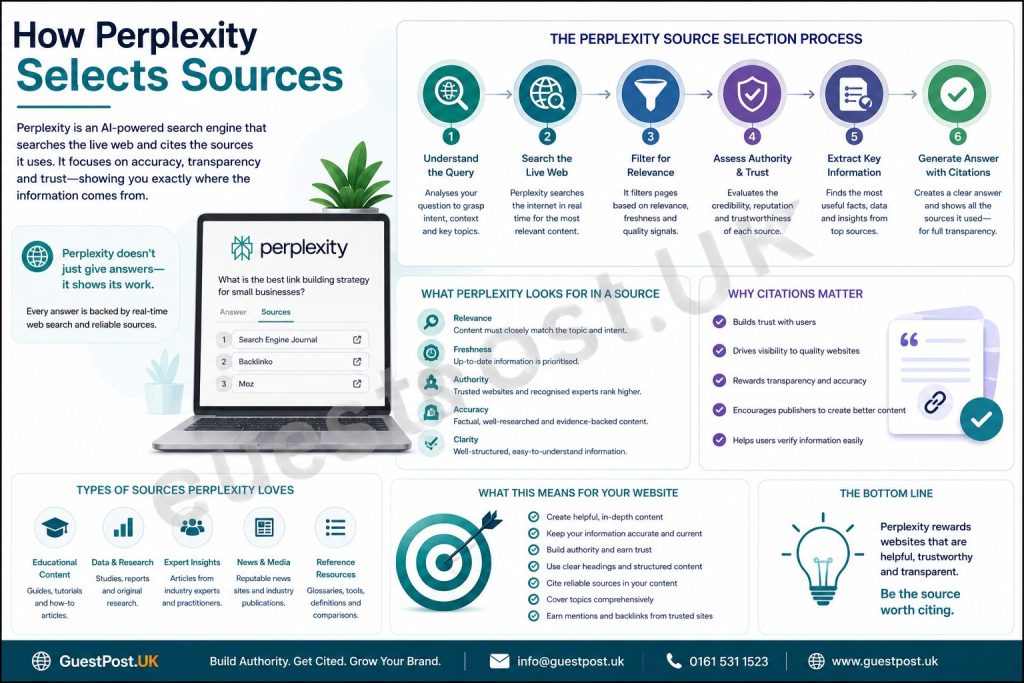
How Perplexity Selects Sources
Perplexity differs slightly from many other AI assistants because it openly cites the websites used to generate its answers.
This provides valuable insight into the kinds of content AI systems prefer.
Perplexity generally favours content that is:
- Well researched
- Clearly structured
- Factually accurate
- Up to date
- Published by trustworthy websites
- Supported by reputable sources
Rather than rewarding aggressive keyword optimisation, it tends to prioritise pages that genuinely help answer the user’s question.
This reinforces an important lesson.
The future of search belongs to the most useful and authoritative content—not necessarily the content with the highest keyword density.
Do AI Search Engines Still Care About SEO?
Absolutely.
Search Engine Optimisation remains one of the foundations of online visibility.
However, SEO alone is no longer enough.
Think of traditional SEO as helping search engines discover your content.
Think of Generative Engine Optimisation as helping artificial intelligence understand, trust and recommend your content.
Businesses that combine both disciplines place themselves in a much stronger position than those relying on either strategy alone.
For example:
Traditional SEO may help your article rank for “best project management software”.
Strong GEO increases the likelihood that ChatGPT, Gemini or Perplexity will recommend your software when users ask:
“What’s the best project management platform for a growing business?”
The distinction is subtle but incredibly important.
One focuses on rankings.
The other focuses on recommendations.
Why Authority Matters More Than Ever
Artificial intelligence is designed to reduce uncertainty.
When several websites discuss the same topic, AI attempts to determine which information deserves the greatest trust.
This is where authority becomes critical.
Authority is not created overnight.
It develops through consistent evidence that your business understands its subject better than most competitors.
Signals contributing to authority include:
- High-quality editorial backlinks
- Digital PR coverage
- Expert interviews
- Research reports
- Industry recognition
- Comprehensive educational content
- Positive brand mentions
- Consistent business information
- Demonstrated experience
When these signals work together, AI gains greater confidence in referencing your organisation.
Businesses that invest in authority building today are effectively increasing their chances of becoming trusted AI sources tomorrow.
The Biggest Shift: From Keywords to Entities
Perhaps the most important concept in modern AI search is the move away from keywords alone.
Traditional SEO often focused on matching search phrases.
Modern AI focuses on understanding entities and their relationships.
An entity could be:
- A business
- A product
- A software platform
- A consultant
- A city
- A service
- A recognised expert
Instead of asking:
“Does this page contain the keyword?”
AI increasingly asks:
“Do I understand who this organisation is, what it specialises in, and whether other trusted sources recognise it?”
That represents a fundamental shift in search optimisation.
Businesses that strengthen their entity presence through content, digital PR, guest posting, consistent branding and authoritative mentions are significantly better positioned for the future of AI search.
What You’ll Learn in This Guide
Understanding how AI platforms work is only the first step.
The real challenge is knowing how to influence the signals that matter.
In the next section, we’ll explore the practical strategies that can genuinely improve your visibility across ChatGPT, Gemini and Perplexity, including how to build topical authority, strengthen entity recognition, earn trusted citations, optimise content for AI systems and develop a long-term Generative Engine Optimisation strategy that delivers lasting results.
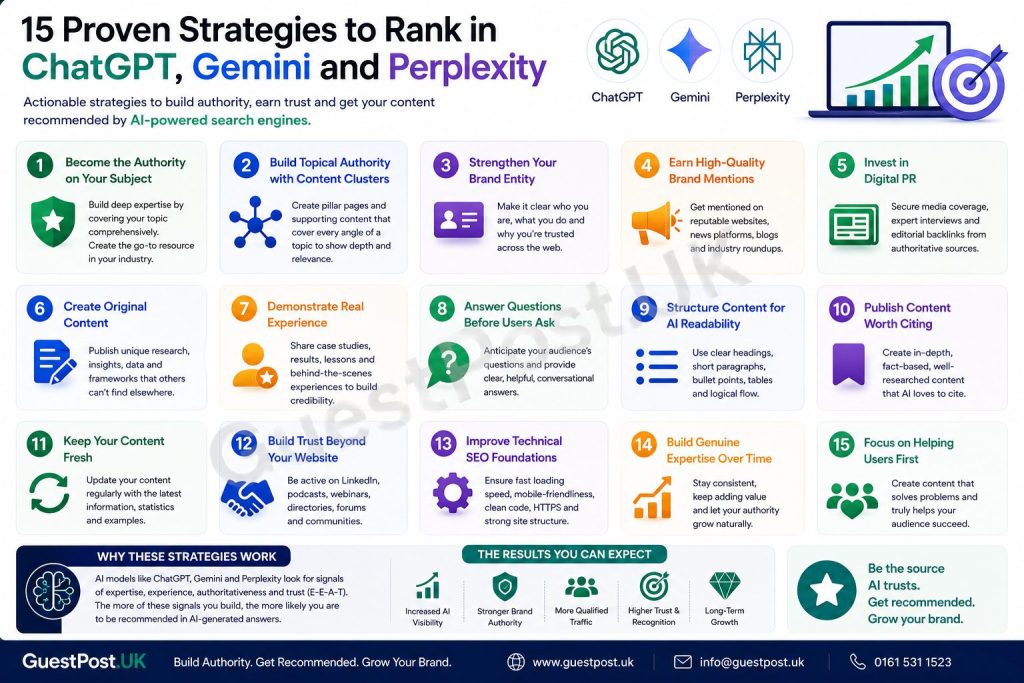
15 Proven Strategies to Rank in ChatGPT, Gemini and Perplexity
There is no magic switch that guarantees your website will appear in AI-generated answers.
Likewise, there is no official “AI ranking score” that determines whether ChatGPT or Gemini recommends your business.
Instead, AI search platforms evaluate hundreds of signals that collectively help them determine whether your website deserves to be trusted.
Businesses that consistently perform well across these areas significantly improve their chances of appearing in AI-generated responses.
Below are the most effective long-term strategies.
1. Become the Authority on Your Subject
AI systems rarely recommend websites that publish only a handful of articles on a topic.
Instead, they favour brands that demonstrate genuine expertise.
For example, if your business provides SEO services, publishing a single article on link building is unlikely to establish authority.
A stronger approach would be to build an entire knowledge hub covering:
- Link building
- Digital PR
- Guest posting
- Technical SEO
- Keyword research
- Local SEO
- AI Search Optimisation
- Generative Engine Optimisation
- Content marketing
- Authority building
This breadth of coverage signals that your organisation has in-depth knowledge of the subject rather than superficial understanding.
Think of your website as a digital library rather than a collection of unrelated blog posts.
2. Build Topical Authority Through Content Clusters
Publishing random content rarely produces long-term results.
Instead, organise your website around pillar pages supported by detailed articles.
For example:
Pillar Page
- Generative Engine Optimisation Services
Supporting Content
- What Is Generative Engine Optimisation?
- How to Rank in ChatGPT, Gemini and Perplexity
- Best Generative Engine Optimisation Strategies
- GEO Case Studies
- AI Search Optimisation Checklist
This structure helps both users and AI systems understand the relationships between your content.
It also strengthens internal linking and improves topical authority.
3. Strengthen Your Brand Entity
Modern AI understands organisations as entities rather than strings of keywords.
Ask yourself:
If someone searched for your company today, would AI immediately understand:
- What your business does?
- Which industry you specialise in?
- What services you offer?
- Why customers trust you?
If the answer is uncertain, your entity requires strengthening.
Practical ways to improve entity recognition include:
- Publishing detailed About Us pages.
- Creating author biographies.
- Using consistent branding everywhere.
- Securing mentions across reputable publications.
- Maintaining accurate business information.
The clearer your digital identity becomes, the easier it is for AI to recognise and reference your business.
4. Earn High-Quality Brand Mentions
Backlinks remain valuable, but AI systems increasingly evaluate overall brand presence.
If respected industry publications regularly mention your company, this reinforces trust.
Examples include:
- Guest articles
- Expert interviews
- Podcast appearances
- Industry round-ups
- Research contributions
- News features
Even unlinked mentions can help reinforce your authority.
The goal is to ensure your business appears naturally wherever your industry is being discussed.
5. Invest in Digital PR
Digital PR has become one of the most valuable investments for businesses targeting AI search visibility.
A successful campaign can generate:
- Editorial backlinks
- Brand recognition
- Media coverage
- Expert quotations
- Industry citations
- Increased trust
AI systems frequently reference information that has already been validated by respected publishers.
The more reputable websites discussing your business, the stronger your authority becomes.
6. Create Original Content Instead of Rewriting Existing Articles
Artificial intelligence is remarkably good at identifying generic content.
Publishing articles that simply repeat what everyone else has already written provides little value.
Instead, produce content that includes:
- Original research
- Expert opinions
- Real-world experience
- Case studies
- Industry statistics
- Practical frameworks
Unique information gives AI a reason to reference your content over competing websites.
7. Demonstrate Real Experience
Google’s Helpful Content principles increasingly reward experience alongside expertise.
The same applies to AI search.
Whenever possible, include:
- Practical examples
- Screenshots
- Campaign results
- Lessons learned
- Success stories
- Mistakes to avoid
Real experience differentiates authoritative content from generic summaries.
8. Answer Questions Before Users Ask Them
AI platforms are built around answering questions.
The more effectively your content answers those questions, the greater its potential value.
Instead of writing:
“Our SEO Services”
Consider addressing questions such as:
- How long does SEO take?
- Is SEO worth investing in?
- What affects search rankings?
- How much does SEO cost?
- How does AI search differ from Google?
This conversational style aligns naturally with how users interact with AI assistants.
9. Structure Content for AI Readability
Clear structure benefits both readers and AI systems.
Good content should include:
- Descriptive headings
- Short paragraphs
- Logical progression
- Bullet points
- Comparison tables
- Numbered processes
- Frequently asked questions
When information is organised logically, AI can interpret and reference it more accurately.
10. Publish Content Worth Citing
Ask yourself one simple question before publishing:
Would another expert genuinely reference this article?
If the answer is no, the content probably needs more depth.
Citation-worthy content often includes:
- Research
- Statistics
- Step-by-step guides
- Original frameworks
- Industry insights
- Practical advice
The goal is to become a resource rather than another opinion piece.
11. Keep Your Content Fresh
AI systems value current information, particularly in rapidly changing industries.
Review cornerstone content regularly.
Update:
- Statistics
- Examples
- Platform features
- Best practices
- Industry trends
- Screenshots
Regular updates demonstrate ongoing expertise and improve content quality over time.
12. Build Trust Beyond Your Website
Authority does not stop at your homepage.
AI also considers your wider digital footprint.
Strengthen trust through:
- Industry directories
- Professional associations
- Conference participation
- Podcasts
- Webinars
- Interviews
- Community involvement
Every credible mention contributes to your overall authority.
13. Improve Technical SEO Foundations
While GEO extends beyond traditional SEO, technical excellence still matters.
Ensure your website offers:
- Fast loading speeds
- Mobile responsiveness
- HTTPS security
- Clear navigation
- Logical internal linking
- Crawlable architecture
- Optimised metadata
Technical issues can undermine even the strongest content.
14. Build Genuine Expertise Over Time
Authority cannot be manufactured overnight.
Businesses that consistently publish useful information, contribute to their industry and earn recognition naturally develop stronger AI visibility.
Long-term consistency almost always outperforms short-term shortcuts.
15. Focus on Helping Users First
This remains the single most important principle.
AI platforms exist to provide users with the most useful answer possible.
Whenever you create content, ask yourself:
- Is this genuinely helpful?
- Does it solve a problem?
- Would I recommend this to someone else?
- Does it provide something unique?
If the answer is yes, you’re already aligned with the direction AI search is moving.
Does Schema Help You Rank in AI Search?
Structured data remains valuable because it helps search engines understand your content more effectively.
While there is currently no evidence that schema alone guarantees AI recommendations, it contributes to clearer entity recognition.
Useful schema types include:
- Organisation
- Person
- Article
- FAQ
- Product
- Local Business
- Breadcrumb
- Review
- Service
Think of schema as one supporting signal rather than the primary ranking factor.
Does Google Ranking Still Matter?
Yes—but perhaps not in the way many people assume.
High-ranking pages often benefit from stronger authority, better backlinks and greater trust, all of which influence AI systems.
However, a website does not necessarily need to rank number one on Google to appear within AI-generated answers.
Conversely, some highly ranked pages may never be referenced if they lack authority, originality or contextual relevance.
The future belongs to businesses that optimise for both traditional search engines and AI-powered search experiences rather than treating them as competing channels.
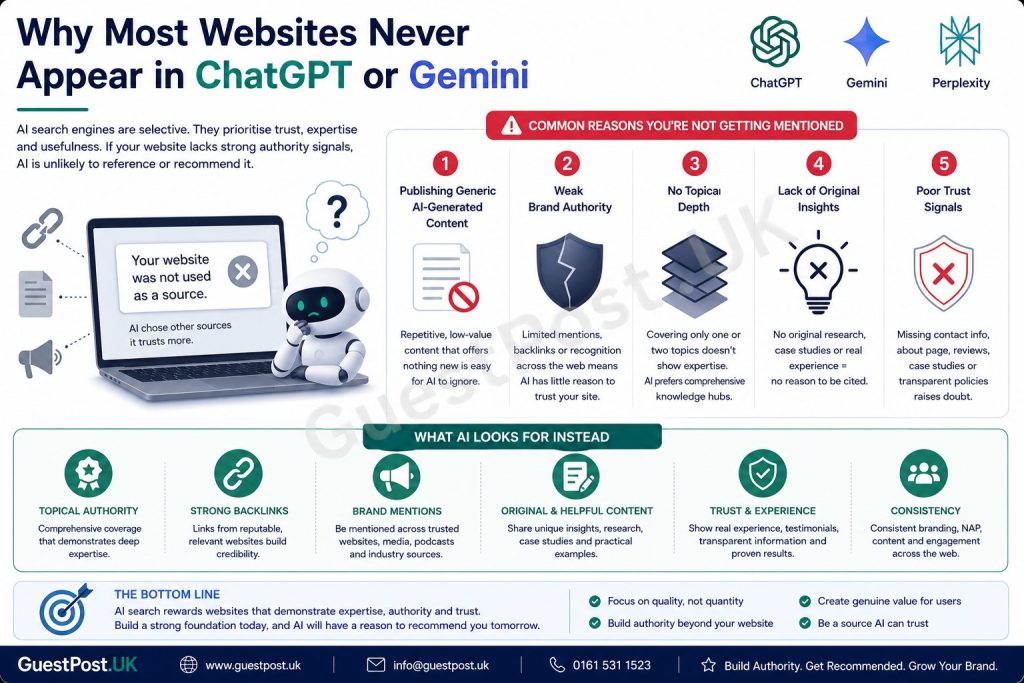
Why Most Websites Never Appear in ChatGPT or Gemini
Many businesses assume that once they publish enough content, AI platforms will eventually begin recommending them.
Unfortunately, it rarely works that way.
Generative AI systems are selective. They aim to provide users with reliable, trustworthy and genuinely useful answers. If your website fails to demonstrate credibility, expertise or authority, AI is unlikely to reference it, regardless of how many pages you publish.
Here are some of the most common reasons businesses fail to gain visibility in AI search.
Publishing Generic AI-Generated Content
Artificial intelligence has made content creation faster than ever, but speed should never replace quality.
Thousands of websites now publish articles that repeat information already available elsewhere, offering little or no original value.
Content that simply rephrases existing material is unlikely to become a trusted source.
Instead, focus on creating:
- Original research
- Expert commentary
- Practical frameworks
- Industry insights
- Real-world examples
- Actionable guidance
The more unique your content, the greater its potential value to both readers and AI systems.
Weak Brand Authority
AI platforms place significant emphasis on authority.
If your business has little recognition outside its own website, AI has fewer signals to indicate that your information deserves to be trusted.
Authority develops through:
- Editorial backlinks
- Digital PR
- Expert interviews
- Speaking opportunities
- Industry awards
- Trusted partnerships
- Positive brand mentions
Think of authority as your reputation across the internet rather than simply the strength of your website.
No Topical Depth
Publishing one article on a subject rarely establishes expertise.
AI prefers websites that demonstrate comprehensive knowledge.
For example, an SEO agency should ideally cover topics such as:
- Technical SEO
- Local SEO
- Link building
- Digital PR
- Keyword research
- AI Search Optimisation
- Generative Engine Optimisation
- Website audits
- Content strategy
The more complete your content ecosystem becomes, the stronger your topical authority.
A Practical Example
Imagine two digital marketing agencies.
Agency A
- Ten short SEO articles
- Few backlinks
- Limited industry mentions
- No original research
- Minimal digital PR
Agency B
- Comprehensive SEO knowledge hub
- Regular expert articles
- Industry case studies
- Guest contributions
- Digital PR campaigns
- Media mentions
- Educational resources
- Strong brand recognition
When asked:
“Which SEO agencies provide high-quality guest posting services?”
Which agency is an AI platform more likely to trust?
In most cases, Agency B has built significantly stronger authority signals.
The lesson is clear.
AI search rewards businesses that invest consistently in becoming recognised experts rather than simply producing more content.
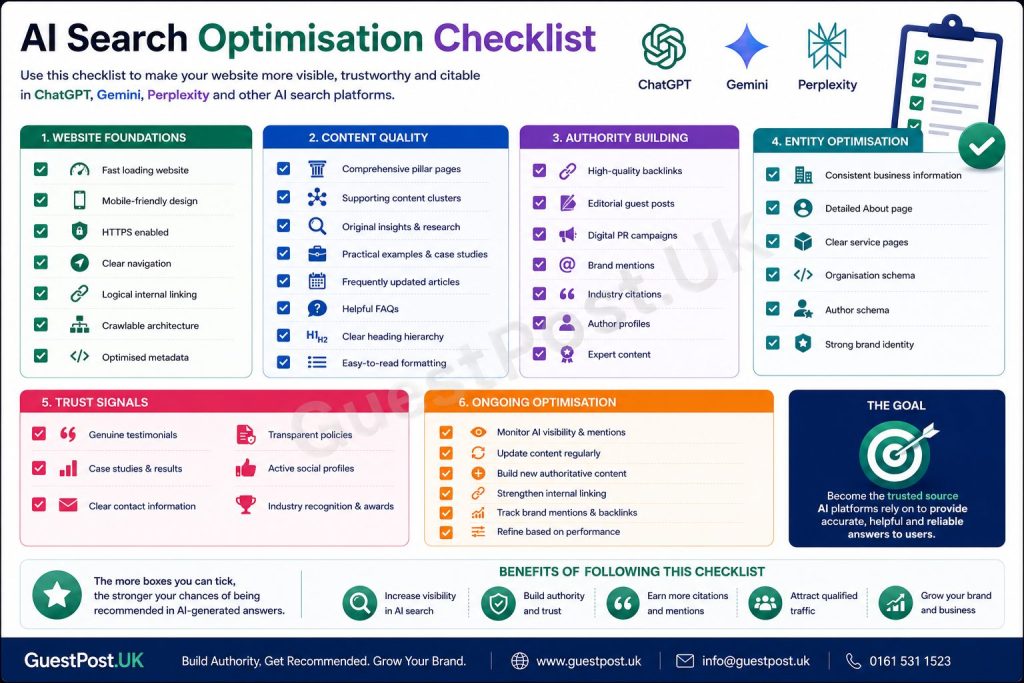
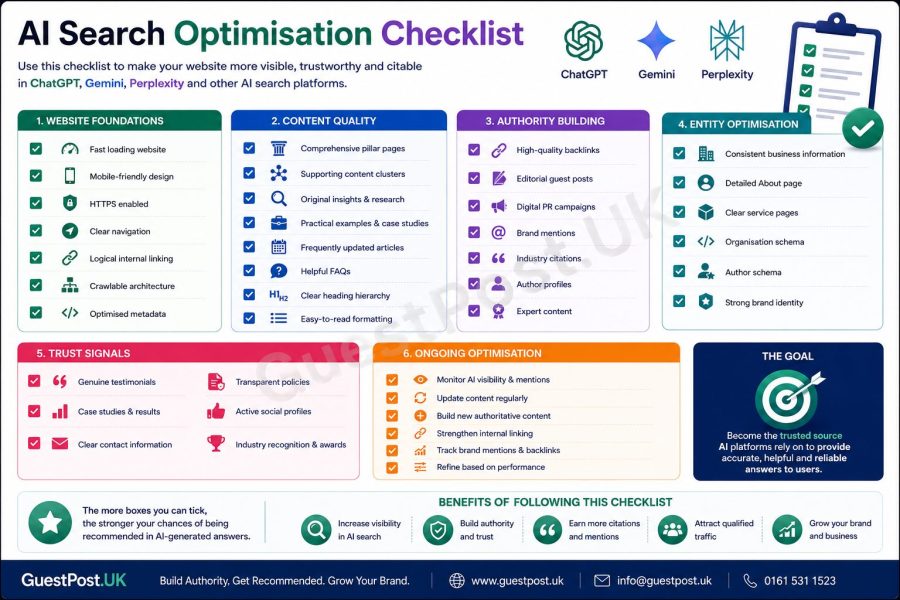
AI Search Optimisation Checklist
Before expecting your website to appear in ChatGPT, Gemini or Perplexity, work through the following checklist.
Website Foundations
✔ Fast loading website
✔ Mobile-friendly design
✔ HTTPS enabled
✔ Clear navigation
✔ Logical internal linking
✔ Crawlable architecture
✔ Optimised metadata
Content Quality
✔ Comprehensive pillar pages
✔ Supporting content clusters
✔ Original insights
✔ Practical examples
✔ Frequently updated articles
✔ Helpful FAQs
✔ Clear heading hierarchy
✔ Easy-to-read formatting
Authority Building
✔ High-quality backlinks
✔ Editorial guest posts
✔ Digital PR campaigns
✔ Brand mentions
✔ Industry citations
✔ Author profiles
✔ Expert content
Entity Optimisation
✔ Consistent business information
✔ Detailed About page
✔ Service pages
✔ Organisation schema
✔ Author schema
✔ Strong brand identity
Trust Signals
✔ Genuine testimonials
✔ Case studies
✔ Contact information
✔ Transparent policies
✔ Active social profiles
✔ Industry recognition
The more boxes you can confidently tick, the stronger your long-term position within AI search.
AI Search Visibility Trend
Although no official scoring system exists, AI visibility often follows a predictable pattern.
Low Website Authority
████

Consistent Content
███████

Topical Authority
███████████

Digital PR & Brand Mentions
████████████████

Recognised Industry Entity
█████████████████████

Frequently Referenced by AI
██████████████████████████
This illustrates an important principle.
Businesses rarely become visible in AI search through a single tactic.
Visibility develops through the accumulation of trust, authority and expertise over time.
The Future of AI Search
Artificial intelligence is still evolving.
Over the next few years we can expect AI search platforms to become even more sophisticated.
Likely developments include:
More Personalised Recommendations
AI systems will increasingly tailor answers based on user preferences, previous interactions, location and intent.
Rather than producing identical answers for everyone, recommendations will become more personalised.
Stronger Entity Understanding
Knowledge Graphs and entity recognition will continue to improve.
Brands with consistent identities across the web are likely to benefit the most.
Greater Importance of First-Hand Experience
Original experience will become increasingly valuable.
Businesses that demonstrate practical expertise rather than simply summarising existing information are likely to stand out.
Increased Emphasis on Trust
As AI-generated misinformation remains a concern, trusted sources will become even more valuable.
Businesses with recognised expertise, editorial coverage and authoritative content will have a significant competitive advantage.
The Relationship Between SEO and GEO
One of the biggest misconceptions surrounding AI search is that SEO is becoming obsolete.
Nothing could be further from the truth.
Traditional Search Engine Optimisation remains the foundation of online visibility.
Without technically sound websites, high-quality content and strong authority, AI systems have little reason to trust your business.
Generative Engine Optimisation simply builds upon these foundations.
Think of the relationship like this:
- SEO helps users discover your website.
- GEO helps AI understand your expertise.
- SEO drives rankings.
- GEO drives recommendations.
- Together they create long-term search visibility.
Businesses that combine both strategies are likely to achieve the strongest results as search continues to evolve.
Ready to Improve Your Visibility in ChatGPT, Gemini and Perplexity?
Appearing in AI-generated answers is no longer a futuristic ambition—it is becoming a competitive necessity.
Whether your goal is to increase enquiries, generate more qualified leads or establish your business as an industry authority, investing in Generative Engine Optimisation today can help prepare your brand for the future of search.
At GuestPost.uk, we help businesses strengthen their visibility across ChatGPT, Google AI Overviews, Gemini, Perplexity and other AI-powered search platforms through a combination of:
- Generative Engine Optimisation (GEO)
- AI Search Optimisation
- Digital PR
- Guest Posting
- Authority Building
- Entity Optimisation
- Topical Authority Development
- Content Strategy
If you’d like to understand how your business currently performs within AI search, or you’re ready to develop a long-term GEO strategy, we’d be delighted to help.
Request Your Free GEO Consultation
Email: info@guestpost.uk
Phone: 0161 531 1523
Website: https://guestpost.uk
Contact Us: https://guestpost.uk/contact/
Discover how your business can become a trusted source for the next generation of AI-powered search.
Frequently Asked Questions
Can you rank in ChatGPT?
Not in the same way you rank on Google. ChatGPT does not publish traditional rankings. Instead, businesses improve their chances of being mentioned or cited by building authority, strong entities, trusted content and comprehensive topical coverage.
How does Gemini choose which websites to recommend?
Gemini evaluates a combination of Google’s search data, entity relationships, authority signals, content quality and relevance before generating responses.
Does Perplexity use live search results?
Yes. Perplexity frequently retrieves live web information and cites the sources it uses, making high-quality, trustworthy content particularly valuable.
Is SEO still important for AI search?
Absolutely. Strong technical SEO, helpful content and authoritative backlinks remain fundamental. Generative Engine Optimisation builds on these foundations rather than replacing them.
What is AI Search Optimisation?
AI Search Optimisation is the practice of improving a website’s visibility within AI-generated search experiences by strengthening authority, entity recognition, topical expertise and trust signals.
Are backlinks still important?
Yes, but quality matters far more than quantity. Editorial backlinks from respected, relevant websites remain one of the strongest authority signals.
Does schema markup help AI search?
Schema helps search engines understand your content more effectively and supports entity recognition. While it is not a direct ranking factor for AI platforms, it contributes to stronger technical foundations.
How long does it take to appear in AI-generated answers?
There is no fixed timeframe. Results depend on your existing authority, the competitiveness of your industry, the quality of your content and the consistency of your GEO strategy.
Should I optimise for ChatGPT, Gemini or Perplexity first?
Rather than treating them separately, focus on building a trusted brand with authoritative content. The same principles generally improve visibility across all major AI search platforms.
What is the most important factor for AI search visibility?
There is no single ranking factor. However, businesses that combine topical authority, entity optimisation, digital PR, helpful content, trusted backlinks and consistent brand recognition are best positioned for long-term success.
All in All!
The rise of AI search is not the end of SEO—it is the beginning of a broader approach to digital visibility.
Businesses that continue relying solely on traditional rankings may find themselves gradually losing prominence as users increasingly turn to conversational AI for answers and recommendations.
Those that embrace Generative Engine Optimisation today have an opportunity to establish authority before AI search becomes even more competitive.
The winning strategy is no longer simply about being found.
It is about becoming the source that artificial intelligence trusts enough to recommend.
Start building that authority today, and your business will be far better prepared for the future of search.